





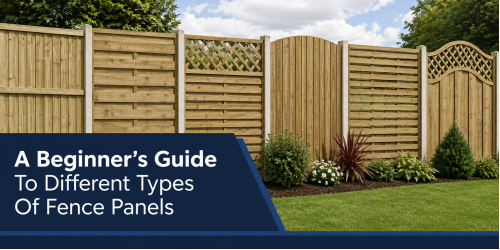
Quick answer: Choose closeboard panels for solid privacy, ultra heavy duty closeboard for a more substantial framed option, waney lap for straightforward traditional screening, picket panels for low open boundaries, Omega lattice for a decorative curved top, hit and miss panels for increased airflow, and double slatted panels for contemporary filtered screening. Check the actual panel width, required height, viewing angle, wind exposure, posts and gravel boards before ordering.
Choosing fence panels is easier once you understand what each design is intended to do. Some panels provide a solid visual barrier. Others allow more light and air through. Decorative panels place greater emphasis on appearance, while picket panels define a boundary without enclosing the garden.
The panel is also only one part of the completed fence. Posts hold it upright, gravel boards protect its lower edge, fixings secure it, and foundations transfer wind pressure into the ground.
This means the best fence panel is not necessarily the strongest-looking or tallest option. It is the panel that provides the required privacy, appearance and airflow while remaining compatible with the supports and conditions in the garden.
This beginner’s guide explains the main East Coast Fencing panel ranges, their available sizes, typical uses, privacy levels, wind considerations and compatible supporting components.
Fence Panel Types At A Glance
| Panel Type | Privacy | Airflow | Appearance | Common Use |
|---|---|---|---|---|
| Standard Closeboard | High | Low | Traditional and solid | Rear garden privacy |
| Ultra Heavy Duty Closeboard | High | Low | Substantial traditional frame | Prominent solid boundaries |
| Waney Lap | High | Low | Traditional horizontal boards | General garden screening |
| Picket | Low | High | Open and decorative | Front gardens and divisions |
| Omega Lattice | High below lattice | Moderate at top | Curved traditional decoration | Patios and planted boundaries |
| Horizontal Hit And Miss | Moderate | Good | Balanced horizontal boards | Exposed or shared boundaries |
| Double Slatted | Moderate to high | Moderate | Contemporary horizontal slats | Modern patios and gardens |
| Trellis | Low to moderate | High | Open plant-support structure | Toppers and garden screens |
What Is A Fence Panel?
A fence panel is a ready-made section of fencing installed between two posts.
Most timber fence panels have:
- An outer frame
- Vertical or horizontal boards
- Supporting rails or battens
- A nominal width and height
Using ready-made panels can make installation faster because the individual boards have already been assembled into a framed section.
This differs from traditional closeboard fencing built on site from separate feather edge boards, rails, posts and gravel boards.
What Does Nominal 6ft Wide Mean?
Most of the main panel ranges are described as nominally 6ft wide, which is approximately 1.83m.
Nominal descriptions are useful for comparing products, but the actual panel should still be measured before new posts are installed.
This is particularly important when:
- Replacing panels between existing concrete posts
- Using older wooden posts
- Mixing panel styles
- Planning a shortened end bay
- Installing a panel between walls or pillars
Existing post openings can also vary from top to bottom if the posts have moved.
What Are Closeboard Fence Panels?
Closeboard fence panels use overlapping vertical feather edge boards held within a timber frame.
The overlapping construction creates a solid screen with no intentional viewing gaps. This makes closeboard one of the principal choices for private rear and side boundaries.
Closeboard panels are suitable for:
- Rear garden privacy
- Side boundaries
- Screening patios
- Dog-friendly gardens
- Replacing existing solid panels
- Traditional garden designs
The vertical board direction creates a clean traditional appearance and helps distinguish closeboard from horizontally boarded waney lap panels.
What Standard Closeboard Panel Sizes Are Available?
Standard closeboard panels are available in a nominal width of approximately 6ft and selected nominal heights of:
- 2ft
- 3ft
- 4ft
- 5ft
- 5ft 6in
- 6ft
Pressure-treated brown and green options are available.
The 5ft 6in height can be useful where the panel will sit above an approximately 6in gravel board, creating a completed section close to 6ft high.
Are Closeboard Panels Good For Privacy?
Yes. Their overlapping boards provide immediate solid screening.
The final privacy level still depends on:
- Panel height
- Ground levels on each side
- Gaps beneath the fence
- Gate clearances
- Post spacing
- Nearby upper windows
A tall panel may not fully screen a garden where the neighbouring ground is substantially higher.
Are Closeboard Panels Suitable For Windy Gardens?
They can be, but closeboard panels are solid and therefore catch considerable wind.
In an exposed position, pay particular attention to:
- Post section
- Post length
- Foundation dimensions
- Post spacing
- Panel fixings
- Ground strength
A pressure-treated closeboard panel will not remain stable if it is installed on weak or inadequately supported posts.
What Are Ultra Heavy Duty Closeboard Panels?
Ultra heavy duty closeboard panels provide a more substantial framed alternative to the standard closeboard range.
They retain the same basic vertical feather edge appearance and high level of privacy while using a heavier-duty panel construction.
They can suit:
- Prominent rear boundaries
- Gardens where a more substantial panel is preferred
- Long solid fence runs
- Replacement projects where suitable strong posts are already present
The description relates to the panel construction. It does not remove the need for appropriate posts and foundations.
What Ultra Heavy Duty Closeboard Sizes Are Available?
The range is nominally 6ft wide and available in selected heights of:
- 3ft
- 4ft
- 5ft
- 5ft 6in
- 6ft
Pressure-treated brown and green finishes are available.
These panels can be heavier to handle than standard panels. Check delivery access and arrange enough help before installation.
Standard Or Ultra Heavy Duty Closeboard?
| Consideration | Standard Closeboard | Ultra Heavy Duty Closeboard |
|---|---|---|
| Privacy | High | High |
| Appearance | Traditional | More substantial traditional frame |
| Handling | Generally more manageable | Heavier |
| Available Minimum Height | 2ft | 3ft |
| Support Requirement | Suitable posts required | Substantial posts particularly important |
What Are Waney Lap Fence Panels?
Waney lap panels use overlapping horizontal boards held within a timber frame.
They are a familiar choice for domestic gardens and provide solid screening with a traditional boarded appearance.
Waney lap panels can suit:
- General rear boundaries
- Side gardens
- Replacing existing lap panels
- Sheltered garden fencing
- Projects requiring straightforward solid screening
The horizontal boards distinguish them visually from closeboard panels, which use vertical feather edge boards.
What Waney Lap Sizes Are Available?
Waney lap panels are nominally 6ft wide and available in selected heights of:
- 3ft
- 4ft
- 5ft
- 5ft 6in
- 6ft
Pressure-treated brown and green options are available.
Are Waney Lap Panels Private?
Yes. Their overlapping boards create a solid visual barrier.
They are suitable where immediate screening is required but a closeboard-style vertical appearance is not essential.
Check the frame and lower boards carefully when replacing an old lap panel. These areas may deteriorate after prolonged exposure to wet ground or trapped debris.
Closeboard Or Waney Lap?
Both provide solid screening.
Choose closeboard where:
- Vertical feather edge appearance is preferred
- A substantial traditional boundary is wanted
- Standard and ultra heavy duty options are being compared
Choose waney lap where:
- Horizontal overlapping boards are preferred
- The existing fence already uses lap panels
- A familiar traditional panel is required
The posts, foundation and installation quality remain as important as the panel style.
What Are Picket Fence Panels?
Picket panels use spaced vertical pales to create a low, open boundary.
They define a space without creating the enclosed appearance of a solid fence.
Picket fencing works particularly well for:
- Front gardens
- Garden paths
- Lawns
- Vegetable plots
- Internal garden divisions
- Cottage-style planting
- Matching picket garden gates
It does not provide meaningful visual privacy.
Round-Top Or Point-Top Picket Panels?
Round-Top Picket Panels
Round-top pales provide a softer traditional appearance.
They can work well around lawns, cottage gardens and paths where a less angular finish is preferred.
Point-Top Picket Panels
Point-top pales create a more defined decorative outline.
They can suit front boundaries and entrances where the fence should have a more pronounced profile.
The choice is primarily visual. Use the same pale style for a matching picket gate where possible.
What Picket Panel Sizes Are Available?
Picket panels are nominally 6ft wide and available in:
- 2ft heights
- 3ft heights
- 4ft heights
Round-top and point-top versions are available in pressure-treated brown and green finishes.
Are Picket Panels Suitable For Dogs?
They may be suitable depending on the dog and the panel spacing.
Check:
- Whether the dog can pass between the pales
- The gap beneath the panel
- The completed fence height
- The gate clearances
- Whether the dog jumps or climbs
- Whether digging protection is required
Solid panels may be more appropriate for dogs that react strongly to activity outside the garden.
What Are Omega Lattice Fence Panels?
Omega lattice panels combine a solid lower section with a curved lattice top.
The lower section provides substantial screening, while the lattice allows more light and air through the upper part of the boundary.
Omega panels suit:
- Traditional decorative gardens
- Patio boundaries
- Flower-bed backgrounds
- Gardens with climbing plants
- Boundaries where a straight top would appear too severe
What Omega Lattice Sizes Are Available?
The range is nominally 6ft wide and available in:
- 3ft heights
- 4ft heights
- 5ft heights
- 6ft heights
The panels are pressure treated green.
Because the top is curved, the stated height normally refers to the maximum nominal height. Check the height at the panel sides when it must align with a wall, gate or adjoining straight panel.
Can Plants Grow On Omega Lattice Panels?
Lightweight climbing plants can use the lattice as support.
Suitable manageable choices may include:
- Clematis
- Annual sweet peas
- Smaller jasmine varieties
- Manageable honeysuckle growth
Dense mature plants add weight, hold moisture and increase wind resistance. Heavy woody climbers may need an independent support structure.
What Are Horizontal Hit And Miss Panels?
Horizontal hit and miss panels have boards positioned alternately on opposite sides of the frame.
This construction interrupts direct views while leaving gaps through which air can pass.
Hit and miss panels are useful for:
- Exposed gardens
- Boundaries visible from both sides
- Modern or transitional landscaping
- Garden zoning
- Patios where a solid screen would feel too enclosed
What Hit And Miss Sizes Are Available?
Horizontal hit and miss panels are nominally 6ft wide and available in:
- 3ft heights
- 4ft heights
- 5ft heights
- 6ft heights
The range is pressure treated green.
Are Hit And Miss Panels Fully Private?
No. The alternating boards provide screening but retain intentional gaps.
When viewed straight on from a distance, the panel may interrupt most of the view. From close range or an angle, more of the opposite side may be visible.
Choose a solid closeboard or waney lap panel where complete immediate privacy is essential.
Do Hit And Miss Panels Reduce Wind Pressure?
They allow more airflow than solid closeboard or waney lap panels, which can reduce some pressure on the completed fence.
They do not remove the need for:
- Suitable posts
- Secure foundations
- Correct panel spacing
- Compatible fixings
- Regular inspection
Dense planting growing through the gaps can reduce the airflow advantage.
What Are Double Slatted Fence Panels?
Framed contemporary double slatted panels use horizontal slats arranged across both faces of the panel.
The double arrangement provides filtered screening while retaining intentional openings for air and light.
Double slatted panels suit:
- Contemporary gardens
- Modern patios
- Garden offices
- Outdoor dining areas
- Structured planting schemes
- Boundaries visible from both sides
- A matching double slatted garden gate
What Double Slatted Sizes Are Available?
The range is nominally 6ft wide and available in:
- 3ft heights
- 4ft heights
- 5ft heights
- 6ft heights
The product naming does not state a brown or green treatment colour. Confirm the current finish before matching the panels with other timber components.
Are Double Slatted Panels Fully Private?
No. They provide substantial filtered screening but are not completely solid.
The visibility through them depends on:
- The viewing angle
- The viewer’s height
- The distance from the fence
- Lighting conditions
- Ground levels
Choose solid closeboard or waney lap fencing where no intentional openings are wanted.
What Are Trellis Panels?
Trellis is an open framed timber structure used for planting support, light screening and decoration.
It can be used:
- As a fence topper
- Between independent posts
- Against a suitable wall
- Around a patio
- Behind climbing plants
- As a garden divider
Trellis is not always a direct alternative to a full fence panel. Its open construction provides less security and immediate privacy.
Which Trellis Styles Are Available?
Traditional Square Trellis
An open square grid suitable for climbing plants and light division.
Privacy Square Trellis
A denser square pattern that provides more screening while retaining an open structure.
Horizontal Slatted Trellis
A contemporary design using horizontal timber sections.
Fan Trellis
A shaped plant-support panel suitable for narrower areas and individual climbing plants.
Decorative Diamond Lattice
A diagonal lattice pattern that can be used for planting, feature screens and fence toppers.
Can Trellis Be Added Above A Fence Panel?
Yes, provided the posts and foundations can support the additional height, wind resistance and future plant weight.
Before adding trellis, check:
- Fence ownership
- Post condition
- Available post height
- The completed boundary height
- The trellis frame width
- The fixing method
- The expected mature plant weight
Do not attach trellis only to thin panel boards. Fix it to substantial posts or an independent frame.
Which Panel Height Should A Beginner Choose?
2ft Panels
Low 2ft panels are available in selected closeboard and picket designs. They suit low divisions and decorative front garden boundaries.
3ft Panels
A 3ft panel defines the boundary while retaining views and an open feeling.
4ft Panels
A 4ft panel provides more containment and screening without creating a full-height privacy boundary.
5ft Panels
A 5ft panel offers substantial screening while allowing more light than a 6ft panel.
5ft 6in Panels
Available in selected closeboard and waney lap ranges, this height is useful when paired with an approximately 6in gravel board to create a completed section close to 6ft.
6ft Panels
A 6ft panel provides the greatest panel height in the principal ranges and is commonly selected for rear garden privacy.
A gravel board raises the total completed height above the nominal panel height.
Fence Panel Size Comparison
| Panel Range | Nominal Width | Available Nominal Heights | Stated Finish |
|---|---|---|---|
| Standard Closeboard | 6ft | 2ft, 3ft, 4ft, 5ft, 5ft 6in, 6ft | Brown or green pressure treated |
| Ultra Heavy Duty Closeboard | 6ft | 3ft, 4ft, 5ft, 5ft 6in, 6ft | Brown or green pressure treated |
| Waney Lap | 6ft | 3ft, 4ft, 5ft, 5ft 6in, 6ft | Brown or green pressure treated |
| Picket | 6ft | 2ft, 3ft, 4ft | Brown or green pressure treated |
| Omega Lattice | 6ft | 3ft, 4ft, 5ft, 6ft | Green pressure treated |
| Horizontal Hit And Miss | 6ft | 3ft, 4ft, 5ft, 6ft | Green pressure treated |
| Double Slatted | 6ft | 3ft, 4ft, 5ft, 6ft | Confirm current specification |
Which Fence Panel Is Best For Privacy?
For maximum immediate privacy, begin with:
- Standard closeboard panels
- Ultra heavy duty closeboard panels
- Waney lap panels
These designs have no intentional viewing gaps.
Omega lattice panels provide strong lower-level privacy but remain open through the top.
Double slatted and hit and miss panels provide filtered screening. Their effectiveness changes with the viewing angle.
Picket and open trellis panels should not be chosen where full privacy is required.
Which Fence Panel Is Best For A Windy Garden?
Hit and miss panels generally provide the greatest airflow among the main full-height decorative panel ranges.
Double slatted panels also allow some air through. Picket panels and trellis provide even greater openness but much less privacy.
Solid panels can still be installed in exposed gardens when the complete support system is designed appropriately.
Do not choose an open panel solely because it is described as wind friendly. Post size, foundation strength and installation quality remain essential.
Which Fence Panel Looks Best From Both Sides?
Horizontal hit and miss panels and double slatted panels provide relatively balanced appearances from both sides.
This can be useful where:
- Both neighbouring gardens see the fence
- The panel divides areas within one garden
- The boundary can be viewed from paths on either side
- A visible rear frame is not wanted
The faces may not be perfectly identical, but neither has the strongly defined structural rear associated with some traditional panels.
Which Panel Is Best For A Modern Garden?
Double slatted panels provide the most distinctly contemporary appearance.
The horizontal slats work well with:
- Porcelain paving
- Rendered walls
- Garden offices
- Modern outdoor furniture
- Geometric borders
- Structured planting
Horizontal hit and miss panels are another suitable option where a more open boarded appearance is preferred.
Which Panel Is Best For A Traditional Garden?
Suitable traditional choices include:
- Closeboard panels
- Waney lap panels
- Round-top picket panels
- Point-top picket panels
- Omega lattice panels
Omega lattice is particularly useful where a decorative curved top and climbing plants form part of the garden design.
Which Panel Is Best For A Small Garden?
A completely solid 6ft boundary can make a small garden feel enclosed, especially when the fence is close to windows or seating.
Consider:
- A lower panel where privacy is not essential
- Omega lattice for a lighter upper section
- Double slatted panels for filtered light
- Hit and miss panels for airflow
- Trellis around selected seating areas
Privacy does not always require raising the whole boundary. A carefully positioned screen near a patio may be more effective.
Which Panel Is Best For A Front Garden?
Picket panels are the clearest starting point for an open front boundary.
They define the property without blocking views of the garden or house.
Low decorative, hit and miss or closeboard panels may also be suitable depending on the property and required screening.
Before choosing the height, check any restrictions that apply to the specific boundary and property.
Which Panels Work With Wooden Posts?
Most framed timber panels can be installed between suitable wooden posts using compatible clips, brackets or exterior screws.
Wooden posts are useful where:
- A complete timber appearance is preferred
- Custom fixing heights are needed
- The fence contains shortened bays
- Trellis will be added
- The project uses picket panels
The post section and length must suit the panel height, weight and site exposure.
Which Panels Work With Concrete Posts?
Compatible framed panels can be lowered into the slots of concrete fence posts.
This system is commonly used with:
- Closeboard panels
- Waney lap panels
- Compatible decorative panels
- Concrete gravel boards
Before ordering replacement panels, measure:
- The clear width between slots
- The slot width
- The panel-frame thickness
- The available height above the gravel board
Do not force a thick decorative frame into a narrow slot.
Do Fence Panels Need Gravel Boards?
Gravel boards are strongly recommended where timber panels would otherwise sit close to soil, lawns or wet garden debris.
They help:
- Protect the lower panel frame
- Reduce rain splash
- Reduce strimmer damage
- Create a level base
- Close gaps beneath the fence
- Make future panel replacement easier
Wooden Or Concrete Gravel Boards?
Wooden Gravel Boards
Wooden gravel boards provide a consistent all-timber appearance. They are comparatively easy to handle and can be cut for shortened bays.
Concrete Gravel Boards
Concrete gravel boards do not rot and work naturally with slotted concrete posts. They are heavy and should not normally be cut as an ordinary adjustment.
Remember that the gravel board adds to the finished fence height.
Can Different Panel Types Be Mixed?
They can, provided the dimensions and support system remain compatible.
A mixed design may use:
- Double slatted panels around a patio
- Closeboard panels along a private rear boundary
- Hit and miss panels in an exposed section
- Picket panels around a front garden
- Omega lattice beside planted areas
Plan transitions carefully. Too many unrelated styles within a short run can make the boundary appear fragmented.
Keep panel tops, gravel boards, post spacing and treatment colours consistent where possible.
Can Fence Panels Be Cut To Width?
Many timber panels can be shortened, but every cut board or slat must remain fixed to a secure side frame.
A correct alteration usually involves:
- Measuring the required finished width.
- Positioning a replacement vertical side frame.
- Fixing every board or slat into the new frame.
- Cutting away the excess panel.
- Protecting the exposed timber.
Decorative lattice and double slatted panels are more difficult to shorten without disturbing the pattern.
Can Fence Panels Be Installed On A Slope?
Rigid framed panels are normally stepped.
Each panel remains level while the next panel begins higher or lower at the following post.
Before ordering, calculate:
- The change in ground level
- The step between each panel
- The post length at each position
- The gravel-board arrangement
- Any gap beneath the lower corner
Traditional closeboard fencing built from individual feather edge boards can follow a slope more closely than rigid panels.
What Does Pressure Treated Mean?
Pressure treatment introduces preservative into timber to improve resistance to biological deterioration.
It does not make the panel:
- Waterproof
- Maintenance free
- Unable to move or split
- Suitable for direct soil contact
- Strong enough for unsuitable posts
Brown and green describe the initial treatment colour. Both finishes will change as the timber weathers.
Can Fence Panels Be Painted?
Pressure-treated timber panels can be painted or stained once they are sufficiently dry and the coating is suitable for treated exterior wood.
Before coating:
- Remove dirt and algae
- Allow the timber to dry
- Repair loose boards
- Remove flaking coatings
- Protect exposed cuts
- Follow the coating instructions
Do not paint over damp timber or active algae.
Should You Replace The Panels Or The Whole Fence?
Panels can be replaced independently where the posts and gravel boards remain sound.
Reuse existing posts only if they are:
- Upright
- Secure in the ground
- Correctly spaced
- Free from significant rot or cracking
- Strong enough for the new panels
Replacing panels alone may be a false economy where the posts already lean or move.
How Do You Measure For Replacement Panels?
- Measure the clear opening between the posts.
- Measure at the top, middle and bottom.
- Record the available height.
- Measure the gravel board.
- Check the post slots or panel clips.
- Record the panel-frame thickness.
- Check whether the posts are upright.
Do not order by the nominal size of the old panel unless the existing opening has also been measured.
Common Beginner Fence Panel Mistakes
- Choosing by appearance without considering privacy
- Expecting hit and miss panels to be completely private
- Expecting double slatted panels to have no visible gaps
- Buying 6ft panels without including the gravel-board height
- Assuming all existing post bays are standard
- Installing heavy panels on weak posts
- Choosing solid panels for an exposed site without strengthening the supports
- Forgetting to measure concrete-post slots
- Placing timber panels directly on soil
- Adding trellis without checking post strength
- Choosing picket fencing where full privacy is required
- Using ordinary panels to retain raised soil
- Cutting a panel without rebuilding its frame
- Ignoring gate positions until after the panels are ordered
- Mixing treatment colours unintentionally
- Underestimating panel weight and handling
Beginner’s Fence Panel Buying Checklist
Before ordering, confirm:
- The purpose of the fence
- The required privacy level
- The required airflow
- The preferred traditional or modern appearance
- The actual panel width
- The required panel height
- The total finished height
- The gravel-board height
- Wooden or concrete posts
- The post section and length
- The concrete-post slot width where relevant
- The ground conditions
- The wind exposure
- The number of complete panel bays
- The position of any shortened panel
- The gate position and style
- The fixings or panel clips
- Delivery and carrying access
- Installation help
FAQs
What Is The Most Private Fence Panel?
Closeboard and waney lap panels provide solid immediate screening. Ultra heavy duty closeboard offers the same basic level of privacy with a more substantial framed construction.
What Is The Strongest Fence Panel?
Panel strength depends on its complete construction. Ultra heavy duty closeboard provides a more substantial closeboard option, but the posts and foundations remain critical.
What Is The Difference Between Closeboard And Waney Lap?
Closeboard panels use overlapping vertical feather edge boards. Waney lap panels use overlapping horizontal boards.
What Is The Difference Between Standard And Ultra Heavy Duty Closeboard?
Both provide solid vertical closeboard screening. The ultra heavy duty range uses a more substantial panel construction and is heavier to handle.
Are Hit And Miss Panels Private?
They provide partial screening. Views can remain possible through the board gaps, particularly from an angle.
Are Double Slatted Panels Private?
They provide filtered screening rather than a completely solid barrier.
Are Omega Panels Private?
The lower section is solid, while the curved lattice top remains open.
Are Picket Panels Private?
No. Picket panels are designed to define a boundary while retaining views and airflow.
Which Panel Is Best For A Windy Garden?
Hit and miss panels allow useful airflow. Double slatted, picket and trellis designs are also more open than solid closeboard or waney lap panels.
Which Panel Is Best For A Modern Garden?
Double slatted panels provide the most distinctly contemporary appearance, followed by horizontal hit and miss panels.
Which Panel Is Best For A Traditional Garden?
Closeboard, waney lap, picket and Omega lattice panels all suit traditional garden designs.
Which Panels Look Good From Both Sides?
Hit and miss and double slatted panels provide relatively balanced appearances from both sides.
Which Panels Are Available In 2ft Heights?
Selected standard closeboard and picket panels are available in nominal 2ft heights.
Which Panels Are Available In 5ft 6in Heights?
Selected standard closeboard, ultra heavy duty closeboard and waney lap panels are available at a nominal 5ft 6in height.
Are Fence Panels Exactly 6ft Wide?
They are nominally described as 6ft wide. Always confirm the actual product and post-opening measurements.
Can Fence Panels Fit Concrete Posts?
Compatible framed panels can fit slotted concrete posts where the width and frame thickness suit the opening.
Can Fence Panels Fit Wooden Posts?
Yes. They can be secured using compatible panel clips, brackets or exterior screws fixed through the main frame.
Do Fence Panels Need Gravel Boards?
They are strongly recommended where timber panels would otherwise sit near wet soil, grass or garden debris.
Can Fence Panels Be Cut?
Many timber panels can be shortened if a secure replacement side frame is fitted before the excess is removed.
Can Decorative Panels Be Cut?
They can sometimes be altered, but lattice and slatted patterns make the process more difficult.
Can Fence Panels Be Installed On A Slope?
Yes. Rigid panels are normally stepped between vertical posts.
Can Different Panel Styles Be Mixed?
Yes, where their dimensions and support systems are compatible. Plan transitions so the design appears deliberate.
Can You Add Trellis Above A Fence Panel?
Yes, where the posts and foundations can support the additional height, wind resistance and plant weight.
Can Fence Panels Be Painted?
Yes. Clean and dry the timber first and use a compatible exterior coating.
Are Brown And Green Panels Different In Strength?
The colour describes the initial treatment appearance rather than the panel’s structural strength.
Can A 6ft Panel Sit Above A 6in Gravel Board?
It can where the posts and installation allow it, but the completed section will be approximately 6ft 6in high.
Can Fence Panels Retain Soil?
No. Ordinary fence panels and gravel boards should not be used as retaining walls.
Should Old Posts Be Reused?
Only where they remain upright, secure, correctly spaced and strong enough for the new panels.
How Many Posts Are Needed For Six Panels?
A straight run of six panels normally requires seven posts. Gates and corners change the quantity and post types.
Should The Gate Match The Fence Panels?
A matching or complementary gate usually creates the most consistent appearance. Feather edge, picket and double slatted gate styles can coordinate with corresponding fencing.
Choose The Panel By Performance, Not Appearance Alone
Closeboard and waney lap panels are the clearest starting points for solid privacy. Ultra heavy duty closeboard provides a more substantial framed option where the supports are suitable.
Picket panels define low boundaries without closing the garden. Omega lattice panels combine private lower screening with a decorative open top. Horizontal hit and miss panels prioritise airflow and balanced appearance, while double slatted panels provide contemporary filtered screening.
Measure the actual post openings and calculate the completed height before ordering. Include gravel boards, gates, trellis and slopes in the plan rather than treating them as later additions.
Finally, choose the panels, posts and gravel boards as one compatible system. A suitable panel supported by correctly selected posts will provide a more reliable boundary than a heavier or more expensive panel installed on inadequate foundations.