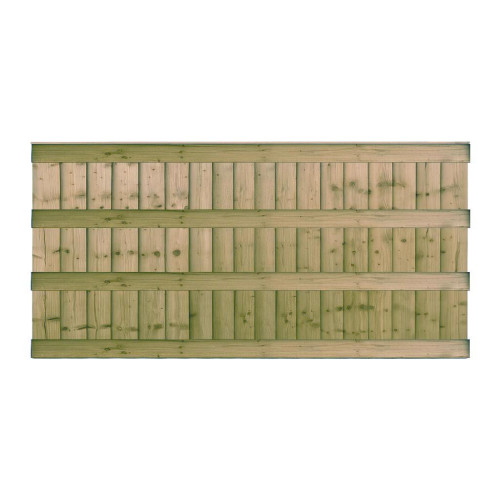
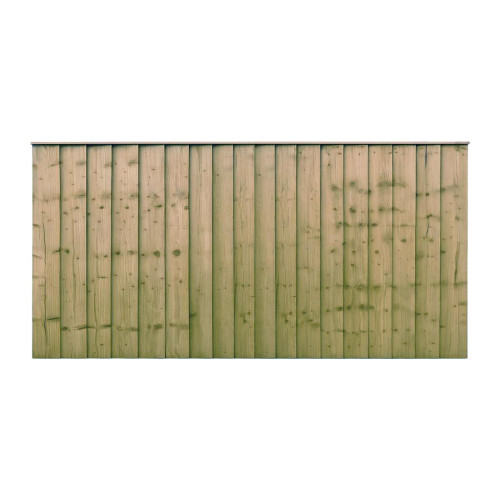
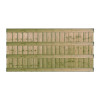
East Coast Fencing manufactures this 3ft Ultra Heavy Duty Closeboard Fence Panel in-house with 4 backing rails to provide more support than the standard panel at the same height. The finished panel is 1830mm wide, 900mm high and 45mm deep, with a green/natural pressure-treated finish. It suits creating a clear 900mm-high boundary while retaining more openness than a taller privacy fence, making it useful beside drives, paths and lower garden divisions, particularly where the buyer wants the traditional solid closeboard face but prefers a more heavily supported panel construction.
On a 900mm-high panel, the fourth rail is not there because the fence is especially tall; it is there to shorten the unsupported sections of the feather edge boards and give the low panel a noticeably more supported build. That can be useful beside driveways, paths or working areas where a fence is more likely to be knocked during everyday use. If the boundary is sheltered and lightly used, the three-rail standard panel remains the direct comparison.
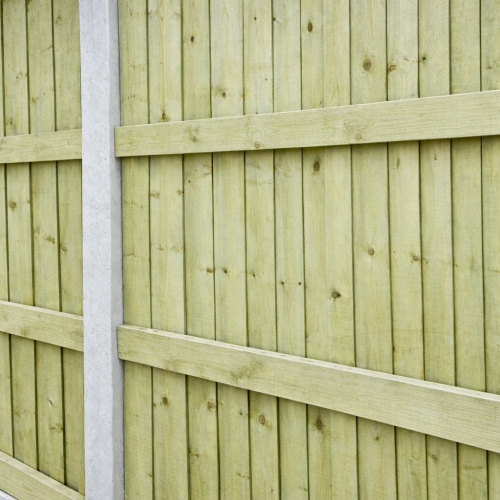
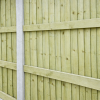
The panel uses overlapping feather edge boards fixed to 4 rails measuring 75 x 32mm. By comparison, our standard 3ft panel uses 3 rails. That difference matters because the boards are supported at more points through the height of the Ultra panel, reducing the distance they span between rails and increasing the stiffness of the assembled panel. It is still an unframed design, so the stronger rail specification does not add bulky side framing. A capping strip runs along the top to finish and protect the exposed upper edge.
The green/natural treatment colour is useful when matching other similarly treated timber in the fence. It should not be confused with a separate structural grade: the reason to choose this product over the standard green/natural closeboard panel is the 4-rail construction. The complete range of closeboard fence panels lets you compare heights, colours and standard versus Ultra support without relying on product names alone.
For installation, plan the whole bay rather than treating the panel in isolation. For replacement work, check both the post opening and the base level. A low panel can still suffer early moisture exposure if one end is allowed to sit in soil on a sloping run, so step the bays or use an even gravel-board line rather than burying the timber. Suitable fence posts must support the chosen height, and the actual opening should be checked before installation, especially when replacing panels between existing posts. A stronger panel cannot compensate for posts that are loose, out of plumb or set at inconsistent centres.
A gravel board is also worth considering where the fence runs over soil or another damp surface. Separating the panel from ground contact reduces repeated wetting and splashback at the bottom of the feather edge boards, while giving the run a defined base. If you have an exposed boundary or simply want the extra rail support at this height, the Ultra specification is the relevant upgrade; if the site is sheltered and the extra support is unnecessary, the standard panel may be the more proportionate choice.