






Quick answer: Buy fencing as a complete system rather than choosing panels alone. Start with the required privacy, appearance, airflow and finished height. Then match the panels with suitable timber or concrete posts, gravel boards, foundations, fixings and a properly supported gate. Measure every existing bay before ordering replacements, include gravel boards and trellis in the total height, and choose stronger supports for tall, solid or exposed boundaries.
Choosing garden fencing becomes much easier when each component is considered as part of one structure. The panels provide privacy and appearance, but the posts, foundations, gravel boards and fixings determine whether the fence remains stable.
The most attractive panel is not necessarily the right panel for every boundary. A solid closeboard panel may suit a private rear garden, while a hit and miss panel may be preferable on an exposed boundary. Picket fencing works well where openness matters, and double slatted or Omega lattice panels provide more decorative alternatives.
The correct choice also depends on the existing site. Ground levels, post spacing, soil conditions, access, wind exposure, neighbouring property and gate positions all affect what can be installed.
This guide covers the principal East Coast Fencing panel styles, wooden and concrete posts, gravel boards, garden gates, trellis, traditional fencing timber, ironmongery, post supports and installation materials.
What Does The Fence Need To Achieve?
Begin with the purpose of the boundary rather than the panel design.
A fence may be required to:
- Create privacy around a rear garden
- Replace storm-damaged or deteriorated panels
- Contain children or pets
- Define a front garden without blocking views
- Screen bins, sheds or utility areas
- Divide a large garden into separate zones
- Provide a decorative background to a patio
- Allow more airflow through an exposed boundary
- Support climbing plants
- Provide access through a matching garden gate
More than one requirement may apply. A rear boundary might need privacy, dog containment and strong gate security, while a patio screen may need appearance and partial privacy without making the area feel enclosed.
Which Fence Type Suits Each Priority?
| Main Priority | Suitable Starting Point | Main Consideration |
|---|---|---|
| Maximum privacy | Closeboard or waney lap | Wind pressure on solid panels |
| Substantial traditional fencing | Ultra heavy duty closeboard | Panel weight and post strength |
| Economical solid screening | Waney lap | Frame support and exposure |
| Open front boundary | Picket fencing | Pale spacing and gate match |
| Traditional decoration | Omega lattice | Open lattice section |
| Airflow and balanced appearance | Horizontal hit and miss | Views through angled gaps |
| Contemporary screening | Double slatted | Filtered rather than solid privacy |
| Plant support | Trellis | Mature plant weight |
Survey The Boundary Before Choosing Products
Walk the complete proposed fence line before ordering anything.
Record:
- The total boundary length
- Every change in direction
- Existing post positions
- Gate openings
- Walls and buildings
- Trees and significant roots
- Raised beds and changes in ground level
- Drain covers and visible services
- Restricted access
- Areas exposed to strong wind
If the existing fence will remain partly in place, measure every individual bay. Older posts may not be evenly spaced, and replacement panels may have been cut during earlier work.
Measure each bay at the top, middle and bottom. Leaning posts can create a tapered opening that appears suitable at ground level but is too narrow higher up.
Confirm The Boundary Before Digging
Do not assume that the current fence sits exactly on the legal boundary. A fence may have been installed inside one property, moved during an earlier replacement or positioned around an old hedge or obstacle.
Before changing the line:
- Record the position of the existing fence
- Check available property documents
- Establish who owns the physical fence where possible
- Discuss the proposed work with the adjoining owner
- Agree any access required from their garden
Do not remove a fence that may belong to a neighbour or attach a new structure to their posts, wall or fence without permission.
Closeboard Fence Panels
Closeboard panels use overlapping vertical feather edge boards within a framed panel. They provide solid screening and a substantial traditional appearance.
They are well suited to:
- Rear garden boundaries
- Side passages
- Private patios
- Dog-friendly gardens
- Secure garden enclosures
- Replacing existing solid panels
Standard closeboard panels are available in a nominal 6ft width and selected nominal heights of:
- 2ft
- 3ft
- 4ft
- 5ft
- 5ft 6in
- 6ft
Brown and green pressure-treated options are available.
Closeboard panels are solid, so they create significant wind resistance. Full-height panels require suitable posts, foundations and fixings.
Ultra Heavy Duty Closeboard Panels
Ultra heavy duty closeboard panels provide a more substantial framed closeboard option.
They are available in a nominal 6ft width and selected heights of:
- 3ft
- 4ft
- 5ft
- 5ft 6in
- 6ft
Brown and green pressure-treated finishes are available.
Choose this range where a heavier framed panel is preferred, but remember that a more substantial panel also places greater weight on the supports. It should not be installed on weak, leaning or undersized posts.
Waney Lap Fence Panels
Waney lap panels use overlapping horizontal timber boards. They provide traditional solid screening and are often chosen where an economical domestic boundary is required.
The range is available in a nominal 6ft width and selected heights of:
- 3ft
- 4ft
- 5ft
- 5ft 6in
- 6ft
Brown and green pressure-treated options are available.
Waney lap panels may be easier to handle than more substantial closeboard panels, but the lighter construction does not remove the need for secure support. Loose or weakly fixed lap panels can move considerably in wind.
Picket Fence Panels
Picket panels create an open boundary using spaced vertical pales.
They are suitable for:
- Front gardens
- Paths and entrances
- Lawns
- Internal garden divisions
- Cottage-style planting
- Lower child or pet boundaries where the spacing is suitable
The available picket panels are nominally 6ft wide and supplied in selected heights of:
- 2ft
- 3ft
- 4ft
Round-top and point-top designs are available, with brown and green pressure-treated options.
Picket fencing does not provide full privacy. Check the pale spacing carefully where the fence will contain a small dog or separate young children from another area.
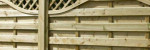
Omega Lattice Fence Panels
Omega lattice panels combine a solid lower section with a curved decorative lattice top.
They work well for:
- Traditional decorative boundaries
- Patio screening
- Flower-bed backgrounds
- Supporting manageable climbing plants
- Gardens where a straight solid top would feel too severe
The range is nominally 6ft wide and available in 3ft, 4ft, 5ft and 6ft heights. The panels are pressure treated green.
The height of a curved panel should be checked at both the sides and its highest point. This matters where the panel meets a wall, gate or differently shaped fence.
The lattice top remains open. It provides decoration and light rather than complete privacy.
Horizontal Hit And Miss Fence Panels
Horizontal hit and miss panels have boards arranged alternately on opposite faces of the frame.
This creates:
- A relatively balanced appearance from both gardens
- Partial visual screening
- More airflow than a solid panel
- A horizontal contemporary or transitional style
The range is nominally 6ft wide and available in 3ft, 4ft, 5ft and 6ft heights. The panels are pressure treated green.
These panels are not completely private. Views may remain possible from an angle, particularly when a person is close to the fence.
Double Slatted Fence Panels
Framed contemporary double slatted panels use horizontal slats across both sides of the frame.
They suit:
- Modern garden designs
- Patios and seating areas
- Garden offices and contemporary buildings
- Boundaries visible from both sides
- Filtered screening with some airflow
The range is nominally 6ft wide and available in 3ft, 4ft, 5ft and 6ft heights.
The gaps are intentional. Although the double arrangement provides useful screening, it is not the same as a completely solid closeboard panel.
Confirm the current finish and treatment specification before trying to match double slatted panels with brown or green posts and gravel boards.
Fence Panel Size Comparison
| Panel Range | Nominal Width | Nominal Heights | Stated Finish |
|---|---|---|---|
| Standard Closeboard | 6ft | 2ft, 3ft, 4ft, 5ft, 5ft 6in, 6ft | Brown or green pressure treated |
| Ultra Heavy Duty Closeboard | 6ft | 3ft, 4ft, 5ft, 5ft 6in, 6ft | Brown or green pressure treated |
| Waney Lap | 6ft | 3ft, 4ft, 5ft, 5ft 6in, 6ft | Brown or green pressure treated |
| Picket | 6ft | 2ft, 3ft, 4ft | Brown or green pressure treated |
| Omega Lattice | 6ft | 3ft, 4ft, 5ft, 6ft | Green pressure treated |
| Horizontal Hit And Miss | 6ft | 3ft, 4ft, 5ft, 6ft | Green pressure treated |
| Double Slatted | 6ft | 3ft, 4ft, 5ft, 6ft | Confirm current specification |
These are nominal sizes. Confirm the actual product dimensions before setting new posts or replacing panels in existing openings.
Which Fence Panel Provides The Most Privacy?
Standard and ultra heavy duty closeboard panels provide strong immediate privacy because their boards overlap vertically.
Waney lap panels also provide a solid visual barrier using overlapping horizontal boards.
Decorative alternatives provide different levels of screening:
- Omega lattice is solid below but open through the top
- Hit and miss allows views through angled gaps
- Double slatted provides filtered screening
- Picket fencing remains open
- Traditional trellis remains open until planting develops
Privacy also depends on ground levels. A 6ft fence may provide limited privacy where the neighbouring garden is significantly higher.
Consider where screening is actually needed. A shorter screen close to a patio may block a direct view more effectively than increasing the height of the complete boundary.
Which Panels Suit Windy Gardens?
Solid closeboard and waney lap panels catch more wind than open designs. This does not make them unsuitable, but their posts and foundations need to be selected accordingly.
Panels that allow more airflow include:
- Horizontal hit and miss panels
- Double slatted panels
- Picket panels
- Omega lattice through the open top
- Open trellis
No panel is storm-proof. Fence performance depends on:
- Panel height
- Post section
- Post length
- Foundation size
- Soil strength
- Post spacing
- Fixing type
- Plant growth
If a previous fence failed, identify whether the panel, post, foundation or fixing was responsible before installing a replacement of the same design.
Which Fencing Suits Front Gardens?
Front boundaries often need to define the property while retaining visibility and an open appearance.
Suitable choices include:
- 2ft or 3ft picket panels
- Low point-top or round-top picket fencing
- 3ft decorative panels
- Low hit and miss panels
- Matching picket gates
Visibility is particularly important close to driveways, junctions and paths.
Check planning requirements before installing a higher front boundary. The position beside a highway may change the permitted height.
Which Fencing Suits Dogs And Children?
For dog containment, check the whole boundary rather than panel height alone.
Look for:
- Gaps beneath gravel boards
- Spaces beside posts
- Gate clearances
- Loose panels
- Digging routes
- Climbable horizontal boards
- Views that may cause reactive behaviour
Solid closeboard and waney lap panels can reduce external views. This may help dogs that react to movement outside the garden.
Horizontal hit and miss and double slatted panels contain features that some dogs or children may attempt to climb. Picket spacing should be checked carefully for small pets and young children.
A standard garden fence should not automatically be treated as a specialist barrier around a pool or other serious hazard.
How Do You Choose The Finished Fence Height?
Calculate the height from the ground to the highest point of the completed structure.
Include:
- The gravel board
- The panel
- Any trellis topper
- Any permanent screening fixed above the panel
Common combinations include:
- A 5ft 6in panel above a 6in gravel board, creating a section close to 6ft
- A 5ft panel above a 12in gravel board, creating a section close to 6ft
- A 6ft panel above a 6in gravel board, creating a section close to 6ft 6in
Use actual product measurements for final planning. Nominal imperial descriptions are useful for comparison but should not replace site measurements.
When Might Planning Permission Be Required?
In England, a fence, wall or gate will generally remain within permitted development where it does not exceed:
- 1m beside a highway used by vehicles or the footpath of that highway
- 2m in many other positions
Additional controls may apply where:
- The property is listed or within the curtilage of a listed building
- The boundary adjoins a listed property
- An Article 4 direction applies
- A planning condition has removed the usual right
- The property is leasehold
- An estate or management agreement restricts fencing
- The property is outside England
Trellis and gravel boards count towards the completed height.
Wooden Fence Posts
Wooden posts provide a natural appearance and straightforward fixing for timber panels, rails, trellis and gate furniture.
The current range includes pressure-treated posts in:
- 75 x 75mm sections
- 100 x 100mm sections
- 1.8m lengths
- 2.4m lengths
- 3.0m lengths
- Brown and green finishes
A 75 x 75mm post may suit lower or lighter fencing in sheltered conditions.
A 100 x 100mm post provides a more substantial starting point for:
- 5ft and 6ft panels
- Solid closeboard fencing
- Heavy decorative panels
- Exposed boundaries
- Structures carrying trellis
Post section is only one part of the decision. A large post can still move if its foundation is inadequate.
Concrete Fence Posts
Concrete posts do not rot and are commonly used with compatible framed panels and gravel boards.
The available post types include:
- Intermediate posts for straight runs
- End posts
- Corner posts
- Three-way posts
Selected lengths are available from approximately 1.5m to 2.7m.
Concrete posts are particularly useful where:
- The ground is damp
- Timber posts have failed previously
- Concrete gravel boards are preferred
- Future panel replacement should be straightforward
- Low routine maintenance is important
They are considerably heavier than wooden posts and require accurate spacing. Once the foundation has set, adjustment is difficult.
Wooden Or Concrete Posts?
| Feature | Wooden Posts | Concrete Posts |
|---|---|---|
| Appearance | Natural timber finish | Practical structural appearance |
| Handling | More manageable | Heavy |
| Fixing | Easy to drill and screw into | Panels normally use slots |
| Ground-Level Rot | Possible | Does not rot |
| Panel Replacement | Fixings must be removed | Panels can often be lifted out |
| DIY Suitability | More approachable | More physically demanding |
| Custom Construction | Highly flexible | Best for planned compatible systems |
How Do You Choose The Correct Post Length?
Calculate the post length from:
- The visible panel height
- The gravel-board height
- Any trellis
- The depth required below ground
- The change in ground level
- Any post projection above the panel
Do not select a 1.8m post simply because the panel is described as 1.8m or 6ft high. The post also needs enough length below ground.
There is no universal excavation depth suitable for every fence. Tall solid panels, weak soil and exposed locations require more support than low open panels in firm sheltered ground.
Why Use Gravel Boards?
Gravel boards sit between the panel and the ground.
They help:
- Keep timber panels above wet soil
- Reduce mud and rain splash
- Protect the panel from strimmers
- Create a defined lower edge
- Close gaps beneath the fence
- Make future panel replacement easier
- Step fencing across a slope
They are strongly recommended where the lower panel frame would otherwise sit close to soil, lawns, mulch or garden debris.
Wooden Gravel Boards
Pressure-treated wooden gravel boards provide an all-timber appearance and are easier to handle and cut than concrete alternatives.
They are available in:
- 1.83m lengths
- 2.4m lengths
- 3.0m lengths
- Brown treatment
- Green treatment
They remain timber components and should not be buried unnecessarily or used to retain a substantial bank of wet soil.
Concrete Gravel Boards
Concrete gravel boards do not rot and work naturally with slotted concrete posts.
The range includes:
- 6in smooth boards
- 12in smooth boards
- 12in recessed boards
- Lightweight 6in rebated boards
- Lightweight 12in rebated boards
- 12in smooth boards with a hedgehog opening
Concrete boards are heavy and should not normally be cut as a routine site adjustment.
The hedgehog opening option can maintain a wildlife route through an otherwise solid fence base.
Can Concrete Gravel Boards Be Used With Wooden Posts?
They can, provided a suitable support system is used.
Concrete boards are too heavy to be balanced casually between timber posts. The brackets, posts and foundations must carry the load securely.
This combination may suit a homeowner who wants timber posts but prefers a rot-resistant concrete base.
Can Wooden Gravel Boards Be Used With Concrete Posts?
They may be used where their thickness and length suit the post slots.
Measure the slot and board before ordering. Do not assume that every timber section will fit every concrete-post system.
Which Garden Gates Are Available?
The principal gate styles include:
- A fully framed premium feather edge garden gate
- Round-top picket gates
- Point-top picket gates
- A framed contemporary double slatted garden gate
Feather Edge Garden Gate
The fully framed feather edge gate measures approximately 1.75m high by 0.9m wide and is available in pressure-treated brown and green finishes.
It is a natural match for closeboard fencing and solid rear-garden boundaries.
Picket Garden Gates
Picket gates are approximately 0.9m wide and available in selected nominal heights of:
- 0.6m
- 0.9m
- 1.2m
Round-top and point-top designs are available, with brown and green pressure-treated variants.
Double Slatted Garden Gate
The framed contemporary double slatted gate measures approximately 1.8m high by 0.9m wide.
It can maintain the horizontal design of a double slatted fence run. Confirm its current finish before matching it with surrounding timber.
Why Do Gates Need Dedicated Posts?
A fence panel remains fixed between two supports. A gate hangs from one side and applies repeated leverage to its hinge post.
Gate posts must resist:
- The weight of the gate
- Repeated opening and closing
- Wind pressure
- Slamming
- Force at the latch edge
Dedicated timber gate posts are available in a 3.0m length and 150 x 150mm section, with pyramid tops and brown or green pressure-treated finishes.
Do not hang a tall solid gate from a lightweight post intended for a low fence or trellis screen.
Which Gate Ironmongery Is Available?
The available gate and fence fittings include:
- A gate furniture pack
- 450mm medium tee hinges supplied as a pair
- A 150mm ring latch
- A 150mm pad bolt
- 46mm fence-panel clips
- Fence-panel security brackets
- 150mm flush-head screws in packs of 10 or 50
The hinge length, fixing method and gate frame must suit one another.
A ring latch provides everyday closure, while a pad bolt can provide additional restraint where required.
Use exterior fittings and fix through substantial gate framing rather than thin boards.
What Trellis Styles Are Available?
Trellis can provide plant support, partial privacy, decoration or additional height.
The principal styles include:
- Traditional square trellis
- Privacy square trellis
- Horizontal slatted trellis
- Fan trellis
- Decorative diamond lattice
- Matching trellis battens
Traditional Square Trellis
This provides an open grid for climbing plants and light garden division.
Selected nominal 1.83m-wide panels are available in heights from approximately 0.3m to 1.83m, with brown and green pressure-treated options.
Privacy Square Trellis
Privacy square trellis uses smaller openings than traditional square trellis, providing denser screening while retaining an open structure.
Horizontal Slatted Trellis
Horizontal slatted trellis provides a more contemporary appearance and selected heights from approximately 0.3m to 1.83m.
Fan Trellis
Fan trellis suits individual plants and narrower wall positions. Confirm its orientation before ordering because the width and height should not be assumed from the product name alone.
Decorative Diamond Lattice
Decorative diamond trellis is available in nominal 6ft widths and selected heights from 1ft to 6ft in a green pressure-treated finish.
Can Trellis Be Added To An Existing Fence?
It can, provided:
- The fence belongs to you
- The posts are sound
- Enough post height is available
- The foundations can carry the added load
- The completed height is acceptable
- The future plant weight has been considered
Fix trellis to substantial posts or an independent frame. Do not rely only on thin panel boards.
Heavy climbing plants can add considerable weight and wind resistance, particularly when wet.
What Is Traditional Closeboard Fencing?
Traditional closeboard fencing is built on site from individual feather edge boards fixed to supporting rails between posts.
A complete system may use:
- Wooden or concrete posts
- Cant rails
- Feather edge boards
- Gravel boards
- Capping
- Exterior nails or screws
This differs from a ready-made closeboard panel, which arrives as a complete framed section.
Traditional construction is useful where:
- The fence follows a slope
- Bay widths are not standard
- A continuous built-on-site fence is preferred
- Individual boards may need replacing later
Which Feather Edge Boards Are Available?
Pressure-treated feather edge boards have a nominal section of approximately 125 x 22mm.
Selected lengths include:
- 0.9m
- 1.2m
- 1.5m
- 1.65m
- 1.8m
- 2.1m
Brown and green pressure-treated options are available.
The boards must overlap. Calculate quantity from the effective cover after overlap rather than the full width of each board.
Which Rails And Timber Components Are Available?
Related fencing timber includes:
- Cant rails with a nominal 125 x 47mm section in 2.4m and 3.0m lengths
- MOT rails measuring approximately 87 x 38mm x 3.6m
- Wallplates with a nominal 100 x 47mm section in selected lengths
- Fence-panel backrails measuring approximately 1.83m x 75 x 32mm
- Trellis battens measuring approximately 1.83m x 38 x 16mm
- Fence capping measuring approximately 1.83m x 45 x 16mm
- Picket pales measuring approximately 75 x 19mm
Picket pales are available in 0.9m and 1.2m lengths, with round-top and point-top profiles and selected brown and green pressure-treated finishes.
Use component dimensions to design the fence rather than assuming that all timber rails and battens can be substituted for one another.
Should Feather Edge Boards Be Screwed Or Nailed?
Suitable exterior nails or screws can be used.
Nails provide quick installation and allow some timber movement. Screws provide controlled fixing and make individual-board replacement easier.
Whichever method is chosen:
- Use exterior fixings suitable for treated timber
- Fix through the thicker part of the board
- Avoid vulnerable edges
- Pre-drill where splitting is likely
- Maintain a consistent overlap
Which Post Supports And Repair Products Are Available?
Related post products include:
- Concrete repair spurs for 75 x 75mm posts
- Concrete repair spurs for 100 x 100mm posts
- Drive-in post spikes for 75 x 75mm posts
- Drive-in post spikes for 100 x 100mm posts
- Bolt-down post supports for 75 x 75mm posts
- Bolt-down post supports for 100 x 100mm posts
- Rapid-set post mix
Concrete Repair Spurs
A repair spur may reinforce a timber post that has failed around ground level while remaining sound above.
It is not suitable where most of the post is rotten, split or undersized.
Drive-In Post Spikes
Drive-in supports have a 600mm driven section and may suit low or lightweight fencing in firm ground.
They should not automatically be used for:
- Tall solid panels
- Heavy gates
- Waterlogged ground
- Loose soil
- Highly exposed boundaries
Bolt-Down Post Supports
Bolt-down supports require a sound structural base.
Ordinary patio slabs, weak screed and decorative walls should not be assumed capable of resisting the leverage of a tall fence.
Rapid-Set Post Mix
Post mix can secure suitable wooden and concrete posts when used according to its instructions.
It cannot compensate for:
- A shallow hole
- An undersized post
- Weak ground
- Poor alignment
- Incorrect spacing
Which Components Work Together?
| Panel Or Structure | Typical Posts | Typical Base | Important Check |
|---|---|---|---|
| Framed closeboard panel | Timber or slotted concrete | Wooden or concrete gravel board | Panel frame and slot thickness |
| Waney lap panel | Timber or slotted concrete | Wooden or concrete gravel board | Secure fixing in exposed sites |
| Decorative framed panel | Timber or compatible concrete | Wooden or concrete gravel board | Frame thickness and cutting difficulty |
| Picket panel | Timber posts | Optional wooden gravel board | Pale spacing and gate style |
| Traditional closeboard | Timber or suitable concrete | Wooden or concrete gravel board | Rail system and board overlap |
| Trellis | Timber posts or independent frame | Project dependent | Height, wind and plant weight |
| Garden gate | Substantial gate posts | Clear threshold | Opening clearance and ironmongery |
How Do You Calculate Panel And Post Quantities?
For a new straight fence:
- Measure the complete run.
- Choose the actual panel width.
- Choose the post section.
- Deduct any gate opening.
- Mark corners and junctions.
- Calculate complete panel bays.
- Plan the shortened end bay.
Do not divide the boundary length only by the panel width. Posts also occupy space.
A straight run of six panels normally needs seven posts. A gate, corner or three-way junction changes the quantity and post type.
Can Fence Panels Be Cut To Width?
Many framed timber panels can be shortened, but the frame must be rebuilt.
A correct alteration usually involves:
- Measuring the required finished width.
- Marking the new side position.
- Installing or repositioning a vertical side batten.
- Fixing every board or slat to that batten.
- Cutting away the excess.
- Protecting exposed timber cuts.
Do not cut through the panel and leave unsupported board ends.
Omega lattice and double slatted panels are more difficult to alter neatly because their decorative pattern must remain balanced and secure.
How Do You Plan Fencing On A Slope?
Rigid framed panels are normally stepped.
Each panel remains level, while the next bay starts higher or lower.
Plan:
- The total change in level
- The step at every post
- The gravel-board position
- The post length required at each bay
- Any triangular gaps beneath panels
- The appearance of curved decorative tops
Traditional closeboard fencing made from individual feather edge boards can follow a slope more closely than rigid panels.
How Do You Plan Around Trees, Walls And Buildings?
Trees And Roots
Do not force standard post spacing through major roots. A shortened bay or adjusted post position may be more appropriate.
Walls
A suitable timber wallplate may provide a fixing surface where the fence meets sound masonry.
Do not rely on loose render, damaged mortar or a weak decorative wall to resist the load of a tall fence.
Sheds And Garden Buildings
Leave enough access to maintain both the fence and building. A narrow gap can collect leaves and remain damp.
Raised Beds
Do not use fence panels or ordinary gravel boards as retaining structures.
Pressure-treated landscaping sleepers measuring approximately 100 x 200mm x 2.4m can form suitable independent raised beds or low landscaping structures when correctly supported, fixed and drained.
Keep retained soil pressure away from the fence.
What Does Pressure-Treated Timber Mean?
Pressure treatment introduces preservative into timber to improve resistance to biological deterioration.
It does not make timber:
- Waterproof
- Unable to split
- Unable to move as it dries
- Maintenance free
- Suitable for every structural application
Brown and green describe the initial treatment appearance. Both colours will change as the timber weathers.
Natural colour variation, knots, minor checks and gradual greying are normal features of outdoor timber and do not automatically mean the product has failed.
Can Pressure-Treated Fencing Be Painted?
Yes, once the timber is sufficiently dry and the coating is suitable for treated exterior wood.
Before coating:
- Allow the timber to dry
- Remove dirt and algae
- Repair loose boards
- Protect exposed cuts
- Follow the coating instructions
There is no single waiting period suitable for every panel. Drying depends on timber thickness, storage, weather and the coating system.
Should You Replace Panels Or The Complete Fence?
Panel-only replacement may be appropriate where the existing posts and gravel boards remain sound.
Reuse posts only where they are:
- Upright
- Secure
- Correctly spaced
- Long enough
- Strong enough for the new panels
- Free from serious rot or cracking
Replace or repair the supports where:
- Wooden posts are soft at ground level
- Concrete posts are cracked or moving
- Slots are damaged
- The posts lean
- The openings do not suit the new panels
- The previous fence repeatedly failed in wind
Installing new panels into failing posts is usually a false economy.
Should You Install The Fence Yourself?
A short, accessible fence on manageable ground may be suitable for an experienced DIYer.
Professional installation may be preferable where:
- Concrete posts and gravel boards are used
- The fence is long
- Access is restricted
- Old foundations must be broken out
- The ground is steep or unstable
- The boundary is disputed
- Buried services are uncertain
- A heavy gate is included
- The site is highly exposed
Concrete products and large panels need enough people or suitable equipment for safe handling.
What Should You Check When Materials Arrive?
Before installation, check:
- The panel style
- The panel height and width
- The treatment colour
- The post section and length
- The concrete-post configuration
- The gravel-board profile
- The gate size
- The ironmongery
- Loose or broken components
- Severe twisting
- Damaged concrete edges
- The total quantities
Inspect products before cutting, drilling or fitting them.
How Should Fencing Be Stored?
Store panels above wet ground on level supports.
Avoid:
- Leaving one corner unsupported
- Resting panels in standing water
- Allowing wind to overturn them
- Placing heavy products on lattice or slats
- Stacking concrete products on unstable ground
- Wrapping wet timber without ventilation
Plan the route from the delivery point to the boundary before heavy products arrive.
How Should A Fence Be Maintained?
Inspect the fence several times a year and after severe weather.
Check:
- Post movement
- Rot around wooden posts
- Loose panel clips
- Broken boards and slats
- Cracked concrete
- Damaged gravel boards
- Gate sag
- Loose hinges and latches
- Heavy climbing plants
- Leaves and soil around the panel base
- Algae in damp shaded areas
Prompt repairs prevent movement spreading into adjoining fence bays.
Common Fencing Buying Mistakes
- Buying panels before measuring the complete run
- Assuming every existing bay is 6ft wide
- Ignoring leaning or rotten posts
- Choosing by appearance without considering privacy
- Expecting hit and miss or slatted panels to be fully private
- Using lightweight posts for tall solid panels
- Forgetting that posts occupy part of the boundary length
- Forgetting that gravel boards increase the finished height
- Adding trellis without checking post strength
- Choosing a gate without dedicated posts
- Buying gate furniture that does not suit the frame
- Assuming every framed panel fits every concrete-post slot
- Using drive-in spikes for unsuitable full-height fencing
- Using bolt-down supports on weak paving
- Using ordinary fence components to retain soil
- Mixing brown and green products unintentionally
- Failing to protect fresh timber cuts
- Underestimating delivery and handling access
Complete Fencing Buying Checklist
Before ordering, confirm:
- The boundary position
- The purpose of the fence
- The required privacy level
- The required airflow
- The panel style
- The actual panel dimensions
- The total fence length
- The number of full and shortened bays
- The finished height
- The gravel-board height
- Any trellis height
- Timber or concrete posts
- The post section or configuration
- The post length
- Intermediate, end and corner quantities
- The ground conditions
- The wind exposure
- The gate style and dimensions
- Dedicated gate posts
- Hinges, latch and bolt
- Panel clips, brackets or screws
- Post mix
- Repair spurs or supports where appropriate
- Delivery access
- Safe lifting arrangements
- Installation tools or professional labour
FAQs
What Is The Best All-Round Fence Panel?
Closeboard panels are a strong starting point where privacy and substantial construction are important. The best choice still depends on exposure, appearance and budget.
Which Fence Panel Is Best For Privacy?
Closeboard and waney lap panels provide solid immediate screening. Omega lattice, hit and miss and double slatted panels contain open sections or gaps.
Which Fence Is Best For A Windy Garden?
Hit and miss, double slatted and picket panels allow more airflow than solid fencing. The posts, foundations and height remain critical.
Which Fence Is Best For A Front Garden?
Low picket panels and matching gates provide a clear boundary while retaining an open appearance.
Which Fence Is Best For A Modern Garden?
Double slatted panels provide the most distinctly contemporary appearance. Horizontal hit and miss panels are another suitable option.
Which Fence Is Best For A Traditional Garden?
Closeboard, waney lap, picket and Omega lattice panels all suit traditional garden designs.
Are Ultra Heavy Duty Panels Worth Choosing?
They provide a more substantial framed closeboard option. The supporting posts and foundations must be suitable for the added weight and wind load.
Are Fence Panels Exactly 6ft Wide?
They are nominally described as 6ft wide. Confirm actual dimensions before setting posts or replacing panels.
Why Are 5ft 6in Panels Available?
They can be combined with an approximately 6in gravel board to create a completed section close to 6ft high.
Can A 6ft Panel Be Installed Above A Gravel Board?
Yes, but the gravel board increases the total height. A 6in board creates a section close to 6ft 6in.
Do Fence Panels Need Gravel Boards?
They are strongly recommended where timber panels would otherwise sit close to soil, grass or wet garden debris.
Are Concrete Gravel Boards Better Than Wooden Boards?
Concrete boards do not rot and require less ground-level maintenance. Wooden boards are lighter, easier to cut and provide an all-timber appearance.
Are Concrete Posts Better Than Wooden Posts?
Concrete posts resist rot and simplify replacement of compatible panels. Wooden posts provide natural appearance, lighter handling and flexible fixing.
Can Wooden Panels Fit Concrete Posts?
Yes, where the panel width and frame thickness suit the post slots.
Can Existing Fence Posts Be Reused?
Yes, if they are upright, secure, correctly spaced and strong enough for the replacement panels.
Can A Rotten Wooden Post Be Repaired?
Some ground-level failures can be reinforced with a compatible concrete repair spur where the upper timber remains sound.
Can Fence Panels Be Cut?
Many timber panels can be shortened if a new side frame is installed and every board or slat remains securely supported.
Can Decorative Panels Be Cut?
They can sometimes be altered, but lattice and slatted patterns make the work more difficult and may affect symmetry.
Can Fencing Be Installed On A Slope?
Yes. Rigid panels are normally stepped. Traditional closeboard fencing can follow the slope more closely.
Can Fence Panels Retain Soil?
No. Use a separate supported and drained retaining structure.
Can Trellis Be Added To A Fence?
Yes, where the fence belongs to you and the posts and foundations can support the extra height, wind resistance and plant weight.
Does Trellis Count Towards Fence Height?
Yes. Measure from ground level to the highest point of the complete boundary.
Can Trellis Provide Complete Privacy?
No open trellis provides the same immediate privacy as a solid fence panel. Privacy square or slatted trellis provides denser screening.
What Gate Matches Closeboard Fencing?
A fully framed feather edge gate provides a natural match for closeboard panels and traditional feather edge fencing.
What Gate Matches Picket Fencing?
Choose a round-top or point-top picket gate matching the pale design and approximate height of the surrounding fence.
Is There A Matching Double Slatted Gate?
Yes. A framed contemporary double slatted gate is available in an approximate size of 1.8m x 0.9m.
Do Gates Need Stronger Posts?
Yes. Gates apply repeated moving and leveraged loads to their hinge posts.
What Ironmongery Does A Gate Need?
A typical gate may require tee hinges, a ring latch, a pad bolt, suitable exterior fixings and a gate stop.
Can Drive-In Spikes Support A 6ft Fence?
Do not assume they are suitable for tall solid panels. Ground, exposure, panel design and post size must be assessed.
Can Bolt-Down Supports Be Fixed To Patio Slabs?
Ordinary paving slabs may not provide sufficient structural support. The base must resist the leverage of the completed fence.
Are Fence Panels Pressure Treated?
The principal closeboard, waney lap, picket, Omega lattice and hit and miss ranges include pressure-treated products. Confirm the specification of the exact product selected.
Can Pressure-Treated Fencing Be Painted?
Yes, once the timber is sufficiently dry and the coating is suitable for treated exterior wood.
How Many Posts Are Needed For Six Panels?
A straight run normally requires seven posts. Gates, corners and junctions alter the quantity and type.
Should A Fence Be Installed Professionally?
Professional installation is sensible for difficult ground, long runs, heavy concrete systems, steep slopes, exposed sites and substantial garden gates.
Choose The Complete System Before Ordering
The best fencing choice is not simply the panel that looks most attractive. It is the combination that meets the garden's need for privacy, appearance, airflow, access and maintenance.
Choose closeboard or waney lap for solid screening, picket fencing for open low boundaries, Omega lattice for traditional decoration, hit and miss for airflow and double slatted panels for contemporary filtered screening.
Match the chosen panel with suitable posts, foundations and gravel boards. Use substantial dedicated posts for gates, and select compatible exterior ironmongery rather than treating hinges, clips and fixings as minor afterthoughts.
Measure actual openings, calculate the finished height and plan slopes, corners, gates and shortened sections before ordering. A complete compatible system will be easier to install, easier to maintain and less likely to require avoidable alterations on site.