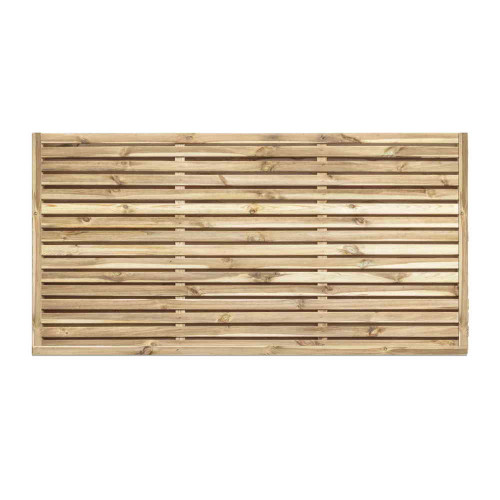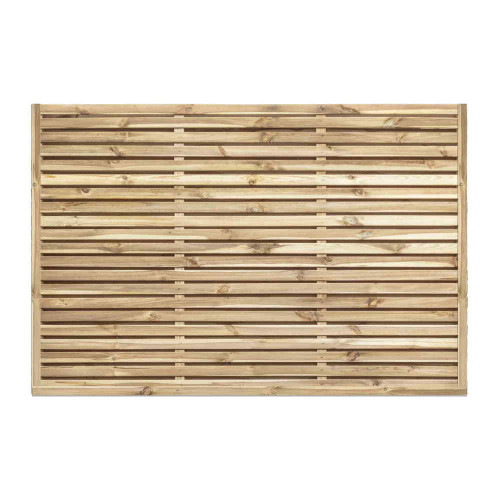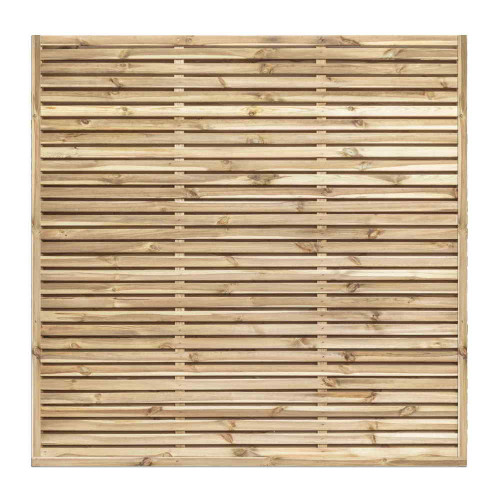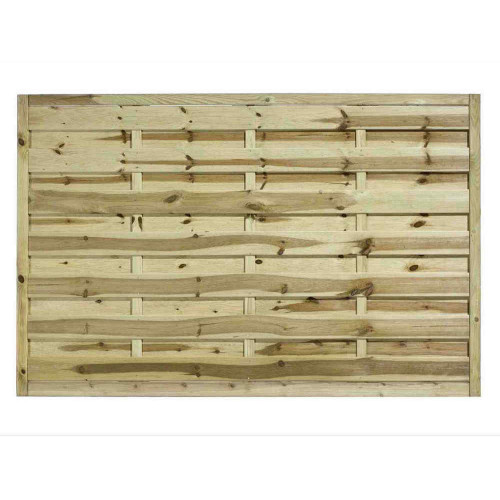


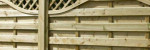

Quick answer: Choose Omega lattice panels for a traditional decorative boundary with a solid lower section and curved lattice top, horizontal hit and miss panels for balanced appearance and increased airflow, or double slatted panels for a contemporary horizontal design with filtered screening. All three ranges are available in nominal 6ft widths and 3ft, 4ft, 5ft and 6ft heights. Check privacy, viewing angles, wind exposure, post compatibility, gravel-board height and the finished boundary height before ordering.
Decorative fence panels provide more than a basic garden boundary. Their shape, board arrangement and open sections can add visual interest, improve airflow, support planting and make both sides of a fence more attractive.
The right decorative panel depends on what the fence needs to achieve. A curved lattice panel may suit a traditional garden where planting and appearance are priorities. A hit and miss panel may be better where the boundary is exposed to wind or visible from both sides. A double slatted panel can complement modern paving, garden rooms and contemporary landscaping.
Decorative panels still need to perform as part of a complete fencing system. The posts, foundations, gravel boards, fixings, ground levels and gate all affect the final appearance and stability.
This buying guide explains the differences between Omega lattice, horizontal hit and miss and double slatted panels. It also covers sizes, privacy, airflow, wind exposure, posts, gravel boards, gates, measuring, cutting, slopes, installation, maintenance and common buying mistakes.
What Counts As A Decorative Fence Panel?
A decorative fence panel uses shape, spacing, lattice or slatted construction to create a more distinctive appearance than a standard closeboard or waney lap panel.
The East Coast Fencing decorative-panel range includes:
- Omega lattice decorative fence panels
- Horizontal hit and miss fence panels
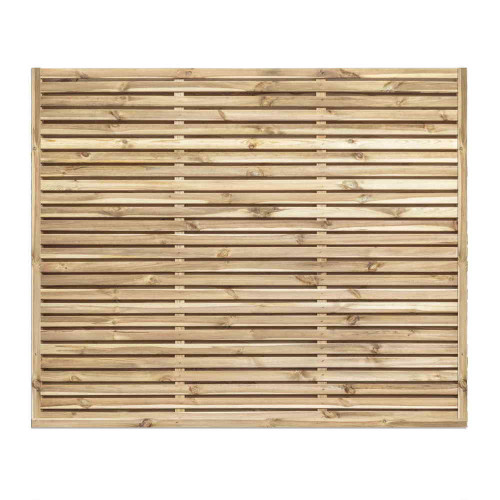
- Framed contemporary double slatted fence panels
Each range is available in a nominal width of approximately 6ft and heights of 3ft, 4ft, 5ft and 6ft.
Although all three are decorative, they perform differently. The best choice depends on the balance required between appearance, privacy, airflow and compatibility with the surrounding garden.
Decorative Fence Panel Types At A Glance
| Panel Type | Appearance | Privacy | Airflow | Best Suited To |
|---|---|---|---|---|
| Omega Lattice | Traditional curved lattice top | High below the lattice | Moderate through the top | Decorative private boundaries |
| Horizontal Hit And Miss | Balanced horizontal boards | Moderate | Good | Exposed gardens and shared views |
| Double Slatted | Contemporary horizontal slats | Moderate to high | Moderate | Modern gardens and patios |
What Is An Omega Lattice Fence Panel?
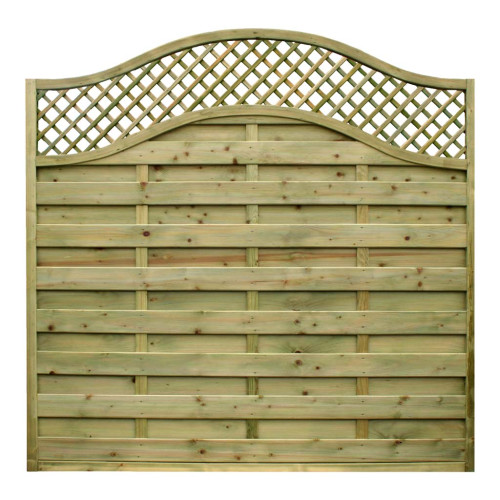
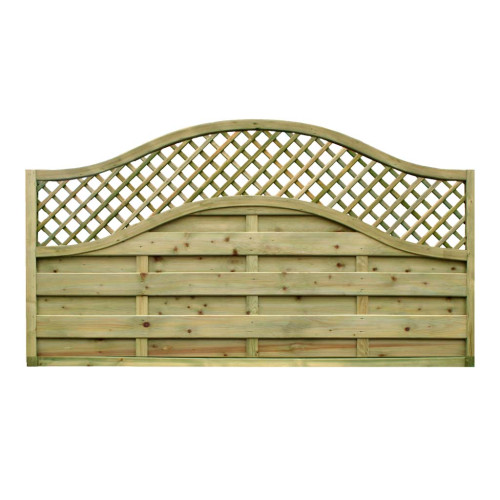
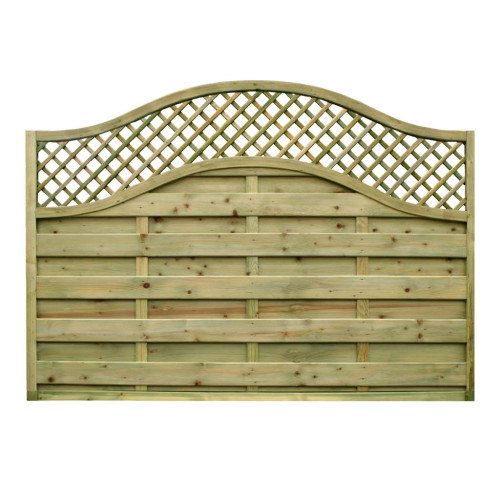
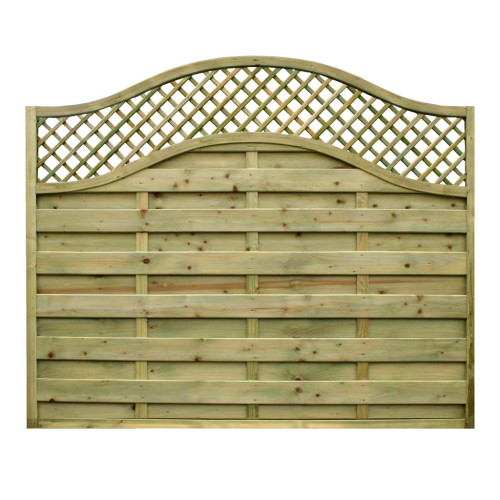
An Omega lattice decorative panel combines a solid lower section with a curved lattice section across the top.
The curved top creates a softer outline than a straight panel and can make a long fence run appear less severe. The lattice admits light and provides attachment points for suitable climbing plants, while the lower section retains useful screening.
Omega lattice panels are suitable for:
- Traditional rear gardens
- Decorative side boundaries
- Patio screening
- Cottage-style planting schemes
- Boundaries beside lawns and flower beds
- Gardens where a completely flat fence line would appear too plain
- Supporting light climbing plants along the upper section
The available Omega lattice panels are pressure treated green.
What Omega Lattice Panel Sizes Are Available?
The Omega lattice range is available in a nominal width of approximately 6ft and the following nominal heights:
- 6ft x 3ft
- 6ft x 4ft
- 6ft x 5ft
- 6ft x 6ft
Because the top is curved, the stated height normally relates to the panel's maximum nominal height. Confirm the actual height at the sides and centre where the fence must align with posts, walls, gates or adjoining panels.
How Private Are Omega Lattice Panels?
The solid lower section provides substantial screening, while the lattice top remains open.
The privacy level depends on:
- The overall panel height
- The depth of the lattice section
- The viewing angle
- The distance from the fence
- Ground levels on both sides
- Whether plants are trained through the lattice
An Omega panel can provide a lighter alternative to a fully solid 6ft panel. It retains privacy at seating level while allowing more light near the top of the boundary.
It will not completely block views from higher neighbouring ground or upper windows.
Can Plants Grow On Omega Lattice Panels?
Yes. The lattice top can support suitable lightweight climbing plants.
Potential choices include:
- Clematis
- Annual sweet peas
- Light jasmine growth
- Smaller honeysuckle varieties
- Other manageable garden climbers
Young stems may need soft ties while they establish.
Do not allow a large mature climber to overwhelm the panel. Dense plants add:
- Weight
- Wind resistance
- Moisture around the timber
- Pressure on the lattice joints
Heavy plants such as mature wisteria normally need a more substantial independent support.
What Is A Horizontal Hit And Miss Fence Panel?
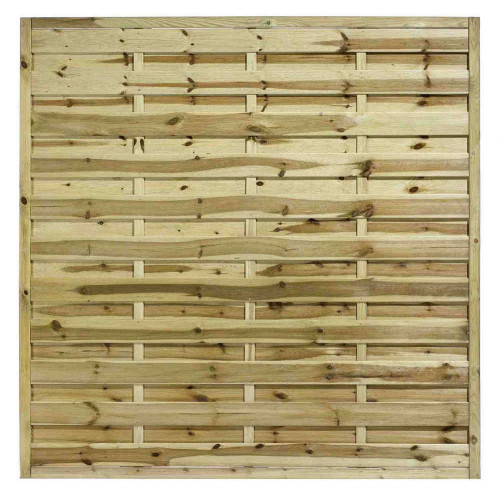
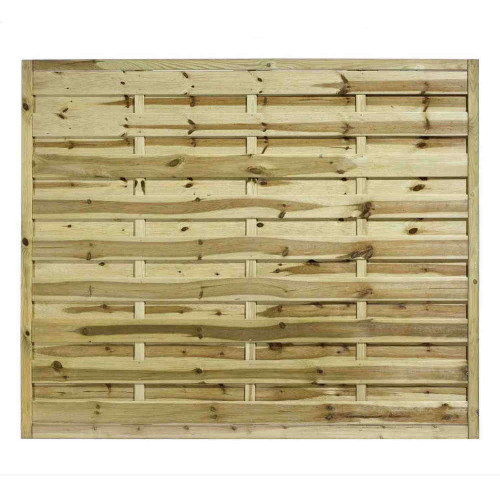
A horizontal hit and miss panel has timber boards fixed alternately to opposite sides of the frame.
The alternating arrangement creates a fence that appears similarly finished from both gardens. Gaps between the boards allow some air and light to pass through while interrupting direct views.
Horizontal hit and miss panels are suitable for:
- Boundaries visible from both sides
- Exposed gardens
- Modern and transitional landscaping
- Patio divisions
- Garden rooms and contemporary structures
- Areas where a solid fence would feel too enclosed
The available horizontal hit and miss range is pressure treated green.
What Horizontal Hit And Miss Sizes Are Available?
The available horizontal hit and miss panels have a nominal width of approximately 6ft and are supplied in:
- 6ft x 3ft
- 6ft x 4ft
- 6ft x 5ft
- 6ft x 6ft
The different heights allow the same design to be used for low garden divisions, medium-height boundaries and full privacy fencing.
Are Hit And Miss Panels Fully Private?
No. Hit and miss panels provide partial screening rather than complete visual privacy.
When viewed straight on, the alternating boards interrupt much of the view. When viewed from an angle or from close range, the gaps can become more visible.
Privacy depends on:
- The board spacing
- The viewing direction
- The distance between the viewer and panel
- The difference in ground level
- Planting near the fence
Choose closeboard or another solid panel where complete immediate screening is essential.
Do Hit And Miss Panels Let More Wind Through?
Yes. The gaps allow more air to pass through than a fully solid closeboard or waney lap panel.
This can reduce some of the pressure applied to the fence during windy conditions, but it does not make the fence immune to storm damage.
The complete installation must still use:
- Suitable posts
- Adequate post length
- Appropriate foundations
- Secure panel fixings
- Correct post spacing
Plants growing through or against the panel can reduce its airflow advantage by closing the gaps with foliage.
Do Hit And Miss Panels Look The Same From Both Sides?
They provide a more balanced appearance than panels with all rails or supports concentrated on one face.
The alternating boards create a similar visual rhythm from both gardens, making them useful where both neighbours will see the boundary.
The two faces may not be perfectly identical because the board positions alternate, but neither side has the obvious structural rear commonly associated with some traditional panel designs.
What Is A Double Slatted Fence Panel?
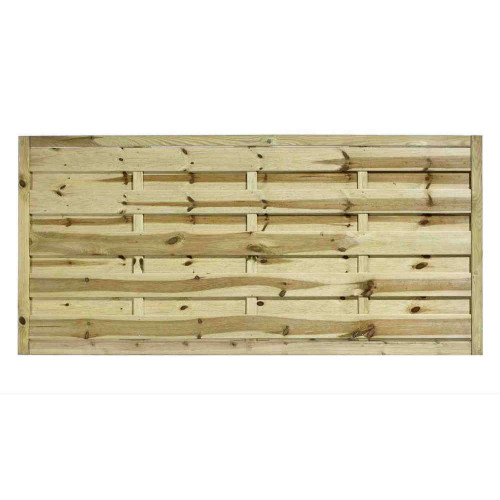
A framed contemporary double slatted panel uses horizontal timber slats arranged across both sides of the panel.
The construction creates a modern linear appearance and provides screening while retaining intentional gaps for light and airflow.
Double slatted panels work well with:
- Modern paving
- Rendered garden walls
- Contemporary garden rooms
- Patios and dining areas
- Structured planting
- Minimalist garden designs
- Matching double slatted garden gates
The supplied product naming does not state a brown or green treatment colour. Confirm the current finish and treatment specification before matching the panels with posts, gravel boards or other timber components.
What Double Slatted Panel Sizes Are Available?
The framed contemporary double slatted range is available in a nominal width of approximately 6ft and the following nominal heights:
- 6ft x 3ft
- 6ft x 4ft
- 6ft x 5ft
- 6ft x 6ft
This allows the design to be used for both low feature fencing and full-height garden boundaries.
Are Double Slatted Panels Fully Private?
Double slatted panels provide substantial screening, but they are not completely solid.
The two layers of slats interrupt direct views while allowing light and air through the intentional openings.
The amount that can be seen through the panel depends on:
- The viewing angle
- The height of the viewer
- The distance from the fence
- Lighting conditions
- Ground levels
- The position of nearby windows
They are suitable where filtered screening is acceptable. Choose a solid closeboard panel where no intentional gaps are wanted.
Is There A Matching Double Slatted Garden Gate?
The available range includes a framed contemporary double slatted garden gate measuring approximately 1.8m high by 0.9m wide.
A matching gate can help maintain the horizontal slatted design across a modern garden entrance.
When planning the gate, include:
- Substantial gate posts
- Suitable hinges
- A ring latch or another closing mechanism
- A pad bolt where additional restraint is required
- Ground clearance
- Hinge and latch gaps
- The direction of opening
The nominal 0.9m gate width is not the same as the required distance between the gate posts. Fitting clearance must be allowed.
Which Decorative Panel Is Best For Privacy?
The answer depends on whether open decorative details are acceptable.
| Panel | Privacy Level | Where Views Remain Possible |
|---|---|---|
| Omega Lattice | High through lower section | Through the lattice top |
| Horizontal Hit And Miss | Moderate | Through angled board gaps |
| Double Slatted | Moderate to high | Through slat gaps at some angles |
Omega lattice panels are useful where privacy is needed at lower level but light is preferred above. Double slatted panels provide more consistent filtered screening across their height. Hit and miss panels provide the greatest emphasis on airflow rather than complete privacy.
Which Decorative Panel Is Best For A Modern Garden?
Double slatted panels provide the most distinctly contemporary appearance.
The horizontal lines complement:
- Porcelain paving
- Rendered walls
- Garden offices
- Geometric planting beds
- Modern outdoor furniture
- Simple architectural landscaping
Horizontal hit and miss panels also work in modern gardens where a slightly more open and substantial boarded appearance is preferred.
Which Decorative Panel Is Best For A Traditional Garden?
Omega lattice panels generally provide the most traditional decorative appearance.
The curved top and lattice work well with:
- Cottage planting
- Climbing roses
- Curved borders
- Traditional patios
- Timber garden buildings
- Decorative gates and arches
The curved panel shape is more visually prominent than a straight-edged fence, so check how several panels will align along the boundary.
Which Decorative Panel Looks Best From Both Sides?
Horizontal hit and miss and double slatted panels provide relatively balanced appearances from both sides.
This can be useful where:
- The fence sits between two visible gardens
- Both neighbours care about appearance
- The panel forms an internal garden division
- The fence can be seen from a path on both sides
Discuss the design with the adjoining owner where the boundary is shared or where installation access is needed.
Which Decorative Panel Is Best For A Windy Garden?
Horizontal hit and miss panels generally allow the greatest airflow of the three main decorative-panel types.
Double slatted panels also allow some air through. Omega lattice panels are open through the upper section but remain solid below.
Panel style is only one factor. Wind resistance also depends on:
- Panel height
- Post material
- Post section
- Post length
- Foundation dimensions
- Ground strength
- Nearby buildings and trees
- Whether plants cover the panel
A low solid panel may place less total load on its posts than a tall open panel. Consider the complete fence rather than judging the panel pattern alone.
Which Height Decorative Panel Should You Choose?
3ft Decorative Panels
A 3ft decorative panel creates a low boundary that retains views across the garden.
It can suit:
- Front gardens
- Internal divisions
- Patio edges
- Raised planting areas
- Boundaries where openness is important
4ft Decorative Panels
A 4ft panel provides more definition and containment while retaining a relatively open feel.
It can work well beside lawns, paths and lower seating areas where full privacy is unnecessary.
5ft Decorative Panels
A 5ft panel provides substantial screening without using the tallest available option.
It may also be combined with a suitable gravel board where an overall height close to 5ft 6in or 6ft is required, depending on the board height.
6ft Decorative Panels
A 6ft panel provides the greatest panel height and is commonly selected for rear-garden boundaries.
Remember that a gravel board adds to the total finished height. A nominal 6ft panel above a 6in gravel board creates a section approximately 6ft 6in high.
How Does A Gravel Board Affect Decorative Panel Height?
The gravel board forms part of the complete boundary.
Typical combinations include:
- A 3ft panel above a 6in board creates a section close to 3ft 6in
- A 4ft panel above a 6in board creates a section close to 4ft 6in
- A 5ft panel above a 6in board creates a section close to 5ft 6in
- A 5ft panel above a 12in board creates a section close to 6ft
- A 6ft panel above a 6in board creates a section close to 6ft 6in
These are nominal examples. Ground levels and actual component dimensions affect the finished result.
Do Decorative Panels Need Gravel Boards?
Gravel boards are strongly recommended where timber panels would otherwise sit close to soil or grass.
They help:
- Protect the panel frame from damp ground
- Reduce rain splash
- Prevent contact with leaves and mulch
- Reduce damage from strimmers and lawnmowers
- Create a level base
- Simplify later panel replacement
Choose wooden gravel boards for a continuous timber appearance and easier cutting. Choose concrete gravel boards where resistance to ground-level rot is the main priority.
Wooden Or Concrete Gravel Boards For Decorative Panels?
| Feature | Wooden Gravel Board | Concrete Gravel Board |
|---|---|---|
| Appearance | Matches timber fencing | Contrasting practical base |
| Handling | Relatively easy | Heavy |
| Cutting | Can be shortened | Should not normally be cut |
| Rot resistance | Improved by treatment | Does not rot |
| Typical post system | Wooden posts | Slotted concrete posts |
Which Fence Posts Work With Decorative Panels?
Decorative fence panels can be installed with compatible wooden or slotted concrete posts, provided the panel dimensions and frame thickness suit the system.
Wooden Fence Posts
Wooden posts provide a consistent timber appearance and make it straightforward to fit panel clips, brackets and screws.
They are useful where:
- A complete timber appearance is preferred
- Panels need to be fixed at custom heights
- The fence includes decorative features
- The layout contains shortened bays
- Panel clips will be used
Concrete Fence Posts
Concrete posts resist rot and allow compatible panels and gravel boards to slide into their slots.
Check:
- The panel width
- The panel-frame thickness
- The slot width
- The remaining post height
- The gravel-board arrangement
Decorative framed panels can be thicker or shaped differently from basic lap panels. Do not assume they will fit every existing concrete-post opening.
Should You Use 75mm Or 100mm Wooden Posts?
The correct post section depends on the panel height, weight, solidity, wind exposure and ground.
A 75 x 75mm post may suit lower decorative fencing in sheltered conditions. A 100 x 100mm post provides a more substantial option for tall or heavier panels.
Consider 100 x 100mm posts where:
- The panels are 5ft or 6ft high
- The site is exposed
- The panels are relatively heavy
- The fence includes a gate
- The ground is difficult
- Additional rigidity is preferred
The post foundation remains critical. A substantial post installed in a shallow or narrow hole can still lean.
Can Decorative Panels Fit Existing Concrete Posts?
They may, but every bay should be measured.
Record:
- The clear width between the slots
- The slot width
- The available height above the gravel board
- The condition of the posts
- Whether the posts lean
- The condition of the existing gravel board
Measure the opening at the bottom, middle and top. Posts can move over time and create a tapered gap.
Do not force a thick decorative panel into a narrow concrete slot. This can damage the frame or chip the post.
Can Decorative Panels Be Used With Existing Wooden Posts?
Yes, where the posts remain upright, sound and correctly spaced.
Check for:
- Rot near ground level
- Loose foundations
- Splits around old fixings
- Leaning
- Insufficient post height
- Incorrect spacing
A decorative panel may be heavier than the panel it replaces. Reusing weak posts can lead to early movement even when the new panel itself is well made.
How Do You Measure For Decorative Fence Panels?
For an existing fence, measure the clear opening between the posts rather than measuring from post centre to post centre.
Take measurements at:
- The bottom
- The middle
- The top
Also record:
- The available height
- The gravel-board height
- The panel-frame thickness
- The concrete-post slot width
- Changes in ground level
- Gate openings
- Corners and junctions
For Omega lattice panels, consider the curved outline when aligning with gate posts, walls and adjoining fence types.
How Many Decorative Fence Panels Do You Need?
A new straight fence normally uses one panel per post bay.
To calculate the layout:
- Measure the total boundary length.
- Confirm the actual panel width.
- Choose the post material and width.
- Mark the position of every gate.
- Identify corners and changes in direction.
- Calculate the full panel bays.
- Plan the shortened end section.
Do not divide the total length only by 6ft. The posts also occupy space.
Place a shortened panel near an end or less prominent area where possible. A narrow panel in the middle of a decorative run can interrupt the pattern.
Can Decorative Fence Panels Be Cut To Width?
Many framed timber panels can be reduced, but decorative patterns make the work more difficult than cutting a basic solid panel.
Cutting Omega Lattice Panels
Cutting can disturb the curved outline and lattice symmetry. A new vertical frame must secure every cut board and lattice strip.
Cutting Hit And Miss Panels
The horizontal boards can be shortened, but each board on both faces must remain securely attached to a new side frame.
Cutting Double Slatted Panels
Every slat must be fixed into the replacement side frame. Poorly planned cutting can leave loose slat ends and an uneven pattern.
Where possible, set new posts around full panel widths and use a shortened panel only at one end.
Can Decorative Panels Be Cut To Height?
Reducing the height is generally more difficult because the upper and lower frame rails contribute to panel strength.
Cutting an Omega panel can remove the defining curved lattice feature. Cutting hit and miss or double slatted panels may require the frame to be rebuilt.
Choose the correct available height rather than relying on major alterations.
How Do Decorative Panels Work On Sloping Ground?
Rigid framed panels are normally stepped between vertical posts.
This means:
- Each panel remains level
- The next panel starts higher or lower
- Gravel boards are also stepped
- Posts may need different above-ground heights
Before ordering:
- Measure the total change in level.
- Divide the boundary into panel bays.
- Calculate the change within each bay.
- Choose the panel and gravel-board heights.
- Confirm post lengths.
- Plan gaps beneath the lower edge.
Omega lattice panels require particular care because the curved tops create a more noticeable rhythm when stepped.
Can Decorative Panels Be Installed Between Brick Pillars?
Yes, provided the opening, panel frame and fixing arrangement are compatible.
Measure the opening at several heights and check that the pillars are upright.
A suitable timber wallplate or frame may be fixed to sound masonry to provide a reliable fixing surface.
Do not rely on:
- Loose render
- Damaged mortar
- Thin decorative brickwork
- Unverified lightweight walls
The fixings must resist wind loads from the complete panel.
Which Fixings Do Decorative Panels Need?
When fitting to wooden posts, compatible fence-panel clips or exterior screws can be used.
Check:
- The panel-frame thickness
- The clip width
- The number of fixing points
- The screw length
- The corrosion resistance
- The distance from frame edges
Fix through substantial framing rather than thin slats, boards or lattice strips.
Tall panels normally need secure fixings at several heights on both sides.
Can Fence-Panel Clips Be Used?
Panel clips can provide a straightforward connection between a compatible framed panel and wooden post.
The available range includes 46mm fence-panel clips.
Before using them, compare the clip with the actual panel-frame thickness. Decorative panels may not use the same frame dimensions as basic fence panels.
A clip that is too narrow will not accept the frame. A clip that is too wide may leave movement.
Can Panel Security Brackets Be Used?
Security brackets may help reduce vertical lifting where a compatible panel sits between slotted concrete posts.
They can be useful where:
- Panels could be lifted from the slots
- The boundary needs additional restraint
- Wind causes upward panel movement
They will not correct:
- Incorrect post spacing
- A panel that is too narrow
- Leaning posts
- A broken gravel board
- A twisted panel frame
Can Decorative Panels Be Capped?
Straight fence capping may suit some flat-topped framed panels where the dimensions are compatible.
It is unlikely to suit:
- The curved top of an Omega lattice panel
- Panels with an integral shaped frame
- Slatted panels whose upper frame is already finished
Measure the top frame before ordering capping. Do not force a narrow capping section over a wider decorative frame.
Are Decorative Panels Suitable For Front Gardens?
Lower 3ft or 4ft decorative panels can suit front gardens where boundary definition is required without completely enclosing the property.
Consider:
- Visibility near driveways
- The relationship with the house
- The height of the matching gate
- Planning restrictions
- Neighbouring fence heights
- Pedestrian visibility
A tall 6ft front fence may require planning permission, particularly where it is next to a highway used by vehicles or its footpath.
Are Decorative Panels Suitable For Rear Gardens?
Yes. Decorative panels can create a more considered rear boundary than a basic solid panel.
Choose:
- Omega lattice for traditional decoration and upper-level light
- Hit and miss for airflow and balanced appearance
- Double slatted for modern filtered screening
Use the 5ft or 6ft options where privacy is important, but include gravel boards when calculating the total height.
Are Decorative Panels Suitable Around Patios?
Decorative panels work particularly well near patios because the panel will be seen at close range.
Double slatted panels create a modern background for outdoor furniture. Omega lattice panels can support planting and soften the patio edge. Hit and miss panels provide screening without making a seating area feel completely enclosed.
Position the screen carefully. A shorter panel close to the patio can sometimes interrupt views more effectively than a higher panel farther away.
Are Decorative Panels Suitable For Children?
The complete fence should be checked for stability, openings and climbability.
Consider:
- Whether horizontal slats create footholds
- The size of gaps
- Sharp or broken timber
- Loose lattice
- Exposed fixings
- Gate latches
- Panel stability
Horizontal hit and miss and double slatted panels may provide more climbing opportunities than smooth solid fencing.
An ordinary decorative garden fence should not automatically be treated as a specialist safety barrier around a pool or other serious hazard.
Are Decorative Panels Suitable For Dogs?
Suitability depends on the dog's size, behaviour and ability to climb or jump.
Check:
- Gaps between boards or slats
- The clearance beneath the gravel board
- Spaces beside posts
- The fence height
- The gate design
- Whether horizontal elements can be climbed
Omega lattice panels provide a solid lower section but remain open at the top. Hit and miss and double slatted panels may allow dogs to see some outside movement through the gaps.
A solid closeboard panel may be preferable for dogs that react strongly to views outside the garden.
Can Decorative Panels Reduce Noise?
No ordinary timber fence panel provides soundproofing.
Panels with more solid material can interrupt direct sound paths more effectively than very open fencing, but gaps, panel height and the position of the noise source all affect the result.
Of the decorative styles:
- Omega lattice has a solid lower section
- Double slatted panels interrupt direct views but contain gaps
- Hit and miss panels deliberately allow airflow
Where noise reduction is a priority, a continuous solid boundary with minimal gaps is generally more appropriate.
What Does Pressure-Treated Green Mean?
Pressure treatment introduces preservative into timber to improve resistance to fungal decay and insect attack.
The green description refers to the initial treatment colour. It does not mean the panel will remain the same shade permanently.
- Weather to a more muted colour
- Develop minor surface checks
- Expand and contract with moisture
- Show natural variations in grain and knots
Pressure treatment does not make timber waterproof or completely maintenance free.
Can Decorative Fence Panels Be Painted Or Stained?
Yes, once the timber is sufficiently dry and the coating is compatible with exterior treated wood.
Before coating:
- Allow damp timber to dry
- Remove dirt and algae
- Repair loose components
- Sand rough areas carefully
- Protect surrounding paving and plants
Decorative panels take longer to coat than simple solid panels because the lattice, slats and gaps need careful coverage.
Painting after dense plants have established may be difficult, so decide on the preferred finish before planting where possible.
Will Decorative Panels Shrink, Split Or Move?
Timber naturally responds to changing moisture levels.
Possible changes include:
- Small surface checks
- Minor changes in board spacing
- Variation in colour
- Slight movement in slats
- Small gaps becoming more visible during dry weather
Movement can be increased by:
- Uneven storage
- Forcing the panel into a narrow bay
- Inadequate frame support
- Constant saturation
- Heavy plant growth
Deep splits, loose frames or severe distortion require closer inspection.
How Should Decorative Panels Be Stored?
Store panels flat on level supports or upright with full restraint.
Avoid:
- Leaving one corner unsupported
- Resting the panel on wet soil
- Placing heavy materials on the lattice or slats
- Leaning panels at a shallow angle
- Leaving them exposed to strong wind
- Wrapping wet timber tightly without ventilation
Decorative slats and lattice can be more vulnerable to localised handling damage than broad solid boards.
What Should You Check When Panels Arrive?
Inspect the panels before installation.
Check:
- The correct design
- The correct nominal height
- The correct width
- The treatment colour where stated
- The panel orientation
- Loose slats or boards
- Broken lattice
- Damaged corners
- Loose frame joints
- Severe twisting
- The correct quantity
Natural timber variation in colour, knots and grain is expected.
How Are Decorative Fence Panels Installed?
A typical new installation follows these stages:
- Confirm the boundary: Establish the agreed fence line before digging.
- Measure the products: Check the actual panels, posts and gravel boards.
- Mark every post: Include ends, corners and gate positions.
- Check for services: Plan excavation around possible cables and pipes.
- Set the first post: Brace it upright.
- Position the gravel board: Use it to help establish the next bay.
- Set the next post: Confirm spacing and alignment.
- Allow foundations to become ready: Avoid loading unstable posts.
- Install the panel: Use compatible slots, clips or fixings.
- Check the pattern: Keep slats, lattice curves and panel tops aligned.
- Install the gate: Use dedicated gate posts and suitable furniture.
Should Decorative Panels Be Installed In A Particular Direction?
Check the panel faces before installation.
Hit and miss and double slatted panels are designed to provide balanced appearances, but frame details may still differ slightly from one side to the other.
Omega panels should be oriented consistently so the curves and lattice pattern align along the fence.
Before fixing the first panel, decide:
- Which face should overlook the main garden
- How the frame relates to the posts
- How the panel will meet the gate
- How cut panels will be positioned
Can Different Decorative Panel Styles Be Mixed?
They can, but the transition should be planned.
Mixing may work where:
- A patio uses double slatted panels
- A planted area uses Omega lattice
- An exposed section uses hit and miss panels
- Different garden rooms need different levels of screening
Check that the panel widths, frames, posts and gravel boards remain compatible.
Using too many unrelated patterns along one short boundary can make the fence appear fragmented.
Can Decorative Panels Be Combined With Trellis?
Additional topper trellis is not always necessary because decorative panels already include open or slatted features.
Adding trellis increases:
- The total fence height
- The wind load
- The post length required
- The weight of future plant growth
Omega lattice panels already contain an integrated lattice top. Extra trellis may disrupt their curved outline.
Where more screening is required, choose a taller version of the same panel before adding a separate topper.
Do Decorative Panels Need Planning Permission?
Planning rules generally consider the total height and location of the boundary rather than whether the panel is decorative.
In England, permission is commonly required where a fence, wall or gate would exceed:
- 1m when next to a highway used by vehicles or the footpath of that highway
- 2m in many other locations
Additional controls may apply to:
- Listed buildings
- Conservation areas
- Properties with planning conditions
- Managed estates
- Leasehold properties
- Locations where permitted development rights have been restricted
Include gravel boards and any additional trellis when calculating the complete height.
How Do You Maintain Decorative Fence Panels?
Inspect the panels several times a year and after severe weather.
Check:
- Loose slats
- Broken lattice
- Frame movement
- Loose clips or screws
- Rot near the bottom rail
- Leaning posts
- Heavy plant growth
- Leaves and soil around gravel boards
- Algae in shaded areas
Prune plants before they become too heavy and remove dead growth from lattice and slatted sections.
How Long Do Decorative Fence Panels Last?
There is no fixed lifespan for every panel.
Durability depends on:
- Timber treatment
- Frame construction
- Post stability
- Use of gravel boards
- Drainage
- Wind exposure
- Plant weight
- Maintenance
- Damage during handling or installation
A securely installed panel held above wet ground should normally perform better than one resting directly on soil.
When Should A Decorative Panel Be Replaced?
Replacement may be required where:
- The frame is extensively rotten
- Several slats are loose or broken
- The lattice is collapsing
- Fixings no longer hold
- The panel is severely twisted
- The panel no longer sits safely in the post slots
- Repair would leave the structure unstable
Check the posts and gravel boards before installing a replacement. A new panel will not remain secure between leaning or damaged posts.
Can Decorative Panels Be Repaired?
Localised repairs may be possible where the main frame remains sound.
Possible repairs include:
- Refixing a loose slat
- Replacing a damaged board
- Securing a loose frame joint
- Repairing a small lattice section
- Replacing panel clips
- Correcting plant damage
Repairs can be difficult to conceal on patterned panels. Matching the original timber section and spacing is important.
Common Decorative Fence Panel Buying Mistakes
- Choosing by appearance without considering privacy
- Expecting hit and miss panels to be completely private
- Assuming double slatted panels contain no visible gaps
- Ignoring the curved height of Omega lattice panels
- Ordering by nominal width without measuring existing posts
- Assuming every decorative frame fits concrete-post slots
- Using weak posts for tall panels
- Forgetting that gravel boards increase the total height
- Adding trellis unnecessarily
- Choosing a panel without considering the matching gate
- Placing the shortened panel in the middle of the fence run
- Cutting slats without rebuilding the frame
- Allowing heavy climbers to overload lattice
- Using too few panel fixings
- Storing panels unevenly
- Matching timber colours without confirming the double slatted finish
- Installing before settling the boundary position
- Using decorative panels to retain soil
Decorative Fence Panels Buying Checklist
Before ordering, confirm:
- Omega lattice, hit and miss or double slatted design
- The required privacy level
- The required airflow
- The nominal panel width
- The required panel height
- The actual post opening
- The panel-frame thickness
- Wooden or concrete posts
- The post section and length
- Intermediate, end and corner post positions
- Wooden or concrete gravel boards
- The total finished fence height
- The matching gate where required
- Gate posts and furniture
- Panel clips, security brackets or screws
- Any shortened panel
- Ground slopes and steps
- Planting plans
- Wind exposure
- Delivery and storage access
FAQs
What Decorative Fence Panels Are Available?
The available range includes Omega lattice, horizontal hit and miss and framed contemporary double slatted fence panels.
What Sizes Are Decorative Fence Panels Available In?
All three main ranges are available in nominal 6ft widths and heights of 3ft, 4ft, 5ft and 6ft.
Which Decorative Panel Is Most Private?
Omega lattice provides a solid private lower section, while double slatted panels provide filtered screening across most of their height. Neither is completely solid throughout.
Which Decorative Panel Allows The Most Airflow?
Horizontal hit and miss panels generally allow the greatest airflow because the boards alternate across both sides of the frame.
Which Decorative Panel Is Best For A Modern Garden?
Framed contemporary double slatted panels provide the most distinctly modern appearance.
Which Decorative Panel Is Best For A Traditional Garden?
Omega lattice panels provide a curved traditional outline and decorative lattice top.
Do Hit And Miss Panels Look Good From Both Sides?
Yes. Their alternating boards create a relatively balanced appearance from both gardens.
Can You See Through Hit And Miss Panels?
Views can be possible through the gaps, particularly from an angle or at close range.
Can You See Through Double Slatted Panels?
Limited views may be possible through the intentional slat gaps from some angles.
Are Omega Lattice Panels Solid?
The lower section is solid, while the curved upper lattice remains open.
Are Omega Lattice Panels Pressure Treated?
The available Omega lattice range is identified as pressure treated green.
Are Hit And Miss Panels Pressure Treated?
The available horizontal hit and miss range is identified as pressure treated green.
What Colour Are Double Slatted Panels?
The supplied product naming does not state a brown or green treatment colour. Confirm the current finish specification before ordering matching components.
Is There A Matching Double Slatted Gate?
Yes. A framed contemporary double slatted garden gate measuring approximately 1.8m x 0.9m is available.
Is There A Matching Omega Lattice Gate?
The supplied sitemap does not identify a dedicated matching Omega lattice gate.
Is There A Matching Hit And Miss Gate?
The supplied sitemap does not identify a dedicated matching hit and miss gate.
Can Decorative Panels Fit Concrete Posts?
They can where the panel width and frame thickness suit the post slots. Measure the existing opening before ordering.
Can Decorative Panels Fit Wooden Posts?
Yes. Use compatible panel clips or exterior fixings and confirm that the posts are strong enough for the panel height and weight.
Can Decorative Panels Be Cut?
They can sometimes be shortened, but every cut slat, board or lattice section must be secured to a rebuilt frame.
Which Decorative Panel Is Easiest To Cut?
Horizontal hit and miss panels may be easier to alter than curved Omega lattice panels, but both faces and the side frame still need rebuilding.
Can Omega Lattice Panels Be Cut?
They can be altered, but cutting may disturb the curved outline and lattice symmetry.
Can Double Slatted Panels Be Cut?
They can be shortened if every slat is securely fixed into a new side frame.
Can Decorative Panels Be Used On A Slope?
Yes. Rigid panels are normally stepped between vertical posts.
Do Decorative Panels Need Gravel Boards?
They are strongly recommended where the panel would otherwise sit close to wet soil, grass or garden debris.
Can A 6ft Decorative Panel Sit On A 6in Gravel Board?
Yes, where the posts and installation allow it, but the total section will be approximately 6ft 6in high.
Can Decorative Panels Retain Soil?
No. Ordinary fence panels and gravel boards should not be used as retaining walls for substantial raised ground.
Can Plants Grow On Decorative Panels?
Light climbers can use Omega lattice and some slatted panels, but plant weight and moisture must be controlled.
Can Ivy Grow On Decorative Panels?
It can, but mature ivy becomes dense and heavy. It can trap moisture and increase wind loading, so regular pruning is required.
Can Decorative Panels Be Painted?
Yes. Allow treated timber to dry and use a compatible exterior timber coating.
Can Decorative Panels Be Pressure Washed?
High-pressure washing can damage softwood, lattice and slats. Use a gentle cleaning method and test a small area first.
Are Decorative Panels Good For Windy Gardens?
Hit and miss and double slatted panels allow more airflow than fully solid fencing, but posts and foundations must still suit the exposure.
Are Decorative Panels Suitable For Dogs?
They may be suitable depending on the gaps, height and the dog's behaviour. Check whether horizontal features create climbing points.
Are Decorative Panels Suitable For Front Gardens?
Lower 3ft and 4ft panels can provide an attractive front boundary, subject to visibility and planning considerations.
Do Decorative Panels Need Capping?
Not necessarily. Many decorative panels already have framed or shaped tops. Standard straight capping may not fit.
How Many Posts Are Needed For Six Panels?
A straight run of six panels normally requires seven posts. Corners, gates and junctions can change the quantity and post types.
Can Old Posts Be Reused?
Yes, if they are upright, sound, correctly spaced and strong enough for the replacement panels.
How Should Decorative Panels Be Stored?
Store them on level supports above wet ground and protect lattice and slats from localised pressure or impact.
Choose Decorative Panels As A Complete System
Omega lattice, horizontal hit and miss and double slatted fence panels each create a different balance of privacy, airflow and appearance.
Choose Omega lattice where a traditional curved top and planting support are important. Choose hit and miss where the fence will be viewed from both sides or additional airflow is useful. Choose double slatted panels for contemporary horizontal screening and access to a matching garden gate.
Measure the post openings and panel frames before ordering, particularly when using existing concrete posts. Include gravel boards in the finished height and choose posts capable of supporting the panel weight and wind load.
Plan shortened bays, gates, slopes, fixings and planting before installation. A decorative panel should not be treated as an isolated product. The posts, foundations, gravel boards and ironmongery determine whether the finished fence remains aligned, stable and visually consistent.