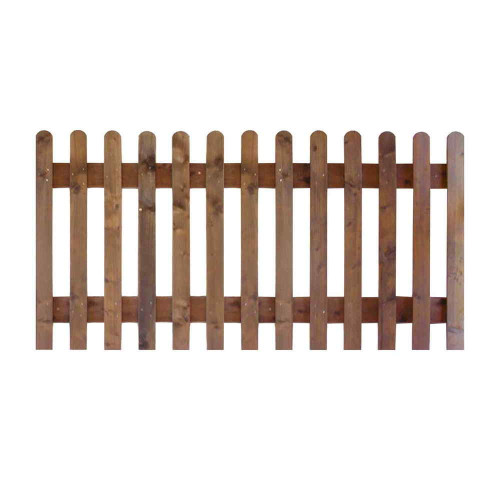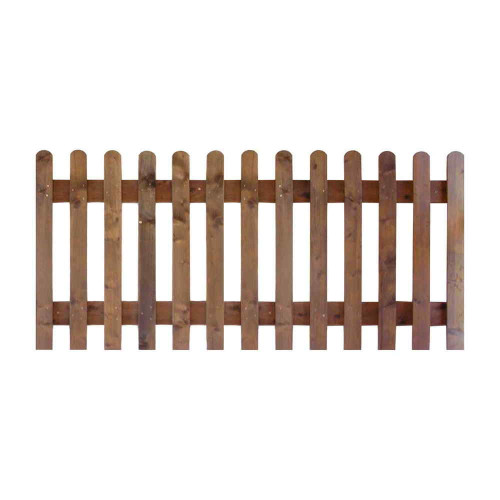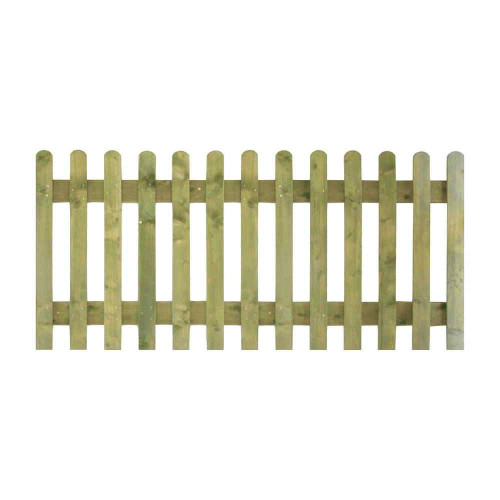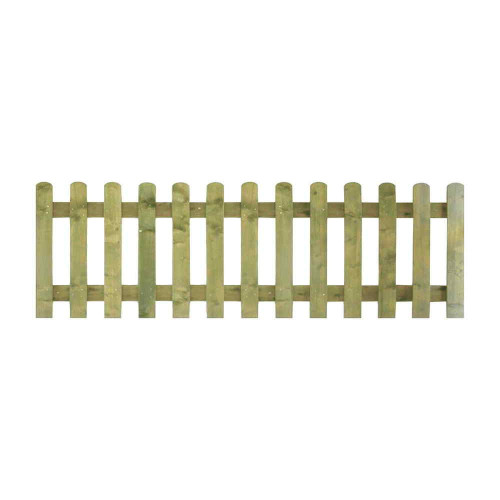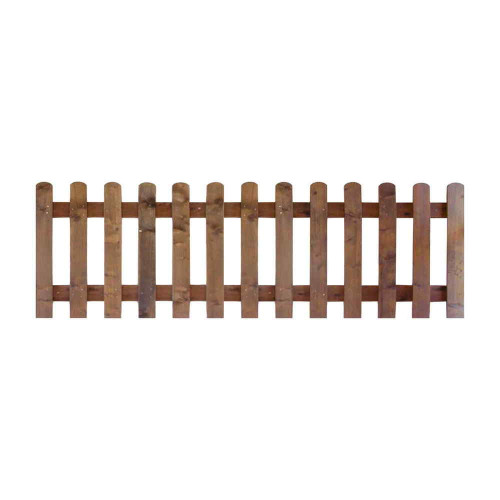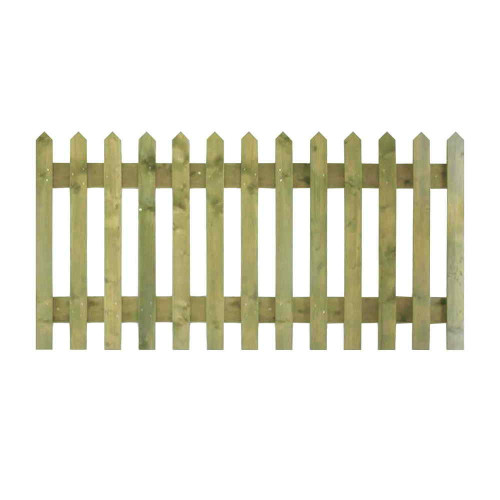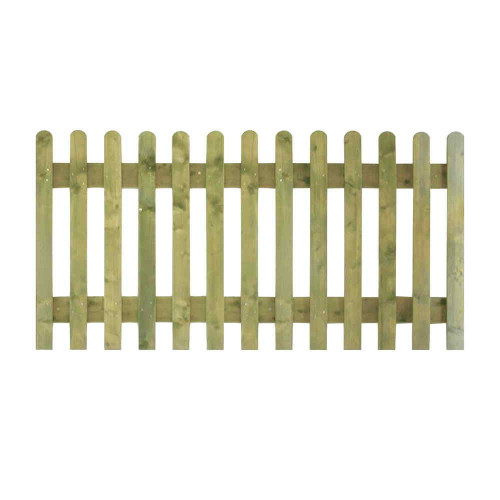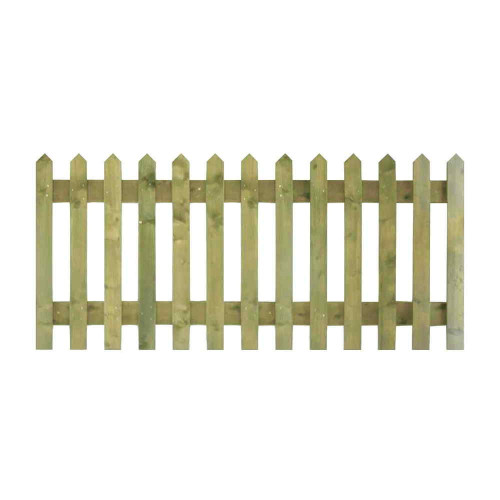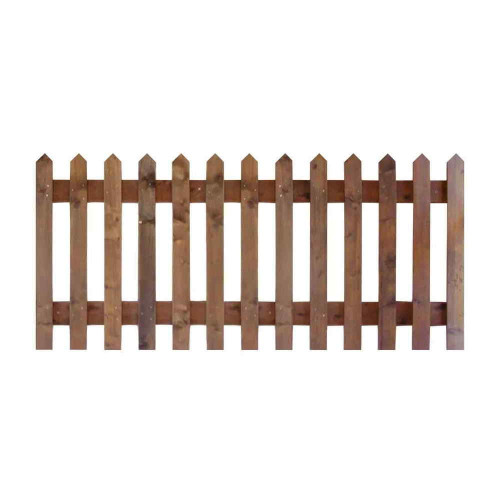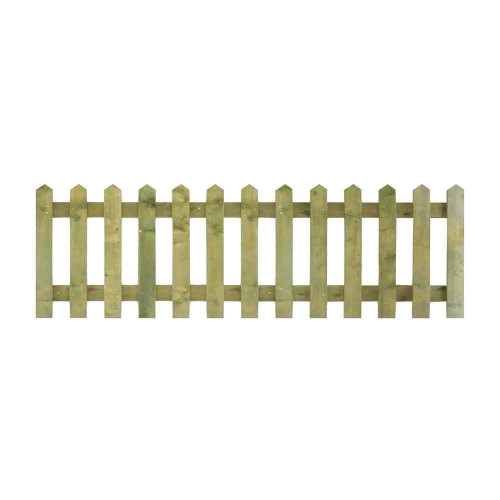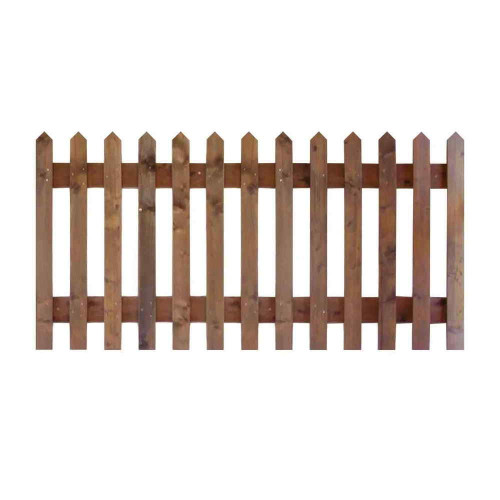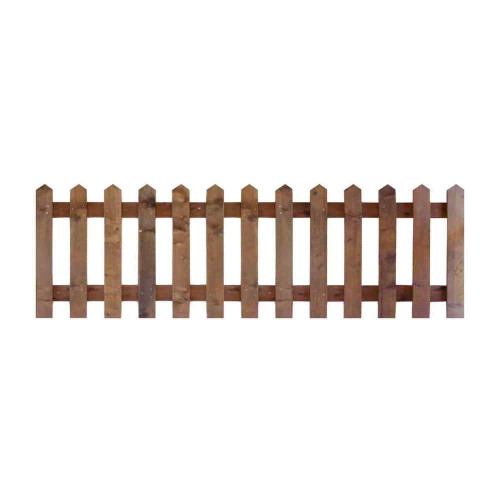




Quick answer: Round Top Picket Fence Panels create a softer, more traditional appearance, while Point Top Picket Fence Panels have a sharper and slightly more formal look. Both are suitable for front gardens, paths, internal garden boundaries and areas where you want to define a space without creating a solid privacy screen. The best choice usually comes down to appearance, fence height, surrounding architecture and whether you need to match an existing fence or gate.
Picket fencing is one of the easiest ways to create a clear garden boundary without making the space feel enclosed.
Unlike solid Closeboard or Waney Lap fencing, Picket Fence Panels deliberately leave spaces between the vertical pales. This allows light and views to pass through while still defining where one part of the garden ends and another begins.
Once you have decided that picket fencing is appropriate, one of the next decisions is whether to choose Round Top or Point Top Picket Fence Panels.
The difference sounds small, but the top profile changes the character of the finished fence. Round Top panels tend to feel softer and more informal. Point Top panels create stronger vertical lines and a slightly sharper traditional appearance.
This guide compares the two styles, explains where each works best and covers height, posts, gates, pressure treatment, installation and the practical details worth considering before ordering.
What Are Picket Fence Panels?
Picket Fence Panels are made using vertical timber pales spaced apart rather than overlapping to form a completely solid screen.
This makes them particularly useful where the objective is boundary definition rather than maximum privacy.
Typical uses include:
- Front gardens
- Garden paths
- Internal garden divisions
- Separating lawns from planted areas
- Creating traditional cottage-style boundaries
- Defining areas around driveways
- Low garden enclosures
East Coast Fencing Picket Fence Panels are nominally 6ft wide and available in 2ft, 3ft and 4ft heights.
Both Round Top and Point Top styles are available pressure treated in brown and green.
What Is The Difference Between Round Top And Point Top Picket Fence Panels?
The main difference is the shape of the top of each vertical pale.
Round Top Picket Fence Panels have a curved top profile.
Point Top Picket Fence Panels finish with a more angular pointed profile.
The underlying purpose of the fencing is similar. Both create an open timber boundary with regularly spaced vertical pales.
The choice is therefore primarily about appearance rather than one style performing a completely different fencing job.
| Feature | Round Top Picket Fence Panels | Point Top Picket Fence Panels |
|---|---|---|
| Top profile | Rounded | Pointed |
| Overall appearance | Soft and traditional | Sharper and more formal |
| Privacy | Low | Low |
| Airflow | High | High |
| Light through boundary | High | High |
| Typical use | Front gardens and informal boundaries | Front gardens and more defined traditional boundaries |
Which Picket Fence Panel Looks More Traditional?
Both Round Top and Point Top Picket Fence Panels are traditional fencing styles.
Round Top tends to create a gentler appearance because the tops of the pales have no sharp visual point.
It can work particularly well with:
- Cottage-style gardens
- Soft planting
- Curved paths
- Informal front gardens
- Traditional timber gates
Point Top fencing is also traditional but creates a stronger repeated pattern along the boundary.
That can make it feel slightly more structured.
Which Picket Fence Panel Looks More Formal?
Point Top Picket Fence Panels generally provide the more formal appearance.
The pointed tops create a clearly defined repeating profile along the fence line.
This can suit:
- Straight front paths
- More symmetrical gardens
- Formal planting layouts
- Traditional properties
- Boundaries where you want the fence itself to be visually noticeable
The difference is still subtle. Both remain open timber fencing rather than highly decorative ornamental barriers.
Which Picket Fence Panels Are Best For Front Gardens?
Both Round Top and Point Top Picket Fence Panels are well suited to front gardens.
Picket fencing is particularly useful at the front of a property because it can define the garden without completely blocking the view between the house and the street.
It can also allow:
- Light into planting
- Views through the boundary
- A less enclosed appearance
- Better visibility around entrances
Choose Round Top where you want a softer appearance.
Choose Point Top where you prefer a sharper traditional profile.
Which Picket Fence Panels Are Best For Cottage Gardens?
Round Top Picket Fence Panels are often the natural starting point for a cottage-style garden.
The curved profile works well with informal planting and gardens where the boundary should feel decorative without dominating the space.
Plants commonly associated with this type of setting can soften the fence further.
Point Top fencing can still work in a cottage garden, particularly if the property or surrounding landscaping has stronger geometric lines.
Which Picket Fence Panels Suit Modern Gardens?
Either can be used in a modern garden, although Picket fencing is inherently a more traditional-looking category than contemporary slatted panels.
Point Top can sometimes feel more structured because of its repeated angular profile.
Round Top can work where the garden combines modern hard landscaping with softer planting.
The treatment colour, posts and gate will also have a significant effect on the finished appearance.
Are Round Top Or Point Top Picket Fence Panels Better For Privacy?
Neither style is designed primarily for privacy.
The gaps between the pales allow views through the boundary.
If maximum screening is required, consider a solid panel style such as:
- Closeboard
- Waney Lap
- Another suitable privacy-focused panel
Picket Fence Panels are better where you want definition without completely closing off the garden.
Are Picket Fence Panels Good For Small Gardens?
Yes.
The open construction can be particularly useful in smaller spaces because it does not create the same visual barrier as a tall solid fence.
Light can pass through the gaps, and the eye can see beyond the immediate boundary.
This can help a compact garden feel less enclosed.
Are Picket Fence Panels Good For Windy Gardens?
Picket fencing allows much more airflow than a solid fence panel.
That can make it worth considering in exposed locations where complete privacy is not required.
Wind passes between the pales instead of acting against one continuous solid surface.
That does not mean the fence can be installed with inadequate posts.
The supporting structure still needs to suit:
- Fence height
- Ground conditions
- Site exposure
- Panel dimensions
Is Round Top Better Than Point Top In Wind?
There is little practical reason to choose one solely because of wind.
The major airflow advantage comes from the open Picket construction itself rather than the small difference in the shape of the top of each pale.
Fence height, post specification and installation matter much more.
Are Point Top Picket Fence Panels More Secure?
Do not treat the pointed profile as a major security feature.
Point Top fencing may look more defensive than Round Top, but ordinary Picket Fence Panels remain relatively low, open garden fencing.
If security is the main objective, consider the complete boundary including:
- Fence height
- Gate construction
- Gate latching
- Post strength
- Other access points
Are Round Top Picket Fence Panels Safer Around Children?
The rounded profile can feel visually softer and may be preferred where sharp-looking points are undesirable.
However, any timber garden fence should still be installed and maintained properly.
Check periodically for:
- Splinters
- Broken boards
- Protruding fixings
- Loose panels
The overall condition of the fence matters more than the decorative profile alone.
Which Picket Fence Panels Are Best Around Pets?
It depends on the animal.
Picket fencing can work well for some dogs, but you need to consider:
- Fence height
- Spacing between pales
- Gaps beneath the panel
- Gate gaps
- Whether the dog jumps
- Whether the dog attempts to squeeze through openings
The Round Top or Point Top profile itself is usually less important than the dimensions of the complete enclosure.
Are Picket Fence Panels Suitable For Keeping Dogs In?
They can be, but do not assume every Picket fence is suitable for every dog.
A small dog may be more affected by spaces between pales.
A large or athletic dog may be more affected by overall fence height.
If containment is critical, assess the actual animal and the complete boundary rather than relying on the panel name.
What Heights Do Picket Fence Panels Come In?
East Coast Fencing Round Top and Point Top Picket Fence Panels are available in nominal heights of:
- 2ft
- 3ft
- 4ft
All are nominally 6ft wide.
The range allows Picket fencing to be used for anything from a low decorative edge to a more substantial open boundary.
Should I Choose 2ft Picket Fence Panels?
Two-foot Picket Fence Panels are suitable where the fence is primarily decorative or intended to mark a low boundary.
Potential uses include:
- Front lawns
- Flower beds
- Garden paths
- Internal garden divisions
They provide very little screening, which is often exactly the point.
Should I Choose 3ft Picket Fence Panels?
Three-foot Picket Fence Panels provide a useful balance between boundary definition and openness.
This height is well suited to many front gardens because the fence is clearly visible without becoming a dominant screen.
It can also suit:
- Paths
- Driveway edges
- Internal garden areas
- Traditional front boundaries
Should I Choose 4ft Picket Fence Panels?
Four-foot Picket Fence Panels create a more substantial open fence.
They may be appropriate where you want greater physical separation without using a solid panel.
Examples can include:
- Larger front gardens
- Side boundaries
- Garden subdivisions
- Some pet enclosures
Always consider the overall finished height and the requirements of the specific location.
Which Picket Fence Panel Height Is Most Versatile?
For general front garden and internal boundary use, 3ft is a useful middle ground.
It provides clearer separation than a 2ft fence without feeling as prominent as a 4ft boundary.
That does not mean it is automatically correct for every garden.
Choose according to:
- What the fence needs to achieve
- Neighbouring boundaries
- Garden scale
- Visibility
- Pets
- Gate requirements
Round Top vs Point Top By Garden Style
| Garden Style | Useful Starting Point |
|---|---|
| Cottage garden | Round Top |
| Informal front garden | Round Top |
| Formal front path | Point Top |
| Traditional symmetrical garden | Point Top |
| Soft planting scheme | Round Top |
| Sharper architectural lines | Point Top |
Should Picket Fence Panels Match The Garden Gate?
Usually, yes.
A consistent top profile between the fence and gate generally produces the cleanest appearance.
If the fence uses Round Top pales, a gate with a compatible rounded appearance can help the entrance feel intentional.
The same principle applies to Point Top fencing.
A deliberately contrasting gate can work, but it should look like a design choice rather than an accidental mismatch.
Should The Gate Be The Same Height As The Picket Fence?
It often looks best when the gate relates closely to the height of the surrounding fence.
However, a gate can sometimes be slightly taller or shaped differently to create a more prominent entrance.
The important practical points are:
- Suitable gate posts
- Correct hinge installation
- Reliable latching
- Adequate clearance
Can Round Top And Point Top Picket Fence Panels Be Mixed?
They can, but using both styles along one uninterrupted fence line can look inconsistent.
Mixing works better where there is a clear visual break such as:
- A gate
- A corner
- A hedge
- A building
- A change in garden level
For most front boundaries, choosing one top profile and using it consistently produces the cleaner result.
Can You Replace Round Top Picket Fence Panels With Point Top?
Potentially, provided the dimensions and existing support system are compatible.
If replacing the whole fence, changing style is straightforward.
If replacing only one panel, the different top profile will be obvious beside the existing sections.
For isolated repairs, matching the surrounding panel usually gives the best appearance.
Can You Replace Point Top Picket Fence Panels With Round Top?
The same principle applies.
Measure the bay carefully and check the existing posts before ordering.
Changing the style is usually more appropriate when replacing a complete run rather than a single damaged panel.
Should You Use Timber Posts With Picket Fence Panels?
Timber posts are a natural choice for Picket fencing because they maintain an all-timber appearance.
East Coast Fencing timber posts are available in common dimensions including:
- 75 x 75mm
- 100 x 100mm
Available lengths include 1.8m, 2.4m and 3.0m.
The appropriate post depends on the fence height and installation.
Low Picket fencing does not generally create the same wind loading as a full-height solid privacy fence, but posts still need to be properly installed.
Can Picket Fence Panels Be Used With Concrete Posts?
This depends on compatibility with the intended concrete post system.
Picket fencing is commonly associated with timber posts because that combination creates a visually consistent traditional fence.
If you intend to use an alternative support system, check the dimensions and fixing method before ordering.
Do Picket Fence Panels Need Gravel Boards?
Not necessarily.
Picket fencing is frequently installed as a timber panel between posts without a prominent gravel board.
However, the lower edge of the timber should still be considered carefully.
Avoid leaving the main panel buried in:
- Soil
- Mulch
- Wet grass
- Accumulated leaves
Keeping exterior timber away from persistent ground-level moisture is beneficial.
Should Picket Fence Panels Touch The Ground?
It is generally preferable not to bury the panel or leave it sitting continuously in wet soil.
A small, consistent clearance can help separate the timber from ground-level moisture.
However, the gap should also suit the purpose of the fence.
If the fence is intended to contain a pet, for example, an excessive opening beneath the panel may create a problem.
How Do You Install Picket Fence Panels On A Slope?
Rigid Picket Fence Panels are commonly stepped as the ground level changes.
Each panel remains approximately level while successive panels move up or down the slope.
For a gentle slope, the steps may be relatively subtle.
For a steep garden, they become more noticeable.
Plan the position of posts carefully before starting installation.
Are Picket Fence Panels Good Around Flower Beds?
Yes.
The open construction allows planting to remain visible rather than hiding it behind a solid barrier.
Low Picket fencing can be useful for:
- Separating lawns from beds
- Defining cottage-style planting
- Protecting delicate areas from foot traffic
- Creating structure around informal planting
Can Plants Grow Through Picket Fence Panels?
Yes, although you should control vigorous plants if they begin placing significant weight on the fence.
Smaller plants can often soften the boundary without creating major structural problems.
Large climbers may be better supported independently.
Are Picket Fence Panels Good Beside A Driveway?
They can be.
One advantage is that the open construction preserves more visibility than a solid fence.
This can be useful near entrances where seeing pedestrians, vehicles or the road matters.
Positioning and height should still be planned carefully for the specific property.
Are Picket Fence Panels Suitable Around A Patio?
Yes, where the aim is to define the patio rather than create full privacy.
Low Picket fencing can visually separate:
- Seating areas
- Lawns
- Planting
- Paths
If privacy around the patio is required, a more solid or taller screening solution may be preferable.
Are Picket Fence Panels Suitable Around Ponds?
A decorative garden fence should not automatically be treated as a safety barrier around water.
If the purpose is specifically to restrict access to a pond, especially where children are concerned, the enclosure needs to be assessed for that safety requirement.
Panel height, gaps, gates and climbability all matter.
Can Picket Fence Panels Be Used Around Vegetable Gardens?
Yes.
They can be used to visually separate growing areas from the rest of the garden.
Depending on the spacing and height, they may also discourage casual access by some animals, although they should not automatically be assumed to form a complete wildlife barrier.
Are Picket Fence Panels Good For Dividing A Garden?
Yes.
This is one of their strongest uses.
A solid panel can make an internal garden division feel severe.
Picket fencing defines the area while allowing:
- Light through
- Views between spaces
- Planting to remain visible
- The garden to feel connected
Round Top Or Point Top For An Internal Garden Boundary?
Round Top is often a good fit where the divider should feel decorative and relaxed.
Point Top works well where you want the division to look more structured.
The decision is primarily visual.
Should You Choose Brown Or Green Picket Fence Panels?
Both Round Top and Point Top Picket Fence Panels are available pressure treated in brown and green.
Choose according to the appearance you prefer.
Brown can work particularly well with:
- Traditional timber features
- Warm-coloured sheds
- Existing brown fencing
Green-treated timber can provide a more natural initial appearance alongside planting.
Both colours will change as the timber weathers.
Does Brown Picket Fencing Last Longer Than Green?
Do not judge durability from colour alone.
Brown and green describe treatment colour and initial appearance rather than providing a durability grade.
The actual performance of exterior timber depends on factors including:
- Treatment specification
- Installation
- Moisture exposure
- Drainage
- Maintenance
Does Green Pressure Treatment Mean Stronger Timber?
No.
Pressure-treatment colour is not a structural grade.
A green panel should not automatically be assumed to be stronger or more heavily treated simply because of its appearance.
Can Picket Fence Panels Be Painted?
Yes.
Pressure-treated Picket Fence Panels can generally be given a suitable exterior decorative finish once the timber is sufficiently dry and correctly prepared.
Follow the coating manufacturer's instructions.
Painting can be particularly effective with Picket fencing because the repeated pales make colour an important visual feature.
What Colours Work Well On Picket Fence Panels?
This is a design choice rather than a technical requirement.
Some homeowners prefer to retain the original pressure-treated appearance.
Others use:
- Natural wood tones
- Traditional opaque garden colours
- Muted neutral shades
Remember that painting a Picket fence involves coating multiple faces and edges around the spaced pales, so preparation can take longer than the apparent surface area suggests.
Are Round Top Picket Fence Panels Easier To Paint?
There is little meaningful difference.
Round Top pales require careful coverage around the curved ends.
Point Top pales require the same attention around the angled top surfaces.
The time involved is more affected by:
- Panel height
- Number of panels
- Existing coating
- Chosen application method
How Do You Maintain Picket Fence Panels?
Routine maintenance is straightforward.
Periodically check for:
- Loose panels
- Moving posts
- Broken pales
- Protruding fixings
- Vegetation trapping moisture
- Wet leaves collecting around the base
- Failed decorative coatings
Address structural issues before focusing on appearance.
How Do You Clean Picket Fence Panels?
Start with gentle cleaning.
- Brush away loose dirt and vegetation.
- Remove leaves from around the base.
- Wash with a suitable mild exterior timber cleaner where required.
- Treat persistent algae with a product suitable for timber if necessary.
- Allow the fence to dry.
Aggressive pressure washing can damage weathered timber fibres, so caution is sensible.
Does Green Algae Mean A Picket Fence Is Rotting?
No.
Algae is usually surface growth associated with damp or shaded conditions.
It does not automatically indicate structural rot.
However, the damp environment producing the algae is worth investigating if the fence remains wet for prolonged periods.
How Long Do Picket Fence Panels Last?
There is no universal lifespan for every Picket fence.
Performance depends on:
- Pressure treatment
- Installation
- Post condition
- Ground clearance
- Drainage
- Exposure
- Maintenance
A well-installed pressure-treated fence in favourable conditions can perform very differently from one left in persistent contact with wet soil.
Which Lasts Longer, Round Top Or Point Top Picket Fencing?
The shape of the pale top should not be treated as the main determinant of service life.
Installation, treatment and exposure are more important.
Choose the profile according to appearance rather than expecting one to have a dramatically longer lifespan.
Can A Broken Picket Be Repaired?
Small local damage may sometimes be repairable if the surrounding panel remains sound.
Inspect:
- The damaged pale
- Rails
- Fixings
- Adjacent timber
If several pales or structural members have failed, replacing the complete panel may be more practical.
Can You Replace Just One Picket Fence Panel?
Yes, where the posts and neighbouring sections remain sound.
Before ordering, measure:
- Clear distance between posts
- Panel height
- Post alignment
- Ground clearance
For the best visual match, replace Round Top with Round Top and Point Top with Point Top where possible.
Why Might A Replacement Picket Panel Not Fit?
Possible causes include:
- Existing posts have moved
- The original panel used different dimensions
- The fence was installed with inconsistent spacing
- A post is leaning
Measure several bays before ordering multiple replacement panels.
Should You Replace Old Posts At The Same Time?
Not automatically.
Retain posts that are sound and suitable.
Replace or repair posts that are:
- Rotten
- Moving
- Badly split
- Leaning significantly
A new panel installed between failing posts will not correct the underlying problem.
Round Top vs Point Top Picket Fence Panels By Use Case
| Situation | Useful Starting Point |
|---|---|
| Cottage-style front garden | Round Top |
| Formal front path | Point Top |
| Low decorative boundary | Either |
| Internal garden divider | Either |
| Soft informal planting | Round Top |
| Sharper traditional appearance | Point Top |
| Matching existing Round Top fence | Round Top |
| Matching existing Point Top fence | Point Top |
Common Mistakes When Choosing Picket Fence Panels
- Choosing Round Top or Point Top without considering the surrounding garden style
- Using Picket fencing where full privacy is actually required
- Choosing a height without considering pets
- Failing to match the gate to the fence
- Replacing one panel with a different top profile
- Allowing the bottom of the panel to remain buried in wet soil
- Assuming treatment colour indicates durability
- Ignoring failing posts when replacing panels
- Ordering nominal panel sizes without measuring existing bays
- Using decorative fencing as a safety barrier without assessing the actual safety requirement
Picket Fence Panels Buying Checklist
- Choose Round Top or Point Top.
- Decide whether you need 2ft, 3ft or 4ft panels.
- Measure the full fence run.
- Measure existing bays if replacing panels.
- Check post condition.
- Choose suitable posts for a new installation.
- Decide between brown and green pressure-treated timber.
- Plan the garden gate.
- Check whether pets need to be contained.
- Consider gaps beneath the fence.
- Plan how panels will step on sloping ground.
- Make sure the style suits the surrounding property and garden.
FAQs
What Is The Difference Between Round Top And Point Top Picket Fence Panels?
Round Top panels have curved pale tops, while Point Top panels have a more angular pointed profile. Their practical purpose is otherwise similar.
Are Round Top Picket Fence Panels Better?
Not universally. They are better if you prefer the softer rounded appearance.
Are Point Top Picket Fence Panels Better?
They are a good choice if you prefer a sharper, more structured traditional look.
Which Picket Fence Panels Are Best For Front Gardens?
Both styles work well. Round Top tends to suit softer informal gardens, while Point Top can suit more formal boundaries.
Which Picket Fence Panels Are Best For Cottage Gardens?
Round Top is often a natural fit because its curved profile complements informal planting.
Which Picket Fence Panels Are Best For A Formal Garden?
Point Top can provide the more structured appearance.
Are Picket Fence Panels Good For Privacy?
No. The spaced pales deliberately allow views and light through the fence.
Are Picket Fence Panels Good In Wind?
They allow considerably more airflow than solid fencing, which can be useful in exposed gardens.
Is Round Top Better In Wind Than Point Top?
There is little practical difference. The open construction of the panel is much more significant than the shape of the pale top.
What Heights Do Picket Fence Panels Come In?
East Coast Fencing Round Top and Point Top Picket Fence Panels are available in nominal 2ft, 3ft and 4ft heights.
How Wide Are Picket Fence Panels?
The panels discussed here are nominally 6ft wide.
Is 3ft Picket Fencing Good For A Front Garden?
It is a useful middle height for many front boundaries because it defines the garden without creating a tall visual barrier.
Is 4ft Picket Fencing Too High?
Not necessarily. It depends on the location and purpose of the fence.
Can Picket Fence Panels Keep Dogs In?
Potentially, but check the fence height, pale spacing and gaps beneath the panel against the size and behaviour of the dog.
Are Point Top Picket Panels More Secure?
The pointed appearance should not be treated as a major security feature. Picket fencing remains relatively open garden fencing.
Are Round Top Picket Fence Panels Better Around Children?
The rounded profile may be visually preferable, but overall fence condition, fixings and maintenance matter more for safety.
Can Picket Fence Panels Be Painted?
Yes, once the pressure-treated timber is sufficiently dry and prepared for a suitable exterior coating.
Do Picket Fence Panels Come In Brown?
Yes. Both Round Top and Point Top styles are available pressure treated in brown.
Do Picket Fence Panels Come In Green?
Yes. Both styles are also available pressure treated in green.
Does Brown Picket Fencing Last Longer Than Green?
Not simply because of colour. Treatment colour is not a durability grade.
Do Picket Fence Panels Need Gravel Boards?
Not necessarily, although the main timber panel should ideally be kept away from persistent soil contact and wet debris.
Can Picket Fence Panels Touch The Ground?
It is generally better to avoid leaving the timber buried in wet soil.
Can I Use Picket Fence Panels On A Slope?
Yes. Rigid panels are commonly stepped as the ground rises or falls.
Can Round Top And Point Top Picket Panels Be Mixed?
They can, but using one profile consistently usually gives a more intentional appearance.
Can I Replace A Round Top Panel With Point Top?
Potentially, if the dimensions are compatible, although it will look different from neighbouring Round Top panels.
Can I Replace Just One Picket Fence Panel?
Yes, provided the surrounding posts remain sound and the replacement fits the existing bay.
Which Picket Fence Panel Style Should Match My Gate?
For the most consistent appearance, match Round Top fencing with a compatible rounded gate style and Point Top fencing with a corresponding pointed profile.
Round Top Or Point Top Picket Fence Panels: The Final Choice
Round Top and Point Top Picket Fence Panels perform very similar practical roles.
Both create an open timber boundary that allows light, air and views through the fence. Both work particularly well in front gardens and for internal garden divisions. Both are available in useful low and medium heights.
The real decision is visual.
Choose Round Top if you want a softer, more informal traditional appearance. It is particularly well suited to cottage-style planting, relaxed front gardens and boundaries where the fence should blend gently into the landscape.
Choose Point Top if you prefer stronger vertical definition and a slightly more formal character. It can work particularly well alongside straight paths, structured planting and traditional properties where the fence itself forms an obvious architectural line.
After choosing the profile, concentrate on the practical details.
Select the height according to what the boundary needs to achieve, measure the fence run carefully, choose suitable posts and plan the gate as part of the same design.
If you are replacing an existing Picket Fence Panel, matching the surrounding top profile will usually give the cleanest result.
Neither Round Top nor Point Top is universally better. The right Picket Fence Panels are the ones that fit the style, dimensions and purpose of the particular garden.