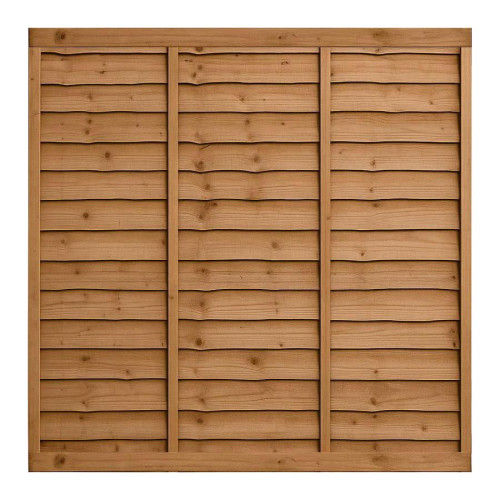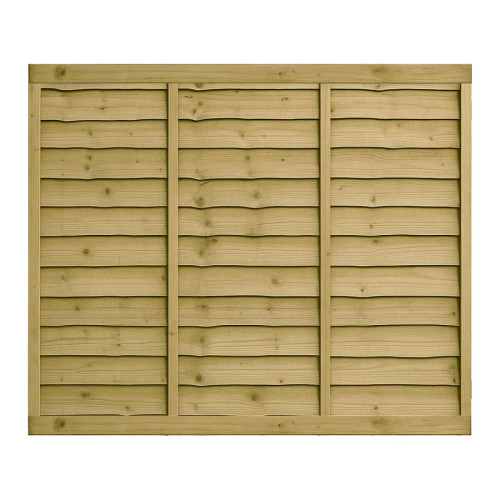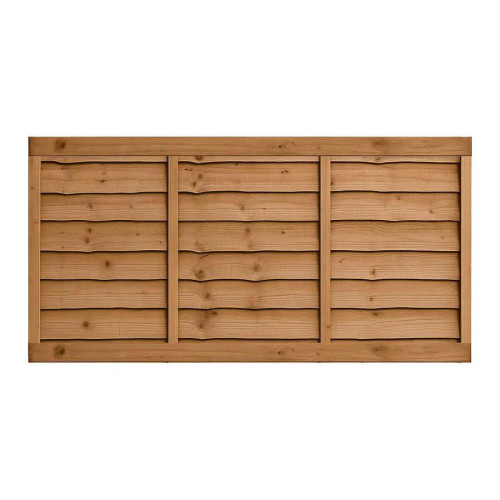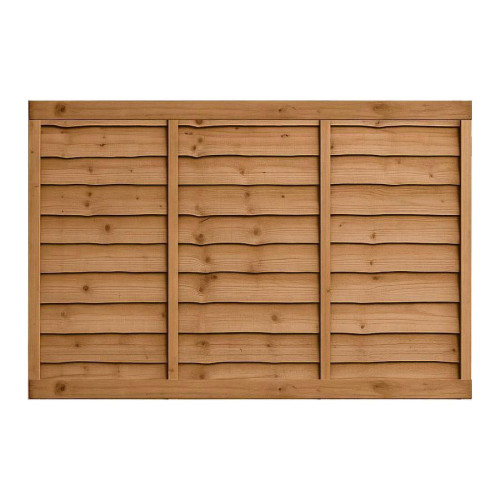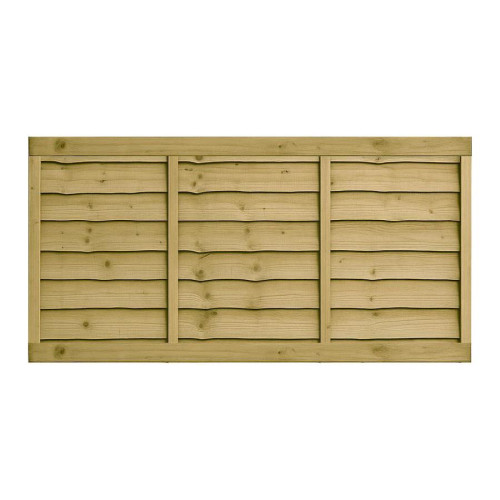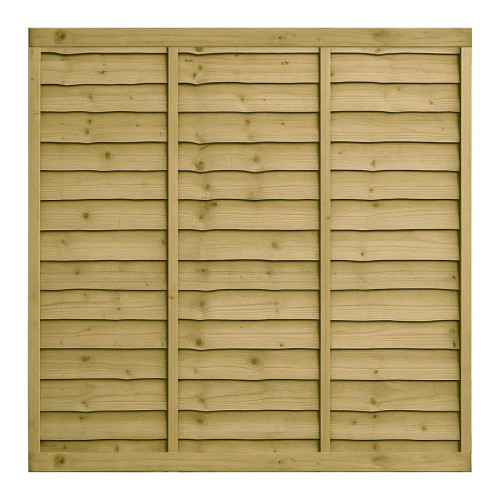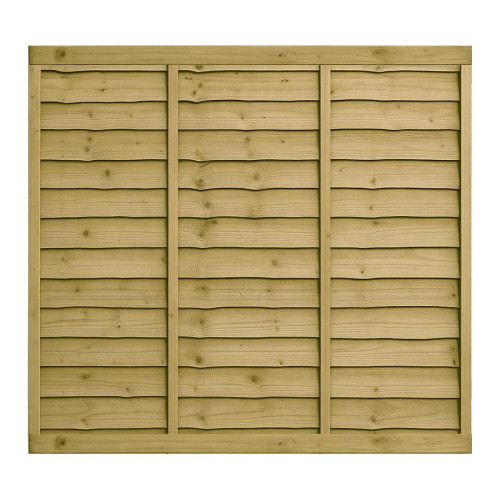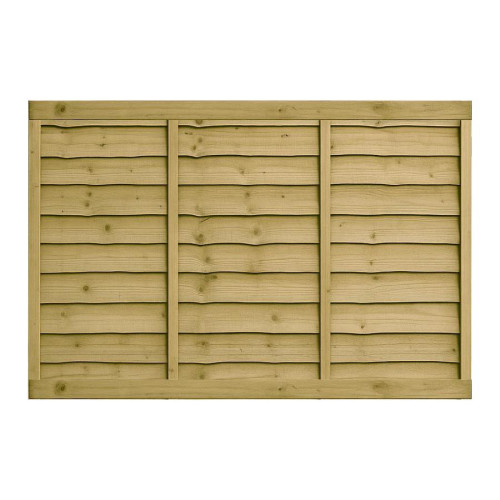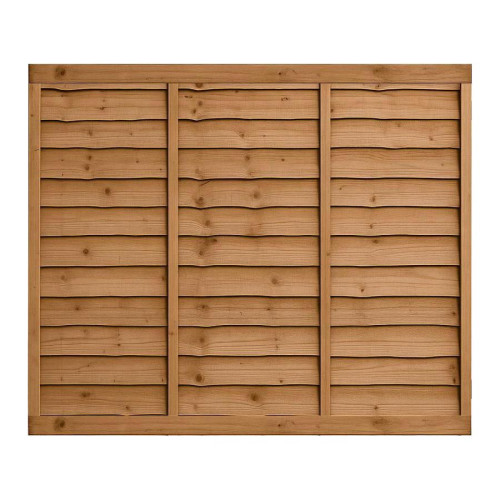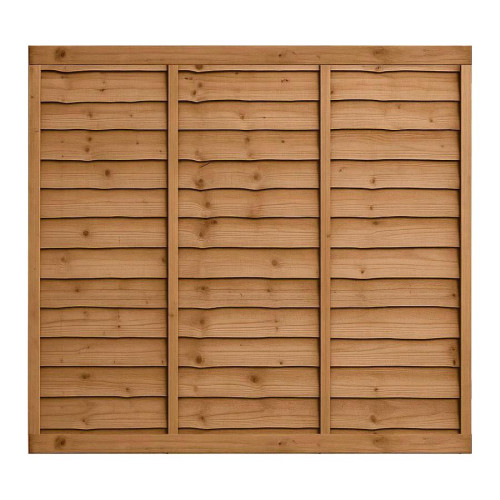



Quick answer: Waney Lap Fence Panels can be used in windy gardens, but they are a relatively solid fencing style and therefore catch more wind than open or partially slatted panels. In exposed locations, the complete fence matters more than the panel alone. Panel height, post size, post condition, foundation depth, ground conditions and installation all affect performance. If a boundary suffers repeated storm damage, replacing panels without addressing weak posts or excessive exposure may not solve the underlying problem.
Waney Lap Fence Panels are one of the most familiar choices for traditional garden boundaries.
They provide good screening, have a recognisable horizontal appearance and are available in several practical heights.
But what if your garden is exposed?
Customers living near open fields, on elevated sites, along the coast or simply in an unusually windy position may reasonably wonder whether Waney Lap is the right panel to use.
The answer is not simply yes or no.
A Waney Lap panel can form part of a strong and reliable fence, but because the design is relatively solid, wind pressure needs to be taken seriously. The supporting posts, foundations and overall fence height become especially important.
This guide explains how Waney Lap Fence Panels behave in windy gardens, what commonly causes fences to fail, how to strengthen the overall installation and when a more open fence design may be worth considering.
Are Waney Lap Fence Panels Good For Windy Gardens?
They can be suitable, provided the fence is correctly specified for the location.
Waney Lap Fence Panels use overlapping horizontal boards, creating a largely solid barrier.
That is useful for privacy, but it also means relatively little wind passes directly through the panel.
Instead, wind pressure is transferred through the panel to:
- The panel frame
- The fixings or post slots
- The fence posts
- The post foundations
- The surrounding ground
For a sheltered suburban garden, this may present little difficulty when the fence is installed properly.
For a very exposed boundary, the same panel can place much greater demands on the supporting structure.
Why Do Solid Fence Panels Catch More Wind?
Wind meeting a solid fence cannot simply pass through it.
Some air moves over and around the enclosure, but pressure is still applied to the panel surface.
The larger the exposed surface, the greater the importance of:
- Strong posts
- Secure foundations
- Correct spacing
- Sound panel construction
This is why a low Picket fence and a tall solid privacy fence behave differently during strong weather.
The issue is not that solid fencing is automatically unsuitable. It simply needs to be supported appropriately.
Does Fence Height Make A Difference In Wind?
Yes.
Height is one of the most important factors to consider with any solid fence.
A 6ft Waney Lap panel presents considerably more surface area to the wind than a 3ft panel of the same width.
A taller fence also creates more leverage on the supporting posts.
This means a high privacy fence generally requires more careful consideration of:
- Post dimensions
- Post length
- Foundation depth
- Ground stability
- Exposure
If a 4ft or 5ft fence provides sufficient privacy, there can be little benefit in automatically choosing the tallest panel available.
What Heights Do Waney Lap Fence Panels Come In?
East Coast Fencing Waney Lap Fence Panels are nominally 6ft wide and available in common heights including:
- 3ft
- 4ft
- 5ft
- 5ft 6in
- 6ft
This gives you flexibility when balancing privacy against exposure.
A garden may not need the same panel height around every boundary.
Should You Use A Lower Waney Lap Fence In An Exposed Garden?
Potentially.
Reducing fence height reduces the area exposed to the wind.
If a 5ft panel provides the privacy you need, choosing 6ft simply because it is the tallest available option can add unnecessary wind loading.
Consider:
- Where people sit in the garden
- Neighbouring ground levels
- Windows and sightlines
- Whether a gravel board adds to the finished height
The objective should be sufficient screening rather than maximum height by default.
Is A 6ft Waney Lap Fence Too Tall For A Windy Garden?
Not automatically.
Six-foot Waney Lap Fence Panels can be used where the complete fencing system is suitable for the location.
The concern is greater where a tall fence is combined with:
- Small or deteriorated posts
- Shallow foundations
- Loose ground
- A very exposed boundary
- Existing structural movement
If several of those factors are present, simply replacing old 6ft panels with new 6ft panels may not solve the problem.
What Usually Fails First In A Wind-Damaged Fence?
The panel is not always the first component to fail.
Common weak points include:
- Fence posts moving in the ground
- Timber posts deteriorating near ground level
- Old fixings pulling out
- Panel frames weakening
- Poorly formed foundations
Sometimes the panel survives while the whole fence leans because the posts have moved.
In other cases, the posts remain upright while an old panel frame breaks.
The failure point depends on the weakest part of the fencing system.
Why Are Fence Posts So Important In Windy Gardens?
Fence posts transfer the load from the panels into the ground.
If the posts are inadequate, it does not matter how strong the panels themselves are.
A tall solid fence acts like a series of large surfaces joined to those posts.
When strong wind pushes against the panels, the posts must resist:
- Sideways pressure
- Bending
- Repeated movement
- Leverage created by fence height
This is why post choice should form part of the original fence design rather than being treated as an accessory.
What Size Timber Posts Can Be Used With Waney Lap Fence Panels?
East Coast Fencing timber fence posts are available in common sections including:
- 75 x 75mm
- 100 x 100mm
Available lengths include 1.8m, 2.4m and 3.0m.
The appropriate post depends on the fence height, exposure, ground conditions and installation.
A taller or more exposed fence may justify a more substantial support system than a low fence in a sheltered position.
Are 100 x 100mm Posts Better For Windy Gardens?
A larger post section can provide a more substantial support than a smaller section, but size alone does not guarantee a strong fence.
You must also consider:
- How much of the post is below ground
- The foundation around it
- Ground conditions
- Fence height
- Spacing
- Condition of the timber
A substantial post installed badly can still move.
Should Waney Lap Fence Posts Be Set Deeper In Windy Areas?
Post depth should be appropriate to the overall fence and site.
There is no single depth that is automatically correct for every garden.
Taller fences and more exposed locations generally place greater demands on their foundations.
Soil conditions matter too.
Ground that is firm and stable behaves differently from:
- Loose made-up ground
- Very wet soil
- Soft ground
- Areas disturbed by previous landscaping
If there is doubt about the suitability of the foundations for a particularly exposed boundary, professional assessment may be appropriate.
Are Concrete Posts Better For Windy Gardens?
Concrete posts are a popular option for substantial panel fencing because they provide a rigid non-timber support.
They can work well with Waney Lap Fence Panels where the panel dimensions are compatible with the slotted post system.
Benefits include:
- No timber rot in the post itself
- A substantial support structure
- Individual panels can often be replaced
- Compatibility with concrete gravel boards
However, concrete posts still rely on correctly formed foundations.
A strong concrete post installed inadequately can still move in the ground.
Are Timber Posts Suitable For Windy Gardens?
Yes, provided they are correctly specified and installed.
Timber posts should not automatically be dismissed simply because a garden is windy.
They are widely used for fencing and can create an attractive all-timber boundary.
The important points are:
- Choose an appropriate post section
- Use sufficient post length
- Create suitable foundations
- Inspect posts periodically
Do Gravel Boards Make Waney Lap Fencing Stronger In Wind?
Gravel boards are primarily used to form the lower section of a fence and help separate timber panels from direct ground contact.
They should not be thought of as a substitute for adequate posts or foundations.
However, they are still an important component of a well-planned panel fence.
They can help:
- Keep the main panel away from soil
- Create a consistent lower edge
- Protect the panel from rain splash and wet grass
- Form part of a compatible post-and-panel system
Should You Use Concrete Gravel Boards In A Windy Garden?
Concrete gravel boards are commonly paired with concrete posts.
They create a non-timber lower section beneath the Waney Lap panel.
This can be useful where a substantial, low-maintenance supporting system is wanted.
Concrete components are heavy, so handling and installation need to be planned properly.
Can Wooden Gravel Boards Be Used With Waney Lap Fence Panels?
Yes.
Pressure-treated wooden gravel boards can provide an all-timber appearance.
East Coast Fencing wooden gravel boards are available in lengths including:
- 1.83m
- 2.4m
- 3.0m
A common depth is 150mm.
Choose the gravel board according to the post system and panel arrangement.
Does A Gravel Board Increase Wind Exposure?
It can increase the total visible height of the enclosure if the panel is mounted above it.
For example, a nominal 6ft panel installed above a visible 150mm gravel board creates a taller completed fence than the panel alone.
That additional height should be considered when planning:
- Posts
- Foundations
- Overall exposure
Do not plan the structural system around the panel height while ignoring everything beneath it.
Does A Waney Lap Fence Let Any Wind Through?
Waney Lap is not completely airtight.
Small gaps and natural movement between timber boards may allow limited airflow.
However, it should still be regarded as a relatively solid fencing style.
It does not provide the same degree of airflow as deliberately open fencing such as:
- Picket fencing
- Hit & Miss panels
- Some slatted fence designs
- Trellis
Would Hit & Miss Be Better Than Waney Lap In A Windy Garden?
Horizontal Hit & Miss fencing is worth considering where airflow is a major concern.
Its construction allows more air movement through the panel than a predominantly solid Waney Lap design.
This can reduce the barrier effect created by a solid panel.
The trade-off is that the appearance and level of screening differ.
If maximum privacy is important, Waney Lap may still be preferred.
Would Picket Fencing Be Better In A Very Exposed Garden?
Picket fencing allows substantially more airflow than a solid Waney Lap panel.
It is therefore worth considering for:
- Front gardens
- Lower boundaries
- Internal garden divisions
- Locations where complete privacy is unnecessary
It is not a direct replacement for Waney Lap where full privacy is the main objective.
Can Trellis Help In A Windy Garden?
Trellis can be useful where some height and boundary definition are wanted without creating another fully solid section.
For example, a lower solid panel with trellis above may feel more open than a taller solid panel.
However, the entire structure still needs to be securely supported.
Climbing plants growing through trellis can also increase wind loading once they become dense.
Which Fence Panel Is Best For Maximum Privacy In Wind?
There is a trade-off.
Solid panels offer greater privacy but also catch more wind.
More open fencing allows greater airflow but provides less complete screening.
If maximum privacy is essential, a solid panel such as Waney Lap or Closeboard can still be appropriate, but greater attention should be given to:
- Post specification
- Foundation quality
- Fence height
- Site exposure
Is Closeboard Better Than Waney Lap In A Windy Garden?
Closeboard is generally a more substantial panel construction, particularly in Ultra Heavy Duty form.
That can make it attractive to customers looking for a more robust traditional fence.
However, Closeboard is also a solid panel.
It still catches wind.
Changing from Waney Lap to Closeboard does not eliminate the need for suitable posts and foundations.
If an existing Waney Lap fence repeatedly fails because the posts move in the ground, fitting heavier panels onto the same inadequate support is unlikely to address the cause.
Why Does My Waney Lap Fence Keep Blowing Down?
Repeated failure usually deserves investigation rather than another like-for-like repair.
Possible causes include:
- Weak or undersized posts
- Rotten timber posts
- Posts set too shallowly for the application
- Weak foundations
- Loose ground
- Very high exposure
- Panels that are too tall for the existing support
- Damaged panel frames
If the same bay fails after several storms, there is probably a recurring cause.
Why Does The Fence Lean After Strong Wind?
A leaning fence often indicates movement in the supporting posts or foundations.
Check whether:
- The post itself is leaning
- The post moves when pushed gently
- The panel is loose while the posts remain upright
- The ground around the post has disturbed
This helps identify whether the problem is the panel, post or foundation.
Can A Loose Waney Lap Panel Be Fixed?
Often, yes.
If the panel remains structurally sound, the solution may involve correcting its fixing or position.
But first determine why it became loose.
If the post is moving, simply adding more fixings to the panel is unlikely to provide a lasting repair.
Can A Wind-Damaged Waney Lap Panel Be Repaired?
Minor local damage may be repairable.
Check:
- The panel frame
- Horizontal boards
- Fixings
- Post condition
If several structural parts of the panel have broken or the frame no longer holds together securely, replacing the panel may be more practical.
Can You Replace Just One Storm-Damaged Waney Lap Panel?
Yes, where the surrounding fencing remains serviceable.
Before ordering a replacement, measure:
- The actual gap between posts
- The panel height
- The gravel board
- Post alignment
Strong winds can move posts, so do not assume a replacement panel will fit simply because the damaged one was nominally 6ft wide.
Should You Replace Posts After Storm Damage?
Only where the posts are damaged, loose or unsuitable.
A storm can sometimes destroy a weak old panel while leaving the posts perfectly serviceable.
In other cases, the panel may survive while the post moves.
Inspect each component individually.
Can Concrete Repair Spurs Help A Wind-Damaged Fence?
Concrete repair spurs can be useful where an existing timber post has failed around ground level but much of the fence remains worth retaining.
Whether repair is sensible depends on the overall condition of the boundary.
If multiple posts and panels are failing, repairing each post individually may be less attractive than planning a more complete replacement.
How Can You Tell Whether A Timber Post Is Rotten?
Pay particular attention to the area around ground level.
Signs include:
- Soft timber
- Crumbly material
- Movement at the base
- Splitting
- A post leaning despite an apparently sound panel
Do not rely on the appearance of the upper section alone.
Does Wet Ground Make Wind Damage More Likely?
Potentially.
Very wet or unstable ground can affect how well the post foundation remains supported.
Water can also contribute to deterioration around timber posts over time.
Pay attention to:
- Standing water
- Persistently saturated soil
- Poor drainage
- Water running towards the boundary
Drainage problems should be addressed where possible rather than treating each fence failure as an isolated event.
Does Clay Soil Affect Fence Stability?
Different soils behave differently as moisture levels change.
The important point is that post foundations should suit the actual ground conditions rather than relying on one universal installation approach.
If a site has unusual, disturbed or particularly difficult ground, greater care may be required when installing a tall solid fence.
Can Trees Make A Garden More Or Less Windy?
Yes.
Trees, buildings, hedges and other structures can alter airflow around a garden.
Some boundaries may be sheltered.
Others can experience turbulent gusts where air is redirected around:
- Buildings
- Walls
- Large sheds
- Dense hedges
This means two fences on the same property can experience very different conditions.
Why Is The Side Passage Sometimes The Windiest Part Of The Garden?
Buildings can channel moving air through narrow gaps.
A passage between a house and neighbouring structure may therefore experience concentrated gusts even when the rear garden appears reasonably sheltered.
If fencing repeatedly fails in one small section, local airflow may be contributing.
Can Hedges Protect Waney Lap Fence Panels From Wind?
Established planting can sometimes provide shelter, but it should not be relied upon as structural protection.
Dense hedges also create other considerations.
They can:
- Trap moisture
- Reduce access for maintenance
- Press against panels
- Deposit wet leaves around the base
Allow reasonable clearance between heavy vegetation and timber fencing.
Can Climbing Plants Make Wind Damage Worse?
Yes.
A mature climber can add substantial weight and increase the effective surface presented to the wind.
Heavy vegetation can also pull on:
- Panel boards
- Frames
- Fixings
Where substantial climbers are planned, independent support can help keep unnecessary loads off the fence.
Should You Remove Ivy From Waney Lap Fence Panels?
If ivy or another climber has become extremely heavy, inspect the fence carefully.
Do not simply pull a large established plant away if it has become intertwined with a fragile old panel, as this can damage already weakened timber.
Where possible, control growth before it becomes excessively heavy.
Does Fence Age Affect Wind Resistance?
Yes.
A new and properly supported panel is generally in a different structural condition from one that has spent many years exposed to:
- Rain
- Sunlight
- Repeated wetting and drying
- Wind
- Plant growth
Older fencing should be inspected before the storm season, particularly if it already moves or has broken boards.
Does Painting Make Waney Lap Fence Panels More Wind Resistant?
No.
Painting does not strengthen inadequate posts, foundations or a broken panel frame.
A suitable coating may help with appearance and surface protection, but it is not a structural repair.
If the fence moves in the wind, investigate the underlying cause.
Does Pressure Treatment Make Waney Lap Fence Panels Stronger?
Pressure treatment is primarily concerned with timber preservation rather than turning the timber into a higher structural grade.
Do not confuse treatment with structural strength.
Pressure-treated timber can still break if subjected to excessive loads or if the fencing system is poorly designed.
Are Brown Waney Lap Fence Panels Better In Wind Than Green?
No.
Brown and green describe the treatment colour and appearance.
Colour should not be interpreted as a strength rating.
Choose between them according to appearance rather than expecting one colour to perform better structurally.
Can You Strengthen An Existing Waney Lap Fence?
Sometimes.
The correct approach depends on what is weak.
Possible improvements may involve:
- Repairing failed posts
- Replacing rotten posts
- Replacing broken panels
- Correcting loose fixings
- Improving damaged sections of the supporting system
Adding random battens or fixings without diagnosing the problem can simply move stress to another component.
Would Adding More Posts Make A Waney Lap Fence Stronger?
Fence design should be based on compatible panel widths and a properly planned support system.
Adding posts arbitrarily to an existing panel fence is not necessarily a practical or appropriate solution.
If the current fence repeatedly fails, it is better to identify whether:
- The posts are inadequate
- The foundations are inadequate
- The panel height is inappropriate
- The location is exceptionally exposed
Should You Leave Gaps Between Waney Lap Fence Panels?
No deliberate gaps should normally be introduced between panels and posts simply as an attempt to reduce wind loading.
The fencing system should be installed as intended.
If greater airflow is required, choose a panel style designed to provide it.
Could Drilling Holes In A Solid Fence Reduce Wind Pressure?
This is not a sensible method of modifying Waney Lap Fence Panels.
Drilling numerous holes can damage the panel, expose untreated internal timber and compromise its appearance and structure.
If airflow is important, select a more open fencing design rather than altering a solid panel.
Are Waney Lap Fence Panels Better Than Decorative Slatted Panels In Wind?
It depends on the actual panel design.
The important factor is not whether a fence is described as decorative, contemporary or traditional.
What matters is how much of the panel is solid and how easily air can pass through it.
A genuinely open slatted panel may behave differently from a tightly spaced privacy panel.
Can You Use Different Fence Panels On The Most Exposed Boundary?
Yes.
There is no requirement for every side of a garden to use exactly the same panel style.
You might use:
- Solid Waney Lap where privacy is essential
- A more open panel on a highly exposed boundary
- Picket fencing around lower internal areas
A change in fencing style can work particularly well where there is a natural break such as a corner, gate or building.
Which Waney Lap Panel Height Is Best For Windy Gardens?
There is no universal best height.
The sensible approach is to choose the lowest panel that still achieves the purpose of the fence.
| Panel Height | Typical Consideration | Wind Exposure |
|---|---|---|
| 3ft | Lower boundary and screening | Less exposed surface than taller panels |
| 4ft | Moderate screening | Lower wind loading than full-height panels |
| 5ft | Strong garden screening | Support system becomes increasingly important |
| 5ft 6in | Intermediate privacy option | Treat as a substantial solid fence |
| 6ft | High privacy | Requires careful support in exposed locations |
How Can You Tell If Your Garden Is Particularly Exposed?
Look at what already happens on the site.
Warning signs include:
- Existing fences regularly moving in ordinary windy weather
- Repeated storm damage
- Open fields beyond the boundary
- An elevated position
- Few surrounding buildings or trees
- Strong gusts channelled between buildings
Local observation can be more useful than simply describing the whole area as windy.
Should You Replace Waney Lap With Something Else After Storm Damage?
Not automatically.
If the panel failed because it was old or already damaged, replacing it with another Waney Lap panel may be perfectly reasonable.
If the same boundary repeatedly fails, investigate whether a different approach is needed.
This may involve:
- Improved posts
- Improved foundations
- A lower fence
- A more open panel design
Is It Better To Replace The Whole Fence After A Storm?
Only if widespread deterioration makes individual repairs uneconomical or impractical.
A complete replacement may make sense where:
- Several posts are failing
- Multiple panels are rotten
- The fence is significantly leaning
- The installation was poorly designed from the beginning
If only one panel is damaged and everything else remains sound, replacing the whole fence may be unnecessary.
Can Old Waney Lap Fence Panels Be Reused?
If a panel is removed intact and remains structurally sound, reuse may sometimes be possible.
Inspect:
- The frame
- Horizontal boards
- Fixing points
- Lower edges
Do not reuse a heavily deteriorated panel simply because it survived removal.
What Should You Check Before A Forecast Storm?
A brief inspection can identify obvious weaknesses.
- Check whether any posts are already moving.
- Look for loose panels.
- Remove fallen branches leaning against the fence.
- Check gates close securely.
- Inspect heavily overgrown climbers.
Do not attempt unsafe temporary repairs in severe weather.
Should A Garden Gate Be Considered Separately?
Yes.
Gates create different loads from ordinary fence panels because they move and place force on hinges and gate posts.
A solid gate in an exposed location needs:
- Suitable gate posts
- Appropriate hinges
- Secure latching
- Correct installation
A gate repeatedly slamming in the wind can damage both its hardware and supporting posts.
Should You Keep A Gate Open During Strong Winds?
A garden gate should normally be kept securely latched rather than allowed to swing uncontrolled.
A loose gate can behave unpredictably in gusts and place severe loads on its hinges and posts.
Do not rely on an unsecured open or partially open gate as a way of managing wind.
Does A Waney Lap Fence Need More Maintenance In A Windy Area?
Not necessarily more decorative maintenance, but more frequent structural inspection can be sensible.
Check after significant storms for:
- Post movement
- Loose panels
- Broken boards
- Failed fixings
- Branches or vegetation pressing against the fence
Addressing small movement early can prevent additional damage.
Does Painting A Fence Protect It From Storm Damage?
No.
Paint and stain are surface finishes.
They do not replace:
- Strong posts
- Suitable foundations
- Sound panel construction
- Correct installation
A freshly painted fence can still blow over if the posts are failing.
Does Pressure-Treated Timber Need Regular Preservative?
Pressure treatment provides preservative protection within the timber according to its treatment specification.
A decorative surface finish may be used later if desired, but maintenance should also focus on the physical condition of the fence.
Keep the panel clear of excessive soil, wet vegetation and debris.
Can Wind Cause Timber To Crack?
Timber naturally changes as moisture levels rise and fall, so not every crack should be blamed on wind.
However, repeated structural movement can worsen existing weaknesses.
Distinguish between:
- Minor surface checking
- Normal timber movement
- Structural splitting
- Broken panel framing
When Is A Wind-Damaged Panel Beyond Repair?
Replacement is usually more sensible when:
- The main frame has broken
- Several horizontal boards have failed
- The panel no longer remains securely positioned
- Extensive timber deterioration is present
- Previous repairs continue failing
Cosmetic marks alone do not require replacement.
Waney Lap Fence Panels Vs Other Styles For Windy Gardens
| Panel Style | Privacy | Airflow | Wind Consideration |
|---|---|---|---|
| Waney Lap | High | Low | Needs suitable support |
| Closeboard | High | Low | Substantial but still solid |
| Horizontal Hit & Miss | Moderate to high | Greater | Useful where airflow matters |
| Picket | Low | High | Suitable where full screening is not required |
How Do You Make Waney Lap Fence Panels More Suitable For A Windy Garden?
Focus on the complete installation.
- Use only as much fence height as you genuinely need.
- Choose posts appropriate to the height and exposure.
- Use sufficient post length for the installation.
- Create suitable foundations for the ground conditions.
- Keep posts correctly spaced.
- Use compatible gravel boards.
- Keep the panel clear of soil and excessive vegetation.
- Inspect the fence after significant storms.
- Repair loose posts before they damage panels.
- Consider a more open panel where exposure is extreme and privacy requirements allow it.
What Should You Measure Before Replacing A Wind-Damaged Fence?
Measure:
- Total boundary length
- Clear distance between existing posts
- Panel height
- Gravel board height
- Post dimensions
- Gate openings
- Changes in ground level
Also inspect how much the existing posts have moved.
If the bays are no longer consistent, replacing panels alone may be difficult.
Waney Lap Fence Panels Windy Garden Checklist
- Is the garden genuinely exposed or only occasionally windy?
- Is full privacy necessary?
- Could a lower panel provide enough screening?
- Are existing posts sound?
- Are the posts large enough for the application?
- Are the foundations stable?
- Is the ground unusually soft or wet?
- Does the fence repeatedly fail in the same location?
- Are heavy plants loading the panels?
- Are gravel boards included in the finished height?
- Would an open panel design be acceptable?
- Are gates separately and securely supported?
Common Mistakes When Installing Waney Lap Fence Panels In Windy Gardens
- Using the tallest panel automatically
- Focusing on panel strength while ignoring the posts
- Retaining rotten posts when replacing panels
- Using shallow or inadequate foundations
- Assuming concrete posts cannot move
- Ignoring the extra height created by gravel boards
- Attaching heavy climbing plants directly to the fence
- Replacing storm-damaged panels without investigating repeated failures
- Trying to solve structural problems with paint
- Modifying solid panels with holes to create airflow
FAQs
Are Waney Lap Fence Panels Suitable For Windy Gardens?
Yes, where the complete fencing system is appropriate for the exposure. Their relatively solid construction means posts and foundations require careful consideration.
Do Waney Lap Fence Panels Catch A Lot Of Wind?
They catch more wind than deliberately open fencing because the overlapping boards form a predominantly solid screen.
Are 6ft Waney Lap Fence Panels Good In Wind?
They can be, but full-height solid fencing places greater demands on posts and foundations than lower panels.
Would 5ft Waney Lap Be Better In Wind?
A 5ft panel presents less surface area than a 6ft equivalent. If it provides enough privacy, the lower height may be worth considering.
Are Concrete Posts Best For Waney Lap Fence Panels?
Concrete posts are a substantial and popular option, particularly with concrete gravel boards. Timber posts can also be appropriate when correctly specified and installed.
Can Waney Lap Fence Panels Be Used With Wooden Posts?
Yes. Choose the post dimensions and length according to the fence height, exposure and ground conditions.
Will Bigger Posts Stop A Fence Blowing Down?
More substantial posts can form part of a stronger system, but foundations, ground conditions and installation are equally important.
Do Fence Posts Need To Be Deeper In Windy Gardens?
The required foundation should reflect the height, exposure and ground conditions. There is no single depth appropriate to every fence.
Does A Gravel Board Strengthen A Waney Lap Fence?
Its main role is to form the lower section and help separate the timber panel from ground-level moisture. It does not replace adequate posts or foundations.
Can I Use Concrete Gravel Boards With Waney Lap Fence Panels?
Yes, where the components are compatible. They are commonly paired with slotted concrete posts.
Can I Use Wooden Gravel Boards?
Yes. Pressure-treated wooden gravel boards provide an all-timber appearance.
Is Closeboard Better Than Waney Lap In Strong Winds?
Closeboard can be a more substantial panel construction, but it is still solid and catches wind. The supporting structure remains critical.
Is Hit & Miss Better For Wind?
Hit & Miss fencing permits more airflow than solid Waney Lap, making it worth considering where wind exposure is a major concern.
Is Picket Fencing Better In Wind?
Picket fencing allows substantial airflow but provides much less privacy, so it serves a different purpose.
Why Does My Waney Lap Fence Keep Blowing Over?
Check the posts, foundations, ground conditions, fence height and exposure. Repeated failure often indicates a recurring structural issue rather than a problem with one individual panel.
Can I Replace One Wind-Damaged Waney Lap Panel?
Yes, provided the posts and neighbouring components remain sound. Measure the bay before ordering.
Should I Replace The Posts At The Same Time?
Only if they are damaged, deteriorated, moving or unsuitable for the new installation.
Can A Concrete Repair Spur Save A Wind-Damaged Fence?
It can be useful for suitable failed timber posts where the rest of the fence remains worth retaining.
Will Painting A Fence Make It Stronger?
No. Paint and stain do not strengthen posts, foundations or panel frames.
Does Pressure Treatment Make A Fence Stronger In Wind?
Pressure treatment is primarily a timber preservation process rather than a structural strength grade.
Are Brown Waney Lap Fence Panels Stronger Than Green?
No. Treatment colour should not be interpreted as a structural rating.
Can Ivy Make A Fence Blow Down?
Heavy climbing growth can add weight and increase the effective surface presented to the wind, potentially increasing loads on the fence.
Should Waney Lap Fence Panels Touch The Ground?
The main timber panels are better kept away from direct soil contact where practical. A compatible gravel board can help create separation.
Should I Use A Lower Fence On An Exposed Boundary?
If a lower fence provides sufficient privacy and boundary definition, reducing height can reduce the surface exposed to wind.
Can Different Boundaries Use Different Fence Panel Styles?
Yes. A more open design can be used on an exposed side while Waney Lap is retained where greater privacy is required.
Waney Lap Fence Panels Can Work In Windy Gardens, But The Whole Fence Must Be Right
Waney Lap Fence Panels should not automatically be ruled out because a garden is windy.
They provide useful privacy, a traditional appearance and a practical range of heights.
But they are predominantly solid panels, so strong winds create meaningful pressure against them.
That makes the supporting structure particularly important.
If you want Waney Lap fencing in an exposed garden, start by choosing only as much height as you need. Then consider the posts, foundations, ground conditions and gravel-board arrangement as one complete system.
If an existing fence has repeatedly blown down, do not simply replace the damaged panel and assume the problem is solved. Check whether the posts move, whether foundations remain sound and whether the chosen height makes sense for the location.
For highly exposed boundaries where full privacy is less important, an open fencing design such as Picket or Hit & Miss may be worth considering because greater airflow can reduce the barrier effect of a solid fence.
Where privacy remains essential, Waney Lap can still be an appropriate choice.
The important point is that no fence panel works independently. A suitable panel supported by appropriate posts, stable foundations and careful installation will always make more sense than choosing a product solely because it is described as stronger or more durable.