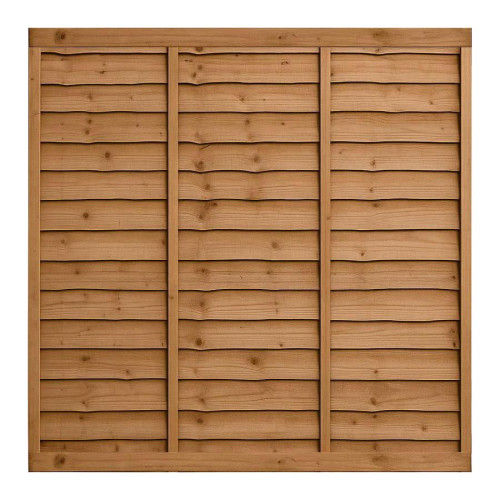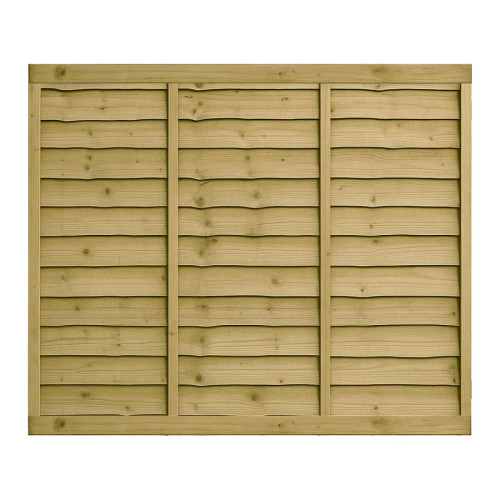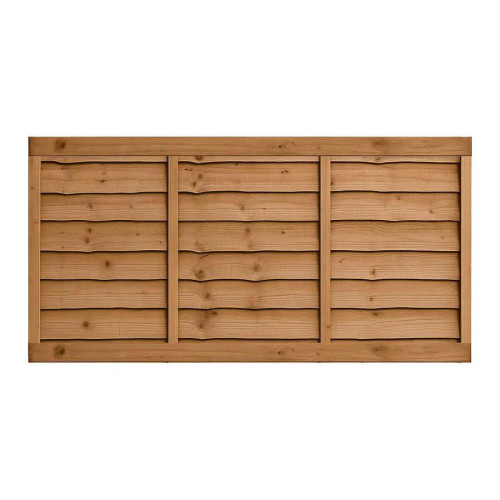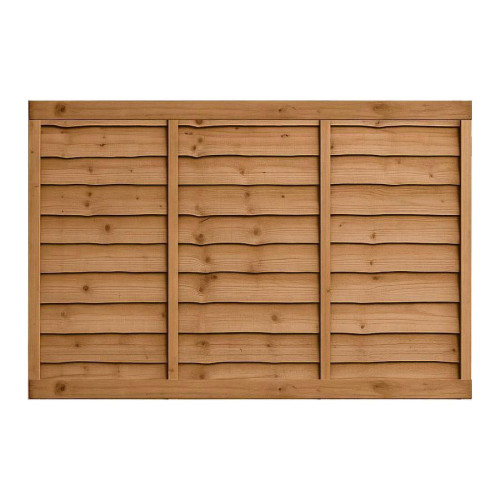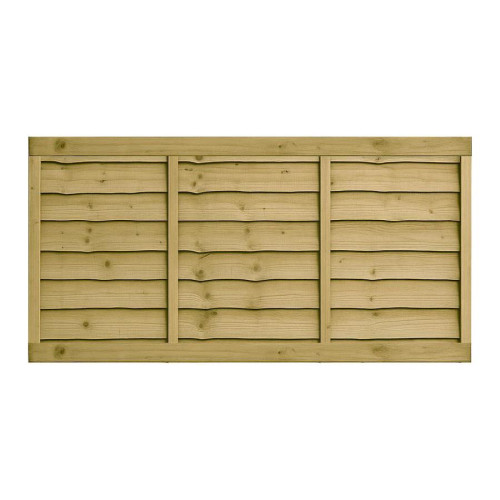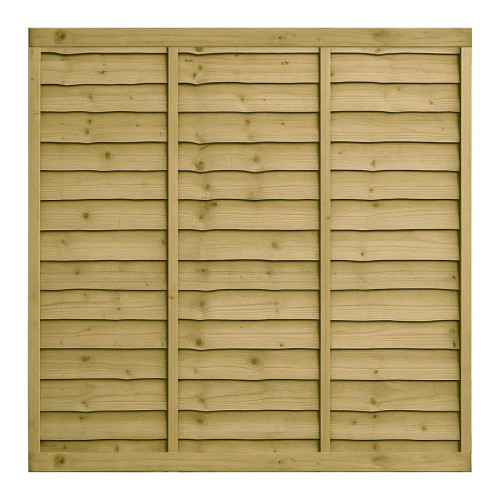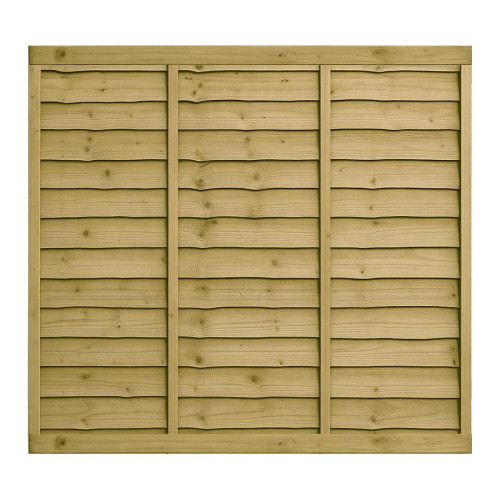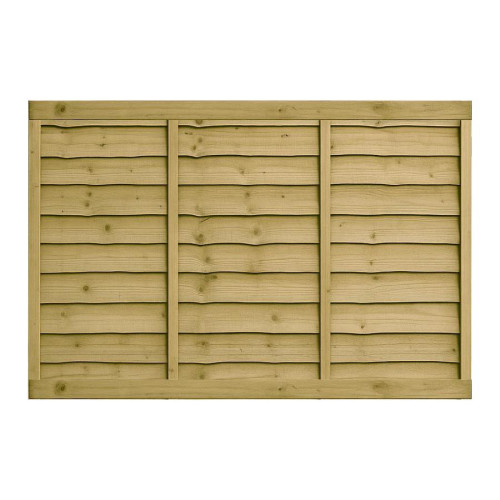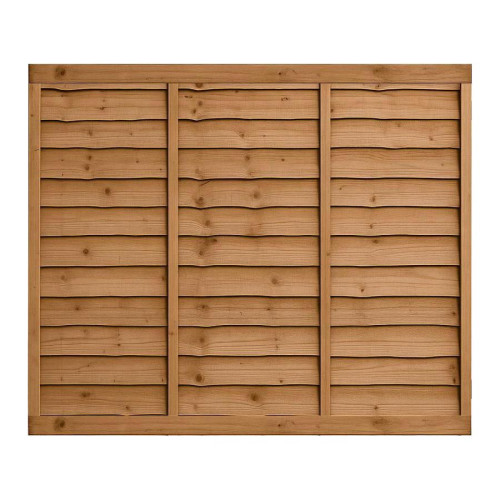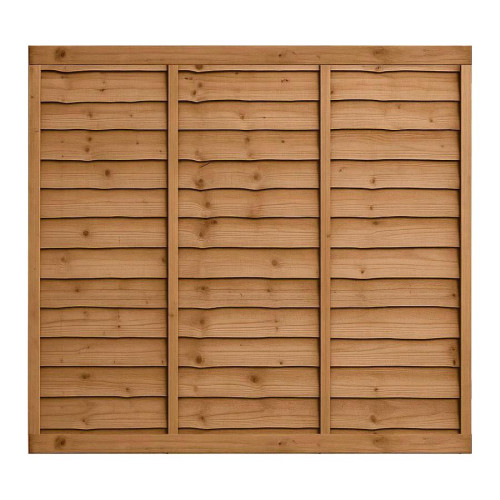



Quick answer: Waney Lap Fence Panels are made from thin sawn waney-edge boards laid horizontally with approximately 25-40mm of overlap, then held together by timber supports on both faces. East Coast Fencing manufactures its Waney Lap panels in-house using pressure-treated timber and galvanised ring-shank nails. The construction is deliberately lighter and more economical than Closeboard fencing, making it well suited to ordinary sheltered garden boundaries, replacement panels and longer runs where value matters.
Waney lap is one of the simplest-looking fence panel designs, but there is more happening in the construction than a row of horizontal boards.
The overlap between the boards, the supports on each face, the top and bottom timbers, the capping, the treatment and the fixings all contribute to how the finished panel behaves.
At East Coast Fencing, we manufacture Waney Lap Fence Panels in-house. That gives us direct knowledge of what goes into the panel rather than relying on a generic description of an overlap fence.
Understanding that construction also explains why waney lap fencing is relatively light, why the front and back look different, what natural timber variation customers should expect and why it should not be confused with heavier Closeboard Fence Panels.
What Is a Waney Lap Fence Panel?
A Waney Lap Fence Panel is a pre-assembled timber panel made from horizontal overlapping boards.
It is also commonly referred to as:
- Lap fencing
- Overlap fencing
- Waney-edge fencing
The horizontal boards overlap rather than sitting edge-to-edge.
This creates a substantially screened face while allowing relatively thin pieces of timber to cover the full area of the panel.
That efficient use of timber is a major reason waney lap remains a practical choice for cost-conscious domestic fencing.
What Timber Do We Use to Make Waney Lap Fence Panels?
Our Waney Lap panels are manufactured from sawn waney-edge timber.
Spruce is generally used, although the timber mix can vary.
This is important because waney lap should not be judged by the same visual standards as a machined decorative panel.
Sawn waney timber naturally shows variation including:
- Knots
- Differences in colour
- Irregular natural edges
- Slight changes in board width
- Small dimensional movement as moisture content changes
Those features are part of the character of this fencing style.
What Does "Waney Edge" Actually Mean?
A waney edge retains some of the natural contour associated with the outside of the log rather than being machined into a perfectly uniform rectangular edge.
That is why two individual boards may not look completely identical.
For this type of fencing, that variation is intentional.
The boards are overlapped so that the individual edge shapes work together to create the familiar rustic horizontal panel.
What Size Are the Individual Lap Boards?
The lap boards used in the current East Coast Fencing construction are nominally approximately:
- 125mm wide
- 4.7mm thick
These are nominal dimensions rather than a promise that every point along every sawn board will measure identically.
Waney-edge timber naturally varies.
That is quite different from buying a planed rectangular timber section where highly regular dimensions are part of the product's purpose.
Why Are Waney Lap Boards Relatively Thin?
The design is intended to create economical screening.
Instead of using thick individual boards to form the entire panel, relatively thin horizontal boards are:
- Overlapped
- Supported at several positions
- Fixed together as one panel assembly
This keeps material use and panel weight down.
It is one of the reasons Waney Lap Fence Panels are lighter and generally more economical than Closeboard Fence Panels.
It also explains why the two products should not be expected to have identical stiffness.
How Much Do the Boards Overlap?
Our current waney lap construction uses approximately 25-40mm of overlap from one board to the next.
The exact appearance varies with the natural boards, but the important principle is that each horizontal board covers part of the board beneath it.
The overlap is fundamental to the design.
Why Is the Board Overlap Important?
The overlap performs several jobs at once.
It helps:
- Create continuous-looking screening
- Reduce direct sightlines through the panel
- Allow natural variation between individual waney boards
- Create the traditional layered appearance
If the boards simply met edge-to-edge, natural timber movement could make gaps considerably more noticeable.
The overlap gives the construction more tolerance as the timber responds to changing outdoor moisture conditions.
Why Do the Boards Sit at a Slight Angle?
The boards are not simply stacked flat against one another.
Because each piece overlaps the next, the board face sits at a slight angle through the panel.
This layered arrangement contributes to the finished thickness of the complete panel.
The current Waney Lap panels have an overall depth of approximately 40mm once the:
- Overlapping boards
- Front supports
- Rear supports
are considered together.
How Is a Waney Lap Panel Supported?
The horizontal lap boards need support to remain together as a complete transportable panel.
Our current construction uses:
- Four vertical supports on the front face
- Four vertical supports on the rear face
These supports hold the horizontal boards together through the height of the panel.
The front face also receives additional timber across its upper and lower edges.
Why Are There Supports on Both Sides?
The lap boards are relatively thin.
Supporting them from both faces helps create a complete panel assembly rather than leaving the boards dependent on one line of timber on one side.
The supports:
- Hold the boards in their intended overlap
- Provide fixing locations
- Help maintain the panel's shape
- Allow the complete panel to be handled and installed as one unit
This support arrangement is one of the details worth inspecting when comparing overlap fence panels.
What Are the Top and Bottom Boards For?
On the front face of our current Waney Lap Fence Panels, 75 x 16mm horizontal timbers are fitted across both the top and bottom.
These help finish and support the panel edges.
The upper section also receives a separate capping strip.
What Does the Capping Do?
The current capping section is approximately 16 x 45mm.
It sits along the upper edge of the panel and provides a cleaner finished line.
The top of any timber fence receives direct exposure to rain, so capping also gives the panel a defined upper surface rather than leaving the assembly visually unfinished.
It should be viewed as part of the overall panel construction rather than decorative trim added after manufacture.
How Are Waney Lap Fence Panels Fixed Together?
We currently assemble the panels using galvanised ring-shank nails.
A ring-shank nail has ridges around the shank rather than a completely smooth surface.
Those ridges improve resistance to the nail being pulled back out of the timber as the components experience normal movement.
Galvanising provides additional protection to the metal fixing for exterior use.
Why Fixing Quality Matters
A fence panel is only as useful as the connections holding its individual pieces together.
The lap boards may still be perfectly serviceable, but if the mechanical connections become loose you can experience:
- Board movement
- Rattling
- Loose support battens
- Local separation of the panel
This is why panel construction should be assessed as a complete assembly.
Looking only at the visible horizontal boards misses the supports and fixings doing much of the work behind them.
Is the Timber Treated Before or After the Panel Is Built?
The timber components in our current Waney Lap Fence Panels are pressure treated before the panel is assembled.
The purpose of pressure treatment is to improve the timber's durability for outdoor use by introducing preservative into the wood.
Pressure treatment does not make the panel waterproof and does not mean installation conditions can be ignored.
The fence should still be designed so that the timber can dry after wet weather.
Why Pressure Treatment Is Particularly Important for a Thin-Board Panel
Waney lap exposes a large amount of timber surface to outdoor conditions.
There are:
- Multiple horizontal boards
- Overlapping edges
- Support battens
- Top and bottom components
Treating the timber for outdoor use therefore forms an important part of the product specification.
It does not remove the need to keep the bottom of the finished panel away from persistently wet soil where practical.
Why Does a Waney Lap Panel Have a Front and Back?
This is one of the details customers sometimes only notice during installation.
The two faces of our Waney Lap panels are not visually identical.
The support arrangement differs between the front and rear, and the front includes the horizontal top and bottom timbers described above.
This means panel orientation matters.
Which Way Should Waney Lap Fence Panels Face?
There is no need to create a complicated rule.
The practical point is consistency.
Before installing the first panel, decide which face you want visible from the main viewing side.
Then orientate every panel in the run the same way.
This is particularly important where the fence is:
- Visible from a patio
- Alongside a lawn
- Viewed from the house
- Replacing only part of an existing run
Why Inconsistent Orientation Looks Wrong
If several panels face one direction and one panel is reversed, the difference in supporting timbers can interrupt the visual rhythm of the fence.
The panels may all be structurally usable, but the boundary will look inconsistent.
Checking orientation before the panel is fixed takes seconds and can avoid having to remove it later.
How Wide Are East Coast Fencing Waney Lap Panels?
Our current Waney Lap Fence Panels are 1830mm wide.
This corresponds to the traditional UK nominal 6ft panel width.
That is particularly useful for:
- Conventional new panel bays
- Replacing older 6ft-wide panels
- Working with common UK fencing layouts
However, never assume an old bay remains exactly the size it was when first installed.
Why Should You Measure Existing Fence Bays?
Posts can move over time.
An older bay may:
- Narrow towards the top
- Widen at one end
- Contain leaning posts
- Have been installed to a non-standard spacing originally
Measure the actual clear opening before ordering replacement panels.
This is especially important with concrete posts because the panel needs to engage with the slots correctly.
What Heights Are Made Using This Construction?
The current Waney Lap Fence Panels range includes:
- 900mm, nominal 3ft
- 1200mm, nominal 4ft
- 1500mm, nominal 5ft
- 1650mm, nominal 5ft 6in
- 1800mm, nominal 6ft
These heights use the same general overlap-panel principle, but increasing the height changes how the finished fence behaves.
Why Panel Height Matters Structurally
A 3ft panel does not place the same demands on a fence as a 6ft panel.
As height increases:
- More surface area is exposed to wind
- The panel becomes heavier
- Post alignment becomes more visually obvious
- Support from the complete fence system becomes increasingly important
This is why a full-height Waney Lap panel should not simply be treated as a taller version of a low decorative boundary.
Why Are Waney Lap Fence Panels Lighter Than Closeboard?
The difference comes from the construction.
Waney lap uses relatively thin horizontal sawn boards arranged with overlap and supported by battens.
Closeboard Fence Panels use a heavier arrangement of overlapping vertical feather edge boards supported across substantial backing rails.
Both create privacy, but they achieve it differently.
| Construction Detail | Waney Lap | Closeboard |
|---|---|---|
| Board direction | Horizontal | Vertical |
| Board style | Thin sawn waney-edge lap boards | Feather edge boards |
| Support principle | Battens on both faces | Substantial horizontal backing rails |
| Overall character | Economical and relatively light | Heavier and more substantial |
This does not mean waney lap is badly made.
It means it is designed for a different position in the fencing range.
Why Economical Construction Is Not the Same as Poor Construction
A product can be intentionally economical and still be correctly manufactured for its intended use.
Waney lap fencing is designed around efficient use of timber.
Its purpose is to provide:
- Traditional garden screening
- A standard panel format
- Relatively easy handling
- A lower-cost alternative to heavier fencing
It should therefore be judged according to that job.
Expecting it to have the construction of an Ultra Heavy Duty Closeboard Fence Panel misses the reason the two products exist separately.
When Does Waney Lap Construction Make the Most Sense?
Waney Lap Fence Panels are particularly well suited to:
- Sheltered domestic gardens
- Rear garden boundaries
- Side boundaries
- Longer runs where overall cost matters
- Like-for-like replacement of older lap fencing
They make less sense when maximum strength in a highly exposed location is the main priority.
Why Wind Exposure Matters
Although the boards overlap rather than forming one continuous sheet, the finished Waney Lap panel still provides substantial screening.
That means a full-height panel presents a significant surface to the wind.
On exposed boundaries, consider:
- Panel height
- Post size and type
- Post depth
- Foundation quality
- Ground conditions
The lighter panel construction does not eliminate the forces acting on a tall fence.
Do Stronger Posts Make a Waney Lap Panel Stronger?
They make the complete fence system better supported.
The panel itself does not change construction, but suitable posts provide the structural support needed to keep it correctly positioned.
This distinction matters.
A fencing system consists of:
- The panel
- The posts
- The foundations
- Any gravel board
- The relevant fixings
No single component should be expected to compensate for weakness everywhere else.
Can Waney Lap Fence Panels Be Used With Wooden Posts?
Yes.
Suitable wooden fence posts create a straightforward all-timber installation.
They also provide convenient fixing points for appropriate exterior panel hardware.
Choose the post according to:
- Panel height
- Fence exposure
- Ground conditions
- Overall fence design
Can Waney Lap Panels Be Used With Concrete Posts?
Yes, where they are compatible with the particular slotted post system.
This is common when replacing existing fence panels while retaining sound concrete posts.
Check:
- Actual bay width
- Panel depth
- Post slot dimensions
- Available height above the gravel board
Do not force a panel into a bay that has become too narrow because the posts have moved.
Why Gravel Boards Are Worth Considering
The lower edge of a fence is normally exposed to the dampest conditions.
Without separation, the panel can sit close to:
- Wet soil
- Grass
- Mulch
- Leaves
- Rain splash
A suitable gravel board provides a lower barrier between the main timber panel and the ground.
This is particularly sensible with waney lap because the bottom section contains relatively thin timber components.
Pressure Treatment Does Not Mean You Should Bury the Panel
Pressure treatment improves durability, but it does not turn the panel into a retaining wall or a timber product intended to be buried indiscriminately.
Keep the panel itself away from direct soil contact where practical.
If ground levels vary, deal with them using:
- Appropriate gravel boards
- Stepped fence bays
- Suitable landscaping details
rather than simply pushing the lower part of the panel into the soil.
What Natural Changes Should You Expect After Installation?
Timber reacts to moisture.
As panels move between wet and dry conditions, individual components can experience modest:
- Shrinkage
- Expansion
- Movement
- Surface checking
- Colour change
Waney lap's overlapping construction is well suited to this natural material because the boards already cover one another.
Small changes do not automatically indicate that the panel has failed.
What Is Normal and What Should You Be Concerned About?
| Observation | Typical Interpretation |
|---|---|
| Knots | Normal natural timber characteristic |
| Irregular waney edges | Normal feature of the panel style |
| Shade differences | Normal natural and treatment variation |
| Minor timber movement | Expected as moisture conditions change |
| Broken support batten | Structural damage requiring attention |
| Several boards pulling free | Fixing or structural problem |
| Panel severely distorted | Inspect panel and supporting posts |
Why Waney Lap Should Not Look Perfectly Machined
A perfectly uniform decorative slatted panel and a waney-edge panel are intentionally different products.
With waney lap, natural edge variation contributes to its traditional appearance.
Customers should expect the fence to look like sawn outdoor timber rather than furniture-grade joinery.
This is particularly important when buying online because photographs cannot show every knot or natural edge variation that will occur across several panels.
How Can You Inspect Waney Lap Panel Quality?
Look at more than the colour of the timber.
Check the construction.
A useful inspection includes:
- Is the board overlap reasonably consistent?
- Are the support battens secure?
- Are the top and bottom components properly attached?
- Is the capping secure?
- Are the boards still fixed firmly to the supports?
- Does the complete panel retain its overall shape?
Natural variation in one board is less important than widespread failure of the panel assembly.
Why the Supports Matter More Than One Imperfect Board
One horizontal lap board covers only part of the panel.
A support batten helps hold many boards together.
That means damage to one of the main supports can have a greater structural effect than a small defect in one individual lap board.
When assessing an older panel, inspect the parts that connect the complete assembly rather than focusing entirely on surface appearance.
Can Individual Waney Boards Be Repaired?
Local repairs may sometimes be practical if:
- The supports remain sound
- Only a small part of the panel is damaged
- The surrounding boards remain secure
Because the boards overlap, however, access can be more involved than simply removing an isolated board from an open fence.
If several boards and supports have failed, replacing the complete panel may be more sensible.
When Should a Whole Waney Lap Panel Be Replaced?
Consider complete replacement when:
- Several support battens have broken
- Large sections of boards are loose
- The panel no longer retains its shape
- There is extensive deterioration around the lower section
- Storm or impact damage affects a substantial area
Before replacing the panel, inspect the posts.
A new panel installed between unstable supports will not solve the underlying problem.
Why Waney Lap Panels Are Easier to Handle Than Heavier Designs
The relatively light construction can be an advantage during installation.
Compared with a substantial Closeboard panel, waney lap is generally easier to:
- Carry through a garden
- Lift between posts
- Position during replacement work
This can be particularly useful where access is restricted.
It does not mean a full-height panel should be handled carelessly.
How Should You Lift a Waney Lap Panel?
Support the complete panel rather than pulling its full weight from one thin lap board.
Avoid:
- Dragging it across the ground
- Lifting it by the capping alone
- Holding the entire panel from one horizontal lap board
- Twisting it heavily while forcing it between posts
For larger panels, use enough people to keep the panel supported and under control.
Why Full-Height Panels Need More Care During Installation
A 1800mm-high panel provides the greatest screening in the current range, but it also has the largest area.
That means:
- Wind can affect it more strongly while it is being handled
- Leaning posts become more obvious
- Accurate top alignment matters more across a long run
Use a string line and check the posts before installing several full-height panels.
Brown or Green/Natural Does Not Change the Construction
The current range includes brown and green/natural pressure-treated options.
The treatment colour changes the initial appearance rather than turning one version into a stronger style of panel.
The same basic construction principles apply:
- Sawn overlapping waney-edge boards
- Front and rear supports
- Top and bottom front timbers
- Capping
- Pressure treatment
- Galvanised ring-shank nail assembly
Why the Initial Treatment Colour Will Change
Pressure-treated timber naturally changes in appearance outdoors.
Sunlight and weather gradually alter the initial colour.
The timber may eventually be coated with a suitable exterior finish if a particular decorative appearance is wanted, but the panel does not require painting simply because it has been installed.
What Makes a Good Waney Lap Fence Panel?
A good Waney Lap panel should make sense as a complete product.
Look for:
- Appropriate overlapping boards
- Secure support battens
- Suitable exterior fixings
- Pressure-treated timber
- A properly finished upper edge
- Consistent overall dimensions
- A structure that remains coherent when handled correctly
Do not reject natural waney timber simply because it has knots or irregular edges.
Those are different from structural failures such as broken supports or boards coming away from their fixings.
When Should You Choose Waney Lap Fence Panels?
Choose Waney Lap Fence Panels when you want:
- A traditional horizontal overlap appearance
- Useful garden privacy
- A relatively lightweight panel
- An economical solution for a longer boundary
- A standard 1830mm-wide replacement panel
- Pressure-treated timber fencing for an ordinary domestic garden
When Should You Consider a Heavier Panel Instead?
Consider Closeboard Fence Panels where:
- The boundary is particularly exposed
- Panel stiffness is a major priority
- You specifically want a heavier construction
- A more substantial traditional fence is preferred
The decision should be based on the actual site rather than assuming the more expensive or heavier option is automatically necessary everywhere.
Common Misunderstandings About Waney Lap Construction
- Assuming every irregular board edge is a defect
- Expecting sawn waney timber to look like planed decorative timber
- Thinking the front and back of the panel should look identical
- Assuming the boards are simply placed edge-to-edge rather than overlapped
- Judging the entire panel from the thickness of one lap board
- Assuming pressure treatment means the panel can sit permanently in wet soil
- Thinking a lighter panel requires no attention to posts in windy locations
- Expecting Waney Lap to have the same construction as Closeboard fencing
- Installing panels in alternating orientations along the same fence run
- Assuming an old 6ft bay is still exactly 1830mm wide without measuring it
Waney Lap Fence Panel Construction Checklist
- Check that the panel width suits the actual fence bay.
- Choose the appropriate height for the required screening.
- Expect natural variation in sawn waney-edge timber.
- Inspect the board overlap rather than expecting perfectly straight edges.
- Check that front and rear supports are secure.
- Inspect the top and bottom front timbers.
- Check that the capping is firmly attached.
- Keep panel orientation consistent along the fence run.
- Use suitable posts for the panel height and site exposure.
- Consider a gravel board to separate the panel from wet ground.
- Support the whole panel properly when lifting it.
- Inspect posts as well as panels when repairing an older boundary.
FAQs
How Are Waney Lap Fence Panels Made?
East Coast Fencing manufactures its Waney Lap Fence Panels from horizontal sawn waney-edge boards laid with approximately 25-40mm of overlap. The boards are supported by four vertical battens on each face, with additional top and bottom timbers on the front and a capping strip along the upper edge. The components are pressure treated before assembly and fixed together using galvanised ring-shank nails.
What Size Timber Is Used for the Waney Lap Boards?
The current lap boards are nominally approximately 125mm wide by 4.7mm thick. Because they are sawn waney-edge boards, some natural dimensional and edge variation should be expected.
Why Do Waney Lap Boards Overlap?
The overlap creates continuous-looking screening and allows the construction to accommodate natural variation and small timber movement without depending on perfectly matched edge-to-edge boards.
How Much Overlap Is Used?
The current East Coast Fencing construction uses approximately 25-40mm of overlap between adjacent lap boards.
Why Do Waney Lap Fence Panels Look Different on Each Side?
The support arrangement is not visually identical on both faces. The front includes additional horizontal timbers at the top and bottom, so panels should be orientated consistently along the fence run.
Are Waney Lap Fence Panels Pressure Treated?
Yes. The timber components in the current East Coast Fencing panels are pressure treated before assembly for outdoor use.
What Fixings Are Used to Manufacture Them?
The current panels are assembled using galvanised ring-shank nails.
How Thick Is a Waney Lap Fence Panel?
The current panels have an overall finished depth of approximately 40mm. That depth includes the overlapping boards, their slight angle and the support layers on the two faces.
Are Waney Lap Fence Panels Made From Spruce?
Spruce is generally used in the current East Coast Fencing construction, although the timber mix can vary.
Are Knots and Irregular Edges Normal?
Yes. Waney lap uses sawn natural timber, so knots, shade variation, irregular edges and minor dimensional changes are normal characteristics of the product style.
Are Waney Lap Panels Weaker Than Closeboard?
They use a lighter and more economical construction than Closeboard Fence Panels. Closeboard is the more substantial option where greater stiffness and heavy-duty construction are priorities, while waney lap is well suited to ordinary sheltered domestic boundaries.
Can Waney Lap Panels Be Used With Concrete Posts?
Yes, where their dimensions are compatible with the slotted concrete post system. Existing bays should always be measured before ordering replacement panels.
Can Waney Lap Panels Be Used With Wooden Posts?
Yes. Suitable wooden posts provide straightforward fixing points and create a traditional all-timber fence system.
Should Waney Lap Panels Have Gravel Boards?
They are worth considering because they help separate the lower timber panel from wet soil, grass and garden debris.
Can a Damaged Waney Lap Panel Be Repaired?
Local repair may be possible where only a small area is damaged and the main supports remain sound. Widespread board or support failure may make complete panel replacement more practical.
What Does the Construction Tell You About Waney Lap Fence Panels?
Waney lap fencing makes much more sense once you understand how it is built.
It is not intended to imitate Closeboard construction at a lower price. It is a separate fencing system designed around thin sawn horizontal boards, controlled overlap and a relatively lightweight support arrangement.
At East Coast Fencing, the current panels use nominal 125 x 4.7mm waney-edge boards with approximately 25-40mm overlap. Four vertical supports are fitted to each face, with 75 x 16mm horizontal timbers at the top and bottom of the front and a 16 x 45mm capping section completing the upper edge. The timber is pressure treated before assembly and the components are secured with galvanised ring-shank nails.
Those details explain the product's main characteristics.
The thin overlapping boards keep the panel relatively light and economical. The support battens hold those boards together as a complete panel. The overlap provides traditional screening while allowing for the natural variation found in sawn waney-edge timber.
It also explains the limitations. Waney lap is not the panel to choose when the heaviest possible construction is the objective. Full-height panels still need suitable posts and careful installation, particularly in exposed gardens.
For ordinary sheltered domestic boundaries, however, the construction is exactly why Waney Lap Fence Panels remain useful: they turn relatively simple pressure-treated timber components into a practical 1830mm-wide privacy panel that is straightforward to handle, familiar in appearance and economical across a longer fence run.