


Quick answer: Waney Lap Fence Panels can be installed with either wooden posts or compatible slotted concrete posts. Measure the actual panels and every fence bay before setting posts, keep the panels level and support them by their timber frame rather than the overlapping boards. A gravel board beneath the panel is worth considering to keep the lower timber away from wet soil and garden debris. With wooden posts, use suitable exterior clips, brackets or screws. With concrete posts, compatible panels are normally lowered carefully into the slots.
Waney Lap Fence Panels are one of the more straightforward ways to create a traditional timber garden boundary.
The panels arrive already assembled, so the main installation work is setting out the fence accurately, installing suitable posts, dealing with changes in ground level and making sure every panel is properly supported.
They are relatively light compared with heavier Closeboard Fence Panels, which can make them easier to handle during a DIY installation. That does not mean the supporting structure can be treated casually.
Straight posts, accurate bay widths and a properly planned lower edge make the difference between a fence that looks neat from the start and one that immediately begins to lean, rattle or sit unevenly.
What Are Waney Lap Fence Panels?
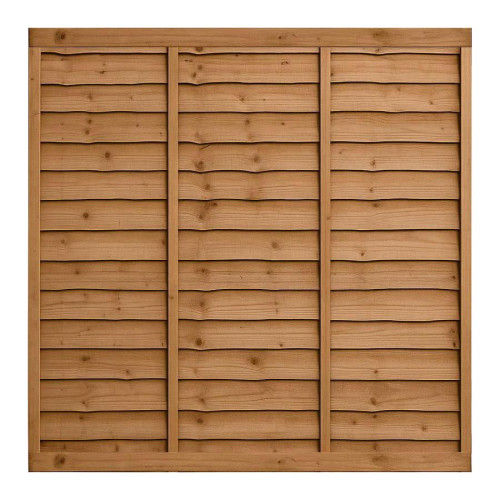
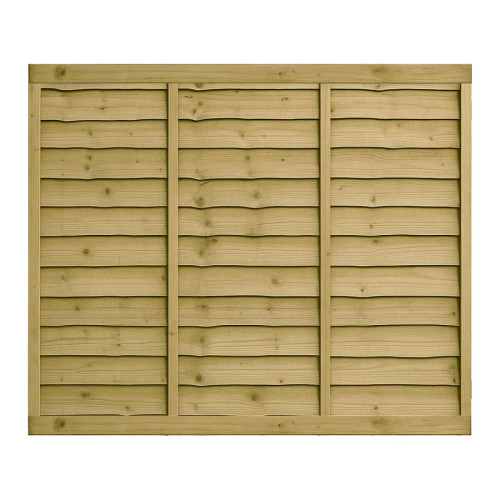
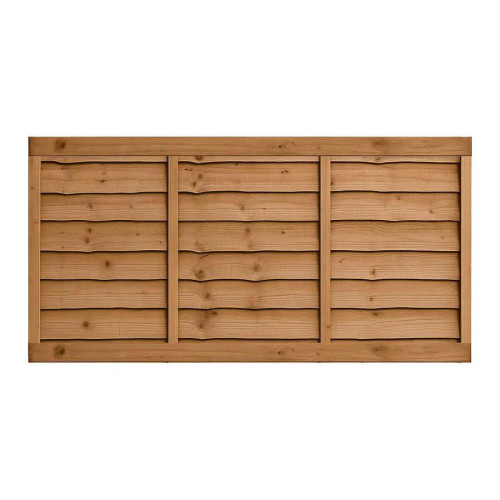
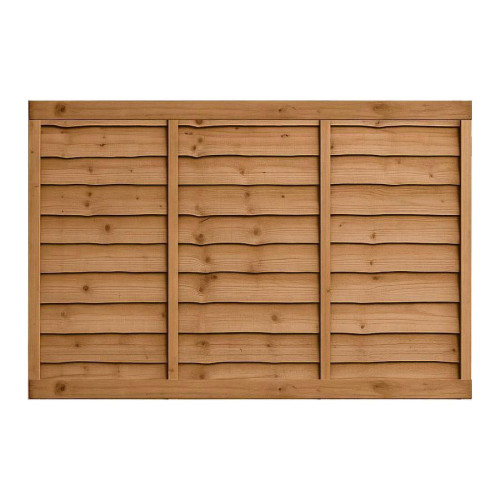
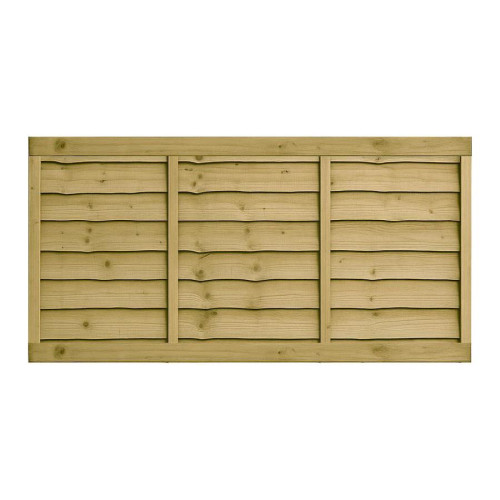
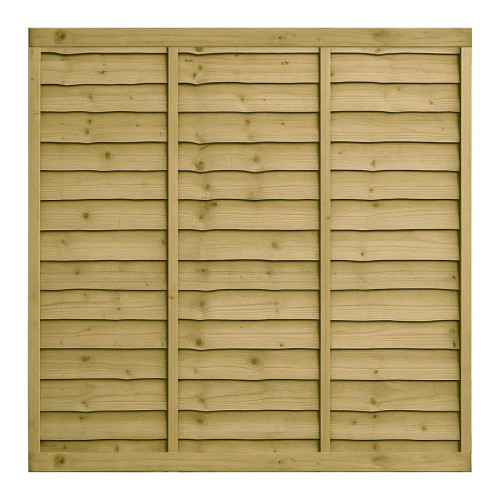
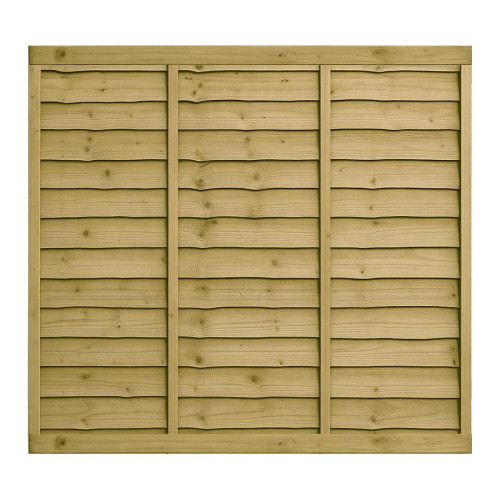
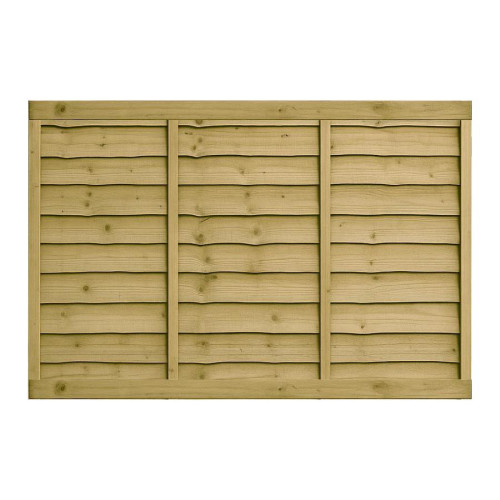
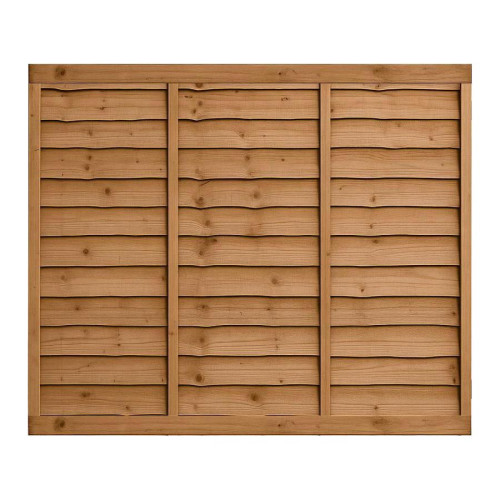
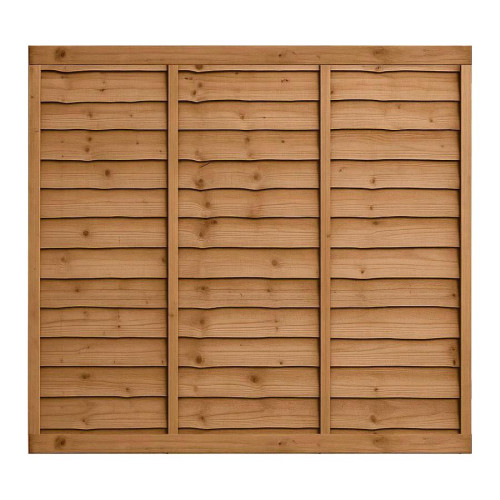
Waney Lap Fence Panels, sometimes called overlap panels, use horizontal timber boards that overlap one another from the bottom of the panel upwards.
The boards are held within a timber framework so the complete panel can be installed as one section.
The overlapping arrangement creates a largely solid boundary that is useful for:
- Rear gardens
- Side boundaries
- Replacement fencing
- Long garden runs
- General privacy screening
They are generally lighter and more economical than Closeboard Fence Panels, which is one reason they are commonly used for straightforward domestic fencing.
What Sizes Are Waney Lap Fence Panels Available In?
The current East Coast Fencing range is approximately 1.83m wide, equivalent to the familiar nominal 6ft panel width.
Current panel heights include approximately:
- 900mm
- 1200mm
- 1500mm
- 1650mm
- 1800mm
Brown and green/natural pressure-treated finishes are available.
These heights make it possible to use the same panel style for anything from relatively low garden boundaries to full-height privacy fencing.
Do Not Set Posts From a Nominal 6ft Measurement Alone
This is one of the most important installation points.
A fence panel may be described as 6ft wide, but you should still check the actual dimensions before setting out an entire run.
The final post spacing also depends on:
- Post dimensions
- Whether the panel sits between or against timber posts
- The chosen fixing method
- Concrete post slot arrangement where relevant
A small mistake at each bay can accumulate across a long boundary.
What Do You Need to Install Waney Lap Fence Panels?
A typical installation may require:
- Waney Lap Fence Panels
- Suitable fence posts
- Gravel boards where required
- Suitable post-setting material
- Exterior fence clips, brackets or screws for timber posts
- Tape measure
- String line
- Spirit level
- Post-hole digging equipment
- Drill and driver where required
- Temporary supports or blocks
- Appropriate personal protective equipment
If a gate is included in the fence run, plan the gate posts and opening before installing the surrounding panels.
Should You Use Wooden or Concrete Posts?
Both can work well with Waney Lap Fence Panels.
The better choice depends on the appearance you want, the existing fence system and how you want replacement panels to be handled in future.
| Feature | Wooden Posts | Concrete Posts |
|---|---|---|
| Appearance | Traditional all-timber fence | Timber panels with visible concrete supports |
| Panel fixing | Clips, brackets or suitable screws | Compatible panel lowered into slots |
| On-site adjustment | More flexible | More dependent on slot compatibility |
| Ground-level decay | Timber specification matters | Concrete post itself will not rot |
| Future panel replacement | Remove mechanical fixings | Often lift panel from slots |
How to Measure an Existing Fence Before Replacing the Panels
If you are keeping existing posts, measure every bay individually.
Do not assume all of them remain identical.
Measure the clear opening:
- Near the bottom
- Around the middle
- Near the top
If the dimensions change significantly, the posts may be leaning.
Also measure the available height from the top of any gravel board to the required finished fence height.
Why Existing Post Spacing Changes Over Time
A fence originally built for standard-width panels may no longer have standard-width openings.
Posts can:
- Lean
- Twist
- Move with the ground
- Become loose in their foundations
A new panel should not be forced into a bay that has become too narrow.
If the posts are significantly out of alignment, correct the support problem rather than damaging the replacement panel.
How to Set Out a New Waney Lap Fence
Start by marking the complete fence line.
- Identify the beginning and end of the boundary.
- Run a taut string line between the main reference points.
- Mark gate openings, corners and changes in direction.
- Measure the actual panels.
- Calculate post positions based on the chosen installation system.
Do not begin digging every hole until you know how the final bay will work.
Plan the Final Fence Bay Before Installing the First Post
A common DIY mistake is starting with full-width panels and only discovering at the end that the remaining gap is awkwardly narrow.
Before construction, calculate:
- Total fence length
- Number of full panels
- Gate width
- Corner positions
- Remaining end section
If a custom-width section is unavoidable, position it somewhere that makes sense visually.
How to Install Waney Lap Fence Panels with Wooden Posts
Wooden posts provide a simple and flexible installation system.
A typical sequence is:
- Establish the fence line with string.
- Install the first post securely and vertically.
- Measure the required position of the next post.
- Install and brace the second post.
- Fit the gravel board if one is being used.
- Support the Waney Lap panel at the intended finished level.
- Check the panel with a spirit level.
- Secure the panel frame with suitable exterior clips, brackets or screws.
- Recheck alignment before continuing.
Use the panel frame as the fixing area rather than relying on the thin overlapping boards themselves.
Where Should You Fix a Waney Lap Panel?
The substantial timber framing should carry the panel.
The horizontal waney boards create the screening, but they are not the best place to transfer the full panel load into the post.
Use a fixing arrangement that securely connects the structural frame to the supporting posts.
Can Waney Lap Panels Be Screwed Directly to Wooden Posts?
They can be secured using an appropriate exterior fixing arrangement.
Depending on how the fence is designed, suitable:
- Screws
- Fence clips
- Brackets
may be used.
The fixing needs adequate penetration into sound post timber.
Should You Pre-Drill the Panel Frame?
Pre-drilling can help where screws are installed close to the edge or end of a timber frame.
It can reduce the risk of:
- Splitting
- Misaligned screws
- Damage from driving substantial fixings too aggressively
Select the pilot hole according to the fixing being used.
How to Install Waney Lap Fence Panels with Concrete Posts
Compatible slotted concrete posts provide a different installation method.
The panel is normally lowered vertically into the post slots and sits above a suitable gravel board.
A typical sequence is:
- Install the concrete posts at the correct spacing.
- Check that every post is vertical.
- Install the gravel board where required.
- Lift the panel using its frame.
- Position both edges over the post slots.
- Lower the panel carefully and evenly.
- Confirm it sits correctly on the lower support.
Do not force a panel down between posts that have been installed too close together.
How Do You Check Concrete Post Compatibility?
Measure:
- The clear distance between posts
- The width of the post slots
- The thickness of the panel frame
- The available height above the gravel board
This is especially important when installing a different make or type of panel into an older fence system.
Do Not Assume Every 6ft Panel Fits Every Concrete Post Bay
Nominal dimensions are useful for identifying products, but installation tolerances matter.
An older post system may have:
- Slightly different spacing
- Narrow slots
- Leaning posts
- Previous packing or modifications
Measure before ordering rather than discovering the difference while holding a full panel above the posts.
How Should Waney Lap Panels Be Lifted?
Support the complete panel using its timber frame.
Do not lift a full panel by pulling hard on one thin overlapping board.
Although Waney Lap panels are generally lighter than heavier Closeboard panels, larger panels are still bulky.
Using two people can make:
- Carrying
- Levelling
- Lowering into concrete slots
- Working around obstacles
considerably easier.
Should You Install Panels in Strong Wind?
Large fence panels can be awkward to handle when strong wind catches them.
Waney Lap fencing has a largely solid face, so even a relatively lightweight panel can behave like a large sail while it is being carried.
Choose suitable conditions for installation where possible.
Should Waney Lap Fence Panels Have Gravel Boards?
They are worth considering.
A gravel board creates a protective lower section beneath the panel and helps keep its bottom frame away from:
- Wet soil
- Grass
- Leaves
- Mulch
- Rain splash
This is useful because the lower part of an older overlap panel is often one of the first places to experience prolonged moisture exposure.
Can Waney Lap Fence Panels Sit Directly on the Ground?
It is better to avoid leaving the timber panel in persistent contact with damp soil.
Where a gravel board is not being used, keep the panel appropriately clear of ground moisture while still maintaining a practical lower boundary.
Do not bury the bottom timber frame simply to hide uneven ground.
Should You Use Wooden or Concrete Gravel Boards?
Both can work with appropriate fence systems.
Wooden gravel boards suit an all-timber run using wooden posts.
Concrete gravel boards work particularly naturally with slotted concrete posts.
| Gravel Board | Useful With | Main Characteristic |
|---|---|---|
| Wooden | Timber posts | Consistent all-timber appearance |
| Concrete | Slotted concrete posts | Non-timber lower boundary component |
Remember That a Gravel Board Changes the Overall Height
The panel height is not necessarily the same as the finished boundary height.
If a gravel board sits beneath the panel, the top of the fence becomes correspondingly higher.
Plan:
- Panel height
- Gravel board height
- Post length
- Finished ground level
as one complete system.
How Do You Keep Waney Lap Panels Level?
Use a spirit level rather than relying solely on the ground.
Ground can rise and fall while the individual panel still needs to sit level.
Useful references include:
- String line
- Spirit level
- Consistent gravel board heights
- Repeated measurements from the post tops
Should the Tops of All Panels Line Up?
On reasonably level ground, a consistent top line generally creates the neatest appearance.
If the ground changes level significantly, the panels may need to be stepped.
Do not allow the top line to drift gradually simply because every panel has been measured independently from the soil underneath it.
How Do You Install Waney Lap Fence Panels on a Slope?
Standard rigid Waney Lap panels are normally stepped between posts.
Each panel remains level and square, while successive bays begin at different heights.
This is preferable to attempting to twist the panel frame to follow the gradient.
Why Shouldn't You Rake a Standard Waney Lap Panel?
A complete framed panel has been manufactured square.
Trying to force it into a raked shape can:
- Distort the frame
- Move the overlapping boards
- Stress panel fixings
If a continuous sloping fence line is essential, a site-built fencing system may provide more flexibility than rigid panels.
How Do You Plan Stepped Panels?
Measure the complete change in level before installation.
Then decide how the steps will be distributed across the fence bays.
Consider:
- Finished top line
- Ground clearance
- Gravel boards
- Gate position
- Gaps under downhill corners
A planned series of steps normally looks better than improvising every bay separately.
Can You Fill Gaps Under Stepped Panels with Soil?
Avoid piling wet soil directly against the timber panel.
If a significant level difference exists, use an appropriate lower landscaping or retaining detail rather than making the fence panel hold back the ground.
Can Waney Lap Fence Panels Retain Soil?
No ordinary fence panel should be treated as a retaining wall.
Soil pressure against the panel can:
- Distort the frame
- Push boards out of position
- Keep the timber persistently wet
Where ground levels differ substantially, retain the soil independently from the fence.
Can Waney Lap Fence Panels Be Cut to Width?
They can be modified, but shortening a complete panel involves more than making one simple cut.
The panel includes:
- Horizontal overlapping boards
- Supporting rails
- Outer framing
Reducing the width may require dismantling and rebuilding the end of the panel.
Where possible, plan the post layout to use complete panels.
What Should You Do with a Narrow Final Bay?
If a custom section is unavoidable, consider creating it deliberately rather than heavily modifying several panels throughout the run.
Positioning the custom bay at an end, corner or beside a gate can make the variation less noticeable.
The exact solution depends on the available timber framework and required width.
Can You Cut Waney Lap Panels Shorter in Height?
It is possible to alter timber, but the current range already includes several panel heights.
Choosing the appropriate 900mm, 1200mm, 1500mm, 1650mm or 1800mm option is normally cleaner than cutting down a complete panel unnecessarily.
What Should You Do with Freshly Cut Pressure-Treated Timber?
Cutting pressure-treated timber exposes surfaces from inside the section.
Freshly exposed areas should receive appropriate end-grain preservative treatment where required by the relevant timber-treatment guidance.
Minimising unnecessary cutting helps preserve the original manufactured treatment and construction.
Can Waney Lap Panels Replace Existing Closeboard Panels?
Potentially, where the support system and dimensions are compatible.
If the existing posts are sound and the new panel fits the bay, replacing a heavier panel with Waney Lap may be possible.
However, check:
- Panel width
- Panel frame thickness
- Post spacing
- Gravel board height
rather than assuming all nominally 6ft fence panels are identical.
Can Waney Lap Panels Replace Old Waney Lap Panels?
Yes, and like-for-like replacement is one of their most straightforward uses.
If the posts and gravel boards remain secure:
- Remove the damaged panel.
- Measure the empty bay.
- Confirm the required height.
- Check the frame compatibility.
- Install the replacement panel.
The new timber may initially look different from older weathered panels.
Will a New Waney Lap Panel Match an Old Fence?
Not necessarily at first.
New pressure-treated timber can have a stronger green/natural or brown appearance than timber that has been outside for several years.
Natural variation also occurs in:
- Grain
- Knots
- Shade
The new panel will weather after installation.
Should You Replace Old Posts at the Same Time?
Only where their condition requires it.
Before installing a new panel, inspect timber posts for:
- Movement at ground level
- Significant decay
- Splitting
- Leaning
Inspect concrete posts for:
- Movement
- Significant cracking
- Damaged slots
- Leaning
A new panel cannot correct unstable supports.
Can You Replace One Waney Lap Panel Without Replacing the Whole Fence?
Yes.
Individual panel replacement is one of the advantages of a panel-based fence system.
If the posts remain sound, one damaged bay can often be replaced without disturbing the rest of the fence.
With compatible slotted concrete posts, this may be particularly straightforward because the damaged panel can often be lifted out.
How Do You Remove a Waney Lap Panel from Wooden Posts?
Remove the mechanical fixings carefully.
Do not pull the panel sideways with excessive force if it is still connected to brackets or clips.
Older panels may be fragile, so support them while dismantling to prevent broken timber falling unexpectedly.
How Do You Remove a Waney Lap Panel from Concrete Posts?
A compatible panel will generally need to move vertically within the slots.
Make sure there is enough space above the fence to lift it.
Dense shrubs, overhanging branches or structures can make removal more difficult than installation initially was.
Can Waney Lap Fence Panels Be Installed Beside a Wall?
Yes, provided the end of the panel has a suitable structural support.
A properly secured timber support may be used in suitable masonry situations.
Do not rely on:
- Weak render
- Loose bricks
- A decorative surface layer
to carry the full end of a fence panel.
How Should a Garden Gate Be Planned into the Fence?
Decide the gate position before setting the surrounding posts.
A gate creates moving loads and generally needs suitably substantial Gate Posts rather than simply being attached to whichever intermediate fence post happens to be nearby.
Allow for:
- Gate width
- Hinges
- Latch
- Opening direction
- Ground clearance
Can Trellis Be Added Above Waney Lap Fence Panels?
Potentially, but plan the complete support structure rather than fixing extra height casually to the panel frame.
Additional trellis increases:
- Total fence height
- Wind exposure
- Potential plant load
The posts need to be suitable for the finished arrangement.
Can Panel Capping Be Added to Waney Lap Panels?
Straight Panel Capping may suit compatible flat-topped framed panels where the upper frame dimensions are appropriate.
Measure the top frame before choosing capping.
Do not force a narrow capping profile over an incompatible panel frame.
Do Waney Lap Fence Panels Need Painting After Installation?
No immediate decorative coating is required simply because the current panels have been installed.
They are pressure treated for outdoor use.
If you later want to refresh or change the colour, a suitable exterior timber coating can be used once the timber is sufficiently dry and correctly prepared.
What Is the Difference Between Brown and Green/Natural Panels?
The most obvious difference is the initial appearance.
Brown-treated panels have a warmer starting colour.
Green/natural panels have the familiar appearance of newly pressure-treated garden timber.
Both will change as they weather outdoors.
Do not treat colour alone as evidence of a different level of structural strength.
How Do You Maintain Waney Lap Panels After Installation?
Routine maintenance is relatively simple.
Periodically check:
- Post stability
- Panel frame
- Clips and brackets
- Lower overlapping boards
- Gravel board condition
Remove wet leaves and dense vegetation that remain trapped against the lower timber.
Why Does a Waney Lap Panel Rattle?
Rattling usually means there is movement somewhere in the fence system.
Possible causes include:
- Loose brackets
- Loose screws
- Clearance in concrete post slots
- A damaged panel frame
- Moving posts
Identify the cause rather than driving random screws through the overlapping boards.
Why Has the Bottom of the Panel Started to Deteriorate?
The lower part of the fence is commonly exposed to more:
- Rain splash
- Wet leaves
- Grass
- Soil moisture
A suitable gravel board and sensible ground clearance can help reduce this exposure.
Why Is My New Panel Leaning?
Check the supporting posts first.
A rigid panel normally follows the alignment of the structure holding it.
Possible causes include:
- A post installed out of vertical
- A loose post foundation
- Uneven lower support
Repositioning the panel without correcting the post problem may only hide the issue temporarily.
Common Waney Lap Fence Panel Installation Mistakes
- Setting posts using only an assumed 6ft panel width
- Failing to measure existing bays individually
- Installing replacement panels between leaning posts
- Fixing through thin overlapping boards instead of the structural frame
- Using unsuitable indoor fixings
- Forcing panels into narrow concrete post bays
- Allowing panels to sit in damp soil
- Ignoring gravel board height when planning the total fence
- Allowing panel levels to drift along the boundary
- Trying to twist rigid panels down a slope
- Using the fence panel to retain soil
- Cutting several panels before checking the complete layout
- Replacing panels without checking failing posts
- Adding trellis without considering the supporting posts
Waney Lap Fence Panels Installation Checklist
- Measure the complete boundary.
- Check the actual panel dimensions.
- Choose the required panel height.
- Choose brown or green/natural treatment appearance.
- Decide between wooden and compatible concrete posts.
- Plan gravel boards where appropriate.
- Mark gates, corners and custom bays before digging.
- Use a string line to keep posts straight.
- Install every post vertically and securely.
- Measure existing bays at several heights when replacing panels.
- Handle panels using the timber frame.
- Keep panels level.
- Use suitable exterior fixings with wooden posts.
- Lower panels carefully into compatible concrete post slots.
- Keep lower timber away from persistent wet ground.
- Step rigid panels on slopes.
- Keep soil-retaining structures independent from the fence.
- Inspect the complete run before finishing the installation.
FAQs
How Wide Are Waney Lap Fence Panels?
The current East Coast Fencing range is approximately 1.83m wide, equivalent to the familiar nominal 6ft panel width.
What Heights Are Waney Lap Fence Panels Available In?
The current range includes approximately 900mm, 1200mm, 1500mm, 1650mm and 1800mm heights.
Are Waney Lap Fence Panels Pressure Treated?
Yes. The current range is pressure treated for outdoor use.
Can Waney Lap Fence Panels Use Wooden Posts?
Yes. They can be secured to suitable wooden posts using appropriate exterior clips, brackets or screws.
Can Waney Lap Fence Panels Use Concrete Posts?
Yes, where the panel dimensions and frame are compatible with the slotted concrete post system.
Should Waney Lap Fence Panels Have Gravel Boards?
They are worth considering because they help keep the lower timber away from wet soil, rain splash and garden debris.
Can Waney Lap Fence Panels Touch the Ground?
It is preferable to keep the timber panel away from persistent contact with wet soil.
Should Waney Lap Panels Be Screwed or Clipped to Wooden Posts?
Suitable exterior screws, clips or brackets may all form part of an appropriate installation. The structural panel frame should be secured firmly to the post.
Can Waney Lap Fence Panels Be Installed on a Slope?
Yes. Standard rigid panels are normally stepped between posts as the ground rises or falls.
Can Waney Lap Fence Panels Be Raked?
A standard framed panel should not normally be distorted out of square to follow a gradient.
Can Waney Lap Fence Panels Be Cut to Width?
They can be modified, but substantial shortening affects the outer frame, supporting rails and overlapping boards. Designing the bays around complete panels is preferable where possible.
Can One Waney Lap Fence Panel Be Replaced?
Yes. Individual panels can often be replaced while sound existing posts and gravel boards remain in place.
Can New Waney Lap Panels Be Installed in Old Concrete Posts?
Potentially. Measure the actual bay width, slot dimensions and available height before ordering.
Can New Waney Lap Panels Be Installed on Old Wooden Posts?
Yes, provided the posts remain secure, suitably spaced and structurally sound.
Do Waney Lap Fence Panels Need Painting?
No immediate coating is required simply because the current panels have been installed. A compatible exterior finish can be applied later if you want to change or refresh their appearance.
Why Is My Waney Lap Fence Panel Rattling?
Possible causes include loose fixings, clearance within concrete post slots, frame damage or movement in the supporting posts.
Why Is the Bottom of My Waney Lap Panel Rotting First?
The bottom of the fence is often exposed to more damp soil, grass, leaves and rain splash. Keeping it away from persistent moisture can improve long-term performance.
Can Trellis Be Added Above Waney Lap Fence Panels?
Potentially, provided the posts and complete fence structure are suitable for the additional height and load.
Can Waney Lap Fence Panels Be Installed DIY?
Yes. Their relatively light construction makes them manageable for many capable DIY installers, but accurate post spacing, secure foundations and careful levelling remain important.
What Is the Best Way to Install Waney Lap Fence Panels?
Start with measuring rather than digging.
The current Waney Lap Fence Panels are approximately 1.83m wide, but post spacing should be based on the actual panel and fixing system rather than the nominal 6ft description alone.
For a new fence, establish a straight boundary line, calculate every bay and plan the gate and final section before installing the posts.
For replacement fencing, measure each existing opening at the top, middle and bottom. If the dimensions differ significantly, investigate the post alignment before ordering new panels.
Wooden posts provide a straightforward all-timber installation and allow the panel frame to be secured with suitable exterior clips, brackets or screws. Compatible slotted concrete posts allow panels to be lowered into position and can make future replacement relatively simple.
Whichever post system you choose, consider using a gravel board where it helps keep the bottom of the panel away from wet soil and garden debris.
Keep each panel level, support it through its structural frame and avoid forcing rigid panels into unsuitable openings.
On sloping gardens, step the panels rather than twisting them. Where significant soil needs to be retained, build a separate retaining solution rather than asking a Waney Lap panel to hold back the ground.
Waney Lap fencing is simple by design. The best installations keep it that way: accurate measurements, straight posts, properly supported panels and a lower edge that is kept away from unnecessary moisture.