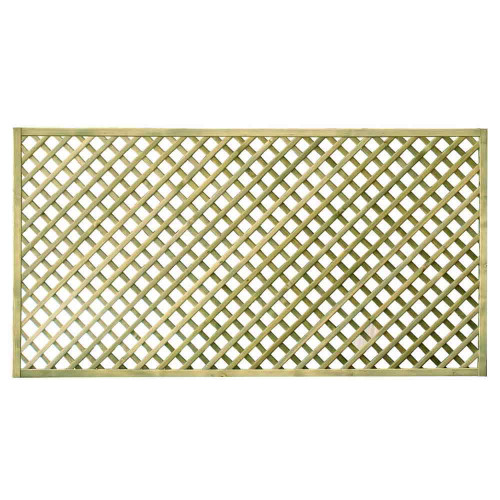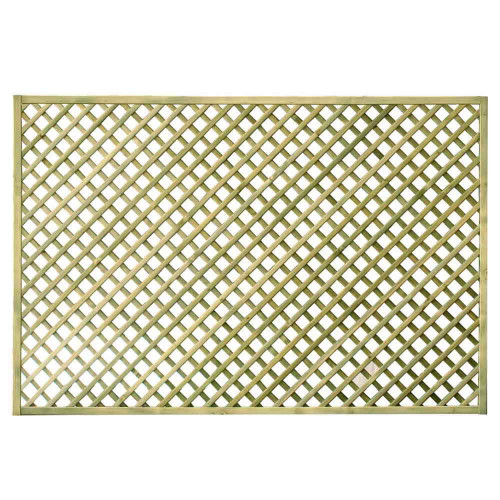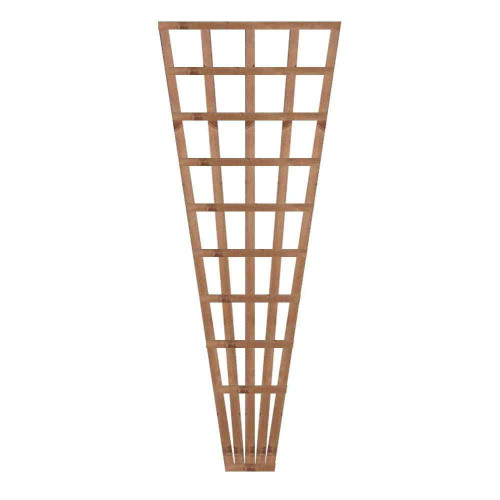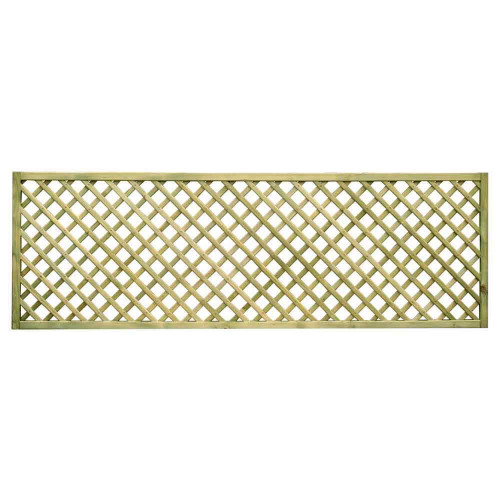



Quick answer: Choose Diamond Trellis when you need a broad rectangular panel for several plants, a garden divider, fence-top feature or larger wall area. Choose Fan Trellis when you are supporting one climbing plant in a narrower space such as between windows, beside a door or on a shed wall. Current Diamond Trellis panels are nominally 1.83m wide and available from roughly 300mm to 1.8m high, while current Fan Trellis is approximately 1.83m high and available in around 900mm and 1.2m widths.
Diamond Trellis and Fan Trellis can both support climbing plants, but they are designed around very different garden spaces.
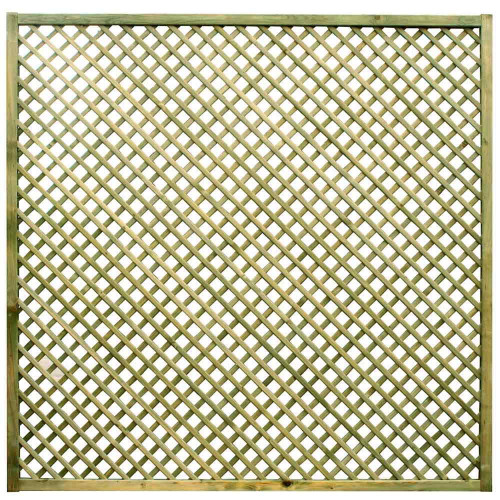
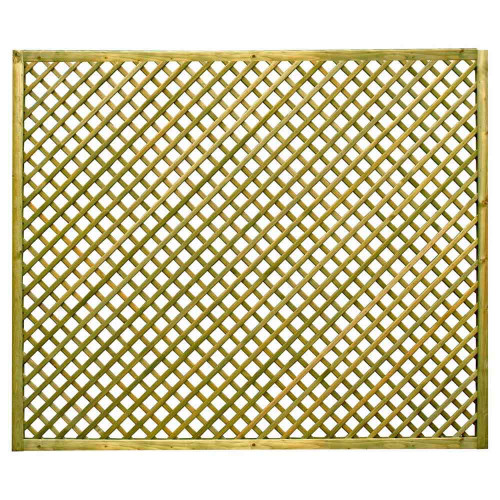
Diamond Trellis is a rectangular panel. Its diagonal lattice covers the full width and height, making it useful where planting needs to spread across a broad area.
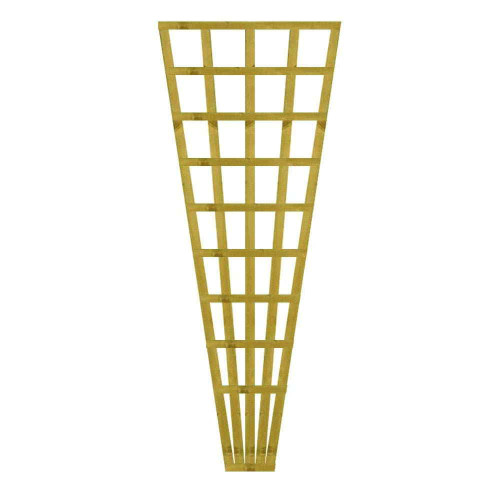
Fan Trellis starts narrower and spreads towards the top. It is primarily a focused plant support rather than a continuous screening panel.
The best choice therefore depends less on which lattice looks more attractive and more on the shape of the space you need to fill.
A climbing rose across a 1.83m-wide boundary and a clematis between two windows need very different supports.
What Is Diamond Trellis?
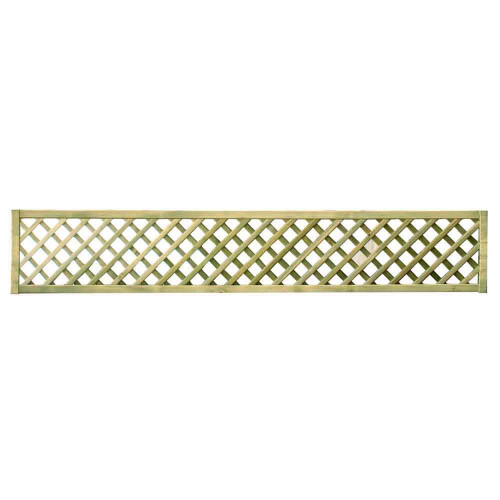
Diamond Trellis is a framed rectangular timber panel with lattice battens arranged diagonally.
The crossing battens create the repeating diamond pattern that gives the range its name.
Current East Coast Fencing Diamond Trellis is supplied in a nominal 6ft width, approximately 1.83m, with heights including approximately:
- 300mm
- 600mm
- 900mm
- 1.2m
- 1.5m
- 1.8m
The range is pressure treated in a green or natural-looking finish for exterior use.
Diamond Trellis is particularly useful for:
- Broad climbing displays
- Decorative garden screens
- Fence toppers
- Freestanding garden divisions
- Large wall-mounted planting areas
What Is Fan Trellis?
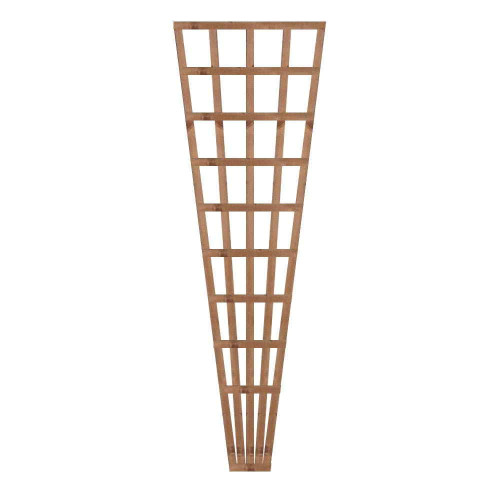
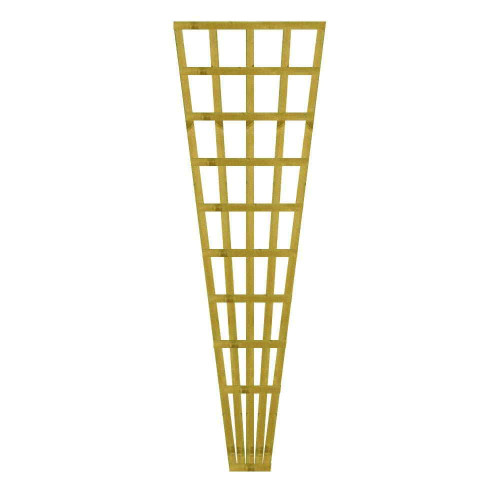
Fan Trellis is a tall tapered plant support.
Rather than maintaining the same width from top to bottom, the timber spreads outward as it rises.
This creates a fan-shaped outline designed to give an individual climber increasing space as it grows upwards.
Current East Coast Fencing Fan Trellis products include nominal sizes around:
- 1.83m high x 900mm wide
- 1.83m high x 1.2m wide
Brown and green or natural-looking pressure-treated options are available across suitable products.
Current Fan Trellis is manufactured in-house from rough-sawn pressure-treated trellis timber.
It works particularly well:
- Between windows
- Beside doors
- Against shed walls
- On brick or rendered walls
- Behind a single climbing plant
- In narrow planting beds
Diamond Trellis vs Fan Trellis At A Glance
| Feature | Diamond Trellis | Fan Trellis |
|---|---|---|
| Shape | Rectangular panel | Tapered fan shape |
| Typical width | Approx. 1.83m | Approx. 900mm or 1.2m |
| Typical height | Approx. 300mm to 1.8m | Approx. 1.83m |
| Best use | Broad screens and climbing areas | Individual climbing plants |
| Fence topper | Suitable lower sizes | Not its main purpose |
| Freestanding screen | Yes, with suitable posts | Generally not intended for continuous screening |
| Narrow wall position | May be too wide | Particularly useful |
| Privacy | Light screening | Very limited |
Which Is Better For A Single Climbing Plant?
Fan Trellis is usually the more purpose-specific choice.
Its narrow base allows it to sit directly behind an individual plant without covering a large area of wall.
As the fan widens, the climber gains more space to spread laterally.
This makes it useful where you have:
- One clematis
- One honeysuckle
- A compact jasmine
- A young climbing rose being trained in a defined area
Diamond Trellis can also support one plant, but a full approximately 1.83m-wide rectangular panel may be unnecessary if the available planting position is relatively narrow.
Which Is Better For Several Climbing Plants?
Diamond Trellis.
Its broad rectangular format provides much more continuous growing area.
You can position several plants along the base and train each one into a different section of lattice.
This can work particularly well:
- Along a long wall
- Behind a mixed border
- Between Wooden Fence Posts
- Along a garden division
Putting several Fan Trellis panels side by side is possible visually, but their tapered shapes leave gaps between the units and do not create the same continuous framework.
Which Is Better For Clematis?
Either can work.
Choose Fan Trellis where one clematis is being trained on a relatively narrow wall section.
The tall tapered form allows the plant to begin in a compact planting position before spreading out as it grows.
Choose Diamond Trellis where:
- The clematis has a broad wall to cover
- Several plants are being combined
- The climber forms part of a larger planted screen
The support should be selected around the available growing space rather than the plant name alone.
Which Is Better For Climbing Roses?
Diamond Trellis usually provides more useful area for a climbing rose that will be trained broadly across a wall or screen.
A mature climbing rose can develop long woody stems, so having a wide support gives more options for spreading growth rather than concentrating it vertically.
Fan Trellis can still work for a smaller or more contained rose where the wall space is narrow.
In either case, climbing roses generally require tying and training.
Do not expect the plant to attach itself securely to the trellis without assistance.
Which Is Better For Honeysuckle?
Both can be suitable.
Fan Trellis works well where the honeysuckle is intended to create one vertical planted feature.
Diamond Trellis is better where it is expected to spread across a wider screen or boundary.
As vigorous plants mature, prune enough growth to prevent the support becoming completely overloaded or inaccessible.
Which Is Better For Jasmine?
The same principle applies.
Choose Fan Trellis for a focused wall feature.
Choose Diamond Trellis for a wider growing surface.
Some climbing plants need initial tying and guidance before they establish themselves across the support, so do not assume the trellis shape alone determines how successfully the plant will cover it.
Which Is Better For Wisteria?
Neither ordinary lightweight trellis should automatically be treated as the complete long-term support for a large mature wisteria.
Wisteria can develop substantial woody growth and considerable mature weight.
A purpose-designed structural support is generally more appropriate.
Diamond or Fan Trellis may potentially form a decorative or training layer within a stronger arrangement, but the mature plant load should be carried by something substantial enough for that purpose.
Which Is Better For A Narrow Wall?
Fan Trellis has a clear advantage.
The current 900mm-wide option is useful where a nominal 1.83m-wide Diamond Trellis panel would be unnecessarily broad.
Typical narrow positions include:
- Between two windows
- Between a window and door
- Beside a Garden Gate
- A narrow shed wall
- A small planting bed against masonry
Remember that the fan becomes wider towards the top.
Measure the available space at the widest part of the intended installation rather than checking only the narrow base.
Which Is Better For A Wide Blank Wall?
Diamond Trellis usually makes better use of the available surface.
The approximately 1.83m-wide rectangular panel creates a broad planting framework immediately.
Several panels can also be installed side by side where a long wall needs covering.
This provides more predictable repeated spacing than trying to create a continuous wall feature from several tapered fans.
Can Diamond Trellis Be Fixed To A Wall?
Yes, using an appropriate support and fixing method for the wall construction.
Leaving practical space behind the trellis can help with:
- Plant stems
- Ties
- Air circulation
- Pruning
- Future wall maintenance
Large Diamond Trellis panels also need sufficient fixing points around their framed structure.
Can Fan Trellis Be Fixed To A Wall?
Yes.
This is one of its main uses.
Fan Trellis can be fixed to suitable:
- Brick walls
- Rendered walls with an appropriate fixing system
- Sheds
- Suitable timber structures
As with Diamond Trellis, the support should be secure before plants are trained onto it.
Do not fix the panel to unstable masonry or rotten timber and expect the plant to make the installation stronger.
Should Trellis Sit Directly Against The Wall?
A small working gap is often helpful.
It gives stems room behind the lattice and makes tying easier.
It also improves access when:
- Pruning
- Cleaning
- Maintaining the wall
- Replacing plant ties
The spacing should remain appropriate to the fixing arrangement.
Moving the trellis unnecessarily far from the wall increases leverage on the supports.
Which Is Better Between Wooden Fence Posts?
Diamond Trellis.
Its rectangular shape makes it naturally suited to framed bays between posts.
Current Diamond Trellis is nominally around 1.83m wide, which corresponds well with common fencing module widths when the actual installation dimensions are correctly planned.
The outer frame can be supported at both vertical edges.
Fan Trellis is not normally intended to fill a complete rectangular post-to-post opening.
Can Fan Trellis Be Installed Between Posts?
Potentially as a decorative planting feature, but it is not normally used as the infill for a continuous fence run.
Its tapered shape means significant open space remains around the sides, particularly near the bottom.
That is useful when the aim is to support one plant.
It is less useful when the aim is to create:
- A continuous boundary
- A repeatable garden screen
- A fence topper
Which Is Better As A Freestanding Garden Screen?
Diamond Trellis.
Its rectangular shape allows multiple panels to form a continuous run between suitable posts.
Taller sizes can create open garden divisions while retaining substantial light and visibility.
Fan Trellis is much better regarded as an individual planting structure.
Putting fans beside one another leaves tapered gaps and produces a very different result from a framed trellis screen.
Which Is Better For Garden Zoning?
Diamond Trellis is generally more suitable.
A rectangular screen provides a clear edge between areas such as:
- Patio and lawn
- Vegetable and ornamental garden
- Seating and planting areas
- Paths and borders
The lattice remains open enough that the two areas still feel visually connected.
Fan Trellis can mark an individual planting position but is not normally a substitute for a proper garden divider.
Which Is Better For Privacy?
Neither is intended for strong immediate privacy.
Diamond Trellis provides light screening across a much larger area because it is a complete rectangular panel.
Fan Trellis provides even less screening because its tapered outline leaves substantial open space around it.
If privacy is the main requirement, consider products designed around denser screening, such as:
- Privacy Square Trellis
- Horizontal Slatted Trellis
- Suitable solid Fence Panels
Choose Diamond and Fan Trellis primarily for plants and decoration.
Does Planting Make Diamond Trellis More Private?
Yes.
A climber spreading across the rectangular lattice can gradually interrupt more of the view.
This can turn a broad Diamond Trellis panel into a useful planted screen.
The amount of screening depends on:
- Plant type
- Plant maturity
- Season
- Pruning
Do not rely on a young climber for immediate privacy.
Does Fan Trellis Become A Privacy Screen When Planted?
It can screen the relatively small area directly behind the plant, but it does not become equivalent to a rectangular privacy panel.
The tapered structure still occupies a limited section of wall or boundary.
That makes it useful for softening a view rather than screening an entire patio or fence run.
Which Is Better For A Fence Topper?
Diamond Trellis.
The current range includes nominal 6ft x 1ft and 6ft x 2ft panels, approximately 1.83m wide by 300mm or 600mm high.
These lower rectangular sizes can create a consistent open lattice section above suitable fencing.
Fan Trellis is approximately 1.83m high rather than being a shallow horizontal topper.
Its shape is designed to rise behind an individual plant, not create a continuous strip across the top of Fence Panels.
Which Diamond Trellis Height Works Best As A Topper?
The 300mm version is mainly decorative.
It adds the diamond pattern and modest plant support without creating a deep upper screen.
The 600mm version provides considerably more planting area and visual impact.
Whichever height is used, check that the supporting posts and framing can carry the additional panel area and any mature plants.
Which Is Easier To Fit In An Awkward Space?
That depends on the shape of the space.
Fan Trellis is better when the space is naturally narrow and vertical.
Diamond Trellis is better when the space is rectangular but simply narrower than a standard panel.
A Diamond Trellis panel can potentially be shortened and reframed.
Fan Trellis should not normally be cut simply to make it narrower because altering the tapered shape can destroy the intended proportions and affect the way its battens are supported.
Which Is Easier To Cut?
Diamond Trellis can be modified, although its diagonal lattice makes cutting more involved than square trellis.
A shortened Diamond Trellis panel needs:
- A new supported frame edge
- Secure cut lattice ends
- A visually balanced remaining pattern
Fan Trellis is less suitable for modification.
Its shape is already carefully tapered from a narrower base to a wider top.
Cutting parts away can alter both its appearance and its structural arrangement.
Choose the closest suitable standard Fan Trellis size where possible.
Which Is Easier To Install Around Windows?
Fan Trellis is normally better.
The current widths of approximately 900mm and 1.2m suit many defined wall sections where a full-width Diamond Trellis would cover too much masonry.
Before fixing a fan between openings, measure:
- Available width at the bottom
- Available width at the widest upper section
- Clearance from window frames
- Space required for mature plant growth
Do not measure only the narrowest lower part of the fan.
Which Is Better Beside A Door?
Fan Trellis can work particularly well.
Its narrow lower section can sit beside the planting position while the top spreads into unused wall space.
Check that neither the timber nor the mature plant will interfere with:
- The door opening
- Handles
- Lights
- Drainpipes
- Other wall fittings
Which Is Better On A Shed?
Either can work depending on the available wall area.
Fan Trellis is useful on the side of a shed where one climber is being trained vertically.
Diamond Trellis is better where most of the shed wall is intended to become a planted feature.
Check the shed construction before fixing.
The trellis and mature plant should be secured into suitable structural timber rather than thin cladding that cannot carry the eventual load.
Which Is Better In A Small Garden?
Fan Trellis can be particularly efficient where every section of wall matters.
You can support one plant without covering an entire boundary with timber.
This works well in:
- Courtyards
- Small patios
- Narrow side gardens
- Compact planting areas
Diamond Trellis can also suit a small garden where a complete open screen is required.
Its lattice preserves more visual connection than a solid Fence Panel.
Which Creates The Stronger Decorative Feature?
Both are decorative, but in different ways.
Diamond Trellis creates a repeated geometric background across a large area.
It is particularly noticeable when:
- Used across several fence bays
- Mounted on a broad wall
- Used before plants establish
Fan Trellis creates a more focused feature.
Its widening silhouette draws attention to one plant and can help turn a plain section of wall into a dedicated planting display.
Which Works Better In A Cottage Garden?
Both work naturally with traditional planting.
Diamond Trellis suits:
- Long rose displays
- Mixed climbing screens
- Decorative boundaries
Fan Trellis is particularly effective where individual climbers are repeated around the garden as separate features.
For example, separate fans can be positioned beside doors, on shed walls and between windows without turning every available surface into one continuous trellis screen.
Which Gives Plants More Growing Area?
Diamond Trellis generally provides more total growing surface because of its broad rectangular format.
A full approximately 1.83m x 1.8m panel provides more than three square metres of overall screen area.
Fan Trellis is approximately 1.83m high but narrower and tapered.
It therefore concentrates the available support around one plant.
More area is not automatically better.
Use the amount of trellis the plant and garden position actually require.
Does A Larger Trellis Mean A Heavier Plant?
Potentially.
A larger support gives the plant more opportunity to spread.
As growth accumulates, the combined structure can carry:
- Woody stems
- Foliage
- Flowers
- Water after rainfall
A full Diamond Trellis screen can therefore carry substantially more mature plant mass than a single Fan Trellis.
The posts or wall fixings should reflect that difference.
How Does Planting Affect Wind Load?
Both types begin as open structures.
Wind can pass through the gaps between the timber.
As plants fill those openings, airflow is reduced.
A mature planted structure can therefore transfer more force into:
- Trellis frames
- Wall fixings
- Wooden Fence Posts
- Foundations
This is especially relevant to large full-height Diamond Trellis screens.
Do Climbing Plants Need Tying To Both Types?
Many do.
Different plants climb in different ways.
Some twine around suitable supports, while scrambling plants such as climbing roses normally need deliberate ties.
Use plant ties that allow room for growth.
Do not tighten wire or cord so severely that it damages the stem.
Should Plants Be Woven Through The Lattice?
Flexible young stems can often be guided around or through sections of trellis.
Avoid trapping substantial permanent woody stems so tightly that the panel can never be removed.
This matters with both Diamond and Fan Trellis.
Eventually you may need to:
- Prune the plant
- Repair the trellis
- Maintain the wall
- Replace the support
Keeping major stems accessible makes these jobs considerably easier.
Which Is Easier To Maintain Behind A Mature Plant?
Fan Trellis can be easier where the plant remains well managed because the installation occupies a smaller wall area.
Diamond Trellis gives more access points across its open lattice but may eventually carry a much larger volume of growth.
Whichever you choose, regular pruning helps preserve access to:
- Frame fixings
- Wall fixings
- Timber condition
- Plant ties
Can Both Be Painted?
A suitable exterior timber coating can generally be used where compatible with the pressure-treated timber and once the product is sufficiently dry and prepared.
It is much easier to decorate trellis before plants become established.
Both designs contain numerous:
- Edges
- Intersections
- Internal surfaces
that become difficult to reach behind mature growth.
Which Is Easier To Replace Later?
A rectangular Diamond Trellis panel installed between posts can often be treated as a replaceable framed component, provided plants have not become permanently entangled through it.
Fan Trellis can also be replaced relatively easily when plants have been tied to its face rather than woven tightly through every opening.
In both cases, consider future replacement when training the plant.
A support may eventually need maintenance before a long-lived climber does.
When Should You Choose Diamond Trellis?
Choose Diamond Trellis when:
- You need a broad rectangular climbing surface
- Several plants will share the support
- You want a freestanding open screen
- You need a decorative fence topper
- The trellis will span between Wooden Fence Posts
- You want to cover a wide wall
- You want the diagonal lattice to form part of the garden design
When Should You Choose Fan Trellis?
Choose Fan Trellis when:
- You are supporting one climbing plant
- The planting bed is narrow
- The available wall section is less than a full rectangular panel width
- You are fitting trellis between windows
- You are creating a feature beside a doorway
- You want the plant to spread wider as it grows upwards
- You do not need the trellis to form a continuous garden screen
Common Mistakes When Choosing Between Diamond And Fan Trellis
- Buying a full 1.83m-wide Diamond Trellis panel for one narrow planting position
- Trying to create a continuous fence from tapered Fan Trellis panels
- Assuming either product provides strong immediate privacy
- Ignoring the widest part of Fan Trellis when measuring between windows
- Forgetting that Diamond Trellis width and Fan Trellis dimensions are orientated differently
- Cutting Fan Trellis and destroying the intended tapered shape
- Cutting Diamond Trellis without rebuilding the frame edge
- Fixing large planted Diamond Trellis only into weak wall surfaces
- Choosing support strength from the young plant rather than its mature size
- Allowing climbing roses to become concentrated on one small area
- Using ordinary lightweight trellis as the sole support for mature wisteria
- Installing trellis flat against a wall with no practical room for plant ties
- Allowing dense plants to hide loose fixings for years
FAQs
What Is The Difference Between Diamond Trellis And Fan Trellis?
Diamond Trellis is a rectangular diagonal-lattice panel used for broad planting areas, screens and fence toppers. Fan Trellis is a tapered plant support designed primarily for individual climbers and narrower wall spaces.
Which Is Better For A Single Clematis?
Fan Trellis is often the more efficient choice where one clematis is growing in a narrow wall position. Diamond Trellis provides more room where the plant is intended to spread broadly.
Which Is Better For Climbing Roses?
Diamond Trellis is usually better for large climbing rose displays because its rectangular width gives more room for spreading and tying stems. A Fan Trellis can suit a smaller rose in a defined wall position.
What Size Is Fan Trellis?
Current East Coast Fencing Fan Trellis includes panels approximately 1.83m high with widths around 900mm and 1.2m. Check the product orientation carefully because fan trellis is tall and relatively narrow.
What Size Is Diamond Trellis?
Current Diamond Trellis is nominally approximately 1.83m wide and available in heights from around 300mm through to 1.8m.
Can Fan Trellis Be Used As A Fence Panel?
It is not normally intended as a continuous fence panel. Its tapered shape leaves open areas around the lower sides. Rectangular Diamond Trellis is much better suited to framed bays between posts.
Can Diamond Trellis Be Used As A Fence Topper?
Yes. Lower current sizes around 300mm and 600mm high can form decorative open toppers where the existing fence posts or supporting structure are suitable.
Can You Cut Fan Trellis To Size?
Cutting is generally best avoided because altering the timber can spoil the tapered pattern and weaken the intended structure. Choose the closest suitable standard width where possible.
Choose Diamond Trellis For An Area, Fan Trellis For A Plant
The easiest way to choose between Diamond Trellis and Fan Trellis is to think about what you are trying to support.
If you are creating a broad planted surface, use Diamond Trellis.
Its nominal approximately 1.83m width makes it suitable for walls, post-to-post bays, freestanding garden divisions and fence-top applications. The range of heights from roughly 300mm to 1.8m also allows the same pattern to be used for shallow decorative features or substantial climbing screens.
If you are creating one focused climbing feature, Fan Trellis is often more efficient.
Its approximately 1.83m height gives a plant room to climb, while the current 900mm and 1.2m widths allow it to fit places where a full rectangular panel would be unnecessarily large.
Neither design should be chosen for strong immediate privacy.
Both are primarily open plant supports, and both need suitable wall fixings, fencing supports or structural framing for the mature plant they will eventually carry.
Diamond Trellis is best thought of as a panel that can support plants.
Fan Trellis is best thought of as a dedicated support built around an individual climbing plant.