


Quick answer: Concrete gravel boards can crack when they are unevenly supported, forced into incorrectly spaced posts, subjected to ground movement, hit by garden machinery or made to retain more soil than the fencing system was designed to hold. A small surface mark does not automatically mean the board has failed. Replacement becomes more important when a crack passes substantially through the board, reinforcement is exposed, sections have separated or the fence panel above is no longer securely supported.
A concrete gravel board is designed to form a durable base beneath a timber fence panel.
Concrete does not rot, which makes it particularly useful at ground level where soil, rain splash, vegetation and garden debris create difficult conditions for timber.
That does not mean a concrete gravel board is impossible to damage.
If a board cracks, the useful question is not simply whether concrete can crack. You need to work out what caused the damage, whether the board is still doing its job and whether fitting another board without changing anything will result in the same problem.
Why Has My Concrete Gravel Board Cracked?
Several different problems can place stress on a concrete gravel board.
| Possible Cause | What You May Notice | What To Check |
|---|---|---|
| Uneven support | Crack through part of the board | Ground beneath the board |
| Ground movement | Board or posts no longer level | Post alignment and ground levels |
| Posts too close together | Board looks tightly wedged | Clear distance between slots |
| Soil pressure | Board bows, cracks or moves | Difference in ground level |
| Impact damage | Chip, local crack or broken corner | Mowers, tools and stored materials |
| Cutting or alteration | Crack near modified edge | Whether the board has been cut |
The location and shape of the damage often provides useful clues.
A board that has cracked after the surrounding posts moved presents a different problem from a board with one chipped corner caused by an impact.
Can Poor Ground Support Crack A Gravel Board?
Yes.
A concrete gravel board should have suitable support rather than being left to bridge an unstable or badly uneven section of ground.
If most of the board is supported but one area is left hanging over a hollow, loads can become concentrated instead of being distributed along the board.
Similarly, one isolated stone or lump of old concrete beneath the board can create a high point.
The aim is not necessarily to build a continuous concrete foundation beneath every gravel board. It is to make sure the board has a suitable firm bearing and is not being twisted or point-loaded by the ground beneath it.
Can Ground Movement Cause Concrete Gravel Boards To Crack?
Yes.
The gravel board is only one part of a complete fence system.
If the surrounding ground moves, the posts can move with it. That changes the relationship between the two post slots holding the board.
You may notice:
- One post leaning
- The gravel board no longer sitting level
- The fence panel above becoming uneven
- A gap opening at one end of the board
- The board becoming tightly trapped between the posts
Replacing the board without investigating the posts can result in another damaged board.
Check the post alignment before treating the concrete gravel board as the only failed component.
Can Concrete Posts Put Pressure On The Gravel Board?
They can if the spacing is wrong or if the posts have moved.
Current East Coast Fencing concrete gravel boards intended for standard fencing bays are commonly approximately 1.83m long.
The posts need to be positioned so the board engages properly with both slots without being forced into the opening.
If posts are set too close together, forcing the board into place can place unnecessary stress on the concrete.
The same problem can develop later if originally correct posts begin leaning towards each other.
When repairing an old fence, measure the clear opening rather than assuming the posts remain exactly where they were first installed.
Should A Gravel Board Be Tight Between Concrete Posts?
It should sit securely within the slots, but it should not need to be hammered or aggressively forced into position.
A board that only fits when considerable pressure is applied may indicate:
- The bay is too narrow
- One or both posts are leaning
- Debris is obstructing a slot
- The replacement board has a different profile
- The existing post system is not compatible with that particular board
Concrete gravel boards are not all interchangeable simply because they share a similar nominal length.
Are All Concrete Gravel Boards The Same Thickness?
No.
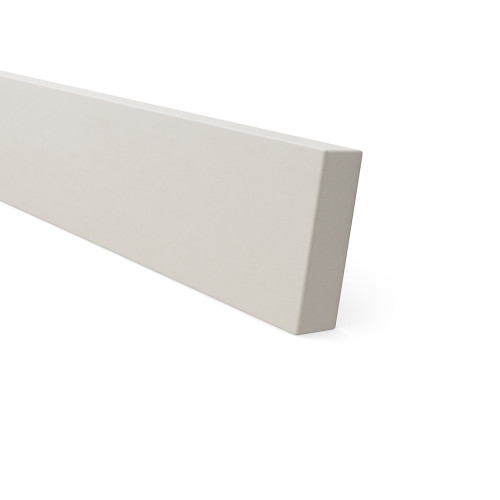
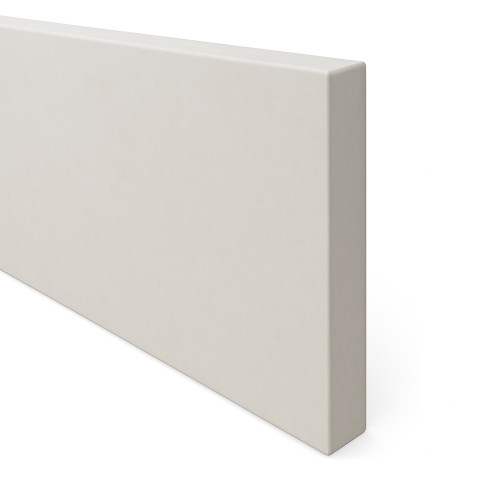
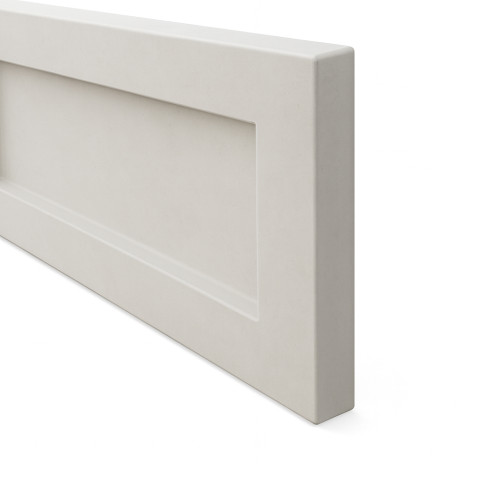
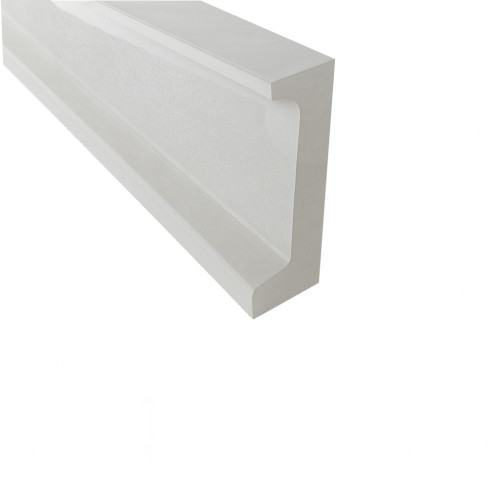
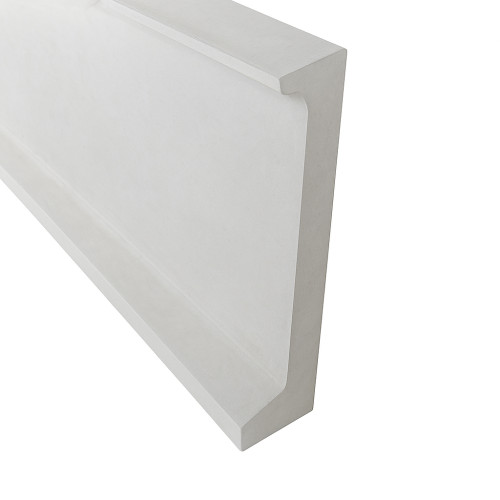
The current East Coast Fencing range includes several concrete gravel board types, including:
- 6-inch smooth boards
- 12-inch smooth boards
- 12-inch recessed boards
- 6-inch lightweight rebated boards
- 12-inch lightweight rebated boards
- 12-inch smooth boards with a hedgehog opening
Current traditional smooth and recessed products are approximately 45 to 55mm deep, depending on the exact board.
A rebated gravel board has a different profile and should not automatically be treated as a direct replacement for every smooth or recessed board.
Check the exact dimensions and profile before fitting a replacement into existing concrete posts.
Does Steel Reinforcement Stop Concrete Gravel Boards Cracking?
No.
Current East Coast Fencing concrete gravel boards are steel reinforced and vibration finished.
The reinforcement provides additional internal support, but it does not make the concrete immune to damage.
A board can still crack if it is:
- Badly supported
- Forced into an unsuitable opening
- Placed under significant sideways pressure
- Hit or mishandled
- Cut or altered incorrectly
Reinforcement can also mean that a badly cracked board remains in one piece rather than immediately falling apart.
That should not be mistaken for proof that the board remains suitable to support the fence.
Is A Hairline Crack In A Concrete Gravel Board Serious?
Not every visible line requires immediate replacement.
Look at the condition of the whole board.
A relatively minor surface mark on a board that remains:
- Straight
- Secure in both slots
- Properly supported
- Stable beneath the fence panel
is different from a crack associated with movement or separation.
Monitor the board and check whether the crack changes.
More concern is justified where the board is visibly moving, bowing, opening along the crack or no longer supporting the panel evenly.
When Does A Cracked Gravel Board Need Replacing?
Replacement becomes more sensible where:
- The board has broken into separate sections
- Steel reinforcement is exposed
- A substantial crack passes through the board
- A large section has broken away
- The board no longer sits securely in the post slots
- The fence panel above has become unstable
- The board has moved significantly out of position
Do not judge the repair only by appearance.
The gravel board has a practical role in supporting and positioning the fencing above it.
Can Soil Behind A Gravel Board Make It Crack?
It can.
A standard gravel board should not automatically be treated as a retaining wall.
There is an important difference between a gravel board sitting against normal garden soil at ground level and a board being expected to hold back a substantial raised area.
Soil creates sideways pressure.
That pressure becomes particularly relevant where one garden is significantly higher than the other.
Possible consequences include:
- Cracked gravel boards
- Boards pushed out of alignment
- Fence posts leaning
- Panel alignment changing
- Foundations being placed under additional load
If a gravel board repeatedly cracks along a boundary with a significant difference in level, consider whether the real problem is the lack of a suitable retaining structure.
Can You Use A 12-Inch Gravel Board To Retain More Soil?
A 12-inch board is taller, but that does not automatically turn it into a retaining wall.
Current 12-inch boards are approximately 305mm high, compared with approximately 150mm for a 6-inch board.
The taller board provides a deeper concrete section below the fence panel, but the fence system still needs to be considered as a complete structure.
The important questions are:
- How much soil is being retained?
- How large is the difference in ground level?
- Are the posts and foundations designed for the load?
- Is the soil placing continuous pressure against the board?
Choosing a taller gravel board is not a substitute for proper retaining work where significant ground levels need to be supported.
Can A Lawn Mower Or Strimmer Damage A Concrete Gravel Board?
Impact can damage concrete.
Gravel boards are positioned at the lowest part of the fence, which puts them close to lawn mowers, wheelbarrows, garden tools, paving work and other everyday activity.
A relatively small impact may chip an edge.
A harder impact can create a crack or break a corner.
This does not mean concrete is unsuitable at ground level. One of its advantages is that it avoids the rot associated with timber in damp locations.
It simply means concrete components should still be protected from unnecessary impacts.
Can Moving A Concrete Gravel Board Cause Damage?
Yes.
Concrete gravel boards are long, rigid components.
A standard board approximately 1.83m long can be awkward to carry through side passages, around corners and between existing posts.
Use enough people or suitable handling equipment.
Avoid:
- Dropping the board onto hard ground
- Allowing one end to fall while the other is held
- Knocking edges against concrete posts
- Using the board as a lever
- Dragging it across hard surfaces
Inspect boards before installation so transport or handling damage is not mistaken for a problem that developed after the fence was built.
Can You Cut A Concrete Gravel Board?
Concrete gravel boards should not normally be cut as a routine way of correcting an incorrectly sized bay.
Current products contain steel reinforcement.
Cutting can:
- Expose reinforcement
- Weaken the board
- Create cracks
- Leave a poor edge
- Create hazardous dust
It is much better to plan post positions around the actual board dimensions before installation.
For unusual bay widths, a timber gravel board may sometimes provide an easier component to customise because timber can be cut to the required length.
Can Cracks Start Around A Hedgehog Opening?
A purpose-designed hedgehog gravel board is manufactured with an opening already formed within the concrete.
This is preferable to trying to cut a wildlife opening into a standard reinforced board after manufacture.
Current East Coast Fencing wildlife-access boards are approximately 1.83m long and 305mm high and are steel reinforced.
If a purpose-made board develops damage, inspect it in the same way as any other concrete gravel board.
Check whether the board remains properly supported, whether the surrounding posts have moved and whether any significant crack affects its ability to remain secure within the fence system.
Can A Cracked Gravel Board Damage The Fence Panel?
It can affect the panel if the board stops providing even support.
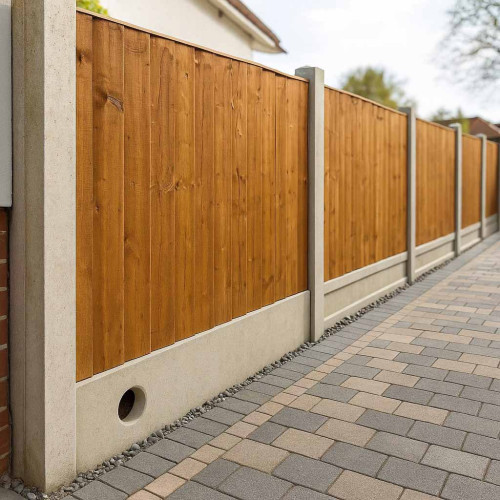
In a common slotted concrete-post system, the gravel board sits below the timber fence panel.
If one side of the gravel board drops or breaks away, the panel above may:
- Sit unevenly
- Drop further into one slot
- Develop a larger gap above one side
- Move more than intended
- Become easier to lift from the opposite side
A badly damaged gravel board should therefore be treated as part of the complete fence rather than merely a cosmetic concrete defect.
Do You Have To Replace The Fence Panel As Well?
No.
If the timber fence panel remains structurally sound, it can normally be reused after the gravel board has been replaced.
Inspect the panel while it is removed.
Check:
- The bottom frame
- The side framing
- Backing rails
- Loose boards
- Rot or deterioration
- Whether the panel remains square
One advantage of a slotted concrete fencing system is that individual panels and gravel boards can be assessed separately.
Can You Replace Just One Cracked Gravel Board?
Yes.
You do not normally need to replace every gravel board simply because one bay has failed.
Before ordering the replacement, measure the existing board and inspect neighbouring bays.
Confirm:
- The length
- The height
- The board profile
- The thickness
- The post spacing
- The condition of both concrete posts
If several boards have cracked in the same fence run, look for a shared cause such as ground movement, poor support or soil pressure rather than assuming several unrelated boards happened to fail.
How Do You Replace A Cracked Concrete Gravel Board?
With standard slotted concrete posts, the fence panel normally needs to be removed first because it sits directly above the gravel board.
A typical sequence is:
- Clear the bay: Remove vegetation, soil and objects that obstruct safe access.
- Lift out the fence panel: Use enough people to handle it safely and place it somewhere stable.
- Remove the damaged board: Lift it vertically from the concrete post slots.
- Inspect the posts: Check they remain upright, stable and correctly spaced.
- Check the ground: Correct obvious high points, hollows or unstable support where appropriate.
- Fit the replacement: Lower the compatible gravel board into both slots without forcing it.
- Check the board: Make sure it sits level and securely.
- Refit the panel: Lower the existing fence panel back into the slots if it remains sound.
How Can You Help Prevent Concrete Gravel Boards Cracking?
Most practical precautions involve reducing unnecessary stress on the board.
- Measure the actual gravel board before setting posts.
- Keep concrete posts upright and accurately spaced.
- Do not force a board into tight slots.
- Provide suitable firm support beneath the board.
- Remove isolated stones or concrete lumps that create pressure points.
- Plan stepped fencing properly on sloping ground.
- Do not assume standard gravel boards can retain substantial differences in soil level.
- Handle boards with enough people or appropriate equipment.
- Protect them from avoidable impact.
- Use the correct smooth, recessed or rebated profile for the fencing system.
- Avoid cutting reinforced concrete boards simply to correct inaccurate post spacing.
What Should You Check If A Replacement Board Cracks Again?
Repeated failure strongly suggests that the board itself is not the whole problem.
Check:
- Whether the posts are moving
- Whether the opening is too narrow
- Whether the board is bridging soft ground
- Whether one point beneath it is carrying excessive load
- Whether soil is pushing against one face
- Whether roots or ground movement are disturbing the fence
- Whether the wrong gravel-board profile has been installed
Simply fitting a third board into the same conditions is unlikely to be a satisfactory repair.
FAQs
Do Concrete Gravel Boards Crack Easily?
A correctly fitted board should provide a durable base beneath fencing, but concrete can still crack if it is badly supported, forced into an unsuitable opening, subjected to ground movement or damaged by impact.
Does A Small Crack Mean The Gravel Board Has Failed?
Not automatically. Check whether the board remains straight, securely supported and stable within both post slots. Significant movement, separation or exposed reinforcement is more concerning.
Can You Leave A Cracked Gravel Board In Place?
A minor stable mark may simply need monitoring. Replace the board where the crack affects its structural condition, the board has separated or the fence panel above is no longer properly supported.
Can Soil Pressure Crack A Gravel Board?
Yes. Standard gravel boards should not automatically be treated as retaining walls. Significant differences in ground level can place sideways pressure on the complete fence system.
Can You Repair A Concrete Gravel Board With Cement?
A cosmetic patch does not correct movement, poor support, exposed reinforcement or a board that has separated structurally. Establish the cause and condition of the board before deciding whether repair or replacement is appropriate.
Are Concrete Gravel Boards Reinforced?
Current East Coast Fencing concrete gravel boards are steel reinforced and vibration finished. Reinforcement improves the construction but does not make a board immune to cracking or impact damage.
Can You Replace One Concrete Gravel Board?
Yes. An individual board can normally be replaced while retaining sound neighbouring boards, posts and fence panels.
Should Concrete Gravel Boards Be Forced Into Post Slots?
No. If a board will not fit naturally, check the post spacing, slot condition and board profile. Forcing it can damage either the board or the concrete posts.
Find The Cause Before Fitting Another Board
A cracked concrete gravel board does not necessarily mean the complete fence has failed.
Start by looking at how the board is supported and whether the posts remain upright and correctly spaced.
Then consider what is happening around it. Ground movement, concentrated support, significant soil pressure, impact damage and forcing incompatible components together can all place unnecessary stress on the board.
If the damage is minor and the board remains secure, monitoring may be sufficient. If reinforcement is exposed, sections have separated or the panel above is no longer properly supported, replacement is the more sensible approach.
Most importantly, do not replace a repeatedly cracked gravel board without investigating the reason it failed. Correcting the underlying installation or ground problem gives the replacement board a much better chance of doing its job properly.