


Quick answer: Smooth and recessed concrete gravel boards perform the same basic job of keeping timber fence panels away from damp ground. The main difference is appearance. Smooth boards have a plain face, while recessed boards have a moulded inset design that gives the concrete base more visual detail. East Coast Fencing currently offers 12-inch smooth and recessed boards at approximately 1.83m long and 305mm high. If you need a lower 6-inch board, smooth options are also available.
Once you have decided to use concrete gravel boards, there is another choice to make.
Should the boards be smooth or recessed?
The difference is much more about appearance than basic function. Both create a durable concrete section beneath a timber Fence Panel. Both keep the main panel away from wet soil, grass and garden debris. Both can form part of a slotted Concrete Fence Post system.
The decision becomes more important when the gravel board is clearly visible.
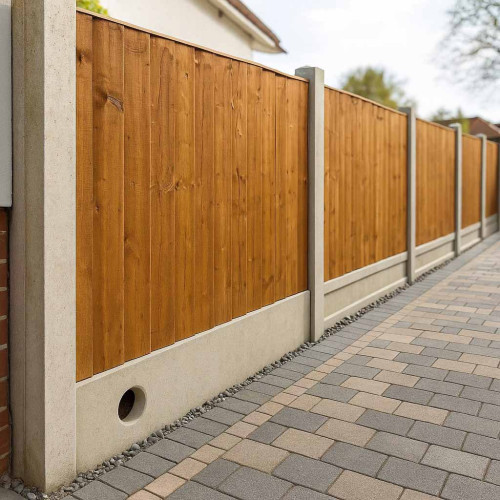
A 12-inch board is approximately 305mm high, so it forms a noticeable part of the finished fence. A smooth face looks simple and understated. A recessed face makes the lower section look more decorative and defined.
What Is A Smooth Concrete Gravel Board?
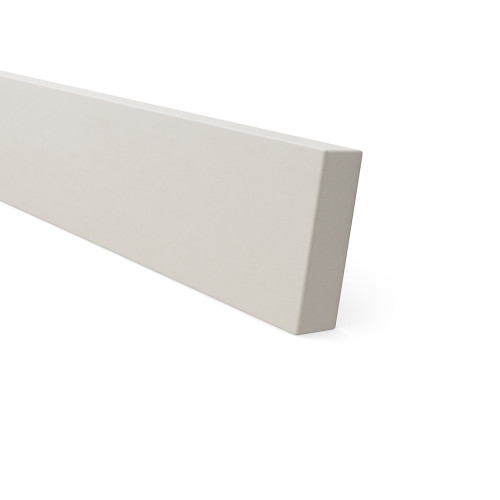
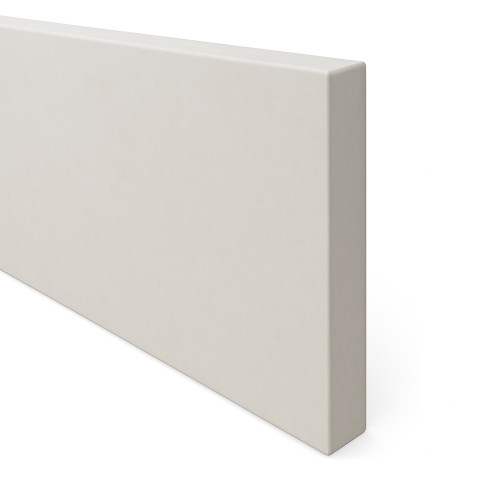
A smooth concrete gravel board has a plain face without a moulded decorative recess.
It creates a simple concrete strip beneath the Fence Panel.
East Coast Fencing's current traditional smooth range includes:
- 6-inch smooth concrete gravel boards, approximately 150mm high
- 12-inch smooth concrete gravel boards, approximately 305mm high
Current standard boards are approximately 1.83m long and around 45 to 55mm deep depending on the product.
They are steel reinforced and vibration finished.
A smooth board is a practical choice when you want the concrete base to do its job without becoming a strong visual feature.
What Is A Recessed Concrete Gravel Board?
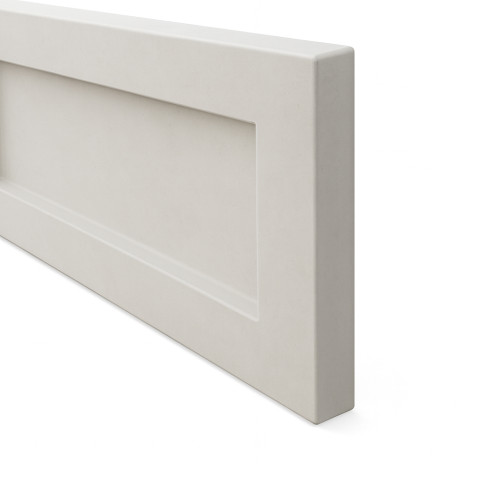
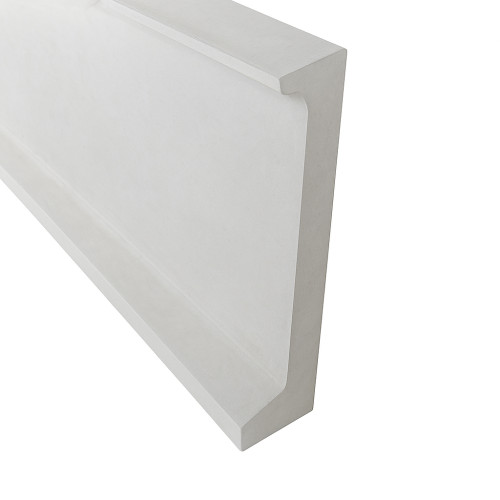
A recessed concrete gravel board has a moulded face with an inset section.
Instead of presenting one completely plain concrete surface, the board has a framed-looking panel within its face.
East Coast Fencing's current recessed option measures approximately:
- 1.83m long
- 305mm high
- 45 to 55mm deep
This makes it a nominal 12-inch gravel board.
Like the traditional smooth boards, it is steel reinforced and vibration finished.
The recessed detail is primarily an appearance choice. It does not change the fundamental reason for installing the board beneath a Fence Panel.
Smooth vs Recessed Gravel Boards At A Glance
| Feature | Smooth Concrete Gravel Board | Recessed Concrete Gravel Board |
|---|---|---|
| Face | Plain | Moulded recessed detail |
| Appearance | Simple and understated | More decorative and defined |
| Current 6-inch option | Yes | No current traditional recessed 6-inch option |
| Current 12-inch option | Yes | Yes |
| Typical length | Approximately 1.83m | Approximately 1.83m |
| Main purpose | Protect and support fencing above | Protect and support fencing above |
| Best reason to choose | You prefer a plain concrete base | You want the base to have more visual detail |
Is A Recessed Gravel Board Stronger Than A Smooth One?
You should not choose between smooth and recessed boards on the assumption that the decorative face automatically makes one stronger.
The main practical distinction in the current traditional range is the face design.
Both are reinforced concrete products intended to form the lower section of a compatible fence system.
Overall fence strength depends on much more than the pattern on the gravel board.
Important factors include:
- Concrete Fence Post type
- Post length
- Post foundation
- Ground conditions
- Post spacing
- Fence Panel construction
- Wind exposure
If structural performance is the concern, look at the complete fence rather than treating the face pattern as a strength rating.
Do Smooth And Recessed Gravel Boards Protect Fence Panels Differently?
Their basic function is the same.
Both put a concrete component between the timber Fence Panel and the ground.
This helps reduce direct exposure of the panel to:
- Damp soil
- Wet grass
- Rain splash
- Leaves
- Mulch
- Garden maintenance damage
Concrete also avoids the ground-level timber rot that can eventually affect Wooden Gravel Boards.
Whether the face is smooth or recessed does not materially change this basic purpose.
Which Looks Better With Traditional Fence Panels?
A recessed board can work particularly well where you want the concrete base to look like an intentional decorative part of the fence.
The moulded face adds detail beneath traditional panel styles such as:
- Closeboard Fence Panels
- Waney Lap Fence Panels
- Other conventional timber privacy panels
A smooth board creates a more restrained result.
Neither is inherently more traditional.
Concrete posts and boards are already common in established British gardens. The choice comes down to how prominent you want the lower concrete section to appear.
Which Looks Better With Decorative Fence Panels?
This depends on the panel.
Contemporary panels such as Double Slatted or Hit & Miss fencing already contain strong repeated horizontal patterns.
A plain smooth board can provide a visually quieter base beneath them.
A recessed board introduces another pattern into the same elevation.
That may work well if you want a more detailed boundary, but it can also make the lower section more prominent.
Stand back and consider the complete fence rather than comparing the gravel boards in isolation.
Which Gravel Board Looks Less Noticeable?
Smooth is normally the more understated choice.
Its plain face tends to visually recede beneath the timber panel.
This can be useful if:
- You want the Fence Panel to remain the main visual feature
- The concrete base is mainly there for practical reasons
- You prefer simple garden details
- The fence already contains a strong decorative pattern
A 12-inch board will still be noticeable because it is approximately 305mm high, but the smooth face gives it less visual emphasis.
When Does A Recessed Board Make More Sense?
A recessed board is worth considering where the gravel board will be clearly visible and you want it to contribute to the appearance of the boundary.
This may suit:
- Long straight fence runs
- Traditional rear gardens
- Boundaries where 305mm of concrete will remain visible
- Fences where a framed concrete appearance complements the panels
The important point is consistency.
If recessed boards are used, install them with the decorative faces orientated consistently along the fence run.
Can You Get A 6-Inch Recessed Concrete Gravel Board?
East Coast Fencing's current traditional recessed concrete gravel board is a 12-inch, approximately 305mm-high product.
The traditional smooth range includes both 6-inch and 12-inch options.
This means the required board height may decide the issue before appearance does.
If you need approximately 150mm of concrete beneath the panel, a 6-inch smooth board is one of the current conventional options.
If you want a recessed face, you need to allow for approximately 305mm of gravel-board height in the current range.
Why Does The 12-Inch Height Matter?
A 12-inch gravel board adds approximately 305mm beneath the Fence Panel.
That is a substantial part of the total boundary.
For example, placing a 1.8m Fence Panel above a 305mm gravel board gives a combined panel-and-board section of approximately:
1.8m + 0.305m = 2.105m.
This is considerably taller than the nominal 1.8m panel itself.
If you want a finished section closer to 1.8m, you could instead consider a 1.5m panel above the 305mm board:
1.5m + 0.305m = 1.805m.
The height calculation matters regardless of whether the board is smooth or recessed.
Does A Recessed Board Need Different Fence Posts?
It needs to be compatible with the post system being used.
Current traditional 12-inch smooth and recessed boards are designed around suitable concrete fencing arrangements.
Before ordering, check:
- Board length
- Board thickness
- Concrete-post slot dimensions
- Clear distance between posts
- Available post height
Do not assume every concrete board fits every old concrete post simply because the visible dimensions appear similar.
Can You Replace A Smooth Board With A Recessed Board?
Potentially, where the dimensions and concrete-post system are compatible.
If replacing a 12-inch smooth board with a 12-inch recessed version, check the actual bay before ordering.
Measure:
- The clear slot-to-slot opening
- The existing board height
- The thickness or profile
- The condition of both posts
Older posts may have moved slightly over time.
A board that theoretically belongs in a standard 1.83m bay should not be forced between posts that have leaned towards one another.
Can You Replace A Recessed Board With A Smooth Board?
Yes, where a compatible smooth board has the required dimensions.
The main change will usually be visual.
One smooth board in a long run of recessed boards will stand out because the face pattern changes.
If appearance matters, matching the surrounding boards is normally the neater repair.
If several old boards need replacing, it may be worth deciding whether to continue the existing style or replace a complete visible section consistently.
Can You Mix Smooth And Recessed Gravel Boards?
You can where the products are dimensionally compatible, but it may create a visibly inconsistent fence.
A mixed run can look accidental because the lower concrete pattern changes from bay to bay.
There are situations where mixing may be less noticeable, such as:
- A board on a separate fence run
- A section hidden behind planting
- A boundary divided by a gate
- A repair where appearance is unimportant
For a continuous visible run, matching the board face usually produces the tidier result.
Do Recessed Gravel Boards Have A Front And Back?
The recessed board has a decorative face, so orientation matters visually.
Plan which side will face the garden before installation.
Keep every board facing the same direction along the run.
This should be decided before the heavy boards are lowered fully into the post slots.
Turning one later can mean removing the Fence Panel above it again.
Can A Smooth Gravel Board Be Installed Either Way Round?
A smooth board has less obvious visual direction than a recessed design, but you should still inspect the product and install the visible faces consistently.
Small manufacturing and surface differences can become more noticeable when several boards are viewed together.
Consistency normally gives the best finished appearance.
Are Recessed Boards Harder To Clean?
The moulded recess creates additional edges where dirt and organic growth can collect compared with a completely plain face.
This does not make the board difficult to maintain.
Ordinary cleaning may involve:
- Brushing away loose soil
- Removing leaves and vegetation
- Cleaning surface algae where required
A smooth board is slightly simpler because there are fewer moulded details.
Neither should need intensive routine maintenance.
Do Concrete Gravel Boards Need Painting?
No.
Painting is a decorative choice rather than a requirement for the concrete board to perform its basic fencing role.
If you decide to paint concrete gravel boards, use a suitable exterior masonry or concrete coating and prepare the surface according to the coating manufacturer's instructions.
Remember that a recessed board has more edges and moulded details to coat consistently.
A smooth board will generally be simpler to paint.
Do Smooth Boards Show Dirt More Easily?
A plain surface can make streaks or isolated marks more visible because there is no pattern to break them up.
A recessed board may visually disguise some minor variation because the moulded face naturally creates changes in shadow.
In practice, both are installed close to soil and garden vegetation, so some weathering and staining should be expected.
Do not choose either style on the expectation that exterior concrete will remain visually unchanged.
Will Smooth And Recessed Concrete Change Colour Over Time?
Outdoor concrete can change appearance as it weathers.
You may see:
- Dirt
- Algae
- Rain marks
- General colour variation
New replacement boards may also initially look different from older concrete that has spent years outdoors.
This does not automatically indicate a problem with the new or old component.
Which Is Better Beside A Lawn?
Either works well.
A smooth board provides a simple hard edge beneath the fence and is straightforward to brush clean.
A recessed board gives the same basic protection with a more decorative visible face.
Concrete is particularly useful beside grass because it does not suffer the timber damage that can result from repeated dampness or accidental contact with garden machinery.
Even so, avoid repeatedly striking the concrete with lawn equipment.
Which Is Better Beside Flower Beds?
Both tolerate soil and moisture better than a timber gravel board.
This makes concrete a practical choice where planting sits close to the boundary.
However, do not confuse moisture resistance with retaining capacity.
A normal smooth or recessed gravel board should not automatically be used to retain a substantial raised bed.
Wet soil creates sideways pressure on the board and posts.
Where there is a meaningful difference in ground level, use a properly considered retaining structure rather than asking the fence to carry a load it was not designed around.
Which Is Better For Sloping Gardens?
The face pattern does not fundamentally change how rigid concrete boards deal with a slope.
Both smooth and recessed boards are normally installed level within each individual bay.
The fence then steps up or down as ground levels change.
Recessed boards make careful alignment particularly noticeable because the moulded pattern provides a clear horizontal reference.
Plan each step before setting the Concrete Fence Posts.
Can You Cut Smooth Or Recessed Concrete Gravel Boards?
Concrete boards are much less convenient to shorten than Wooden Gravel Boards.
Current traditional concrete boards are steel reinforced.
Cutting can:
- Expose reinforcement
- Weaken the board
- Create cracks
- Produce hazardous dust
- Damage the finished face
Accurate post spacing is therefore important.
For shortened or unusual fence bays, timber may be the more adaptable material unless the concrete system has been specifically planned for the required dimensions.
Are Smooth And Recessed Boards Easy To Replace?
Replacement is usually straightforward in a compatible slotted Concrete Fence Post system once the Fence Panel above has been safely removed.
The normal sequence is:
- Remove the Fence Panel: Lift it carefully from the concrete post slots.
- Remove the damaged Gravel Board: Lift it vertically without striking the slot edges.
- Inspect the posts: Check for cracks, leaning or damaged slots.
- Measure the bay: Confirm the replacement dimensions.
- Lower the new board: Keep it controlled and level.
- Check orientation: This is particularly important with recessed boards.
- Refit the Fence Panel: Lower it evenly onto the board.
Concrete components are heavy, so plan safe handling before starting.
What Are Lightweight Rebated Gravel Boards?
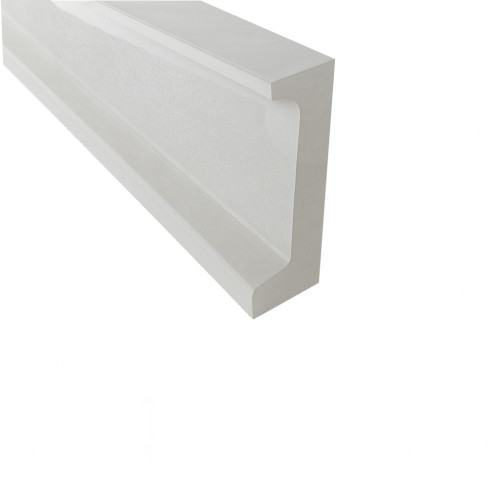
Lightweight rebated boards are a separate concrete gravel-board design.
The current range includes both approximately 150mm and 305mm versions.
They use a shaped or rebated profile and are intended for compatible fencing arrangements.
Do not treat "smooth", "recessed" and "rebated" as interchangeable descriptions.
Before replacing one type with another, check:
- Profile
- Thickness
- Post compatibility
- Panel arrangement
What About Concrete Gravel Boards With Hedgehog Openings?
East Coast Fencing's current range also includes a 12-inch smooth concrete gravel board with a purpose-made hedgehog opening.
This is another reason not to make the buying decision purely around smooth versus recessed appearance.
If wildlife movement through the boundary matters, the board configuration may be more important than the decorative finish.
The opening should be planned where it will remain accessible rather than being blocked later by:
- Soil
- Paving
- Planters
- Dense planting
- Stored garden items
Which Board Should You Choose For A New Fence?
Work through the decision in this order.
- Choose the required gravel-board height: Decide whether approximately 150mm or 305mm suits the fence.
- Calculate finished fence height: Add the Fence Panel and Gravel Board together.
- Choose compatible Concrete Fence Posts: Make sure there is enough post length for the visible fence and below-ground installation.
- Decide whether a specialist profile is required: Check whether the system needs a conventional or rebated board.
- Consider wildlife access: Decide whether a purpose-made opening is needed.
- Choose the face: If both smooth and recessed 12-inch boards suit the system, select according to the appearance you prefer.
This prevents appearance from taking priority over dimensions and compatibility.
Which Board Should You Choose For An Existing Fence?
Matching the existing system is usually the safest starting point.
Before ordering a replacement, check:
- Existing board height
- Existing board length
- Existing board profile
- Concrete-post slot condition
- Clear bay width
- Whether neighbouring boards are smooth or recessed
If only one board has failed, matching the surrounding appearance usually gives the neatest result.
Do not order from memory simply because the old board looks approximately 6ft long.
Common Mistakes When Choosing Smooth Or Recessed Gravel Boards
- Assuming recessed automatically means stronger
- Choosing the face style before deciding the required height
- Expecting a current 6-inch recessed version when the traditional recessed option is 12-inch
- Forgetting that 305mm contributes to total fence height
- Mixing smooth and recessed boards unintentionally
- Installing recessed faces in different directions
- Assuming all concrete gravel boards share the same profile
- Confusing rebated boards with conventional smooth boards
- Forcing replacement boards between leaning posts
- Cutting reinforced concrete to correct inaccurate post spacing
- Using a gravel board as a substantial retaining wall
- Ignoring safe handling because the board is only one component of the fence
FAQs
What Is The Difference Between Smooth And Recessed Concrete Gravel Boards?
The main difference is the face. Smooth boards have a plain concrete surface, while recessed boards have a moulded inset design that creates a more decorative appearance.
Are Recessed Concrete Gravel Boards Stronger?
Do not assume so simply because of the face design. The recessed pattern is primarily a visual distinction. Fence performance depends on the complete post, panel, foundation and gravel-board system.
What Size Are Recessed Concrete Gravel Boards?
The current East Coast Fencing recessed board is approximately 1.83m long, 305mm high and around 45 to 55mm deep.
Can You Get 6-Inch Smooth Concrete Gravel Boards?
Yes. The current smooth range includes a 6-inch board approximately 150mm high as well as a 12-inch board approximately 305mm high.
Can You Get 6-Inch Recessed Gravel Boards?
The current traditional East Coast Fencing recessed option is approximately 12 inches or 305mm high. If you require a lower traditional concrete board, compare the current 6-inch smooth options.
Can Smooth And Recessed Gravel Boards Be Mixed?
They may be dimensionally compatible in some systems, but mixing the visible face styles can make a continuous fence run look inconsistent. Match existing boards where appearance matters.
Do Recessed Gravel Boards Need To Face A Particular Direction?
The decorative face should be orientated consistently. Decide which side is intended to be visible before lowering the board fully into the post slots.
Which Concrete Gravel Board Is Best?
There is no universal best type. Choose the required height and compatible profile first. Then select smooth or recessed according to the appearance you want. Consider rebated and wildlife-access options separately where those features are required.
Choose Height And Compatibility Before Appearance
The choice between smooth and recessed concrete gravel boards is relatively straightforward once the rest of the fence has been planned.
If you want a plain, understated concrete base, choose smooth.
If you are using a 12-inch board and want the concrete to have more visual detail, a recessed face may suit the garden better.
The important point is that appearance comes after the practical decisions.
Confirm whether you need a 150mm or 305mm board. Calculate the complete Fence Panel and Gravel Board height. Check the Concrete Fence Posts and post slots. Make sure the bay is actually around the required 1.83m and confirm whether the system uses a conventional or rebated profile.
Once those points are correct, smooth versus recessed becomes what it should be: a simple choice about how you want the lower part of the finished fence to look.