


Quick answer: Yes, climbing roses can be trained on Diamond Trellis, but they need tying and guidance because they do not simply attach themselves securely to the lattice. The diagonal pattern provides plenty of positions for spreading stems across the panel. Choose the trellis height around the mature plant, secure the outer frame to sound posts or a suitable wall support, and plan for the rose becoming much heavier over time. Very large mature plants may benefit from additional independent support.
Diamond Trellis and climbing roses make a natural-looking combination.
The diagonal timber pattern gives the plant several directions in which it can be trained, while the open lattice allows flowers and foliage to grow through and around the panel.
The important part is understanding what happens after the first few seasons.
A young climbing rose may be easy to tie to almost any trellis. An established rose can develop substantial woody stems and a large amount of foliage. The trellis, fixings and posts therefore need to be chosen for the mature plant rather than the small plant being installed today.
Used properly, Diamond Trellis provides an attractive training framework. It should not, however, be expected to carry an unrestricted mature climbing rose from a few lightweight lattice strips alone.
Why Does Diamond Trellis Work Well With Climbing Roses?
The diagonal lattice creates repeated support points across the complete panel.
This makes it possible to guide rose stems:
- Upwards
- Sideways
- Diagonally
- Across several areas of the panel
That is useful because a climbing rose usually benefits from deliberate training rather than being allowed to grow as one narrow column towards the top of the support.
Spreading the stems over a broader area also helps distribute the plant's eventual weight rather than concentrating everything on one small section of lattice.
Does A Climbing Rose Attach Itself To Diamond Trellis?
Not in the same way as a self-clinging plant.
Climbing roses generally need to be tied and trained to their support.
The trellis provides the framework, but the gardener still needs to guide the main stems into suitable positions.
Use plant ties appropriate for the job and avoid tightening them so much that they restrict the stem as it thickens.
The aim is to hold the rose in position without clamping it rigidly against the timber.
Should You Weave Rose Stems Through The Diamond Openings?
Flexible young growth can sometimes be guided through open lattice, but avoid permanently threading every major stem tightly through multiple openings.
A stem that is thin today can become substantially thicker and woodier over time.
If it becomes trapped through the lattice, future work can become difficult when you need to:
- Prune the rose
- Repair the trellis
- Replace the panel
- Repaint or maintain a wall behind it
For substantial permanent stems, tying the rose against the face of the support can provide more flexibility than weaving every branch deeply through the panel.
Should Climbing Rose Stems Be Trained Sideways?
Spreading suitable main stems across the available structure can make much better use of a wide trellis panel than allowing every shoot to head directly upwards.
A nominal 6ft-wide Diamond Trellis panel provides substantial horizontal growing space.
Training across that width also helps create a more evenly planted screen.
Instead of ending up with dense growth at the top and bare lattice beneath it, you can gradually use more of the available panel.
The diagonal pattern is useful here because there are support points in several directions rather than only horizontal rails.
What Sizes Of Diamond Trellis Are Available For Roses?
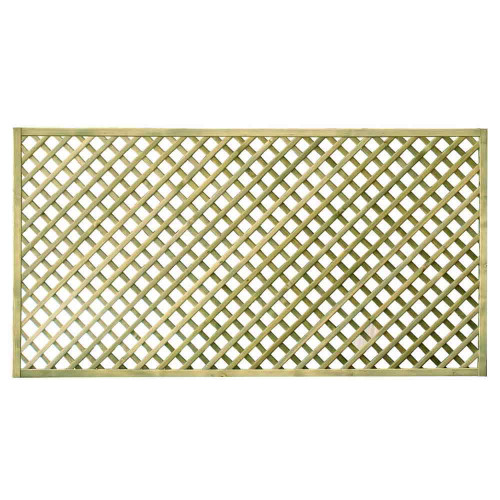
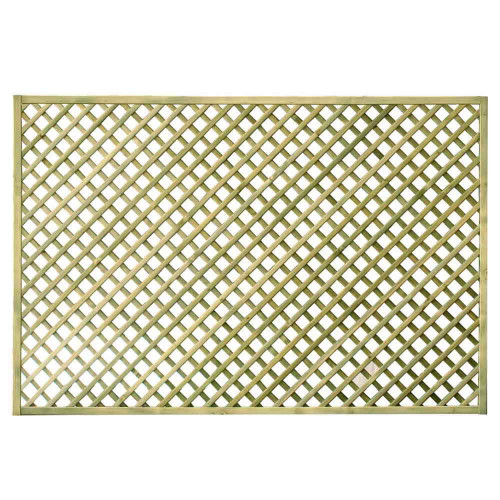
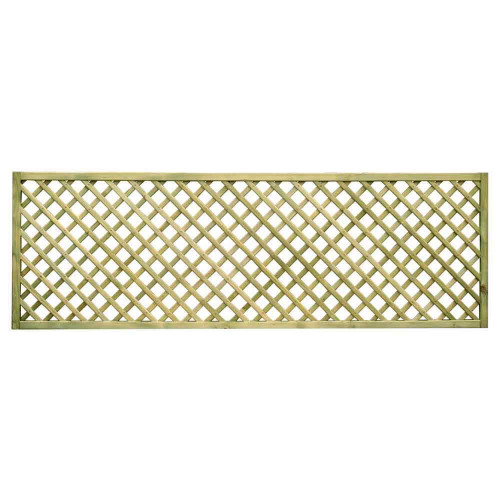
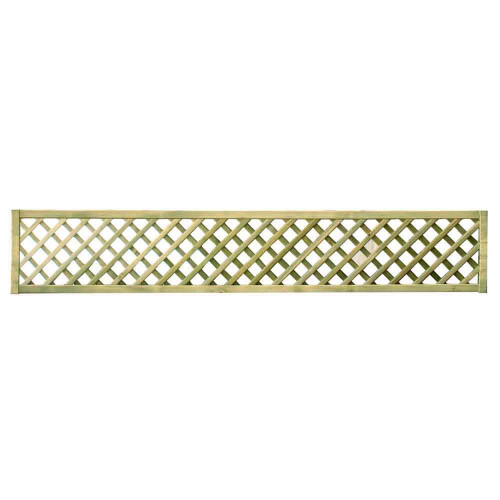
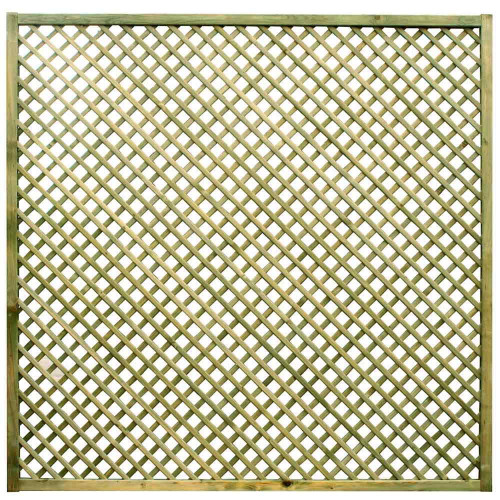
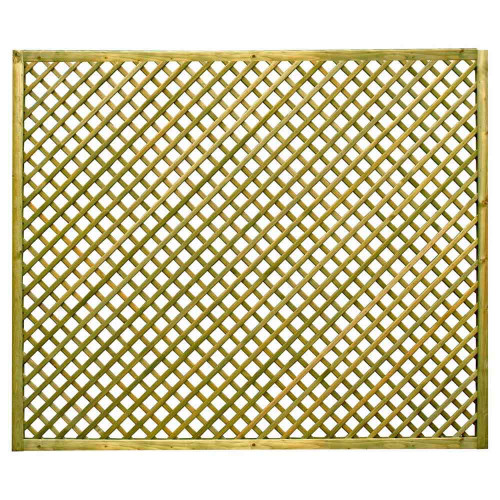
The current East Coast Fencing Diamond Trellis range includes nominal 6ft-wide panels in heights from approximately 1ft to 6ft.
Current options include:
- 6ft x 1ft, approximately 1.83m x 300mm
- 6ft x 2ft, approximately 1.83m x 600mm
- 6ft x 3ft, approximately 1.83m x 900mm
- 6ft x 4ft, approximately 1.83m x 1.2m
- 6ft x 5ft, approximately 1.83m x 1.5m
- 6ft x 6ft, approximately 1.83m x 1.8m
The right size depends on where the trellis is installed and how large you intend the planted display to become.
| Diamond Trellis Height | Potential Rose Use | Main Consideration |
|---|---|---|
| 300mm | Low fence-top planting | Limited growing area |
| 600mm | Deeper fence-top feature | Support from existing posts |
| 900mm | Partial climbing screen | Useful horizontal training space |
| 1.2m | Substantial planted feature | Post and fixing strength |
| 1.5m | Tall climbing display | Mature plant weight |
| 1.8m | Full-height rose screen | Treat as a substantial planted structure |
Is 1ft Diamond Trellis Enough For A Climbing Rose?
A 300mm panel provides relatively little growing area on its own.
It makes more sense where the rose is already growing against a solid fence and the Diamond Trellis is being used only as an additional upper training section.
For example, a climbing rose could be supported lower down by another suitable structure and then trained through a decorative diamond topper above the fence.
Do not expect a shallow 300mm panel to function as the complete support for a substantial mature climbing rose.
Is 2ft Diamond Trellis Better As A Fence Topper?
A nominal 2ft or approximately 600mm-high panel gives considerably more growing area.
This can work where you want roses or other climbers to extend above a lower solid fence.
At 600mm high, however, the trellis becomes a significant addition to the boundary.
The support should come from sound Fence Posts or suitable structural framing rather than relying only on the upper edge of the Fence Panel below.
Is 3ft Diamond Trellis Suitable For Climbing Roses?
At approximately 900mm high, Diamond Trellis provides a substantial planting surface.
This size can work as:
- A partial freestanding rose screen
- A decorative panel against a wall
- A larger planting feature above suitable lower structures
The combination of approximately 1.83m width and 900mm height gives plenty of room to spread young stems sideways rather than allowing everything to grow through one narrow area.
When Should You Choose 4ft Diamond Trellis?
A 1.2m-high Diamond Trellis panel creates a much larger planted feature.
It can suit a wall or freestanding screen where the climbing rose is intended to become one of the main visual features of the area.
At this point, the support arrangement becomes more important than it would for a shallow topper.
Check:
- Post size
- Post stability
- Wall fixing condition
- Panel frame support
- Future rose weight
Is 5ft Diamond Trellis Good For A Mature Rose?
A nominal 5ft or approximately 1.5m-high panel provides a large growing area.
It can create a tall decorative rose display while remaining more open than solid fencing.
It is particularly important at this height to stop thinking of the trellis as a small decorative accessory.
Once covered by an established climbing rose, it becomes a substantial planted screen.
The panel and posts need to remain secure under that finished condition.
When Does 6ft Diamond Trellis Make Sense?
A full approximately 1.8m-high Diamond Trellis panel provides the largest climbing area in the current range.
It can create a full-height open garden screen when correctly supported.
This can be useful where you want:
- A large climbing rose display
- A planted garden division
- A decorative screen that retains light and airflow
The panel may look relatively lightweight before planting.
After several years of growth, the combination can be much heavier and less permeable to wind.
Plan the posts and foundations accordingly.
Can Diamond Trellis Be Fixed To A Wall For Climbing Roses?
Yes, provided the wall and fixing arrangement are suitable.
A wall-mounted panel creates a useful decorative framework for training stems while keeping the plant separate from the masonry itself.
It is normally useful to leave some working space between the trellis and the wall.
This provides room for:
- Plant ties
- Stems
- Air movement
- Pruning
- Future maintenance
Fixing the lattice completely flat against the wall can make all of those jobs more difficult.
Should You Fix The Trellis Directly Against Brickwork?
A supporting batten or suitable stand-off arrangement can make a wall-mounted trellis more practical.
The supporting system needs to be firmly fixed into sound masonry using suitable exterior fixings.
The main Diamond Trellis frame can then be attached securely to those supports.
Do not rely on loose mortar, damaged render or a weak surface to carry a mature climbing plant.
How Far Should Diamond Trellis Sit Away From A Wall?
There is no universal spacing that suits every wall, trellis frame and plant.
The practical requirement is enough room to:
- Pass ties around the support
- Guide stems behind or across the lattice where appropriate
- Allow reasonable airflow
- Access the wall for maintenance
Avoid making the gap unnecessarily large, because this increases the leverage on the wall fixings.
The support should be designed as a complete installation rather than choosing a spacer dimension in isolation.
Can Diamond Trellis Be Installed Between Wooden Posts For Roses?
Yes.
This is a useful option where you want a freestanding rose screen rather than fixing the plant structure to a wall or existing fence.
Wooden Fence Posts provide straightforward fixing surfaces for framed timber trellis.
Post selection should consider:
- Trellis height
- Number of panels
- Wind exposure
- Ground conditions
- Mature plant weight
A low 600mm planted panel and a full-height 1.8m screen should not be treated as equivalent structural jobs.
Should A Climbing Rose Be Supported By The Trellis Or The Posts?
The complete structure works together.
The lattice provides the training surface.
The outer panel frame carries that lattice.
The posts, wall supports or other structural framing carry the completed panel.
For a substantial mature rose, it can also be sensible to use additional plant support so that the entire plant weight is not concentrated through relatively light lattice strips.
This creates a clearer load path back to the structural supports.
Should You Screw Through The Diamond Lattice To Hold A Heavy Rose?
Do not use individual lattice strips as the main structural fixing points for the complete panel.
The primary trellis fixings should normally secure substantial framed sections to the structural supports.
Likewise, avoid hanging a large section of mature rose from one isolated lattice intersection.
Spread ties and plant weight across the available structure.
Can Climbing Roses Become Too Heavy For Diamond Trellis?
Yes.
A mature climbing rose can become substantially heavier than a young plant.
The load includes:
- Permanent woody stems
- Seasonal new growth
- Leaves
- Flowers
- Water held after rain
Large plants can also extend beyond the original trellis area.
If the rose is likely to become particularly substantial, use a stronger independent support arrangement rather than assuming ordinary decorative lattice should carry unlimited growth.
Do Wet Roses Put More Weight On Trellis?
Yes.
Foliage and flowers retain water during wet weather, temporarily increasing the load carried by the structure.
This may not be important on a properly designed installation, but it illustrates why the support should not be selected around the lightest possible condition.
Plan for the mature plant outdoors in ordinary UK weather.
Do Climbing Roses Increase Wind Load?
Yes.
Bare Diamond Trellis is deliberately open, allowing substantial air to move through the lattice.
Once stems and foliage fill many of those openings, the structure becomes less open.
Wind pressure is then transferred through:
- The plant
- The trellis
- The fixings
- The posts or wall supports
A heavily planted full-height trellis should therefore not be treated as though it will always behave like the bare lattice panel originally installed.
Can A Rose Pull A Fence Topper Trellis Loose?
It can contribute if the topper is inadequately supported.
A climbing rose above a fence adds plant weight high on the boundary.
This also increases leverage on the Fence Posts.
Before adding a planted Diamond Trellis topper, inspect:
- The existing Fence Posts
- Post foundations
- Main Fence Panels
- Topper supports
- Fixings
If the fence already moves noticeably in ordinary wind, adding more height and mature planting is unlikely to improve it.
Can Diamond Trellis Be Added Above Closeboard Fencing For Roses?
Potentially.
This combination can provide:
- Solid privacy at lower level
- An open decorative section above
- A climbing framework
- A softer planted top edge
The main consideration is supporting the trellis properly.
Do not simply fix a large planted topper into Panel Capping or another relatively light decorative part of the fence.
Transfer the load back to suitable posts or structural framing.
Can Diamond Trellis Be Added Above Waney Lap Fencing?
Potentially, if the existing fence remains structurally sound.
Waney Lap Fence Panels that are already old, loose or moving should be repaired before additional trellis and planting are added.
The rose may eventually outlive the Fence Panel supporting it.
Consider how the lower panel could be replaced later without destroying the complete plant-support arrangement.
Why Should You Think About Future Fence Panel Replacement?
Climbing roses can remain in place for many years.
A timber Fence Panel beneath the trellis may eventually need attention sooner.
If the complete rose and trellis arrangement depends directly on that panel, replacement can become difficult.
A better installation keeps the main plant support connected to durable structural points such as:
- Sound Fence Posts
- An independent timber frame
- A suitable wall support
This can allow lower fencing components to be maintained with less disturbance to the established plant.
Can Diamond Trellis Be Used As A Freestanding Rose Screen?
Yes.
This can be particularly useful where you want to create a planted division inside the garden rather than use the main boundary.
A freestanding screen can:
- Divide a patio from a lawn
- Create a backdrop to seating
- Frame a path
- Separate two planting areas
The open diamond pattern retains visual depth before the rose becomes fully established.
As foliage increases, the screen gradually becomes denser.
Does Diamond Trellis Provide Privacy Before The Rose Grows?
Only light visual screening.
The diamond openings remain deliberately open.
This makes Diamond Trellis a poor choice where strong immediate privacy is essential.
Once a rose spreads across the panel, the foliage can interrupt more of the view, but this coverage:
- Takes time to establish
- Depends on plant size
- Changes through the seasons
If immediate screening is the primary objective, choose the fence or trellis design around that requirement rather than expecting a young rose to solve it.
Can Climbing Roses Be Used For Privacy?
They can contribute useful planted screening, especially when trained across a wide trellis area.
However, the result should be treated as planting rather than guaranteed year-round solid privacy.
The density of foliage changes as the plant grows and through seasonal cycles.
A solid Fence Panel with a planted Diamond Trellis section above it can provide a more predictable balance of privacy and planting than open trellis from ground level upwards.
Should You Use Diamond Trellis Or Privacy Square Trellis For Roses?
Both can support suitable climbing plants, but their visual roles differ.
Choose Diamond Trellis where:
- The decorative diagonal pattern matters
- You want the screen to remain relatively open
- The rose will become the main visual feature
- Light and airflow are priorities
Choose Privacy Square Trellis where:
- More immediate filtered screening is wanted
- You prefer a close square grid
- The trellis needs to provide useful screening before the rose establishes
For complete immediate privacy, a solid Fence Panel is a better starting point than either open lattice design.
Should You Use Diamond Trellis Or Traditional Trellis For Roses?
Both provide open plant-training frameworks.
Traditional Trellis uses a regular square grid, while Diamond Trellis uses diagonal lattice.
The practical difference for many rose displays is therefore mainly:
- Appearance
- How you want to train the stems
- Which pattern suits the rest of the garden
Diamond Trellis is particularly suited to gardens where the lattice itself should remain decorative between stems and flowers.
How Do You Keep A Climbing Rose From Overloading One Part Of The Trellis?
Spread the plant across the available panel as it develops.
A useful approach is to:
- Identify the main stems: Decide which parts of the plant will form the long-term framework.
- Guide them across the panel: Avoid allowing everything to rise through one narrow section.
- Use several ties: Distribute support rather than relying on one point.
- Control excessive growth: Keep the plant manageable through appropriate maintenance.
- Check the trellis: Make sure lattice, frame and posts remain sound beneath the foliage.
Why Should You Keep The Trellis Accessible?
Once a rose fills the complete panel, small faults can disappear behind foliage.
You still need access to inspect:
- Panel frame joints
- Wall fixings
- Fence Post condition
- Loose lattice sections
- Timber around the base
Do not allow the plant to become such a dense unmanaged mass that the support cannot be inspected for years at a time.
Can Dense Rose Growth Keep Diamond Trellis Damp?
Dense planting can reduce airflow around the timber and make surfaces slower to dry after rain.
This may encourage:
- Surface algae
- Damp staining
- Accumulated dead leaves
The Diamond Trellis range is pressure treated for outdoor use, but good surrounding conditions still help with long-term maintenance.
Remove excessive dead growth and keep the lower frame clear of built-up soil and garden debris.
Should Diamond Trellis Touch The Soil Behind A Rose Border?
Keep ordinary timber trellis away from unnecessary persistent soil contact where practical.
Planting beds often rise gradually because gardeners add:
- Compost
- Mulch
- Organic matter
Do not allow this material to bury the bottom of the trellis frame over time.
Maintaining some access around the lower timber makes inspection and cleaning considerably easier.
Can A Raised Bed Sit In Front Of Diamond Trellis?
Yes, and it can provide an attractive arrangement for climbing roses and other plants.
The raised bed should retain its own soil.
Do not use the Diamond Trellis as the retaining back wall.
Keep enough separation for:
- Timber inspection
- Plant training
- Future panel replacement
- Air movement
Can You Paint Diamond Trellis Before Growing Roses On It?
A suitable exterior timber coating can generally be applied where compatible with the product and once the pressure-treated timber is sufficiently dry and prepared.
If you plan to change the colour, doing so before the rose becomes established is considerably easier.
Diamond Trellis contains many:
- Narrow edges
- Lattice intersections
- Internal openings
These become difficult to reach once woody rose stems run across the panel.
What If The Diamond Trellis Breaks Behind An Established Rose?
Deal with the plant load before removing damaged structural components.
Depending on the extent of the growth, it may be necessary to:
- Support stems temporarily
- Untie part of the plant
- Reduce excessive growth
- Provide a replacement support before removing the old panel
Minor local lattice damage may sometimes be repairable.
If the outer frame is badly damaged or multiple sections have failed, replacing the complete panel may be more practical.
Can You Replace The Trellis Without Losing The Rose?
Potentially, particularly if the plant has been trained in a way that allows stems to be untied rather than permanently woven through every opening.
This is another reason not to trap thick permanent stems deep inside the lattice.
A plant tied to the face can potentially be:
- Temporarily supported
- Detached from the old trellis
- Positioned against a new support
with less disturbance than one that has grown tightly through numerous timber sections.
Common Mistakes When Growing Climbing Roses On Diamond Trellis
- Expecting a climbing rose to attach itself without ties
- Letting every stem grow straight to the top
- Concentrating the complete plant on one small part of the panel
- Choosing trellis height from the young plant rather than the mature display
- Using a 300mm topper as the complete support for a substantial mature rose
- Fixing trellis only to weak Fence Panel components
- Using individual lattice strips as the main structural attachment
- Underestimating the weight of woody mature growth
- Ignoring additional weight after rainfall
- Ignoring increased wind resistance as foliage fills the lattice
- Weaving thick permanent stems through the panel so tightly that future replacement becomes impossible
- Allowing the plant to hide loose fixings and damaged timber
- Burying the lower trellis frame beneath mulch or soil
FAQs
Is Diamond Trellis Good For Climbing Roses?
Yes. The diagonal lattice provides numerous points for tying and training rose stems across the panel. The complete trellis and supporting structure still need to be suitable for the mature plant.
Do Climbing Roses Attach To Trellis By Themselves?
Climbing roses generally need deliberate tying and training. Use suitable plant ties and leave room for stems to thicken.
What Height Diamond Trellis Is Best For Roses?
It depends on the intended display. Current Diamond Trellis ranges from approximately 300mm to 1.8m high, with taller panels providing considerably more growing area for substantial climbing displays.
Can A Climbing Rose Grow On Diamond Trellis Above A Fence?
Yes, where the topper is securely supported from sound Fence Posts or suitable framing. Account for the eventual rose weight and additional wind loading.
Can Diamond Trellis Be Fixed To A Wall For Roses?
Yes. Use a suitable masonry support arrangement and leave practical space between the wall and trellis for plant ties, stems, airflow and maintenance.
Can A Climbing Rose Become Too Heavy For Trellis?
Yes. Mature climbing roses can develop substantial woody stems and dense foliage. Large plants may benefit from additional independent support rather than placing their complete weight onto ordinary decorative lattice.
Should Rose Stems Be Woven Through Diamond Trellis?
Flexible young growth can be guided through open sections, but avoid trapping major permanent stems tightly through several openings. Tying substantial stems to the face can make future pruning and trellis replacement easier.
Does A Climbing Rose Make Trellis Catch More Wind?
Yes. Foliage fills the open lattice and reduces airflow through the panel, so a mature planted screen can place significantly more load on posts and fixings than bare Diamond Trellis.
Let The Diamond Trellis Guide The Rose, Not Carry Everything Alone
Diamond Trellis provides an attractive and practical framework for climbing roses.
The diagonal pattern makes it easy to spread stems across a broad area, while the open lattice keeps the timber visible between flowers and foliage.
Choose the panel height around the final display you want.
A 300mm or 600mm panel works mainly as a decorative upper planting section. A 900mm or 1.2m panel provides a substantial climbing surface. The 1.5m and 1.8m sizes create tall planted screens that need properly specified posts, wall supports or other structural framing.
Tie and train the plant rather than expecting it to support itself. Spread growth across the panel and avoid trapping large permanent stems so tightly through the lattice that maintenance becomes impossible.
Most importantly, remember that the plant changes the installation.
The bare trellis may be relatively light and open. A mature rose adds woody stems, foliage, rainwater weight and additional wind resistance.
Use Diamond Trellis as the framework that organises the planting, while making sure the posts, wall fixings or independent supports carry the completed mature structure.