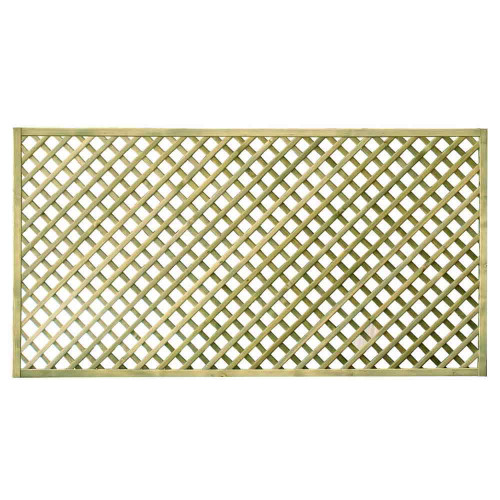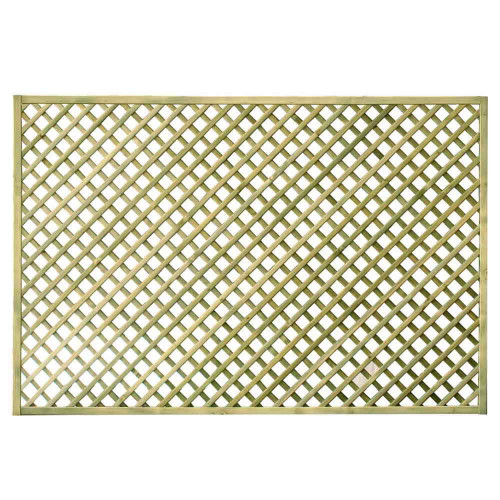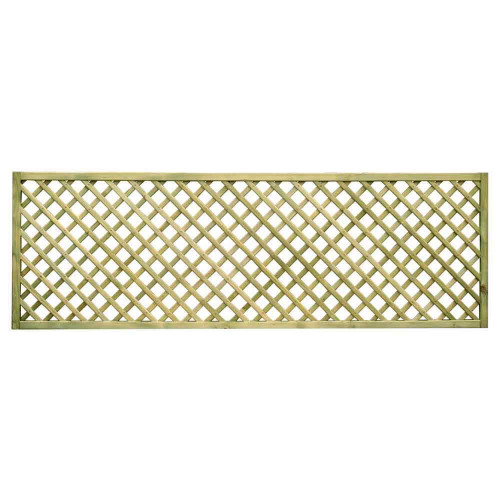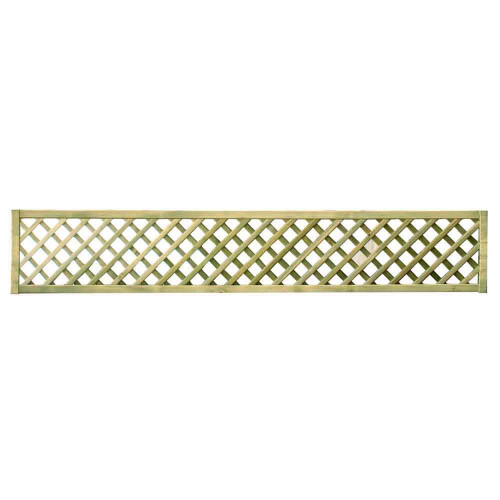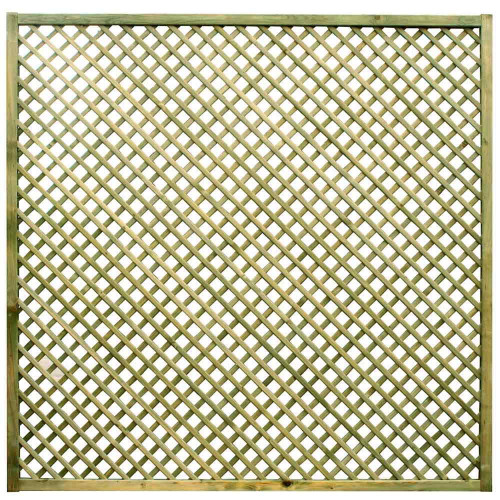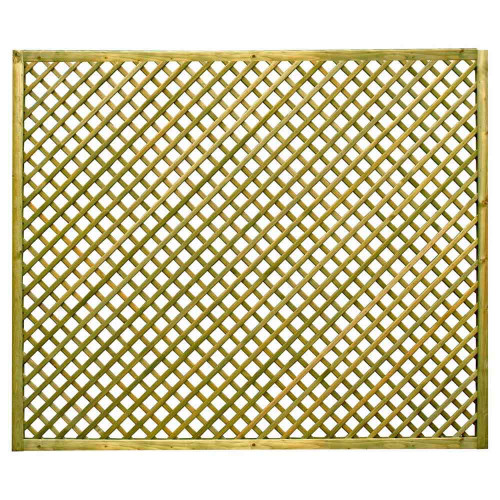



Quick answer: Yes, Diamond Trellis can be cut to fit a non-standard space, but it is more awkward to shorten neatly than square trellis because the battens run diagonally. Cutting through a framed panel can leave several unsupported lattice ends and an unbalanced diamond pattern. Where possible, choose a standard panel size. If cutting is necessary, establish a new frame edge, secure every lattice strip to it, remove the excess timber and protect freshly exposed treated timber where required.
Diamond Trellis is supplied as a finished framed panel, which makes standard sizes straightforward to install.
Real gardens are rarely made entirely from standard-sized openings.
You may have a narrow section beside a Garden Gate, an existing gap between two posts, a wall-to-post opening or a final fence bay that is shorter than the rest.
Timber trellis can be adapted to deal with these situations.
The complication with Diamond Trellis is the diagonal pattern. A straight vertical cut passes through several lattice strips at different positions, so shortening the panel without planning the new edge can leave an untidy collection of unsupported angled ends.
Can Diamond Trellis Be Cut To Width?
Yes.
Reducing the width is possible where a standard panel is too wide for the available opening.
The important point is that you are modifying a framed lattice panel rather than simply cutting a plank of timber.
A proper shortened panel still needs:
- A secure outer frame
- Supported diagonal lattice ends
- A reasonably balanced diamond pattern
- Suitable structural fixing points
If those elements are ignored, the panel may fit the opening but no longer behave like a complete trellis panel.
Why Is Diamond Trellis Harder To Cut Than Square Trellis?
The difference comes from the direction of the battens.
Traditional Trellis has horizontal and vertical pieces. A new vertical edge therefore crosses the horizontal battens in relatively predictable positions.
Diamond Trellis uses diagonal pieces.
A vertical cut may intersect one strip:
- Near the top of a diamond
- Through the middle of another opening
- Close to a lattice intersection
- At an awkward short angle near the frame
That can make both the structural repair and the finished appearance more difficult.
| Trellis Pattern | Cutting Difficulty | Main Issue |
|---|---|---|
| Traditional Square | Moderate | Rebuilding straight frame edge |
| Privacy Square | Moderate | Many closely spaced lattice ends |
| Horizontal Slatted | Moderate | Supporting every shortened slat |
| Diamond | More involved | Angled ends and pattern symmetry |
What Sizes Of Diamond Trellis Are Available Before You Start Cutting?
Before modifying a panel, check whether a standard size already solves the problem.
The current East Coast Fencing Diamond Trellis range includes nominal 6ft-wide panels in heights of approximately:
- 1ft or 300mm
- 2ft or 600mm
- 3ft or 900mm
- 4ft or 1.2m
- 5ft or 1.5m
- 6ft or 1.8m
The width is approximately 1.83m across the range.
If your problem is height rather than width, choosing the nearest appropriate standard product is normally better than buying a taller panel and cutting most of it away.
When Does Cutting Diamond Trellis Make Sense?
Cutting is most useful where the required width genuinely cannot be achieved with a standard panel.
Typical examples include:
- The final bay of a fence run
- A narrow section beside a Garden Gate
- A gap between a wall and Fence Post
- An existing pair of posts that cannot reasonably be moved
- A decorative screen around a fixed garden feature
It makes much less sense to modify every panel across a new screen because the posts were set out incorrectly.
On a new installation, plan the posts around the panels wherever practical.
Should You Measure The Trellis Or Trust The 6ft Description?
Measure the actual panel.
Nominal sizes are useful for identifying products, but they should not replace measurement when you are about to make an irreversible cut.
Also measure the installation opening at more than one point.
Existing posts and walls may not be perfectly parallel.
For a panel being fitted between two supports, check:
- Width near the top
- Width around the centre
- Width near the bottom
If the opening varies substantially, investigate the supports before cutting a panel to match the narrowest point.
What If The Existing Fence Posts Are Leaning?
Do not immediately alter the trellis.
A leaning Fence Post can make a standard opening narrower at one height and wider at another.
Cutting a new Diamond Trellis panel to suit that distorted opening may leave you with a custom panel that only fits because the fence is already out of alignment.
Check whether the post is:
- Loose
- Leaning
- Twisted
- Failing around ground level
Correct structural problems before adapting the decorative panel where practical.
Should Diamond Trellis Fit Tightly Between Posts?
No.
A framed timber panel should not need to be hammered or forced into position.
Forcing an oversized panel between posts can:
- Bow the frame
- Stress lattice intersections
- Push the panel out of square
- Damage the posts or fixings
Measure around the actual fixing method and allow practical fitting clearance.
Do not deliberately cut the panel oversize because you expect the posts to squeeze it into place.
Why Does The New Frame Edge Matter?
The frame does more than make Diamond Trellis look finished.
It also restrains the ends of the diagonal lattice.
When you cut through a panel, those strips can be left terminating in open space.
A new frame edge provides:
- Support for each cut lattice piece
- A straight finished side
- A substantial fixing area
- Greater resistance to individual strips becoming loose
This is the central principle of cutting framed trellis properly.
Do not cut first and then decide afterwards what to do with all the loose ends.
Should You Install The New Frame Before Cutting?
Where the construction allows, establishing the new frame position before removing the surplus lattice can make the job easier.
A sensible general sequence is:
- Measure the required finished panel width.
- Mark the position of the new outer edge.
- Check how every diagonal strip crosses that line.
- Position or relocate suitable framing at the new edge.
- Secure the lattice strips to that frame.
- Cut away the excess timber beyond it.
This helps keep the lattice controlled while you work.
The exact method depends on how the individual Diamond Trellis panel has been manufactured.
How Do You Cut Diamond Trellis To Width?
A typical careful approach is:
- Measure the installation: Confirm the finished width needed at the actual trellis position.
- Measure the panel: Check the real dimensions before marking anything.
- Study the diamond pattern: Look at where the new edge will pass through the diagonal strips.
- Mark the finished edge: Use a straight reference and make sure the panel itself is square.
- Plan the new frame: Decide how every remaining lattice end will be secured.
- Support the panel: Work on a suitable surface so the frame does not twist while being altered.
- Secure the new edge: Fix the diagonal lattice to suitable framing.
- Cut away the surplus: Work carefully around the thin lattice components.
- Deal with rough edges: Remove problematic splinters without unnecessarily thinning the timber.
- Protect fresh cuts: Apply appropriate cut-end treatment where required.
- Check the panel: Make sure no diagonal strip has been left loose.
What Tools Are Useful For Cutting Diamond Trellis?
The exact equipment depends on the panel and repair method, but a typical timber trellis modification may use:
- Tape measure
- Pencil
- Square or straight edge
- Suitable timber saw
- Drill or driver
- Exterior-grade fixings
- Suitable framing timber where required
- Cut-end timber treatment where appropriate
- Eye protection
- Gloves
Support the panel properly while using cutting tools.
Diamond lattice contains relatively narrow timber sections that can move or vibrate if the panel is poorly supported.
Can You Use A Hand Saw?
Yes, where suitable for the timber and amount of cutting involved.
A hand saw gives good control when only a few lattice strips and frame components need altering.
A suitable power saw can be quicker, but speed is not the main objective with decorative lattice.
The priority is making controlled cuts without:
- Splitting neighbouring strips
- Pulling lattice intersections apart
- Damaging the new frame edge
Why Should You Support The Panel While Cutting?
A framed trellis panel can flex if it is allowed to hang unsupported.
That is particularly unhelpful when several diagonal strips are being cut.
Poor support can result in:
- The frame twisting
- Existing lattice joints being stressed
- Cut pieces tearing rather than separating cleanly
Use a stable working arrangement that supports the panel without crushing the lattice underneath it.
How Do You Keep The Diamond Pattern Looking Balanced?
This is one of the biggest differences between cutting Diamond Trellis and shortening a simple slatted panel.
Before cutting, stand back and look at where the proposed new edge crosses the diamonds.
You may have some flexibility to move the finished edge slightly so it does not leave particularly awkward narrow fragments of the pattern.
The goal is not to preserve every complete diamond.
That may be impossible in a non-standard width.
The aim is to produce an edge that looks deliberate rather than leaving a row of tiny irregular fragments where a slightly different cut position would have looked cleaner.
Should You Cut Equal Amounts From Both Sides?
Usually, one modified edge is simpler than two.
Removing material from both sides potentially gives more control over visual symmetry, but it also creates:
- Two new frame edges
- Twice as many sets of cut diagonal battens
- More labour
- More opportunities for alignment errors
For an ordinary shortened end bay, retaining one original factory edge and rebuilding the other is normally the practical approach.
Cutting both sides may only be justified where the panel's visible symmetry is especially important.
Can You Cut Diamond Trellis In Half?
Potentially, but one full panel does not automatically become two finished half-width panels with a single saw cut.
Dividing it creates two cut edges.
Both new panels need:
- Proper edge framing
- Secure lattice ends
- Suitable fixing areas
Account for that additional framing before deciding that cutting one panel in half is necessarily the simplest or most economical solution.
Can Diamond Trellis Be Cut To Height?
Potentially, but first check the current standard sizes.
With nominal heights available from approximately 1ft to 6ft in 1ft increments, there is often a standard panel close to the required height.
Reducing the height of a finished Diamond Trellis panel can involve:
- Removing the top or bottom frame
- Cutting numerous diagonal strips
- Creating a new horizontal frame edge
- Changing the visual diamond pattern
If a standard 2ft or 3ft panel will do the job, there is little benefit in buying a 6ft panel and rebuilding half of it.
Can You Cut Diamond Trellis Diagonally For A Sloping Garden?
It is generally better to avoid this where practical.
Diamond Trellis already contains a diagonal internal pattern, but that does not mean the outer panel is intended to become a triangular or raked shape.
An angled cut through the outer frame may create:
- Numerous different lattice lengths
- Partial diamond openings
- An angled frame that needs complete reconstruction
- More difficult fixing at the supports
Rigid trellis panels are generally easier to keep rectangular and step from bay to bay as the ground changes.
How Should Diamond Trellis Be Installed On A Slope Instead?
Keep each rectangular panel square and level.
Then change height at the Fence Posts.
This creates a stepped screen.
The approach preserves:
- The panel frame
- The diamond pattern
- Proper edge support
If a slope is steep enough to create an impractical gap below one side of a full-width panel, consider whether a shorter custom bay would create smaller, cleaner steps.
Can Diamond Trellis Be Cut To Fit Beside A Garden Gate?
Yes.
A gate is one of the most common places for a shortened final panel to be useful.
Measure from the final Fence Post or trellis support to the Gate Post after the structural positions are established.
Then adapt the Diamond Trellis to that genuine opening.
Do not allow the trellis to:
- Overhang into the gate opening
- Restrict the gate movement
- Depend on the moving gate for support
The shortened trellis needs proper static support at both ends.
Can You Cut Diamond Trellis For A Wall-To-Post Gap?
Yes.
This is another situation where standard approximately 1.83m width may not match the available space.
Measure the clear opening at the actual trellis height.
Walls are not always perfectly vertical, and existing timber posts may have moved.
If the panel will be mounted near a wall for climbing plants, also account for the support arrangement rather than measuring only the visible gap.
Can Diamond Trellis Be Cut For A Fence Topper?
Yes, particularly where one fence bay is narrower than the others.
A typical fence-top run may use several full-width nominal 6ft panels and one shortened section at the end.
Keep the topper pattern as consistent as practical across the run.
Also ensure that the shortened section remains supported from suitable Fence Posts or structural framing.
Cutting it narrower does not mean it can simply be attached to thin Fence Panel capping.
Should Every Fence Topper Be Cut To Make The Pattern Match Exactly?
Normally not.
Modifying every panel introduces more cut edges and more work.
Use full panels wherever the bays allow it.
Reserve custom cutting for:
- End bays
- Gate sections
- Fixed obstructions
- Genuinely unusual openings
Slight natural variation in where a diamond pattern meets each post is preferable to unnecessarily rebuilding every panel edge.
Can You Cut Diamond Trellis To Fit Existing Concrete Fence Posts?
The fact that the timber can be shortened does not guarantee compatibility with a concrete-post system.
Check:
- Actual panel frame thickness
- Available clear width
- Post slot arrangement
- How the trellis will be supported
Do not alter the reinforced Concrete Fence Posts simply because the timber panel is slightly too wide.
If the particular trellis frame is not suitable for the slot arrangement, another supporting method may be required.
Can You Cut Diamond Trellis For Wooden Fence Posts?
Yes.
Wooden Fence Posts provide practical surfaces for fixing a correctly reframed timber panel.
If the opening is genuinely shorter than the panel:
- Check both posts are sound and plumb.
- Measure the real clear width.
- Modify the panel to suit the fixing arrangement.
- Secure the new outer frame rather than fixing through loose lattice ends.
Do not cut the panel to disguise posts that should actually be repaired or reset.
Do Fresh Cuts Need Protecting?
The current Diamond Trellis range is pressure treated in a green or natural-looking finish for outdoor use.
Cutting exposes fresh timber surfaces.
Where required for the particular treatment, use an appropriate cut-end timber preservative on exposed cuts.
Pay attention to:
- Cut lattice ends
- New frame cuts
- Replacement supporting timber
It is easier to deal with these surfaces before the panel is fixed into position and covered with plants.
Will The Cut Edge Match The Existing Trellis Colour?
Not necessarily at first.
Freshly exposed wood and replacement framing may look different from the pressure-treated outer surfaces.
An older panel can show an even greater difference because its visible timber has already weathered.
Natural timber appearance changes with:
- Weather exposure
- Moisture
- Grain
- Treatment colour
A small initial colour difference does not automatically indicate a poor structural repair.
Can You Paint A Cut Diamond Trellis Panel?
A suitable exterior timber coating can generally be applied where compatible with the product and once the timber is sufficiently dry and prepared for that finish.
Complete the structural modification first.
Do not use paint to hide:
- Loose lattice ends
- An unsupported frame
- Split timber
If climbing plants are planned, decorating the finished modified panel before dense growth develops will make access considerably easier.
What If One Lattice Strip Splits While Cutting?
Stop and assess the damage rather than continuing to install the panel.
A small local problem may be repairable if:
- The surrounding lattice remains sound
- The new frame can still support the damaged area
- The split does not run through several important intersections
If several strips split or the outer frame becomes badly damaged, the modification may no longer provide a sensible finished panel.
Can A Badly Cut Diamond Trellis Panel Be Repaired?
Sometimes.
If the main problem is that somebody has removed the frame and left several unsupported lattice ends, installing suitable new edge framing may restore the panel.
Repair becomes less practical if:
- Several diagonal strips are too short
- Many intersections have broken
- The complete lattice has moved out of alignment
- The remaining frame is badly split
At that stage, replacing the panel may involve less work and give a cleaner result.
Can You Use Loose Timber Battens To Reframe Diamond Trellis?
Potentially, provided the replacement timber is suitable for the panel and outdoor application.
Do not assume a batten from another trellis range will automatically match the Diamond Trellis frame or lattice dimensions.
The current Diamond Trellis range is supplied rather than manufactured in-house by East Coast Fencing, and its construction should be checked directly before selecting replacement timber.
Match the actual panel rather than borrowing dimensions from Traditional or Privacy Square Trellis.
Why Is That Important?
Current Traditional and Privacy Square Trellis use known 16 x 38mm in-house trellis battens.
That dimension should not automatically be applied to Diamond Trellis.
Using unsuitable replacement timber can:
- Make the new edge stand proud
- Make the panel unnecessarily bulky
- Create poor fixing alignment
- Look visibly mismatched
Measure the Diamond Trellis components you actually have.
Is It Better To Alter The Trellis Or Move The Posts?
For an existing boundary, moving established posts may be far more work than modifying one timber panel.
In that situation, a carefully shortened Diamond Trellis section can be the practical answer.
For a completely new screen, the opposite often applies.
Setting the posts correctly to suit standard panels can avoid:
- Unnecessary cutting
- Extra framing
- Material waste
- An awkward narrow final bay
Plan the complete run before setting the first post.
How Can You Avoid Needing To Cut Every Panel?
Set out the project as a complete run rather than beginning with one end and hoping the dimensions work out.
Before installation, mark:
- Every full trellis panel
- Every Fence Post
- Gate positions
- Corners
- Wall ends
- Any genuinely shortened panel
If the overall run does not divide neatly into standard bays, decide where the custom section will look most deliberate.
A planned shortened end panel normally looks much better than discovering a tiny leftover space after all the posts have been concreted in.
Common Mistakes When Cutting Diamond Trellis
- Cutting before measuring the real installation opening
- Trusting nominal 6ft dimensions instead of measuring the actual panel
- Removing the frame without creating a new supported edge
- Leaving angled lattice ends loose
- Ignoring how the cut changes the visual diamond pattern
- Trying to preserve every complete diamond at the expense of the required finished width
- Cutting both sides when one new edge would be sufficient
- Buying a much taller panel when a suitable standard height is already available
- Cutting panels to fit around leaning or failing posts
- Forcing a slightly oversized panel into the finished bay
- Cutting the panel diagonally to follow a slope when stepping would be cleaner
- Failing to protect freshly exposed timber where required
- Assuming Diamond Trellis uses the same timber section as another trellis range
FAQs
Can You Cut Diamond Trellis To Width?
Yes. The panel can be shortened where required, but the new cut edge needs proper framing so every remaining diagonal lattice strip is securely supported.
Is Diamond Trellis Difficult To Cut?
It is more awkward than square trellis because a straight edge crosses diagonal battens at different positions. This can create partial diamonds and multiple angled lattice ends.
Can You Cut Diamond Trellis To Height?
Potentially, although the current range already includes nominal heights from approximately 1ft to 6ft. Choosing the closest standard height is normally simpler than rebuilding a taller panel.
Can You Cut Diamond Trellis In Half?
Potentially, but both resulting sections would need properly supported new frame edges. A single cut does not automatically produce two finished framed panels.
Can Diamond Trellis Be Cut Diagonally?
It is possible to alter timber, but diagonal outer cuts make the framing and lattice pattern considerably more complicated. On sloping ground, keeping rectangular panels level and stepping them is normally cleaner.
Do Cut Trellis Ends Need Treating?
Freshly exposed pressure-treated timber should receive suitable cut-end protection where required for the product's treatment system.
Can Diamond Trellis Be Cut To Fit Beside A Gate?
Yes. A shortened panel can be useful beside a Garden Gate, provided it has secure support at both edges and does not interfere with gate movement.
Can You Use 16 x 38mm Trellis Batten To Reframe Diamond Trellis?
Do not assume so. That is the current timber section used for East Coast Fencing's in-house Traditional and Privacy Square Trellis, but the Diamond Trellis range is a separately supplied product. Measure its actual frame before choosing replacement timber.
Keep The Frame, Not Just The Diamond Pattern, In Mind
Diamond Trellis can be shortened successfully, but it needs more planning than simply drawing a line and cutting through the lattice.
The diagonal pattern means every new vertical or horizontal edge can intersect several timber strips at awkward points.
Start by checking whether the current standard range already provides the height you need. With nominal 6ft-wide panels available from approximately 1ft through to 6ft high, many projects can avoid unnecessary height modification entirely.
If the width genuinely needs changing, measure the finished opening and study the lattice before cutting.
Create a proper new frame edge, secure each remaining diagonal strip to it and only then remove the unwanted section. Protect freshly exposed treated timber where required.
For new screens, accurate setting out will usually reduce the amount of cutting needed. For existing fences, walls and gate openings, one carefully modified Diamond Trellis panel can be a practical way to complete a non-standard final bay.
The finished result should look like a smaller framed Diamond Trellis panel, not a standard panel with one side sawn off.