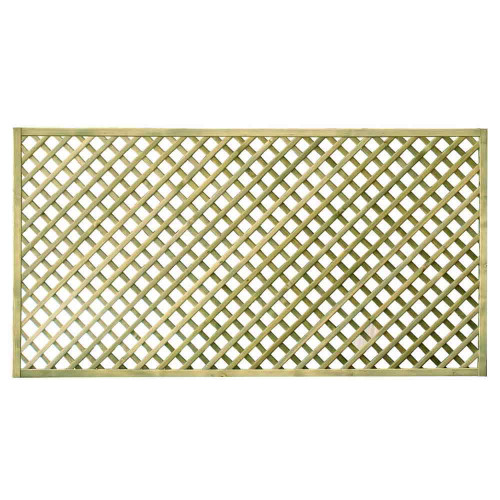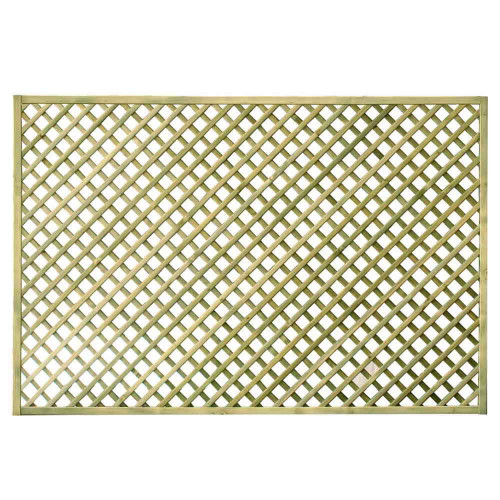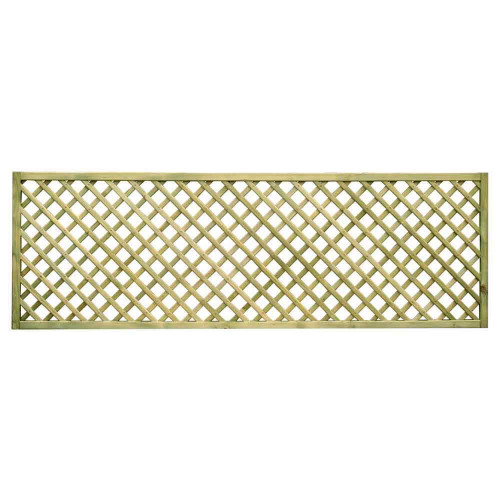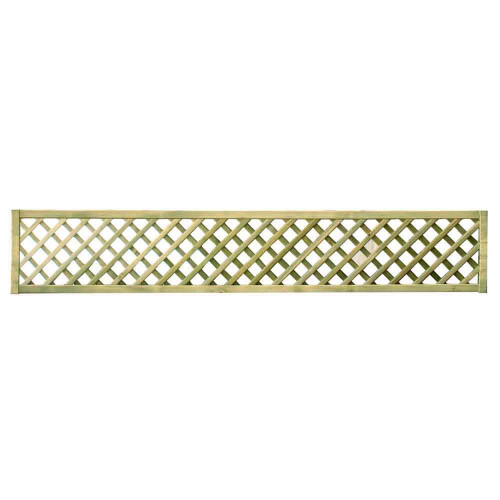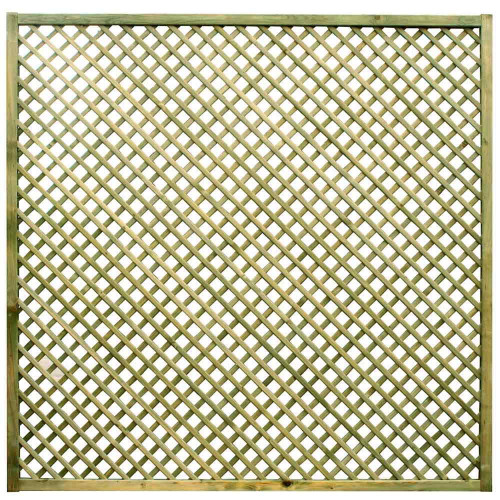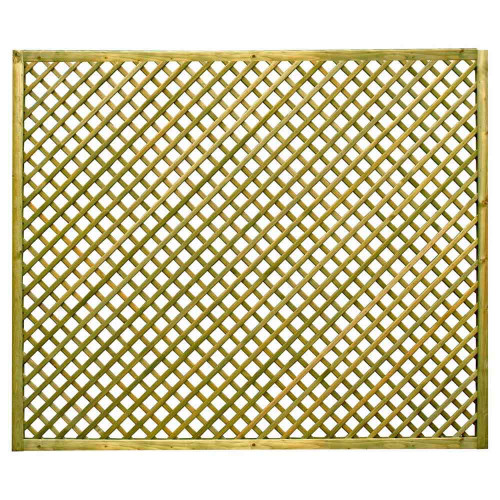



Quick answer: Minor Diamond Trellis damage can sometimes be repaired if the outer frame remains sound and the problem is limited to one lattice strip, one intersection or a loose fixing. Replacement becomes more sensible when several diagonal battens are broken, the frame has split or twisted, or the panel can no longer remain securely supported. Check the posts and installation before blaming the trellis, because movement in the surrounding structure can pull an otherwise serviceable panel out of shape.
A broken section of Diamond Trellis does not always mean the whole panel needs replacing.
The deciding factor is where the damage has occurred.
A single loose lattice strip can be a relatively local problem. A damaged outer frame is much more significant because the frame holds the diagonal pattern together and provides the main fixing points for the complete panel.
There is also another possibility: the trellis may only appear damaged because the posts supporting it have moved.
Before reaching for new timber or ordering a replacement panel, inspect the complete installation and work out what has actually failed.
What Parts Of Diamond Trellis Can Become Damaged?
A framed Diamond Trellis panel contains several components that can experience different types of damage.
Problems can affect:
- Individual diagonal lattice strips
- Lattice intersections
- The outer timber frame
- Connections between lattice and frame
- Panel-to-post fixings
The repairability of the panel depends heavily on which of these parts has failed.
What Diamond Trellis Damage Is Usually Repairable?
Local repairs are most realistic where the complete panel remains structurally coherent.
Examples include:
- One loose diagonal strip
- One damaged lattice intersection
- A local fixing that has pulled loose
- A small isolated split away from a major frame joint
- Minor damage caused while installing or handling the panel
If the frame remains straight and most of the lattice is secure, replacing the whole panel may be unnecessary.
When Is Replacement Usually Better?
Replacement becomes more practical when damage spreads beyond one local section.
| Damage | Likely Approach | Reason |
|---|---|---|
| One loose lattice strip | Repair often possible | Localised damage |
| One failed intersection | Repair often possible | Limited fixing issue |
| Several broken diagonal strips | Compare repair with replacement | Pattern becomes difficult to reconstruct |
| Split outer frame | Inspect carefully | Main panel support may be affected |
| Badly twisted frame | Replacement usually preferable | Complete panel geometry is affected |
| Widespread deterioration | Replace | New fixings need sound timber |
Why Is The Outer Frame So Important?
The frame holds the Diamond Trellis together as one panel.
It also provides the substantial edges through which the trellis can be supported by:
- Wooden Fence Posts
- Wall-mounted framing
- Other suitable structural supports
If one internal diagonal strip breaks but the frame remains sound, the fault may stay local.
If the frame fails, several lattice pieces can lose their support at the same time.
Repairing individual pieces inside a badly damaged frame rarely addresses the real problem.
How Can You Tell If The Frame Is Still Sound?
Stand back and inspect the complete rectangular panel.
Look for:
- Top and bottom edges that remain reasonably straight
- Side frames that remain parallel
- Corners that have not separated
- No substantial splits through fixing areas
- No major twist through the complete panel
A small amount of natural timber movement is different from a frame that has visibly lost its shape.
Could Moving Fence Posts Be Causing The Damage?
Yes.
Post movement can place significant stress on a framed trellis panel.
If two posts move towards one another, the bay becomes narrower and can compress the trellis.
If one post leans away, the panel may be pulled at its fixings.
Typical warning signs include:
- A growing gap down one side
- One corner of the trellis dropping
- The outer frame bowing
- Lattice intersections becoming loose in one area
- Fixings pulling through the frame
Repair the supporting structure first if that is the cause.
A repaired or replacement panel installed between moving posts is likely to develop the same problem again.
How Can You Check Whether A Wooden Post Has Moved?
Use a spirit level and compare the post in both directions.
Also inspect the area around ground level.
Look for:
- Leaning
- Movement when gently pushed
- Timber deterioration
- Foundation movement
Do not attempt to straighten the trellis with extra screws if the post itself is no longer stable.
Can An Incorrectly Sized Bay Damage Diamond Trellis?
Yes.
A framed timber panel should not be forced into an opening that is too narrow.
Compression can affect:
- The outer frame
- Diagonal battens
- Lattice intersections
- Panel fixings
If the panel is noticeably bowed between otherwise stable posts, measure the clear opening at the top, middle and bottom.
The bay may have been set too narrow or may have become narrower as posts moved.
Can A Single Broken Diamond Lattice Strip Be Replaced?
Potentially.
The first requirement is a replacement timber section that properly matches the existing panel.
Do not assume Diamond Trellis uses the same batten dimensions as Traditional Square Trellis or Privacy Square Trellis.
The current Diamond Trellis range is a separately supplied range, so measure the actual lattice component before selecting replacement timber.
Check:
- Width
- Thickness
- Surface finish
- Angle
- How the strip meets the outer frame
Why Is Matching The Existing Batten Important?
A visibly different timber section can disrupt both the structure and appearance of the panel.
A replacement that is too thick can stand proud of neighbouring lattice.
One that is too narrow can look noticeably weak within the repeated diamond pattern.
Decorative lattice tends to reveal mismatches quickly because the same shapes repeat across the panel.
How Do You Replace One Damaged Lattice Section?
The exact construction should be inspected before dismantling anything, but a typical repair process is:
- Remove plant growth from the working area: Support any substantial stems rather than allowing them to fall.
- Inspect the frame: Confirm that the main panel structure is worth repairing.
- Measure the damaged lattice: Record its actual dimensions and position.
- Study the pattern: Identify how the strip crosses neighbouring battens.
- Remove the damaged timber carefully: Avoid disturbing sound intersections unnecessarily.
- Cut a matching replacement: Reproduce the required length and end angles.
- Protect exposed treated-timber cuts where required: Do this before inaccessible faces are installed.
- Restore the original pattern: Keep the new strip on the same lattice layer as the component it replaces.
- Secure it using suitable exterior fixings: Avoid unnecessarily large fixings in narrow timber.
- Inspect neighbouring joints: Make sure the repair has not pulled other parts of the lattice out of position.
Why Does The Lattice Layer Matter?
Diamond Trellis is created from crossing diagonal components.
One direction sits on one layer and the opposing direction crosses it.
If a replacement is fitted on the wrong side at one section, the pattern can visibly jump.
This may also change how neighbouring intersections sit together.
Take photographs before dismantling the damaged area if there is any doubt about the original arrangement.
Can A Loose Lattice Intersection Be Refixed?
Often, if both pieces of timber remain sound.
First check why the intersection became loose.
If the original fixing has simply failed while the surrounding timber remains intact, a suitable exterior repair may be straightforward.
If the timber has split around the fixing point, adding another fastener in almost exactly the same damaged position may provide little benefit.
Use sound material for the new fixing.
Should You Add More Screws To Every Diamond Intersection?
No.
Repair the actual problem rather than attempting to reinforce the whole panel indiscriminately.
Excessive fixings can:
- Split narrow lattice timber
- Create unnecessary holes
- Restrict natural timber movement
- Make the decorative pattern untidy
A panel with dozens of apparently loose joints may be approaching the point where replacement is more sensible anyway.
Can A Split Outer Frame Be Repaired?
It depends on the size and position of the split.
A small local split that does not compromise the frame joint or main fixing area may potentially be repairable.
Replacement becomes more attractive if the split:
- Runs through a corner joint
- Passes through several panel fixings
- Allows the side frame to move independently
- Has caused several lattice ends to become loose
The more structural work needed to restore the outer frame, the closer the job becomes to rebuilding the complete panel.
Can You Straighten A Twisted Diamond Trellis Panel?
Do not immediately use screws to force a badly twisted panel flat.
First determine why it is twisted.
Possible causes include:
- Natural timber movement
- Poor storage
- Compression between posts
- Post movement
- Uneven plant loading
If the frame has permanently distorted significantly, forcing it flat can simply transfer stress into the fixings and lattice.
Complete replacement is often cleaner where the main frame has lost its shape.
Can Heavy Climbing Plants Break Diamond Trellis?
They can contribute to damage.
Diamond Trellis is particularly useful for climbing plants, but a mature planted panel is very different from the bare panel originally installed.
Over time, the structure may carry:
- Woody stems
- Dense foliage
- Dead accumulated growth
- Water held after rainfall
Dense planting can also reduce airflow through the lattice and increase wind resistance.
What Should You Do Before Repairing Trellis Behind A Mature Plant?
Do not remove damaged timber without considering what the plant is resting on.
A mature climber may need to be:
- Temporarily supported
- Untied from the damaged area
- Pruned to reduce excessive weight
- Moved carefully away from the repair zone
This is particularly important with established climbing roses and other woody growth.
A trellis repair is much easier when the plant is not pulling the damaged components out of position while you work.
Can You Repair Diamond Trellis Without Removing The Panel?
Sometimes.
Small accessible faults may be repairable in position, including:
- One loose intersection
- A local panel-to-post fixing
- A short damaged lattice section
Removing the panel can be useful where:
- A longer lattice component needs replacing
- The frame needs checking for twist
- Several intersections require attention
- Access to the rear face is poor
What Can You Learn By Removing The Panel?
A removed panel can be inspected independently of the posts.
This helps answer a useful question:
Is the trellis distorted, or is the installation distorting the trellis?
If the panel sits reasonably square once removed, check:
- Post alignment
- Bay width
- Fixing positions
If the panel remains badly twisted away from the fence, the problem is within the panel itself.
Can Cut Diamond Trellis Be Repaired?
Yes, in some cases.
A common problem occurs when Diamond Trellis is shortened and the original outer frame is simply removed.
That can leave numerous diagonal strips ending without proper edge support.
A suitable repair may involve establishing a new outer frame edge and securing the remaining lattice pieces to it.
The finished result should behave like a smaller framed panel rather than a cut lattice sheet with loose ends.
What If The Cut Diamond Pattern Looks Uneven?
Some partial diamonds are unavoidable when a diagonal lattice is shortened to a non-standard width.
The priority is to create:
- A straight outer edge
- Secure lattice ends
- A visually balanced pattern
If a previous cut has left several tiny unsupported fragments, it may be cleaner to shorten the panel slightly further and establish a better new frame edge.
Measure carefully before making another irreversible cut.
Can Pressure-Treated Diamond Trellis Still Deteriorate?
Yes.
Pressure treatment improves outdoor durability but does not remove the need for sensible installation and maintenance.
Long-term performance is still affected by:
- Persistent moisture
- Soil contact
- Plant density
- Post movement
- Mechanical damage
The current Diamond Trellis range is pressure treated in a green or natural-looking finish for outdoor use.
Colour weathering by itself is not evidence that the panel requires replacement.
Does Green Algae Mean The Diamond Trellis Is Rotten?
No.
Algae is commonly surface growth associated with damp and shaded conditions.
Inspect the timber itself.
More significant warning signs include:
- Soft timber
- Components breaking away
- Fixings no longer gripping
- Widespread structural deterioration
Surface colour should not be used as the sole test of panel condition.
Can You Pressure Wash Damaged Diamond Trellis?
Use considerable caution.
Diamond Trellis contains relatively narrow decorative timber components.
A concentrated pressure washer can potentially:
- Raise timber fibres
- Damage weakened battens
- Disturb loose intersections
- Damage an existing decorative coating
Gentle manual cleaning is normally the better starting point, particularly where you are already assessing the panel for repair.
Can A New Replacement Panel Use The Existing Posts?
Yes, if the posts remain suitable.
Before ordering the replacement, check:
- Both posts remain plumb
- The bay width is appropriate
- The supports remain structurally sound
- The replacement panel dimensions are compatible
The current Diamond Trellis range uses a nominal 6ft width, approximately 1.83m, with heights from around 300mm to 1.8m.
Measure the actual opening and panel rather than assuming every nominal 6ft bay is identical.
Should You Replace One Panel Or The Whole Trellis Run?
One damaged panel can usually be treated independently where neighbouring panels and posts remain sound.
There is no structural reason to replace an entire run simply because one section was damaged by:
- Impact
- A fallen branch
- A local plant problem
- A failed fixing
Check adjoining panels carefully, particularly if the damage followed strong winds or post movement.
Will A New Panel Look Different Beside Older Diamond Trellis?
Possibly.
Outdoor timber changes appearance as it weathers.
An older panel may have:
- A lighter or greyer colour
- Different treatment tone
- More visible weathering
A new pressure-treated panel can therefore stand out initially.
This does not mean the replacement is incompatible purely because the colour is fresher.
Can You Paint A Repaired Diamond Trellis Panel?
Potentially, using a suitable exterior timber coating once the timber is appropriately prepared and dry.
Make structural repairs before decorating.
Paint or stain should not be used to disguise:
- Loose lattice
- Split frames
- Failed fixings
- Soft timber
If climbing plants are present, decoration is much easier while enough of the panel remains accessible.
How Can You Reduce Future Diamond Trellis Damage?
- Keep posts stable: Movement in the supports can distort the panel.
- Avoid force-fitting panels: Trellis should not be compressed into an undersized opening.
- Fix through substantial framed sections: Do not rely on individual diagonal strips to support the complete panel.
- Control climbing plants: Prevent mature growth becoming excessively heavy or concentrated in one area.
- Keep the lower frame clear: Avoid unnecessary soil, mulch and wet debris against the timber.
- Inspect small faults early: One loose lattice strip is easier to deal with before neighbouring intersections begin moving.
Common Diamond Trellis Repair Mistakes
- Repairing one broken strip without checking the outer frame
- Ignoring a leaning Wooden Fence Post
- Assuming Diamond Trellis uses the same batten dimensions as another trellis range
- Using noticeably mismatched replacement timber
- Installing a replacement lattice strip on the wrong layer
- Using oversized fixings in narrow decorative timber
- Adding many unnecessary screws to the complete panel
- Trying to force a twisted panel flat with fixings
- Repairing plant damage without reducing the plant load
- Leaving cut diagonal strips without a supported new frame edge
- Replacing the panel without measuring the existing bay
- Assuming weathered colour means structural failure
- Painting over damage instead of repairing it
FAQs
Can Broken Diamond Trellis Be Repaired?
Minor local damage can sometimes be repaired if the outer frame and surrounding lattice remain sound. Widespread lattice or frame damage normally makes replacement more practical.
Can You Replace One Diamond Trellis Batten?
Potentially. Measure the actual existing component first because the Diamond Trellis range should not be assumed to use the same batten dimensions as East Coast Fencing's in-house square trellis ranges.
Can You Repair A Loose Diamond Lattice Joint?
Often, provided both pieces of timber remain sound. If the original fixing area has split badly, simply adding another fixing in the same damaged spot may not provide a durable repair.
Should You Replace Diamond Trellis If The Frame Is Split?
Small isolated damage needs inspection, but substantial frame splitting is more serious because the outer frame supports the lattice and provides the main panel fixing areas.
Can Climbing Plants Damage Diamond Trellis?
Heavy mature vegetation can add substantial weight and wind resistance. Pruning and suitable independent support may be needed for vigorous climbers.
Can Existing Posts Be Reused With A Replacement Diamond Trellis Panel?
Yes, where the posts remain stable, suitably spaced and compatible with the replacement panel. Check them before replacing the trellis.
What Width Is Diamond Trellis?
The current East Coast Fencing range is nominally 6ft wide, approximately 1.83m, with heights from around 300mm to 1.8m. Measure the actual panel before fitting it into an existing bay.
Does Pressure Treatment Mean Diamond Trellis Cannot Deteriorate?
No. Pressure treatment improves outdoor durability, but installation, moisture, plant weight, exposure and maintenance still affect long-term condition.
Repair Local Damage, But Do Not Rebuild A Failed Panel Piece By Piece
Diamond Trellis can often be repaired when the problem is genuinely local.
One loose intersection or damaged lattice strip does not automatically justify replacing a complete nominal 6ft-wide panel.
Start with the outer frame. If it remains sound, inspect the damaged lattice and determine whether a compatible replacement component can be fitted without disturbing large areas of the surrounding diamond pattern.
Then check the structure supporting it.
Leaning posts, incorrect bay widths and heavy climbing plants can all create damage that will simply return if the cause is ignored.
Be more cautious when the outer frame has failed.
Once several diagonal strips are broken, multiple intersections are loose or the frame is badly twisted, repairing every individual component can become more complicated than replacing the panel.
The practical dividing line is whether the trellis still behaves like one sound framed panel.
If it does, local repair may be worthwhile. If it no longer does, replacement is usually the cleaner solution.