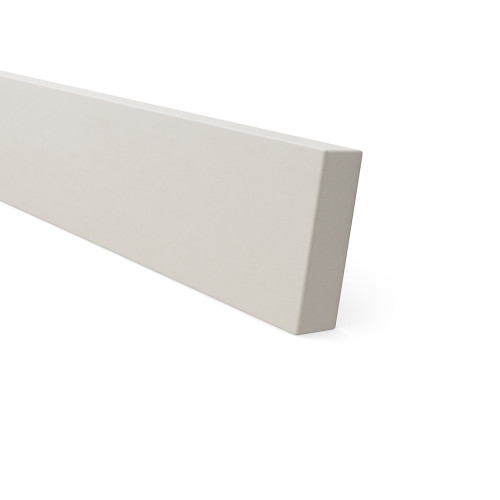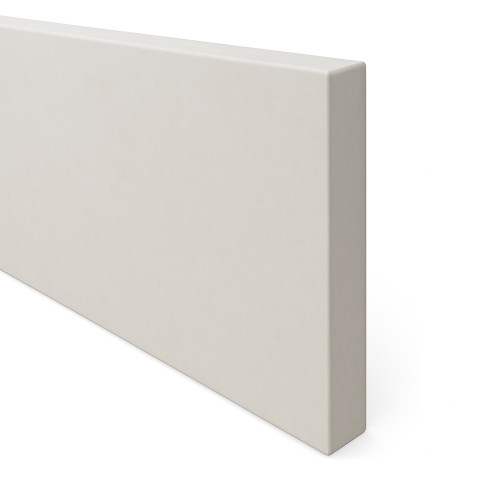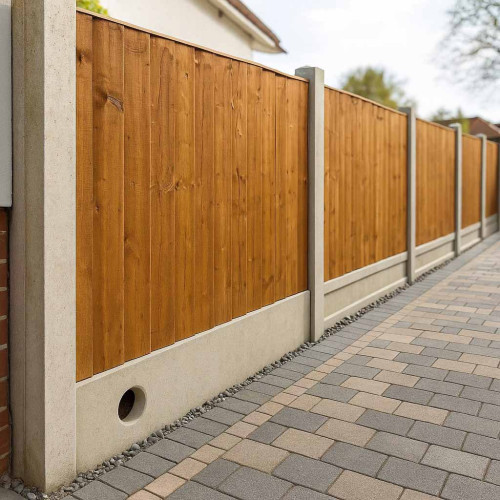



Quick answer: Choose a 6-inch concrete gravel board, approximately 150mm high, when you mainly want to keep a timber fence panel clear of damp ground without adding too much extra height. Choose a 12-inch board, approximately 305mm high, when you need a deeper concrete base, greater panel clearance or more flexibility around changing ground levels. Remember that the gravel board contributes to the finished fence height, so the panel, board and posts should be selected together.
Choosing between a 6-inch and 12-inch concrete gravel board is not simply a matter of deciding which one looks better.
The difference in height changes where the timber fence panel sits, how much concrete is visible at ground level, the post length you may need and the total height of the completed fence.
East Coast Fencing's current concrete gravel board range includes both 150mm and 305mm options across suitable smooth and rebated designs, along with selected 12-inch recessed and wildlife-access boards.
Both sizes perform the same basic job. They create a concrete barrier between the timber panel and the dampest part of the garden.
The right height depends on what you need that barrier to achieve.
What Is The Difference Between A 6-Inch And 12-Inch Gravel Board?
A 6-inch concrete gravel board is approximately 150mm high.
A 12-inch concrete gravel board is approximately 305mm high.
The 12-inch option therefore adds around 155mm more height beneath the fence panel.
Current standard East Coast Fencing concrete gravel boards are approximately 1.83m long for use within suitable standard-width fencing bays. Traditional smooth and recessed versions are approximately 45 to 55mm deep, depending on the particular product.
| Feature | 6-Inch Gravel Board | 12-Inch Gravel Board |
|---|---|---|
| Approximate Height | 150mm | 305mm |
| Typical Role | Low concrete base | Deeper concrete base |
| Panel Clearance | Moderate | Greater |
| Visible Concrete | Less | More |
| Effect On Fence Height | Adds around 150mm | Adds around 305mm |
| Uneven Ground | Suitable for modest requirements | Provides more depth to work with |
When Is A 6-Inch Concrete Gravel Board Usually Enough?
A 150mm gravel board suits many ordinary garden fences.
It provides a useful concrete barrier beneath the timber while keeping the amount of visible concrete relatively modest.
Consider a 6-inch board when:
- The garden is reasonably level
- You mainly want to separate timber from damp ground
- You want a relatively discreet concrete base
- You do not need a large height difference between ground and panel
- The existing fence already uses 150mm boards
- You want to minimise the additional height beneath the fence panel
For many straightforward panel fences, this is the natural starting point.
When Does A 12-Inch Concrete Gravel Board Make More Sense?
A 305mm gravel board creates a much deeper concrete section beneath the timber panel.
That can be useful where more separation is required between the panel and surrounding ground.
Consider a 12-inch board where:
- The ground varies noticeably between bays
- You want more of the lower fence constructed from concrete
- The existing installation already uses 305mm boards
- A shorter fence panel will be installed above it
- A substantial visible concrete base suits the appearance of the boundary
- A purpose-made 12-inch wildlife-access board is required
A taller gravel board should be chosen deliberately because the additional 155mm has consequences elsewhere in the fence.
Does A 12-Inch Gravel Board Protect The Fence Panel Better?
It creates greater physical separation between the timber panel and the ground.
That can be useful where vegetation, rain splash or surrounding ground would otherwise sit close to the timber.
However, a 12-inch board should not automatically be viewed as twice as good as a 6-inch board.
If a 150mm board already keeps the panel comfortably above the surrounding ground, adding another 155mm of concrete may provide little practical benefit.
The taller board also:
- Raises the panel further
- Requires more usable post height
- Changes the visual proportions of the fence
- Increases the total height of the fence arrangement
More concrete is useful only where the extra depth solves a real problem.
How Does Gravel Board Height Affect Total Fence Height?
This is one of the most important differences between the two sizes.
The gravel board sits beneath the fence panel, so its height must be added to the panel height.
For example, a nominal 1.8m-high fence panel above a 150mm gravel board gives a panel-and-board height of approximately:
1.8m + 0.15m = 1.95m.
The same panel above a 305mm gravel board gives:
1.8m + 0.305m = 2.105m.
That is a difference of approximately 155mm simply from changing the gravel board.
This is why the panel and gravel board should not be selected independently.
Can You Use A Shorter Fence Panel With A Gravel Board?
Yes.
Using a shorter panel above the gravel board can keep the overall fence closer to the height you actually want.
For example:
| Panel Height | Gravel Board | Combined Approximate Height |
|---|---|---|
| 1.65m | 150mm | 1.80m |
| 1.50m | 305mm | 1.805m |
| 1.80m | 150mm | 1.95m |
| 1.80m | 305mm | 2.105m |
These examples show why buying a full-height panel first and then deciding to add a gravel board underneath can produce a fence considerably taller than expected.
Is A 6-Inch Gravel Board Better With A 5ft 6in Fence Panel?
This is a useful combination where a finished panel-and-board section of approximately 1.8m is wanted.
A panel around 1.65m high plus a 150mm gravel board gives approximately 1.80m overall.
The exact finished height can still vary slightly with nominal product dimensions and the way the fence sits relative to the ground.
Measure the actual components rather than relying entirely on traditional foot-and-inch descriptions.
Is A 12-Inch Gravel Board Better With A 5ft Fence Panel?
A 1.5m panel above a 305mm gravel board produces a combined height of approximately 1.805m.
This creates a broadly similar overall height to a taller panel above a 150mm board, but with much more concrete and less timber.
That can be useful where you specifically want the deeper concrete base.
The visual result is different.
A fence with 305mm of visible concrete beneath it will look more substantial at ground level than one using a 150mm board.
Which Size Is Better For Wet Gardens?
Concrete itself does not rot, so both sizes are useful where the lower fence is regularly exposed to moisture.
The decision should depend on how high the timber actually needs to be kept above the surrounding conditions.
A 6-inch board may be perfectly adequate if the ground is level and water drains reasonably well.
A 12-inch board may be useful where:
- Vegetation grows high around the boundary
- The soil line varies
- More clearance above splashback is wanted
- The existing layout already uses a deeper concrete base
Do not use a taller gravel board as a substitute for dealing with severe drainage problems.
If water regularly sits against the fence for long periods, the drainage issue deserves separate attention.
Which Size Is Better On Uneven Ground?
A 12-inch board provides more depth and can sometimes give greater flexibility where ground levels vary.
However, neither size should simply be buried at random until the fence looks level.
On a slope, panel fencing is commonly installed in steps.
Each fence panel and gravel board remains level across its individual bay, while the next bay starts higher or lower.
This creates a series of controlled changes rather than forcing rigid rectangular components to follow a gradient.
The taller board can be useful where a deeper base works better with these changes, but the complete layout should be planned before the posts are installed.
Can A 12-Inch Gravel Board Fill A Gap Under A Fence?
Potentially, if the larger board forms part of a properly planned fence layout.
Do not automatically swap a 150mm board for a 305mm board simply because there is a gap beneath the fence.
First establish why the gap exists.
Possible reasons include:
- Sloping ground
- Soil erosion
- The fence being installed too high
- A broken or incorrectly positioned gravel board
- A change in landscaping
If you replace a 6-inch board with a 12-inch version, the fence panel above also moves upwards unless the rest of the installation is changed.
You may close one gap while creating a new height problem at the top.
Can A 12-Inch Gravel Board Be Used To Retain Soil?
A taller board should not automatically be treated as a retaining wall.
A gravel board can deal with normal ground-level fencing conditions and small amounts of loose surface material, but significant retained soil introduces continuous sideways pressure.
Wet soil can be particularly demanding.
Excessive pressure can contribute to:
- Cracked concrete boards
- Leaning fence posts
- Movement between fence bays
If there is a substantial difference in ground level across the boundary, the retaining requirement should be considered separately.
Simply choosing the tallest gravel board available does not turn an ordinary fence into a retaining structure.
Does A 12-Inch Board Need A Longer Fence Post?
Often, depending on the panel height and installation.
A post needs enough length for:
- The gravel board
- The fence panel
- Any required post projection
- The section installed below ground
If the gravel board becomes 155mm taller while everything else stays the same, the fence assembly also becomes 155mm taller.
This may mean the post length that worked for the 6-inch arrangement is no longer appropriate.
Calculate the complete vertical layout before ordering the posts.
Can You Replace A 6-Inch Gravel Board With A 12-Inch One?
Potentially, but it is not a simple like-for-like replacement.
You need to check:
- The available height within the posts
- The fence panel height
- The desired finished fence height
- The surrounding fence bays
- The board profile
- The post-slot compatibility
If one bay uses a 305mm board while every neighbouring bay uses 150mm boards, the fence line will also need careful consideration.
For straightforward repairs, matching the existing gravel-board height is usually the simplest approach.
Can You Replace A 12-Inch Board With A 6-Inch One?
Again, it may be possible, but the fence panel will sit approximately 155mm lower if no other changes are made.
That may affect:
- The top line of the fence
- The gap beneath the panel
- Privacy
- Pet containment
- Alignment with neighbouring bays
A smaller board should therefore be part of a planned alteration rather than an improvised replacement.
Are 6-Inch And 12-Inch Boards The Same Length?
Current East Coast Fencing standard concrete gravel boards in these sizes are generally approximately 1.83m long for standard fencing bays.
The height changes, but the nominal bay length remains the same across suitable products.
Do not rely on nominal length alone when working with an existing fence.
Measure the clear opening between the actual post slots.
Older concrete posts may have moved slightly, and different board profiles can also affect compatibility.
Are 6-Inch And 12-Inch Gravel Boards The Same Thickness?
Not necessarily.
Current traditional concrete boards are approximately 45 to 55mm deep depending on the product.
The range also includes lightweight rebated designs, which use a different profile.
When replacing an existing board, check:
- Length
- Height
- Depth
- Face style
- Rebate or profile
Do not assume that any 1.83m x 150mm concrete board will fit any concrete fencing system.
What Concrete Gravel Board Styles Are Available?
The current range includes several configurations.
These include:
- 6-inch smooth concrete gravel boards
- 12-inch smooth concrete gravel boards
- 12-inch recessed concrete gravel boards
- 6-inch lightweight rebated concrete gravel boards
- 12-inch lightweight rebated concrete gravel boards
- 12-inch smooth concrete gravel boards with a hedgehog opening
Height and appearance are therefore separate decisions.
You may decide that 305mm is the correct height and then still need to choose between a smooth, recessed, rebated or wildlife-access version depending on the fence system and appearance required.
What Is The Difference Between Smooth And Recessed Boards?
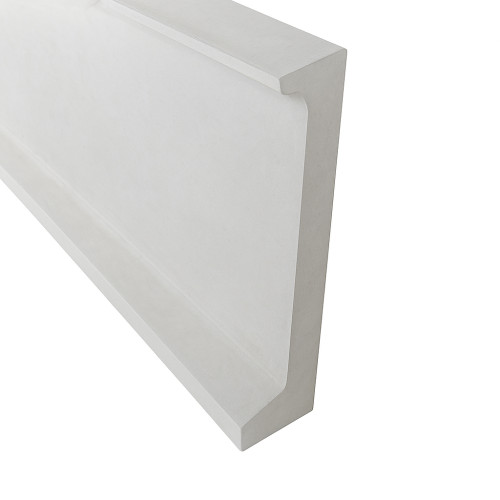
A smooth concrete gravel board has a plain face.
This gives the lower fence a simple, understated appearance.
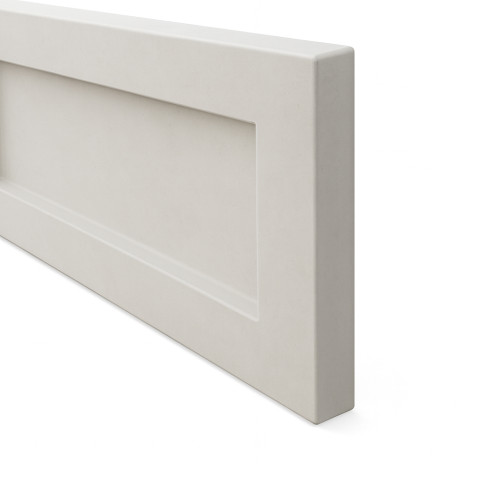
A recessed board has a shaped face that creates more visual detail.
The recessed design does not fundamentally change why the gravel board is installed. Its main distinction is appearance.
The current recessed option is a 12-inch board, approximately 305mm high.
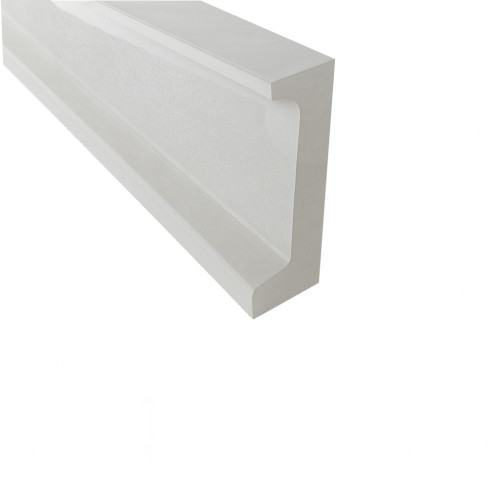
What Is A Lightweight Rebated Gravel Board?
A lightweight rebated board uses a shaped profile intended for compatible fencing arrangements.
Current versions are available in both approximately 150mm and 305mm heights.
The key issue is compatibility.
A rebated board should not automatically be substituted for a smooth or recessed board simply because its external length and height look similar.
Check how the rebate interacts with the posts and panel before ordering.
Why Is The Hedgehog Gravel Board 12 Inches High?
The current wildlife-access concrete gravel board is approximately 305mm high and contains a purpose-made opening.
The opening allows small wildlife such as hedgehogs to move between suitable neighbouring gardens without requiring the board to be cut after manufacture.
The board still performs the normal role of forming the concrete base beneath the rest of the panel.
If using one, make sure the opening remains accessible after landscaping.
Do not position it where soil, paving, planting or stored items immediately block it.
Should You Choose 6-Inch Or 12-Inch Boards For Pets?
The taller board may be useful where you want a deeper solid section beneath the timber fence, but gravel-board height alone does not make a fence secure for a particular animal.
Check the complete boundary for:
- Gaps beneath the boards
- Spaces beside posts
- Gate clearances
- Damaged panels
- Ground that can easily be dug away
A 12-inch board installed badly can leave a more useful escape gap than a properly fitted 6-inch board.
Which Size Looks Better?
This is largely personal preference.
A 150mm gravel board creates a relatively narrow concrete strip beneath the timber.
This keeps most of the visible boundary as timber.
A 305mm board creates a noticeably deeper base.
That can look deliberate and substantial, particularly with a recessed face, but it reduces the proportion of visible timber if the total fence height remains similar.
Look at the complete elevation rather than judging the gravel board on its own.
Does A Taller Gravel Board Make The Fence Stronger?
Not automatically.
Fence strength depends on the complete system, including:
- Post type
- Post length
- Foundation
- Ground conditions
- Panel construction
- Fence height
- Wind exposure
A 12-inch gravel board gives you more concrete beneath the panel, but it does not compensate for leaning posts or inadequate foundations.
Does A Taller Gravel Board Mean Less Timber Maintenance?
It places more concrete and less timber near ground level when compared with a shorter board used at the same overall fence height.
For example, a shorter panel above a 305mm board can create a similar total fence height to a taller panel above a 150mm board.
This can reduce the amount of timber close to the ground.
The fence panel above still remains an outdoor timber product and should be inspected and maintained appropriately.
Which Size Is Easier To Install?
Both are precast concrete components and need careful handling.
A 12-inch traditional concrete board contains more material and is physically more substantial than a comparable 6-inch version.
Do not plan the installation around what one person thinks they might be able to lift.
Use enough people or suitable handling equipment for the actual component.
Wear appropriate gloves and footwear, keep fingers away from post slots while lowering boards and make sure the working area is clear.
Do Concrete Gravel Boards Need To Be Level?
They should normally sit level within each individual fence bay.
The fence panel above then has a straight base to sit on.
On sloping ground, the normal solution with rigid panels is to step the fence between bays rather than deliberately installing each gravel board at a different angle.
Plan the steps before fixing the posts because the change affects the height of the complete arrangement.
Should A 12-Inch Board Be Buried More Deeply?
Not simply because it is taller.
If you buy a 305mm gravel board and then bury most of the additional height, you may gain little practical benefit from selecting it.
Some ground contact is normal, but the board should be positioned according to the actual fence design and site levels.
Avoid creating a deep trench unnecessarily because that can disturb the fence line and create areas where water collects.
How Do You Choose Between 6-Inch And 12-Inch Gravel Boards?
Work through the decision in this order.
- Measure the ground: Identify slopes, high points and low areas along the boundary.
- Decide how much panel clearance you need: A 150mm board may be enough on ordinary level ground.
- Choose the required total fence height: Do not choose the panel before doing this calculation.
- Select the panel height: Allow for the gravel board underneath it.
- Choose 150mm or 305mm: Pick the board that creates the required lower section.
- Check the profile: Smooth, recessed and rebated products are not automatically interchangeable.
- Choose sufficient post length: Allow for both the visible fence and the below-ground installation.
- Measure the actual bay: Confirm the board will fit the post system.
Common Mistakes When Choosing Gravel Board Height
- Buying a 6ft panel and then adding a gravel board without calculating the finished height
- Choosing 12-inch boards simply because they look stronger
- Using 6-inch boards where changing ground levels require a different layout
- Assuming a 12-inch board can act as a retaining wall
- Forgetting that taller boards require enough usable post height
- Mixing 6-inch and 12-inch boards unintentionally along one level fence run
- Replacing an existing board without measuring it first
- Assuming every concrete gravel board has the same profile
- Ignoring the difference between smooth, recessed and rebated products
- Setting the concrete posts before confirming the actual component dimensions
FAQs
How High Is A 6-Inch Concrete Gravel Board?
Current 6-inch East Coast Fencing concrete gravel boards are approximately 150mm high and around 1.83m long across suitable products.
How High Is A 12-Inch Concrete Gravel Board?
A current 12-inch concrete gravel board is approximately 305mm high and commonly around 1.83m long for a standard fencing bay.
Is A 12-Inch Gravel Board Better Than A 6-Inch Board?
Not automatically. Choose 12-inch where you need the additional concrete height. A 6-inch board is usually the more proportionate option where you simply need to keep a timber panel clear of the ground.
Can You Put A 6ft Fence Panel On A 6-Inch Gravel Board?
You can where the posts and complete installation are suitable, but the combined panel-and-board section will be around 1.95m if the panel itself is approximately 1.8m high.
Can You Put A 6ft Fence Panel On A 12-Inch Gravel Board?
Physically it may be possible with suitable posts, but a 1.8m panel plus a 305mm board produces a combined height of approximately 2.105m. Calculate the required finished fence height before choosing this arrangement.
Which Gravel Board Is Best For Uneven Ground?
A 12-inch board can provide more depth to work with, but sloping fences still need careful setting out. Standard rectangular panels and gravel boards are commonly stepped between bays rather than forced to follow the gradient.
Can I Replace A 6-Inch Board With A 12-Inch Board?
Possibly, but it raises the fence panel by approximately 155mm unless other components are changed. Check the post height, panel height and surrounding bays first.
Are 6-Inch And 12-Inch Gravel Boards The Same Thickness?
Not necessarily. Current traditional boards are approximately 45 to 55mm deep depending on the product, while rebated versions have a different profile. Check the exact specification before replacing an existing board.
Choose The Height As Part Of The Complete Fence
A 6-inch concrete gravel board is often the simplest choice where the main aim is to lift a timber panel away from damp ground while keeping the concrete base relatively discreet.
A 12-inch gravel board provides another approximately 155mm of concrete. That can be useful on uneven sites, where more panel clearance is wanted or where a deeper base deliberately forms part of the fence design.
Neither option is universally better.
Start with the finished fence height you actually want. Then select the panel height, gravel board and post length as one compatible arrangement.
Measure existing post slots when carrying out repairs and check the complete board profile rather than looking only at whether it is described as 6-inch or 12-inch.
Getting those measurements right before installation is much easier than discovering afterwards that the correct gravel board has made the finished fence 155mm taller than expected.