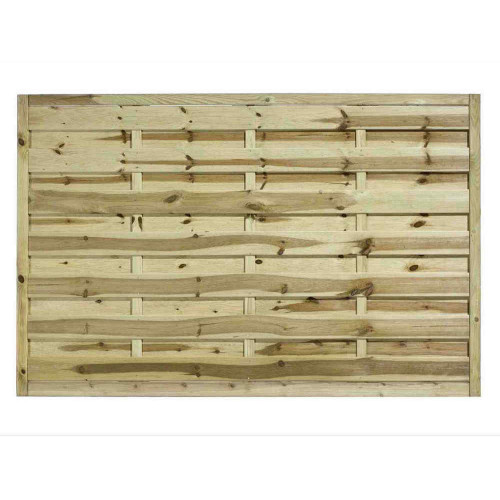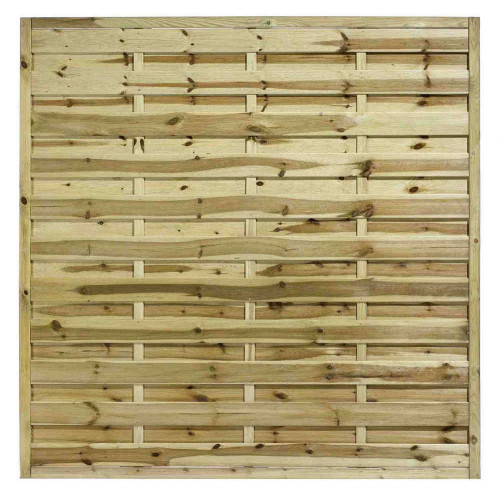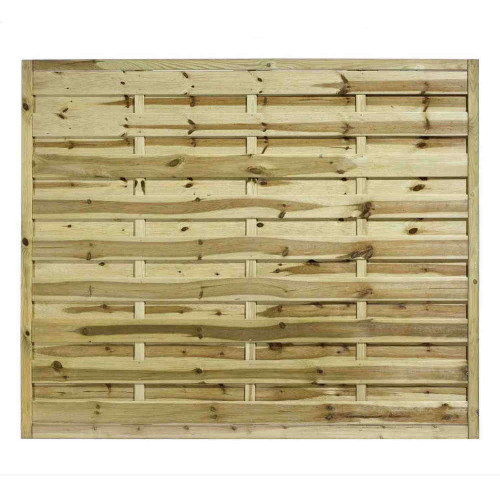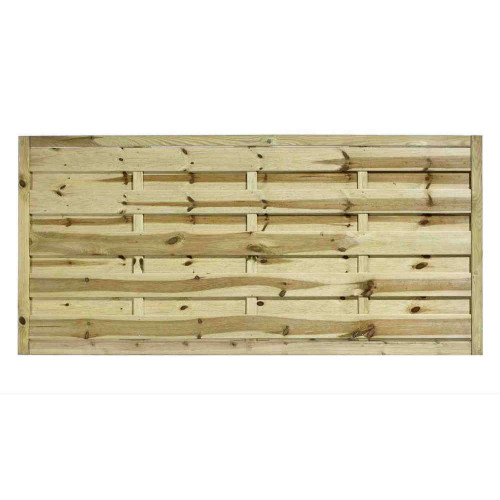


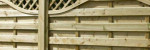

Quick answer: Minor damage to Hit & Miss Fence Panels can sometimes be repaired, but the frame matters more than one damaged slat. If a single board is loose or locally damaged while the 45 x 45mm outer frame remains square and secure, a repair may be practical. If the frame is split, badly distorted, several slats are loose or the panel no longer fits securely between the posts, complete replacement is usually the better option. Always inspect the posts before blaming the panel.
A damaged fence panel does not automatically need replacing.
With Hit & Miss Fence Panels, the decision comes down to understanding which part of the panel has failed.
The current East Coast Fencing design uses a 45 x 45mm semi-planed timber frame surrounding horizontal grooved slats measuring approximately 100 x 5mm. Those slats alternate between the two faces of the panel to create the characteristic combination of screening and airflow.
If one decorative slat develops a problem, the panel may still remain structurally sound. If the surrounding frame has failed, the situation is quite different.
Start by Working Out Whether the Panel or the Fence System Has Failed
Before repairing anything, identify the actual source of the problem.
A fence is a system made from several components:
- Fence panels
- Posts
- Post foundations
- Fixings or brackets
- Gravel boards where used
A panel that appears crooked may simply be sitting between leaning posts.
A panel that rattles may have too much clearance within the bay.
A lower frame that is deteriorating may have been sitting against soil rather than failing because of the panel design itself.
Repairing the wrong component usually means the problem returns.
How Are Hit & Miss Fence Panels Constructed?
Understanding the construction makes troubleshooting much easier.
The current East Coast Fencing Hit & Miss Fence Panels use:
- A 45 x 45mm semi-planed timber outer frame
- Approximately 100 x 5mm grooved horizontal slats
- Slats positioned alternately on opposite faces
- An overall panel depth of approximately 45mm
- Pressure-treated green/natural timber
The panels are manufactured in Poland and imported by East Coast Fencing.
They are made at approximately 1.828m wide, matching the traditional nominal UK 6ft panel format rather than the 1.8m width found on many other imported decorative products.
Why the Frame Is the Most Important Part to Check
The horizontal slats create the appearance and screening, but the 45 x 45mm perimeter frame holds the panel together as one complete unit.
The frame:
- Maintains the overall rectangular shape
- Supports the horizontal slats
- Provides the main handling area
- Provides the main interface with the fence-post system
If the frame remains square and secure, local damage within the panel may sometimes be manageable.
If the frame is badly split or distorted, repairing individual slats does not address the main structural problem.
What Damage Can Sometimes Be Repaired?
Local repair is most realistic when the problem is limited.
Examples include:
- One loose slat
- One locally split slat
- A minor fixing problem
- A small area of impact damage
- Minor movement where the main frame remains sound
The closer the damage is to being cosmetic or localised, the stronger the case for repair.
When Is Complete Panel Replacement Usually Better?
Replacement normally becomes more sensible when damage affects the main assembly.
Examples include:
- A split outer frame
- A frame that has become badly twisted
- Several loose or broken slats
- Major storm or impact damage
- Widespread deterioration around the lower frame
- A panel that can no longer be supported correctly between the posts
At that point, repairing several individual components can become more complicated than replacing the complete panel.
Repair or Replace: A Practical Decision Table
| Problem | Repair May Be Practical | Replacement More Likely |
|---|---|---|
| One loose slat | Yes | Usually no |
| One damaged slat | Potentially | If matching repair is impractical |
| Several broken slats | Sometimes | Often |
| Split outer frame | Limited cases only | Often |
| Panel badly twisted | Rarely | Usually |
| Leaning fence | Check posts first | Panel may be fine |
| Lower frame deterioration | Depends on severity | If structurally compromised |
How Do You Check Whether the Frame Is Still Sound?
Inspect all four sides of the outer frame.
Look for:
- Splits running through the timber
- Loose corners
- Major twisting
- Crushing or impact damage
- Deterioration near the lower edge
Then stand back and look at the complete panel.
It should still appear broadly rectangular rather than visibly bowed into a distorted shape.
Why a Square Frame Matters With Horizontal Fencing
Horizontal lines make distortion particularly easy to see.
If the frame changes shape, the slat lines no longer appear level.
This can create:
- Uneven gaps
- A visibly sagging panel
- Misalignment with neighbouring panels
Trying to straighten each individual slat does not solve a distorted perimeter frame.
How Do You Check the Horizontal Slats?
Inspect the panel from both sides.
Remember that the boards alternate between faces, so one side does not show every fixing position in the same way.
Look for:
- Loose boards
- Broken ends
- Significant splits around fixing points
- Boards that have pulled away from the frame
- Unusual gaps compared with the rest of the panel
Small natural timber movement is different from a board that is no longer securely attached.
Is a Small Crack in a Slat Always a Problem?
No.
Timber naturally responds to changing moisture conditions.
Minor surface checking or small cracks can occur without the component losing its usefulness.
More concern is justified when:
- The crack runs through a fixing point
- The board can move freely
- The split has separated the slat
- The damaged board presents a sharp loose edge
Assess the condition physically rather than judging only from appearance.
Can You Refix a Loose Hit & Miss Slat?
Potentially.
If the slat itself remains sound and the surrounding frame provides a suitable fixing point, local refixing may be possible using an appropriate exterior fixing.
Before doing so, determine why the original fixing became loose.
Possible causes include:
- Impact
- Timber movement
- Damage around the original fixing point
- Distortion elsewhere in the panel
Simply adding another fixing without understanding the cause can hide a wider problem.
Can You Replace One Broken Horizontal Slat?
Potentially, but achieving a neat match is more difficult than it might first appear.
The current Hit & Miss design uses grooved slats approximately 100 x 5mm.
A replacement needs to match more than width alone.
Consider:
- Thickness
- Width
- Grooved surface profile
- Length
- Position within the alternating pattern
- Treatment appearance
A generic flat board of approximately the same width may repair the opening physically while remaining obviously different from the original panel.
Why Slat Position Matters During a Repair
Hit and miss fencing depends on alternating faces.
The sequence might broadly be thought of as:
- One slat on the first face
- The next slat on the opposite face
- The next back on the first face
That alternating arrangement is what interrupts direct sightlines while leaving airflow routes through the panel.
If a replacement slat is fitted to the wrong face, the visual and screening pattern can change.
Why You Should Photograph the Panel Before Dismantling Anything
Before removing a damaged component, take clear photographs of:
- The complete panel
- Both faces
- The damaged board
- Adjacent slat positions
This gives you a reference for the original alternating arrangement.
It is a simple precaution that can prevent confusion after several components have been loosened.
Can a Broken Slat Mean the Frame Is Damaged Too?
Yes.
A strong impact can affect several components at once.
If a football, branch, garden equipment or another object breaks a slat, inspect:
- The surrounding frame
- Adjacent slats
- Nearby fixings
- The panel-to-post connection
The most visible damage is not necessarily the only damage.
Why Lower Frame Damage Deserves Particular Attention
The bottom of the panel is usually exposed to the dampest conditions.
Problems are more likely where the frame remains close to:
- Wet soil
- Long grass
- Mulch
- Leaf debris
- Persistent rain splash
The current panels are pressure treated for exterior use, but pressure treatment does not mean prolonged direct soil contact is desirable.
What Does Pressure Treatment Protect Against?
Pressure treatment improves the timber's resistance to biological deterioration during outdoor use.
It does not prevent:
- Physical breakage
- Impact damage
- All timber movement
- Loose fixings
- Structural problems caused by failing posts
Maintenance still involves inspecting the physical fence rather than assuming the treatment takes care of everything.
Can a Gravel Board Help Protect the Panel?
Where appropriate to the installation, yes.
A gravel board can provide a separate lower edge between the Hit & Miss Fence Panel and the ground.
This can help reduce exposure to:
- Soil
- Rain splash
- Wet vegetation
- Garden debris
It should form part of the planned fence system rather than being treated as a repair for timber that has already deteriorated significantly.
What If the Bottom Frame Has Already Started Deteriorating?
Assess how extensive the damage is.
If deterioration is only superficial, the panel may remain serviceable.
If the lower structural member has become:
- Soft
- Substantially weakened
- Broken
- Unable to hold adjoining components securely
replacement becomes much more sensible.
The lower frame forms part of the complete structural perimeter.
Why You Should Inspect the Posts Before Replacing a Panel
A damaged or misaligned panel is often blamed for symptoms caused by the posts.
Check whether the posts are:
- Vertical
- Secure at ground level
- Correctly spaced
- Undamaged
If the posts have moved, replacing the panel alone may achieve very little.
How Can You Tell Whether a Post Has Moved?
Measure the clear opening between the posts at several heights.
Check:
- Near the bottom
- Through the middle
- Near the top
The current Hit & Miss panels are approximately 1.828m wide.
If the clear opening becomes substantially narrower towards the top, the posts may be leaning towards one another.
Do Not Force a Replacement Panel Into a Narrow Bay
A framed decorative panel should not need to be heavily distorted to fit.
Forcing it into an undersized opening can:
- Damage the frame
- Disturb the slat pattern
- Make future removal difficult
- Transfer unnecessary stress into the panel
Correct the bay or choose a genuinely compatible solution.
Why the 1.828m Width Matters When Replacing Panels
The current Hit & Miss range uses a traditional nominal UK 6ft width of approximately 1.828m.
Many imported decorative panels are manufactured at 1.8m instead.
The difference is 28mm.
That may sound minor, but within an established fence bay it can affect:
- Clearance
- Bracket positioning
- Visible gaps
- Compatibility with existing posts
Always replace according to actual dimensions rather than the words "6ft panel" alone.
Why Panel Depth Matters Too
The current frame has an overall depth of approximately 45mm.
This becomes important when using:
- Slotted concrete posts
- Existing channels
- Close-fitting brackets
A panel can have the correct width while still being incompatible because its frame is too thick for the existing support system.
Can Hit & Miss Panels Be Used With Concrete Posts?
Potentially, provided the actual panel dimensions are compatible with the slots and clear opening.
Before replacing a damaged panel between concrete posts, check:
- Clear bay width
- Slot width
- Panel depth
- Available height
- Gravel board arrangement
Never assume two different decorative panel ranges will automatically share identical frame dimensions.
Can Hit & Miss Panels Be Used With Wooden Posts?
Yes.
Suitable wooden posts provide straightforward fixing points.
If a panel has become loose between timber posts, check:
- The panel frame
- The brackets or fixings
- The timber post around those fixing points
- Post movement at ground level
Adding more fixings to a loose post will not solve the underlying problem.
What Causes a Hit & Miss Fence Panel to Rattle?
Rattling can come from several places.
Potential causes include:
- A loose panel-to-post connection
- Excessive movement within a concrete-post bay
- A loose horizontal slat
- A damaged frame connection
- A moving post
Listen carefully and try to identify where the movement actually occurs before tightening random components.
Why Rattling Should Not Be Ignored
Repeated movement can gradually enlarge fixing holes or place additional stress on timber connections.
A small amount of movement found early may be straightforward to correct.
Left unattended, the repeated motion can turn a minor fitting issue into more substantial panel damage.
What Causes Horizontal Slats to Look Uneven?
There are several possibilities.
The panel itself may be distorted, but first check:
- Whether the panel is level
- Whether the posts are vertical
- Whether the ground has moved
- Whether one corner of the panel is being forced upward
The long horizontal lines make installation errors particularly visible.
Why One Crooked Panel Can Stand Out So Much
Several correctly aligned Hit & Miss Fence Panels create continuous horizontal lines across the garden.
If one panel sits higher at one end, the eye immediately notices the break in the pattern.
That is why a panel that appears defective should first be checked with a level before assuming its individual boards were manufactured incorrectly.
Can a Twisted Hit & Miss Panel Be Straightened?
Minor natural movement may sometimes reduce after installation when a panel is correctly supported.
A seriously twisted frame is different.
Trying to force a badly distorted panel square can place substantial stress on:
- The frame
- The slat connections
- The post fixings
If the frame cannot sit naturally and securely within the correct bay, replacement may be more appropriate.
Does Timber Movement Mean the Panel Is Defective?
Not automatically.
Timber gains and loses moisture in response to outdoor conditions.
That can cause modest changes in:
- Dimension
- Surface texture
- Straightness
- Colour
The relevant question is whether the complete panel continues to perform as a secure framed assembly.
What About Green Marks, Knots and Colour Differences?
Those characteristics should be separated from structural problems.
Pressure-treated natural timber can show:
- Knots
- Grain differences
- Shade variation
- Treatment-related colour variation
They do not automatically mean the panel needs repairing.
Focus on whether components are sound and securely attached.
Should You Repair Weathered Colour?
Weathering itself is not a structural repair issue.
The initial green/natural appearance of pressure-treated timber changes with exposure.
If the panel remains sound, the choice to apply a decorative coating is primarily about appearance.
A suitable exterior timber coating can be considered once the timber is sufficiently dry and properly prepared.
Painting Cannot Repair Structural Damage
Do not use paint or stain as a way to hide:
- Loose slats
- Broken frame members
- Serious splitting
- Decay
Repair or replace damaged timber first.
A decorative coating does not restore structural integrity.
What If Climbing Plants Have Damaged the Panel?
Dense climbing plants can place more load on a decorative fence than many homeowners expect.
Mature growth can add:
- Weight
- Wind resistance
- Moisture
If a panel has begun to distort behind heavy vegetation, reduce the plant load before repairing the fence.
Otherwise the repaired panel may immediately be subjected to the same conditions.
Do Hit & Miss Panels Need Plant Support?
Light planting may be manageable, but substantial climbers are often better supported independently.
The horizontal slats are part of the decorative screening pattern, not an unlimited structural framework for heavy mature plants.
Providing separate support also makes future panel maintenance easier.
What Should You Check After Strong Winds?
Hit and miss construction allows more air through than a fully solid panel, but the fence is still exposed to wind loading.
After unusually strong weather, inspect:
- Posts for movement
- Panel-to-post connections
- Frame corners
- Loose slats
- Lower-frame damage
Look at the complete run rather than only the panel that appears most exposed.
Why Wind Damage Often Starts at the Posts
The panel transfers loads into its supports.
If a post begins to move, the panel can then experience:
- Changing bay dimensions
- Repeated rattling
- Twisting
- Uneven loading on fixings
This is why a wind-damaged fence should be assessed as a system.
Can You Replace Just One Hit & Miss Panel?
Yes.
If the surrounding posts remain suitable, there is no automatic need to replace the entire fence run because one panel has failed.
Before ordering the replacement, check:
- Panel width
- Panel height
- Frame depth
- Existing bay width
- Post type
What Heights Are Available for Replacement?
The current Hit & Miss Fence Panels range includes:
- 3ft, approximately 900mm
- 4ft, approximately 1200mm
- 5ft, approximately 1500mm
- 6ft, approximately 1800mm
Measure the existing panel rather than assuming its height from memory.
A 5ft and 6ft panel can look surprisingly similar when installed above different gravel-board heights.
Will a New Replacement Panel Match Older Panels?
Not perfectly at first.
The older timber has already weathered.
A new pressure-treated green/natural panel will generally appear fresher.
The most important match is:
- Construction
- Width
- Height
- Frame depth
- Slat pattern
The colour of the replacement will also change through outdoor exposure.
Why Mixing Different Hit & Miss Constructions Can Look Wrong
"Hit and miss" describes a broad construction principle rather than one universal specification.
Different products can use different:
- Board widths
- Board thicknesses
- Frames
- Spacing
- Overall widths
A nominally similar replacement from another range may therefore look noticeably different beside the remaining panels.
Should You Repair a Panel Before Selling a Property?
If the damage is minor and repairable, a secure neat repair can improve the appearance of the boundary.
For significant structural damage, a replacement is generally more convincing than a visibly improvised repair across several broken components.
The objective should be a sound fence rather than simply concealing the damage temporarily.
How Often Should Hit & Miss Panels Be Inspected?
There is no need for an elaborate maintenance schedule.
A practical inspection can be carried out:
- After severe weather
- When cutting back plants
- When cleaning the garden
- Whenever movement or rattling is noticed
Early identification of a loose board or fixing is preferable to waiting until several components have moved.
Simple Maintenance That Can Reduce Future Repairs
- Keep soil away from the lower frame.
- Remove wet leaves caught around the panel base.
- Control heavy climbing plants.
- Check posts after strong winds.
- Investigate rattling rather than ignoring it.
- Keep the panel correctly supported.
- Do not use individual slats as lifting points.
Common Repair Mistakes
- Replacing the panel without checking the posts
- Assuming every 6ft decorative panel is exactly the same width
- Using a generic flat board that does not match the grooved slats
- Refitting a slat to the wrong face and disrupting the hit and miss pattern
- Adding fixings to badly deteriorated timber
- Painting over decay instead of addressing it
- Forcing a new framed panel into leaning concrete posts
- Ignoring widespread frame damage because only one broken slat is visually obvious
- Leaving the lower frame in direct contact with wet soil
- Repairing a panel while leaving heavy plant growth pulling against it
Hit & Miss Fence Panel Repair Checklist
- Inspect the outer 45 x 45mm frame first.
- Check both faces of the panel.
- Identify loose, split or broken horizontal slats.
- Check whether the damage is local or widespread.
- Inspect the panel-to-post fixings.
- Check the posts for movement.
- Measure the clear bay at several heights.
- Check for soil or wet debris against the lower frame.
- Repair isolated components only where the surrounding timber remains sound.
- Replace the complete panel where the structural frame is badly compromised.
- Match the 1.828m width, height and approximately 45mm depth when replacing.
- Do not assume colour differences between new and weathered timber indicate incompatibility.
FAQs
Can Hit & Miss Fence Panels Be Repaired?
Yes, in some cases. A loose or locally damaged slat may be repairable where the surrounding frame remains sound. Major frame damage or widespread slat failure often makes complete replacement more practical.
Can You Replace One Slat in a Hit & Miss Panel?
Potentially, but the replacement should match the approximate 100 x 5mm grooved profile and be positioned correctly within the alternating front-and-back pattern.
What Size Frame Do Hit & Miss Panels Use?
The current East Coast Fencing range uses a 45 x 45mm semi-planed outer timber frame.
How Thick Are Hit & Miss Fence Panels?
The current panels have an overall depth of approximately 45mm.
How Wide Are Hit & Miss Fence Panels?
The current East Coast Fencing range is approximately 1.828m wide, corresponding to the traditional nominal UK 6ft panel format.
Why Is My Hit & Miss Panel Rattling?
Possible causes include a loose panel-to-post fixing, excessive clearance within the bay, loose slats, frame damage or movement in the supporting posts.
Why Does My Hit & Miss Fence Look Crooked?
Check the posts and panel level before assuming the panel itself is distorted. Horizontal slats make small installation errors particularly easy to see.
Can a Twisted Hit & Miss Panel Be Repaired?
Minor timber movement is not necessarily a problem, but a seriously distorted structural frame is difficult to correct reliably and may justify replacement.
Can Hit & Miss Panels Be Installed Between Concrete Posts?
Potentially, provided the panel width and approximately 45mm frame depth are compatible with the post slots and actual clear bay.
Can Hit & Miss Panels Be Installed With Wooden Posts?
Yes. Suitable wooden posts provide straightforward fixing points for the framed panel.
Should Hit & Miss Panels Touch Soil?
Persistent direct contact between the lower timber frame and wet soil should be avoided where practical. A suitable gravel board can provide separation in compatible installations.
Does Pressure Treatment Mean Hit & Miss Panels Cannot Rot?
No. Pressure treatment improves durability outdoors, but moisture management, correct installation and maintenance still matter.
Should You Replace a Hit & Miss Panel if One Board Is Broken?
Not automatically. Check the frame and surrounding slats first. A single localised problem may not justify replacing the complete panel.
When Should a Hit & Miss Panel Definitely Be Replaced?
Complete replacement is usually sensible where the outer frame is badly broken or distorted, numerous slats have failed or deterioration prevents the panel from being supported securely.
Are Replacement Hit & Miss Panels Always the Same Size?
No. Different manufacturers can use different widths, frame depths and slat arrangements. Measure the existing fence system before ordering.
Should You Repair or Replace Your Hit & Miss Fence Panel?
Start with the frame.
That is the simplest and most useful rule.
The current Hit & Miss Fence Panels use a substantial 45 x 45mm outer frame containing approximately 100 x 5mm horizontal grooved slats arranged alternately across the two faces.
If one slat is loose or locally damaged while that surrounding frame remains square and secure, a repair may be perfectly reasonable.
If the frame has split, twisted badly or deteriorated enough that it no longer supports the slats properly, fixing individual boards becomes much less worthwhile.
Then check the fence posts.
A surprising number of apparent panel problems actually begin with post movement. Leaning posts change the bay width, place uneven pressure on framed panels and can make otherwise sound fencing rattle or sit out of level.
For complete replacement, measure rather than assume. The current East Coast Fencing Hit & Miss range uses a true nominal UK 6ft width of approximately 1.828m and a frame depth of approximately 45mm, with 3ft, 4ft, 5ft and 6ft heights available.
Finally, prevent the same problem from returning. Keep the lower frame away from persistent wet soil, control heavy vegetation and investigate movement before it develops into more substantial damage.
Hit & Miss Fence Panels are decorative framed products, so a neat repair depends on preserving the frame, matching the slat pattern and maintaining the alternating construction. When those parts can no longer be restored sensibly, replacing the complete panel is usually the cleaner long-term solution.