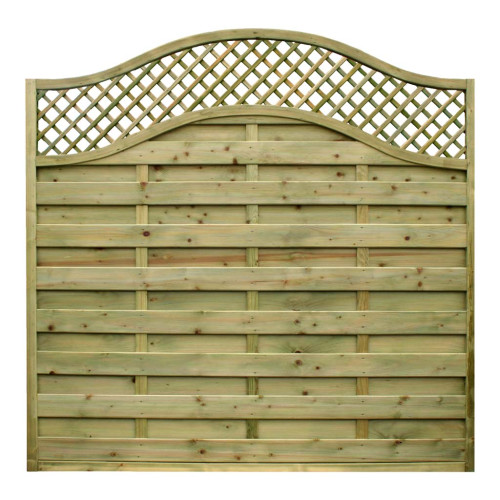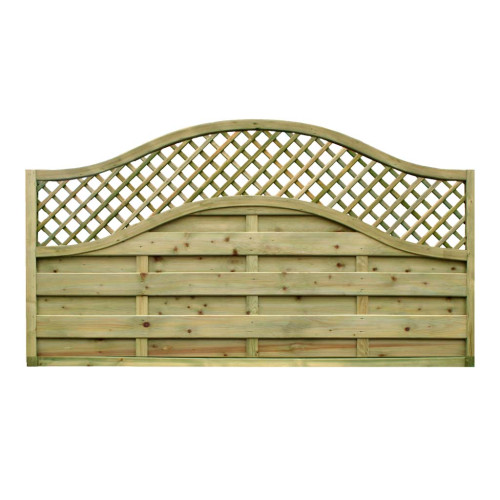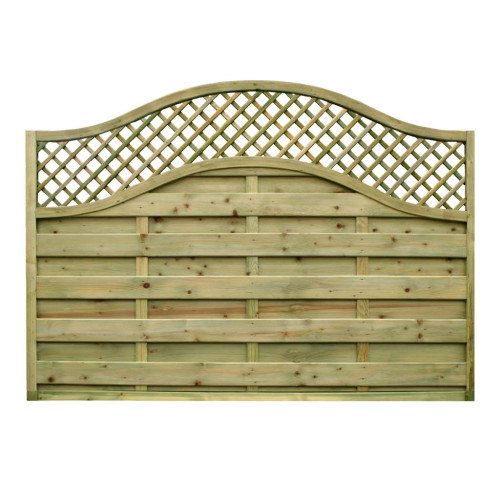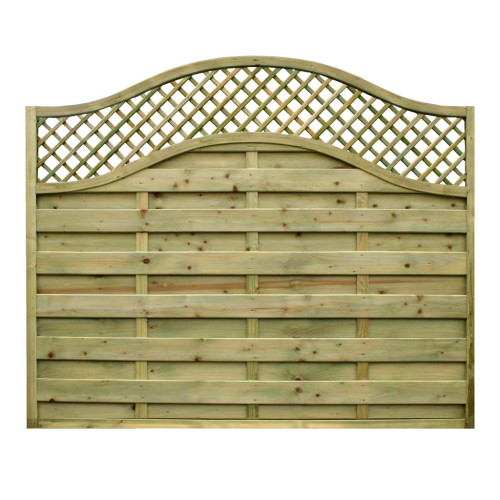


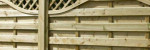

Quick answer: Omega Lattice Fence Panels are best when you want a decorative boundary that keeps the garden feeling light and open. The lattice construction allows considerably more light, air and visibility through than solid fencing, so it should not be chosen for immediate full privacy. It can, however, provide partial screening and an attractive framework around planting. If using climbers, consider their eventual weight and keep the panel accessible for maintenance.
Omega Lattice fencing sits at the more open end of the fence panel spectrum.
Instead of creating a solid timber barrier, the lattice construction deliberately allows views, light and air through the boundary.
That makes it particularly useful where conventional privacy fencing would feel too heavy.
It also explains why lattice fencing is so often considered for planted gardens. The open pattern can form an attractive backdrop to shrubs and climbing plants without completely separating one part of the garden from another.
The trade-off is privacy.
If you want to immediately block neighbouring views, Omega Lattice is unlikely to be the right panel on its own. If you want decorative screening, planting opportunities and a lighter garden boundary, it can be an excellent option.
This guide looks at privacy, climbing plants, panel heights, wind, light, posts, maintenance and the situations where a more solid fence may be preferable.
What Is Omega Lattice Fencing?
Omega Lattice fencing uses an open timber lattice pattern within a framed fence panel.
The openings form part of the design rather than being gaps created accidentally by the construction.
The result is a boundary with considerably more openness than conventional panel fencing such as Closeboard or Waney Lap.
East Coast Fencing Omega Lattice panels are nominally 6ft wide and available in:
- 3ft
- 4ft
- 5ft
- 6ft
They are pressure treated in green.
The range of heights means lattice can be used for everything from a low internal garden division to a full-height decorative boundary.
Are Omega Lattice Panels Good For Privacy?
They provide partial screening rather than complete privacy.
The lattice openings allow you to see through the fence, particularly when it is first installed without planting.
That means it is important to distinguish between two different objectives:
- Creating a visual boundary
- Blocking views completely
Lattice is very good at the first.
It is not designed primarily for the second.
If your main requirement is immediate privacy between neighbouring gardens, a more solid style such as Closeboard may be more suitable.
How Much Can You See Through Omega Lattice?
The open construction means significant visibility remains through the panel.
Exactly how open the fence feels depends on:
- Viewing angle
- Distance from the fence
- Panel height
- Planting around the fence
- Light conditions
A lattice boundary seen from across a garden can create clear separation while still allowing the eye to travel beyond it.
At close range, the openings are even more apparent.
This should be considered an intentional feature rather than a weakness.
Can Omega Lattice Become More Private With Plants?
Yes, planting can increase the amount of visual screening.
As suitable climbers and surrounding plants develop, they can gradually break up views through the lattice.
This can produce a softer form of privacy than a completely solid fence.
However, the amount of screening will depend on:
- The plants chosen
- How densely they grow
- Whether they lose leaves seasonally
- How they are trained
- How long they have been established
Do not rely on young planting to provide immediate privacy if screening is required from the day the fence is installed.
Is Planting A Reliable Replacement For A Privacy Fence?
Not always.
Plants grow at different rates and can change considerably through the seasons.
A boundary that feels well screened in summer may be much more open at another time of year.
Planting can work extremely well where gradual, natural screening is acceptable.
If you need dependable immediate privacy, choose the panel construction accordingly rather than expecting planting to solve the problem later.
Are Omega Lattice Panels Good For Climbing Plants?
They can form an attractive framework around climbing plants.
The open pattern provides numerous points around which suitable plants can be trained.
That makes lattice particularly useful for:
- Decorative garden divisions
- Planted boundaries
- Creating green backdrops
- Softening hard landscaping
- Separating garden zones without building a solid wall
The important consideration is the mature plant rather than the small plant you begin with.
Can Climbing Plants Damage Lattice Fence Panels?
Potentially, if the vegetation becomes too heavy or is poorly maintained.
A mature climber can place considerably more weight on a fence than a young plant.
Dense growth can also:
- Increase the surface exposed to wind
- Trap moisture around timber
- Hide damaged sections
- Make future repairs difficult
- Make panel replacement harder
For vigorous or potentially heavy climbers, independent plant support may be preferable to relying entirely on the fence panel.
Should Heavy Climbers Have Separate Support?
It is often sensible.
The fence can remain the visual backdrop while a separate support system carries more of the mature plant weight.
This can make it easier to:
- Inspect the fence
- Repair panels
- Manage plant growth
- Replace fencing in future
It also reduces the likelihood of turning a decorative panel into the main structural support for a very substantial plant.
Should You Leave A Gap Between Plants And The Fence?
Some space is useful where practical.
Extremely dense vegetation pressed permanently against timber can restrict drying and make inspection difficult.
A little separation can improve:
- Air movement
- Maintenance access
- Visibility of the panel condition
You do not need to keep planting far away, but avoid creating a dense wet mass that completely conceals the fence.
Do Climbers Reduce Airflow Through Lattice?
Yes, potentially.
One advantage of lattice is that the open construction allows substantial airflow.
As vegetation becomes denser, it begins to fill those openings.
A heavily planted lattice fence can therefore behave differently from an uncovered panel.
This is worth remembering if airflow was one of the main reasons you selected lattice in the first place.
Do Climbers Increase Wind Loading?
Dense plant growth can increase the amount of material exposed to the wind.
Leaves and stems can effectively turn part of an open fence into a much more substantial surface.
This means a lattice fence covered with mature vegetation may experience different wind forces from the same panel with no plants attached.
Posts and foundations should therefore be appropriate for the complete installation, not merely the bare panel.
Are Omega Lattice Panels Good For Windy Gardens?
The open lattice construction allows a high level of airflow.
This can make lattice worth considering in an exposed garden where privacy is not the primary objective.
Compared with a predominantly solid fence, substantially more air can pass through rather than meeting one continuous barrier.
However, the fence still requires:
- Suitable posts
- Sound foundations
- Appropriate installation
- A sensible height for the site
Adding dense climbing plants can also change how the fence behaves in the wind.
Are Omega Lattice Panels Better Than Hit & Miss For Wind?
Lattice is considerably more open, so it allows a high level of airflow.
Hit & Miss provides more screening while still allowing air through.
The choice depends on what you need:
- Choose lattice where openness and airflow matter most
- Choose Hit & Miss where you need a stronger balance between privacy and airflow
Are Omega Lattice Panels Better Than Double Slatted For Wind?
If airflow is the main criterion, lattice has the advantage because it contains much more open space.
Double slatted fencing provides significantly stronger screening.
The trade-off is therefore straightforward:
- Lattice for openness
- Double slatted for privacy
Are Omega Lattice Panels Better Than Closeboard In Wind?
Lattice allows far more air through than Closeboard.
Closeboard creates a predominantly solid screen, while lattice contains substantial openings.
That does not make lattice universally better.
If strong privacy is required, Closeboard may still be the more appropriate solution.
Which Fence Gives The Best Balance Of Privacy And Airflow?
Different styles sit at different points on the privacy and airflow scale.
| Fence Style | Privacy | Airflow |
|---|---|---|
| Closeboard | High | Low |
| Double Slatted | High | Moderate |
| Hit & Miss | Moderate to high | Good |
| Omega Lattice | Low | High |
| Picket | Low | High |
Lattice is therefore most appropriate when openness is a positive feature rather than something you are trying to avoid.
Do Omega Lattice Panels Let Plenty Of Light Through?
Yes.
This is one of their main advantages.
The openings allow daylight to pass through the boundary far more freely than a solid panel.
This can be particularly useful where the fence is close to:
- Flower beds
- A patio
- A small lawn
- A narrow garden
- A side passage
Are Omega Lattice Panels Good For Shaded Gardens?
They can be.
If a garden already receives limited light, surrounding it with tall solid fencing can make it feel even more enclosed.
Lattice preserves more visual openness and allows additional light through.
The actual amount of sunlight reaching a particular area will still depend on:
- Fence orientation
- Buildings
- Trees
- Time of year
Can Lattice Help A Small Garden Feel Bigger?
It can help the space feel less enclosed.
A solid boundary creates a clear visual stopping point.
Lattice lets the eye continue through the openings, which can add a sense of depth.
This is particularly effective when the boundary is softened with:
- Planting
- Climbers
- Shrubs
- Garden lighting
Are Omega Lattice Panels Good For Small Gardens?
Yes, particularly where you want to divide the space without making it feel smaller.
They can be useful for:
- Separating a patio from a lawn
- Creating a planted corner
- Screening part of a garden without forming a solid wall
- Creating depth in a compact plot
A full-height lattice panel remains visually lighter than a full-height solid panel.
Are Omega Lattice Panels Good For Large Gardens?
Yes.
Larger gardens often benefit from internal divisions that create separate areas without completely isolating them.
Lattice can help create:
- Planting zones
- Outdoor rooms
- Path entrances
- Kitchen garden divisions
- Decorative screens
The open construction means different garden areas remain visually connected.
Are Omega Lattice Panels Good For Garden Zoning?
This is one of their strongest uses.
An internal garden division usually does not require the same degree of privacy as the main property boundary.
A solid panel may make separate zones feel disconnected.
Lattice can define an area while maintaining:
- Views
- Light
- Airflow
- A sense of continuity
Can Omega Lattice Separate A Patio From A Lawn?
Yes.
A lower lattice fence can give the patio a more defined edge without making it feel enclosed.
Planting alongside the lattice can soften the transition further.
If the patio also requires strong privacy from neighbouring properties, a more screened panel may be appropriate on the external boundary while lattice is used internally.
Are Omega Lattice Panels Good Around Outdoor Dining Areas?
They can be where the objective is atmosphere rather than complete privacy.
Lattice can:
- Frame the dining area
- Support planting nearby
- Allow air movement
- Keep the space light
If neighbouring sightlines are the main problem, Double Slatted or another more heavily screened panel may be more suitable.
Are Omega Lattice Panels Good Around Patios?
Yes, particularly for decorative zoning.
They can help create an outdoor room without forming a solid visual barrier.
A lattice panel positioned beside planting can provide an attractive backdrop while still allowing light and views through.
Are Omega Lattice Panels Good For Hot Tub Privacy?
Not on their own if strong privacy is required.
The open pattern leaves substantial visibility through the fence.
Planting may increase screening over time, but it does not provide guaranteed immediate coverage.
For a hot tub area where privacy is critical, a more solid or closely screened fence is usually the stronger starting point.
Are Omega Lattice Panels Good For Screening Bins?
They can provide decorative partial screening but will not completely hide bins from every angle.
If the objective is complete concealment, a more solid panel may work better.
If you simply want to soften a utility area and combine it with planting, lattice can be effective.
Can Omega Lattice Panels Screen A Shed?
They can soften the appearance of a shed without hiding it completely.
This can work particularly well when combined with planting.
Leave adequate space between the fence, vegetation and shed so you can:
- Inspect the structures
- Carry out maintenance
- Remove leaves
- Maintain airflow
Can Omega Lattice Panels Hide A Neighbour's Shed?
Partially.
The lattice pattern breaks up the view but does not create an opaque screen.
Planting can gradually increase the visual interruption.
If the neighbouring structure needs to disappear from view immediately, choose a more solid panel.
Are Omega Lattice Panels Suitable For Rear Garden Boundaries?
Yes, if full privacy is not required.
A rear boundary using lattice can keep a garden feeling open and connected to surrounding planting.
It is especially useful where:
- There is open land beyond
- A hedge provides additional screening
- The garden is not significantly overlooked
- Light matters more than privacy
Are Omega Lattice Panels Suitable For Side Boundaries?
They can be.
Side boundaries are often narrow and can become dark when enclosed by tall solid fencing.
Lattice can preserve more light and airflow.
However, if neighbouring windows or paths create a significant privacy issue, consider whether the openness is appropriate.
Are Omega Lattice Panels Suitable For Front Gardens?
They can provide an attractive decorative boundary where openness is wanted.
Lower panels can define a front garden while allowing:
- Views through
- Light into planting
- An open relationship with the street
As with any front boundary, consider the location, visibility and finished fence height before installation.
Are Omega Lattice Panels Good Along Driveways?
Their openness can be useful where preserving visibility is important.
A lattice boundary creates clear separation without the same solid visual obstruction as conventional privacy fencing.
Site-specific visibility around vehicle entrances should still be considered carefully.
What Heights Are Omega Lattice Panels Available In?
East Coast Fencing Omega Lattice panels are available in nominal:
- 3ft
- 4ft
- 5ft
- 6ft
All are nominally 6ft wide.
The best height depends on whether the panel is being used for decoration, garden zoning, planting or a main boundary.
When Should You Choose 3ft Omega Lattice?
Three-foot lattice is particularly useful for lower garden divisions.
Typical applications include:
- Patio edges
- Planting zones
- Internal garden divisions
- Decorative boundaries
At this height, the panel is primarily a visual and structural garden feature rather than a privacy screen.
When Should You Choose 4ft Omega Lattice?
Four-foot panels create a stronger division while preserving openness.
This can suit:
- Kitchen garden boundaries
- Large flower beds
- Garden zoning
- Decorative side boundaries
They provide more presence than a 3ft panel without creating a full-height fence.
When Should You Choose 5ft Omega Lattice?
Five-foot lattice can create a substantial decorative screen.
It works well where you want greater separation but still want views and light through the boundary.
With suitable planting, a 5ft panel can gradually provide a meaningful amount of visual screening.
When Should You Choose 6ft Omega Lattice?
Six-foot lattice creates a full-height boundary while retaining the open pattern.
It can be particularly effective as:
- A planted rear boundary
- A tall decorative screen
- A garden backdrop
- A division between larger garden areas
Remember that greater height increases the importance of suitable posts and foundations.
Does A Taller Omega Lattice Panel Provide More Privacy?
It can block or interrupt more of the view simply because it extends higher.
However, the lattice openings remain.
A 6ft lattice panel therefore does not necessarily provide more direct privacy than a shorter solid panel.
Height and openness are separate considerations.
Which Height Is Best For Climbing Plants?
That depends on the planting plan and the role of the fence.
For low planting and garden zoning, 3ft or 4ft may be sufficient.
For taller decorative planting screens, 5ft or 6ft may be more appropriate.
Do not choose a taller panel solely because you expect the plant to grow tall.
A vigorous mature plant may still require additional support.
Can You Use Different Omega Lattice Heights In One Garden?
Yes.
Using different heights can work particularly well when different parts of the garden have different purposes.
For example:
- 3ft around a patio
- 4ft around planting
- 6ft along a rear boundary
Use natural transitions such as corners, gates, paths or changes in ground level.
Can Omega Lattice Panels Be Installed On A Slope?
Yes.
Rigid panels are normally stepped as ground level changes.
Each panel remains approximately level, with neighbouring bays installed at progressively different heights.
Plan the steps before setting posts permanently.
Do Stepped Lattice Panels Look Good?
They can, particularly if the steps are consistent.
Because lattice has a strong repeated pattern, irregular panel levels can be noticeable.
Careful setting out helps create a more deliberate finished appearance.
Can A Slope Leave Large Gaps Under Lattice Panels?
Yes.
A rigid panel stepped across sloping ground may have greater clearance beneath the downhill end.
This should be considered if the fence also needs to:
- Restrict pets
- Define a neat garden edge
- Provide visual screening near ground level
Are Omega Lattice Panels Suitable For Dogs?
They should be assessed carefully.
The openings within lattice mean it is not the same as a solid containment fence.
Consider:
- Size of the dog
- Panel openings
- Panel height
- Gap beneath the fence
- Gate arrangement
- Whether the dog climbs or jumps
If secure containment is the main requirement, another panel style may be more appropriate.
Are Omega Lattice Panels Suitable For Cats?
Do not assume ordinary lattice will contain a cat.
Cats can climb and jump effectively, and the lattice itself may provide climbing opportunities.
Choose the fencing according to the garden design rather than treating it as a cat-proof system.
Are Omega Lattice Panels Good For Children's Gardens?
They can work well as decorative internal boundaries.
As with any timber fence, inspect periodically for:
- Damage
- Loose sections
- Splinters
- Protruding fixings
If the fence is intended as a safety barrier around a particular hazard, ordinary decorative lattice should not automatically be assumed suitable.
Can Omega Lattice Be Used Around A Vegetable Garden?
Yes.
Lattice can visually separate a vegetable area while keeping it connected to the rest of the garden.
It can also create a useful backdrop for suitable planting.
If the purpose is to exclude specific wildlife or pets, check whether the lattice openings are appropriate.
Can Omega Lattice Divide A Vegetable Garden From A Lawn?
Yes.
A lower panel can create a clear visual division without blocking light.
This can be particularly useful where the vegetable garden sits within a larger landscaped space and you do not want it hidden behind solid fencing.
Can Omega Lattice Be Used Around Flower Beds?
Yes.
It is especially suitable where the fence should complement planting rather than dominate it.
Flowers and foliage can remain visible through the panel, helping the fence become part of the overall garden design.
Do Omega Lattice Panels Work With Raised Beds?
Yes.
The open timber pattern can provide an attractive backdrop to raised planting.
Be careful not to build soil directly against the main timber panel.
A normal fence panel should not automatically be treated as a retaining wall.
Can Soil Be Piled Against Omega Lattice Panels?
It is better to avoid it.
Soil against the lower frame can:
- Keep the timber persistently damp
- Create pressure against the panel
- Make inspection difficult
If soil needs to be retained, provide an appropriate retaining solution separately from the fence.
Do Omega Lattice Panels Need Gravel Boards?
A compatible gravel board can be worth considering where it helps keep the main timber panel away from ground-level moisture.
This can reduce direct exposure to:
- Soil
- Wet grass
- Mulch
- Rain splash
The visual effect should also be considered because lattice is often selected for its light decorative appearance.
Do Concrete Gravel Boards Look Good With Omega Lattice?
This is largely an aesthetic decision.
A concrete board creates a clearly defined solid base beneath the open timber panel.
That contrast can work well in some gardens but may feel heavier in others.
A timber gravel board can maintain a more continuous timber appearance.
Will A Gravel Board Increase The Fence Height?
Yes, if the panel sits above a visible gravel board.
The finished enclosure will then be taller than the nominal panel measurement alone.
Consider this when selecting:
- Posts
- Panel height
- Overall proportions
Can Omega Lattice Panels Be Used With Timber Posts?
Yes, where the posts and fixing arrangement suit the panel.
Timber posts can produce a consistent all-timber appearance that works particularly well with decorative lattice.
East Coast Fencing timber posts are available in common sections including:
- 75 x 75mm
- 100 x 100mm
Available lengths include 1.8m, 2.4m and 3.0m.
Select the post according to the complete fence height, exposure and ground conditions.
Can Omega Lattice Panels Be Used With Concrete Posts?
Compatibility should be checked for the specific panel and post system.
Do not assume that every nominally 6ft wide decorative panel will automatically fit every existing slotted concrete post.
Check:
- Actual panel width
- Panel thickness
- Post slot dimensions
- Existing gravel board arrangement
Can Omega Lattice Replace Existing Fence Panels?
Potentially.
If your existing support system is suitable and dimensions are compatible, lattice can be used to make a previously solid boundary feel much more open.
Before ordering, measure:
- Actual distance between posts
- Existing panel height
- Panel thickness requirements
- Gravel board position
Also inspect the posts for movement or deterioration.
Can You Replace Closeboard With Omega Lattice?
Potentially.
This can transform the character of a garden by allowing more:
- Light
- Views
- Airflow
The trade-off is a substantial reduction in immediate privacy.
Make sure this is genuinely what you want before replacing an established solid boundary.
Can You Replace Omega Lattice With Closeboard?
Potentially, where the support system is compatible.
This may make sense if privacy requirements have changed.
Remember that switching to a solid panel can also change:
- Wind exposure
- Light levels
- The visual openness of the garden
Can Omega Lattice Be Mixed With Solid Fence Panels?
Yes.
This is often one of the most effective ways to use lattice.
You might use:
- Solid fencing around a private patio
- Lattice around planted garden areas
- Closeboard along a neighbouring boundary
- Lattice for an internal garden division
This allows each section of the garden to use the panel that best suits its purpose.
Can Omega Lattice Be Mixed With Double Slatted Fencing?
Yes.
Double slatted can provide strong screening around a seating area, with lattice used nearby where you want planting and greater openness.
Use clear transition points such as:
- Corners
- Gates
- Paths
- Changes in garden level
Can Omega Lattice Be Mixed With Hit & Miss?
Yes.
This can create a useful progression from more screened fencing to a much more open planted section.
Hit & Miss provides the middle ground between solid fencing and lattice.
Can You Use Omega Lattice As A Feature Panel?
Yes.
You do not need to install lattice along an entire boundary.
A small number of panels can be used to:
- Frame planting
- Create a focal point
- Break up a long solid fence run
- Define an entrance to another garden area
Can Omega Lattice Make A Solid Fence Feel Less Heavy?
Yes.
Using lattice strategically can introduce openings into a garden dominated by solid boundaries.
For example, you might use a lattice section where privacy is less important to allow more visual depth and light.
Does Omega Lattice Suit Modern Gardens?
Yes.
The repeated geometric pattern can complement:
- Modern paving
- Simple planters
- Garden rooms
- Structured planting
It can create a softer alternative to horizontal slatted panels while remaining visually deliberate.
Does Omega Lattice Suit Traditional Gardens?
Yes.
Lattice has a strong association with planted gardens and can work particularly well alongside:
- Cottage-style planting
- Established shrubs
- Climbing plants
- Traditional paths
Its versatility is one reason it can sit comfortably in both contemporary and traditional settings.
Are Omega Lattice Panels Easy To Maintain?
They are manageable, but the open pattern creates more individual edges and intersections than a simple solid panel.
Routine checks should include:
- Loose lattice sections
- Panel movement
- Vegetation becoming too heavy
- Debris collecting around the base
- Algae in damp areas
Do Climbing Plants Make Maintenance Harder?
They can.
Dense planting can hide the condition of:
- Timber
- Fixings
- Posts
- Panel framing
Regular pruning helps maintain access and prevents the plant from overwhelming the structure.
Can Omega Lattice Panels Be Painted?
Pressure-treated timber can generally be given a suitable exterior decorative coating once sufficiently dry and properly prepared.
Follow the coating manufacturer's instructions.
Lattice does require patience because there are many:
- Edges
- Intersections
- Internal corners
Is Omega Lattice Harder To Paint Than A Solid Panel?
It can be more time-consuming.
A large proportion of the work is around the edges of the lattice rather than simply coating broad flat faces.
If the fence will eventually be heavily planted, consider how easy it will be to reach the timber for future maintenance.
Can You Paint Omega Lattice After Plants Have Grown Over It?
You can, but it becomes considerably more difficult.
Ideally, plan decorative finishes before allowing dense plants to cover the fence.
If future recoating is expected, keep enough access to:
- Inspect the panel
- Clean the timber
- Apply the finish properly
Does Algae Grow On Omega Lattice?
It can.
Any external timber can develop green surface growth where conditions remain damp and shaded.
Lattice surrounded by dense planting can be particularly slow to dry if airflow becomes restricted.
Does Algae Mean The Lattice Is Rotting?
No.
Surface algae does not automatically mean the underlying timber is structurally decayed.
However, persistent damp conditions are worth addressing.
Keep the area around the fence reasonably clear and inspect the timber rather than judging its condition from surface colour alone.
How Should Omega Lattice Be Cleaned?
Start gently.
- Trim back vegetation if necessary.
- Remove loose leaves and debris.
- Brush away dry surface dirt.
- Use a suitable mild timber cleaner where required.
- Use a timber-safe algae treatment for persistent growth if appropriate.
- Allow the timber to dry.
Take additional care around the smaller lattice components and their intersections.
Can You Pressure Wash Omega Lattice?
Use caution.
Excessive pressure can damage:
- Timber fibres
- Lattice edges
- Decorative coatings
- More delicate sections
Gentle hand cleaning is generally a safer starting point.
How Long Do Omega Lattice Panels Last?
There is no universal lifespan for every installation.
Long-term performance depends on:
- Timber treatment
- Installation
- Post condition
- Ground clearance
- Moisture exposure
- Wind
- Weight of vegetation
- Maintenance
A correctly installed panel kept reasonably clear of persistent damp can perform very differently from a lattice fence carrying uncontrolled heavy vegetation.
Will Climbing Plants Shorten The Life Of A Lattice Fence?
Not automatically.
The issue is how the planting is managed.
Problems are more likely where vegetation:
- Becomes excessively heavy
- Keeps timber permanently damp
- Prevents inspection
- Adds substantial wind loading
Regular pruning and sensible plant support can reduce those risks.
Can You Repair Omega Lattice?
Minor local damage may sometimes be repairable, depending on the affected part of the panel.
Inspect:
- Lattice sections
- Main framing
- Fixings
- Posts
If the main frame is badly damaged or several sections have failed, full panel replacement may be more practical.
Can You Replace One Omega Lattice Panel?
Yes, where the surrounding posts remain sound and a compatible panel is available.
Measure the actual bay rather than relying solely on the nominal panel width.
Check:
- Distance between posts
- Panel height
- Post alignment
- Existing gravel boards
What If Plants Have Grown Across Several Panels?
Replacing a panel can become much more difficult when mature vegetation links several bays together.
You may need to prune or temporarily support the plant before removing the damaged panel.
This is another reason not to allow valuable or heavy climbers to depend completely on the fence for support.
Are Omega Lattice Panels Worth It?
They are particularly worthwhile where openness is part of the design objective.
They can provide value by combining:
- A decorative boundary
- High airflow
- Light transmission
- Planting opportunities
- Garden zoning
They are less suitable where the main requirement is immediate complete privacy.
Are Omega Lattice Panels More Expensive Than Standard Fencing?
Purchase prices vary according to style, size and construction.
Compare the complete garden requirement rather than simply comparing individual panel prices.
Include:
- Panels
- Posts
- Gravel boards where appropriate
- Fixings
- Installation
- Plant support where required
The right panel is the one that performs the job you actually need.
When Should You Choose Omega Lattice Instead Of Closeboard?
Choose lattice when:
- You want more light through the boundary
- You want high airflow
- You prefer an open decorative appearance
- Planting is part of the design
- You are dividing areas within the same garden
Choose Closeboard when:
- Strong immediate privacy is essential
- You want a predominantly solid boundary
- You prefer a traditional appearance
When Should You Choose Hit & Miss Instead?
Hit & Miss may be more appropriate when you want more screening than lattice provides but still value airflow.
It occupies a useful middle position between open lattice and solid privacy fencing.
When Should You Choose Double Slatted Instead?
Double slatted fencing is a stronger option when privacy and contemporary design matter more than maximum openness.
It can be particularly appropriate around:
- Patios
- Outdoor dining areas
- Garden rooms
- Overlooked rear boundaries
When Should You Choose Picket Fencing Instead?
Picket fencing can be preferable where you want a low traditional open boundary rather than a lattice screen.
It is particularly suitable for:
- Front gardens
- Paths
- Low garden divisions
Lattice becomes more useful where decorative planting support and taller open screening are required.
Omega Lattice By Garden Use
| Garden Use | Suitability |
|---|---|
| Climbing plants | Excellent with sensible weight management |
| Garden zoning | Excellent |
| Maximum airflow | Excellent |
| Allowing light through | Excellent |
| Immediate full privacy | Poor |
| Patio decoration | Very good |
| Hot tub privacy | Limited without additional screening |
| Windy garden | Very good where openness is acceptable |
| Small shaded garden | Very good |
Common Mistakes When Choosing Omega Lattice
- Expecting full privacy from an open lattice panel
- Choosing it for a hot tub or seating area without checking sightlines
- Expecting young climbing plants to provide immediate screening
- Allowing mature climbers to become too heavy
- Completely covering the fence and losing its airflow advantage
- Letting vegetation prevent access for maintenance
- Piling soil against the lower frame
- Ignoring post condition when replacing old panels
- Assuming every nominally 6ft panel will fit existing posts
- Choosing 6ft automatically when a lower panel would suit the garden better
- Forgetting that gravel boards affect finished height and appearance
Omega Lattice Buying Checklist
- Decide whether you need privacy or decorative screening.
- Consider how much visibility through the fence is acceptable.
- Choose between 3ft, 4ft, 5ft and 6ft height.
- Measure the complete fence run.
- Measure existing bays if replacing panels.
- Check existing posts for movement or damage.
- Choose suitable posts for a new fence.
- Consider gravel boards where appropriate.
- Plan the mature size and weight of climbing plants.
- Consider separate support for vigorous climbers.
- Allow access for future pruning and fence maintenance.
- Check how much airflow and light you want to retain.
- Plan panel steps carefully on sloping ground.
FAQs
Are Omega Lattice Fence Panels Good For Privacy?
They provide partial decorative screening rather than complete privacy because the lattice construction remains open.
Can You See Through Omega Lattice Fence Panels?
Yes. Significant visibility remains through the lattice openings.
Can Plants Make Omega Lattice More Private?
Yes. Established planting can gradually reduce views through the fence, although the amount of screening depends on the particular plants and their growth.
Are Omega Lattice Fence Panels Good For Climbing Plants?
Yes. The open framework can work very well around suitable climbing plants, provided their eventual weight is considered.
Can Heavy Climbers Damage Lattice Panels?
Potentially. Dense mature vegetation can add weight, increase wind loading, hold moisture and make maintenance more difficult.
Should Climbers Have Their Own Support?
For vigorous or heavy mature plants, independent support can be preferable to relying completely on the fence panel.
Are Omega Lattice Fence Panels Good For Windy Gardens?
They allow a high level of airflow, which can be useful in exposed locations. Suitable posts and foundations are still required.
Are Omega Lattice Panels Better Than Hit & Miss For Wind?
Lattice allows more airflow but provides much less privacy. Hit & Miss offers a stronger balance between screening and airflow.
Are Omega Lattice Panels Better Than Closeboard For Wind?
They allow substantially more air through than Closeboard, but provide far less privacy.
Do Omega Lattice Panels Let Light Through?
Yes. Their open construction allows a high level of light through the boundary.
Are Omega Lattice Panels Good For Small Gardens?
Yes. Their openness can help a small garden feel less enclosed.
Are Omega Lattice Panels Good For Shaded Gardens?
They can be particularly useful where preserving as much light as possible is important.
Are Omega Lattice Panels Good For Garden Zoning?
Yes. This is one of their strongest applications because they define spaces without visually isolating them.
Can Omega Lattice Be Used Around A Patio?
Yes, especially as a decorative divider where full privacy is unnecessary.
Is Omega Lattice Good For Hot Tub Privacy?
Not on its own where strong privacy is required. A more solid panel is generally a better starting point.
Can Omega Lattice Hide Bins?
It can soften the view but will not completely hide bins from every angle.
What Heights Do Omega Lattice Fence Panels Come In?
East Coast Fencing Omega Lattice panels are available in nominal 3ft, 4ft, 5ft and 6ft heights.
How Wide Are Omega Lattice Fence Panels?
The panels discussed here are nominally 6ft wide.
Are 3ft Omega Lattice Panels Good For Garden Divisions?
Yes. They are particularly useful for low decorative zoning.
Are 6ft Omega Lattice Panels Private?
The extra height increases the size of the screen, but the lattice openings remain, so the fence is still not completely private.
Can Omega Lattice Be Installed On A Slope?
Yes. Rigid panels are generally stepped as ground level changes.
Can Omega Lattice Fence Panels Be Used With Timber Posts?
Yes, where the post specification and fixing method suit the complete fence.
Can Omega Lattice Fence Panels Be Used With Concrete Posts?
Compatibility should be checked for the particular panel and post system.
Do Omega Lattice Fence Panels Need Gravel Boards?
A suitable gravel board can help keep the main timber panel away from persistent ground-level moisture where compatible with the fence system.
Can Omega Lattice Replace Closeboard Panels?
Potentially, provided the dimensions and supporting system are compatible. The resulting boundary will be considerably more open.
Can Omega Lattice Be Mixed With Closeboard?
Yes. Solid fencing can be used where privacy is required and lattice where openness and planting are more important.
Can Omega Lattice Be Mixed With Double Slatted Panels?
Yes. Double slatted can provide privacy around seating areas while lattice creates lighter planted sections elsewhere.
Can Omega Lattice Be Painted?
Pressure-treated timber can generally be given a suitable exterior decorative finish once sufficiently dry and prepared.
Is Omega Lattice Difficult To Paint?
It can be more time-consuming than a simple panel because there are numerous edges, intersections and internal corners.
Can You Pressure Wash Omega Lattice?
Use caution. Excessive pressure can damage timber fibres and smaller lattice components.
Does Algae Mean Omega Lattice Is Rotting?
No. Algae is generally surface growth associated with damp conditions, although persistently wet timber should still be inspected.
Will Climbing Plants Shorten The Life Of Omega Lattice?
Not automatically. Problems are more likely if vegetation becomes excessively heavy, keeps the timber constantly damp or prevents proper maintenance.
Is Omega Lattice Suitable For Dogs?
It depends on the animal and the panel openings. If secure containment is essential, assess whether a more closed fencing style would be appropriate.
Is Omega Lattice Worth It?
It is particularly worthwhile where you want decorative garden division, planting opportunities, high airflow and plenty of light rather than complete privacy.
Should You Choose Omega Lattice Fence Panels?
Choose lattice when you want the fence to divide the garden without closing it off.
Its biggest strengths are openness, light and airflow.
It works particularly well for garden zoning, planted boundaries, patios, decorative screens and areas where a conventional solid fence would feel unnecessarily heavy.
It is also a natural choice when climbing plants form part of the garden design.
The lattice can provide a useful framework around planting, but consider what those plants will become after several growing seasons. Vigorous mature climbers can add significant weight, trap moisture and make future fence maintenance difficult. Where necessary, give substantial plants independent support rather than asking the fence to carry everything.
Privacy is the main limitation.
Even a 6ft lattice panel remains visibly open. Planting can gradually create more screening, but it should not be relied upon for immediate complete privacy.
If privacy is the main requirement, consider Closeboard or Double Slatted fencing. If you want a stronger balance between privacy and airflow, Hit & Miss may be the better middle ground.
If the goal is a lighter decorative boundary that allows the garden, planting and surrounding spaces to remain visually connected, Omega Lattice is one of the most appropriate panel styles to consider.