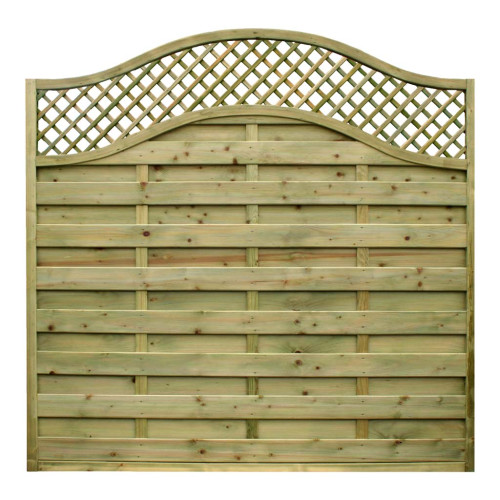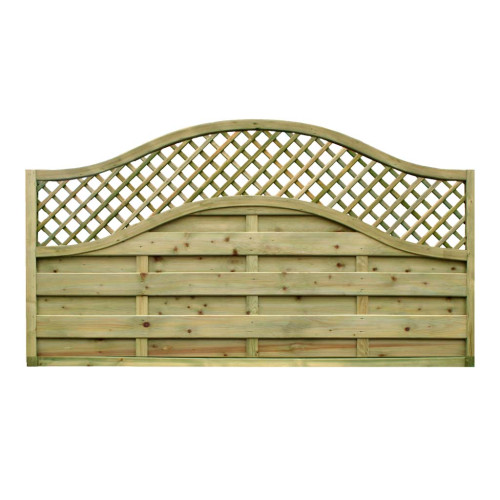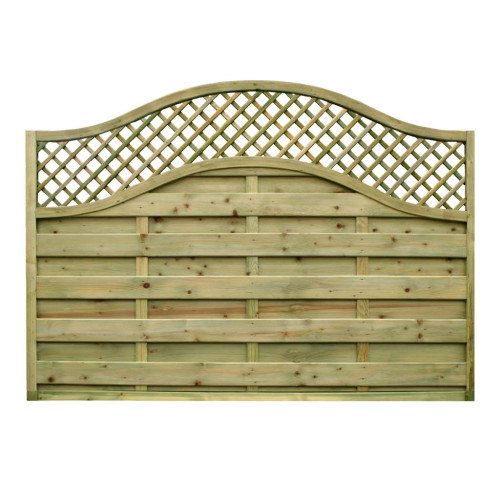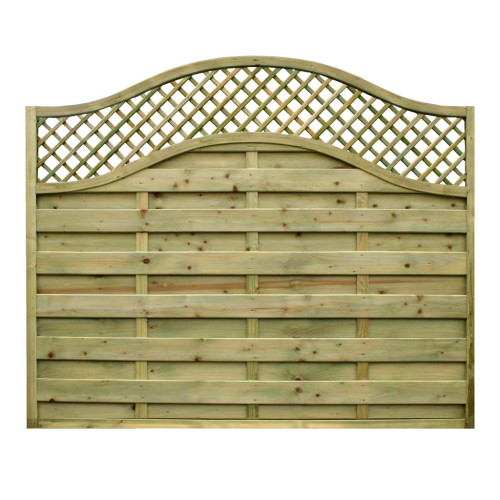


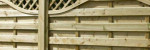

Quick answer: Install Omega Lattice Fence Panels between accurately positioned posts, supporting the panel by its main outer frame rather than the curved lattice top. Keep each panel level, measure the actual bay before installation and use a gravel board where appropriate to keep the lower timber away from damp ground. Compatible wooden or slotted concrete posts can be used. The curved centre makes handling, height measurement and alignment particularly important, especially beside walls, gates and on sloping ground.
Omega Lattice Fence Panels need a little more care during installation than a conventional rectangular fence panel.
The decorative curved lattice is part of their appeal, but it is not intended to be used as a lifting handle or structural fixing point. The main framed section needs to carry the panel.
The curved top also means you cannot judge installation height from the panel sides alone. The centre rises higher, which matters beside walls, gates, branches and other fixed features.
Good installation therefore starts with accurate measuring and careful handling rather than simply dropping a nominal 6ft panel between two posts.
What Size Are Omega Lattice Fence Panels?
The current East Coast Fencing range is nominally 6ft wide, approximately 1.83m.
Current height options include:
- 3ft
- 4ft
- 5ft
- 6ft
The panels are pressure treated and supplied in a green/natural finish.
Each panel combines a screened lower section with a curved decorative lattice at the top.
Because the upper edge is curved, always check the individual panel dimensions before setting posts or replacing an existing panel.
Why Is Installing Omega Lattice Different From A Rectangular Panel?
Three features need particular attention:
- The curved top
- The lighter lattice section
- The decorative appearance across adjoining panels
A conventional rectangular panel has one consistent top height.
Omega panels rise towards the centre, so you need to consider both the lower side height and the highest central point.
The lattice section also requires more careful handling than the substantial lower frame.
What Do You Need To Install Omega Lattice Fence Panels?
A typical installation may require:
- Omega Lattice Fence Panels
- Suitable wooden or compatible concrete fence posts
- Gravel boards where appropriate
- Suitable post-setting material
- Exterior brackets, clips or screws where using timber posts
- Tape measure
- String line
- Spirit level
- Post-hole digging equipment
- Drill and driver where required
- Temporary supports or timber blocks
- Suitable personal protective equipment
The exact components depend on whether you are installing a completely new fence or replacing panels within an existing structure.
Measure The Actual Panel Before Setting Posts
Do not set out an entire fence run using an assumed nominal 6ft panel measurement.
Before installing posts, confirm:
- Actual panel width
- Panel frame thickness
- Side height
- Highest point of the curved top
- Post dimensions
- Fixing allowance
- Gravel board dimensions
A small spacing error repeated across several bays can become a significant problem by the end of the boundary.
How Do You Measure The Height Of An Omega Lattice Panel?
Do not treat the curved panel as though the entire upper edge sits at one height.
Check:
- The height at the outer sides
- The maximum height around the centre
The central measurement is particularly important where the panel sits:
- Below tree branches
- Beside a wall
- Under an overhang
- Next to a garden building
- Beside another fence of fixed height
How Do You Measure An Existing Fence Bay?
When replacing an old panel, measure the clear opening between the posts.
Take measurements:
- Near the bottom
- Around the middle
- Near the top
This is important because old posts may have moved or leaned.
A bay that was originally installed for a nominal 6ft panel may no longer be the same width throughout its height.
Why Should You Measure At Several Heights?
A rigid framed panel needs sufficient clearance throughout the complete opening.
If two posts lean towards each other, the bottom of the bay may be wide enough while the top is too narrow.
This becomes particularly important with Omega Lattice Fence Panels because forcing the panel into a narrowing gap risks damaging the decorative upper frame.
Should Omega Lattice Fence Panels Have Gravel Boards?
Gravel boards are worth considering where the bottom of the panel would otherwise sit close to soil, grass or damp garden material.
A gravel board helps separate the timber panel from:
- Wet soil
- Grass
- Mulch
- Leaves
- Rain splash
This can be particularly useful along flower borders.
Can Omega Lattice Fence Panels Sit Directly On Soil?
A framed timber panel should not simply be left resting in persistently wet soil.
Where appropriate, use a gravel board or another correctly designed lower detail to keep the panel clear of direct ground moisture.
Do not pile soil against the lower frame after installation to hide an uneven gap.
Does A Gravel Board Change The Finished Fence Height?
Yes.
If a panel is installed above a gravel board, the complete boundary becomes taller than the nominal panel height.
Calculate the finished height using the full combination of:
- Gravel board
- Panel
- Curved lattice centre
This is particularly important with Omega panels because their highest point is not at the sides.
Can Omega Lattice Fence Panels Use Wooden Posts?
Yes.
Wooden fence posts work naturally with decorative timber panels and create a consistent all-timber appearance.
The panel can be secured using suitable exterior:
- Fence clips
- Brackets
- Screws
The exact fixing arrangement should support the substantial panel frame rather than individual lattice battens.
How Do You Install Omega Lattice Fence Panels With Wooden Posts?
A typical sequence is:
- Mark the fence line.
- Install the first post vertically and securely.
- Measure for the next post using the actual panel width and fixing arrangement.
- Install the next post.
- Fit the gravel board where required.
- Support the Omega panel at the required height.
- Check that the main frame is level.
- Check the curved top visually.
- Secure the panel through its substantial frame using suitable exterior fixings.
- Recheck alignment before proceeding to the next bay.
Where Should Omega Panels Be Fixed To Wooden Posts?
Fix through or support the substantial outer frame.
Avoid using the decorative lattice as the primary connection between the panel and post.
The lattice is designed to provide:
- Decoration
- Light
- Airflow
- Plant support
It is not intended to carry the full structural load of the fence panel.
Can Omega Lattice Fence Panels Use Concrete Posts?
They may be used with compatible slotted concrete fence posts.
Before ordering, check:
- Clear bay width
- Panel frame thickness
- Concrete post slot width
- Available installation height
Do not assume every decorative panel will fit every slotted concrete post simply because both are designed around a nominal 6ft bay.
How Do You Install Omega Panels Between Concrete Posts?
Where the system is compatible, the panel can be lowered into the post slots.
Use enough people to control the panel safely.
Keep the panel as level as practical while lowering it.
Avoid:
- Dropping the panel suddenly
- Forcing one side down ahead of the other
- Twisting the frame
- Pulling on the lattice
Allow the main outer frame to carry the panel.
Never Lift An Omega Panel By The Curved Lattice
This is one of the most important handling rules.
The curved lattice is the light decorative section of the panel.
Do not use it as a handle.
Lifting the complete panel from the top lattice can place unnecessary stress on:
- Lattice battens
- Lattice joints
- The curved frame
Lift and carry the panel using its substantial outer frame.
How Many People Should Handle An Omega Panel?
Using two people is generally more practical for full-size framed panels.
This is particularly useful when:
- Handling 5ft or 6ft panels
- Lowering panels into slotted concrete posts
- Working on a slope
- Moving panels through restricted access
A second person also makes it easier to keep the decorative top away from branches, walls and other obstacles.
Should You Install Omega Panels In Strong Wind?
Large fence panels are awkward to control in strong winds.
The open lattice allows some air through, but the screened lower section still catches substantial wind.
A sudden gust can:
- Twist the panel while being carried
- Push it into a wall or post
- Make accurate positioning difficult
Choose suitable conditions for handling large panels safely.
How Do You Keep Omega Lattice Fence Panels Level?
Use the main panel frame as the installation reference.
Do not try to level the curved top itself.
Use:
- A spirit level
- A string line
- Consistent gravel board levels
across the fence run.
Once the main frame is level, the curved upper section should sit in its intended position.
How Do You Make Several Omega Panels Look Consistent?
The repeating curved profile is visually prominent, so adjoining panels should be installed at consistent heights.
If one panel sits noticeably higher than the next, the curves can appear uneven even when each individual panel is undamaged.
Before fixing permanently, stand back and compare:
- Bottom frame level
- Side heights
- Highest central points
- Post alignment
Can Omega Lattice Fence Panels Be Installed On A Slope?
Yes.
Rigid framed Omega panels are normally stepped as ground level changes.
Each individual panel remains square and level, while successive bays begin at different heights.
This preserves the:
- Panel frame
- Curved upper profile
- Lattice geometry
Should Omega Lattice Panels Follow The Slope?
Do not twist a rigid framed panel into a raked shape to make it follow a gradient.
Doing so can distort:
- The frame
- The curved top
- The lattice
Stepped installation is the more appropriate approach for standard rigid panels.
How Do You Plan Omega Panels On Sloping Ground?
Measure the overall change in level before installation.
Then plan where each panel will step.
Consider:
- Panel height
- Gravel board height
- Ground clearance
- The repeating curved top line
A planned sequence usually looks more deliberate than making an improvised height change at every bay.
Can Gravel Boards Be Stepped With Omega Panels?
Yes.
The gravel boards can be stepped as the panels rise or fall along the boundary.
Keep each gravel board properly supported and level within its own bay.
What If Stepping Creates A Gap Under The Fence?
Sloping ground can create a larger gap beneath the downhill end of a level gravel board or panel.
Do not solve this simply by piling soil against the timber panel.
Consider an appropriate lower landscaping or retaining detail instead.
This is particularly important where pets need to remain within the garden.
Can Omega Lattice Fence Panels Retain Soil?
No.
An ordinary decorative fence panel should not be used as a retaining wall.
If the ground level is significantly higher on one side, the soil needs its own appropriate retaining structure.
The fence should then be supported independently.
Can You Cut An Omega Lattice Fence Panel To Width?
Modifying a finished Omega panel is considerably more complicated than trimming a single board.
The panel includes:
- An outer frame
- A screened lower section
- A shaped upper frame
- Lattice components
Cutting through the side can require reconstruction of several parts of the panel.
Where possible, set the fence bays around the available panel width rather than altering the panel afterwards.
Can You Cut The Curved Top?
Doing so would substantially alter the panel design.
It may also remove or weaken sections holding the lattice together.
If a curved panel does not fit beneath an obstruction, choosing a lower panel or a different fence style is usually more sensible than cutting away the decorative top.
Can You Trim The Side Frame Slightly?
A rigid decorative panel should not be planed down substantially simply because two existing posts are too close together.
First determine why the bay is narrow.
Possible causes include:
- Leaning posts
- Incorrect original spacing
- An incompatible replacement panel
Correcting the support problem is preferable to weakening the panel frame.
What If The Fence Bay Is Too Wide?
If an existing opening is substantially wider than the replacement panel, do not rely on unusually long fixings spanning an unsupported gap.
A properly designed packing or infill arrangement may be possible with timber posts.
With concrete posts, compatibility is more restrictive because the panel needs to engage correctly with the slots.
Can Omega Lattice Fence Panels Replace Old Fence Panels?
Yes, where the existing posts and gravel boards remain sound and compatible.
Before buying a replacement, check:
- Actual opening width
- Available height
- Post condition
- Gravel board condition
- Panel frame thickness
This is particularly important when changing from a simpler panel style to a framed decorative panel.
Can Omega Panels Replace Closeboard Fence Panels?
Potentially.
The replacement can create a much more decorative boundary with additional light through the lattice top.
However, the existing support system needs to accommodate the Omega panel dimensions and frame.
Do not assume that because both panels are nominally 6ft wide they will be identical in every dimension.
Can Omega Panels Replace Waney Lap Fence Panels?
Potentially, subject to the same compatibility checks.
Omega panels have a more substantial decorative construction than basic Waney Lap fencing.
Inspect older posts carefully before installing new decorative panels.
Should You Reuse Existing Wooden Fence Posts?
Only if they remain straight, stable and suitable for the new fence.
Check for:
- Movement at ground level
- Significant decay
- Splits around fixing points
- Leaning
A new decorative panel will not correct a weak post.
Should You Reuse Existing Concrete Posts?
Concrete posts can often outlast timber panels, making panel replacement practical.
Before reusing them, check for:
- Movement
- Significant cracking
- Damage to the slots
- Leaning
Also measure each bay individually.
Can Omega Lattice Panels Be Installed Beside A Wall?
Yes, provided the end of the fence has a suitable support.
A timber wallplate or another properly fixed support may be appropriate depending on the construction.
Do not fix a full-size panel to weak render or another unsuitable surface.
Remember to allow for the raised curved centre if an overhang or coping is nearby.
Can Omega Lattice Panels Be Installed Beside A Garden Gate?
Yes.
Plan the gate before installing the neighbouring panel.
The gate needs its own suitably substantial supporting post because it creates moving loads.
The Omega panel should not be expected to:
- Carry gate hinges
- Support gate weight
- Act as a substitute gate post
Should The Gate Match The Omega Curve?
A matching decorative gate can create a coordinated boundary, but structural suitability comes first.
A simple straight-topped gate can also work if the contrast is intentional.
Consider how the gate height relates to:
- The sides of the Omega panel
- The central high point
- The surrounding posts
Can You Add Panel Capping To Omega Lattice Fence Panels?
Straight Panel Capping is not generally suited to the curved Omega upper profile.
The shaped frame and integral lattice already form the decorative top of the panel.
Do not try to force a straight capping section around the curve.
Can You Add Trellis Above Omega Lattice Fence Panels?
Omega panels already incorporate an open lattice top.
Adding another trellis section above them would change the appearance and increase the total height and wind loading of the fence.
If considerably more height is required, it is usually better to reconsider the overall fence design rather than stack decorative components together without a clear structural plan.
Can Climbing Plants Be Grown On The Lattice Immediately?
Suitable lightweight climbers can be trained around the lattice once the fence is securely installed.
Avoid putting heavy plant loads onto a newly installed panel before checking that:
- The posts are stable
- The panel is securely supported
- The lattice is undamaged
How Should Climbers Be Attached?
Guide growth gently rather than forcing thick stems through small lattice openings.
Plant ties can be useful where appropriate.
Do not use heavy fixings through thin lattice battens merely to support a plant.
Can Mature Climbers Damage Omega Lattice?
They can if allowed to become excessively heavy.
Dense mature plants add:
- Weight
- Wind resistance
- Moisture around timber
Control vigorous growth and consider an independent support system for particularly heavy climbers.
Should Omega Lattice Fence Panels Be Painted After Installation?
The current panels are pressure treated and do not need an immediate preservative coating simply because they have been installed.
If you later want a different appearance, use a compatible exterior timber coating once the timber is sufficiently dry and correctly prepared.
The lattice contains many narrow edges and intersections, so decorative coating can be more time-consuming than painting a solid fence panel.
Is It Easier To Paint Omega Panels Before Installation?
It can make the lattice edges easier to reach.
However, only coat the timber when it is ready to accept the chosen product.
You may still need to touch up areas affected by:
- Handling
- Fixing
- Any necessary cutting
How Do You Protect The Bottom Of Omega Panels?
Focus on installation rather than relying only on decorative coatings.
Useful measures include:
- Using gravel boards where suitable
- Keeping soil below the timber frame
- Removing wet leaves
- Maintaining drainage
- Keeping dense vegetation controlled
What Should You Check After Installation?
Before finishing the job, inspect the complete run.
Check that:
- Posts are vertical
- Panels are level
- Curved tops align consistently
- Gravel boards are supported
- Panels are clear of wet soil
- Frame fixings are secure
- Lattice sections were not damaged during handling
- Gates operate freely
Why Does An Omega Panel Look Crooked Even When The Posts Are Straight?
Check the panel level and gravel board first.
A curved top naturally creates varying height across the panel, which can make visual assessment more difficult than with a straight panel.
Use the main frame as the reference rather than trying to judge the curve by eye alone.
Why Do Adjacent Omega Curves Look Uneven?
Possible causes include:
- Different panel heights
- Uneven gravel boards
- One panel installed out of level
- Leaning posts
Natural timber variation may also cause small differences, but substantial changes usually indicate installation alignment should be checked.
Can A Broken Lattice Section Be Repaired?
Minor local damage may sometimes be repairable.
The practicality depends on whether the damage affects:
- One lattice batten
- Several intersections
- The curved outer frame
Damage to the main shaped frame is more significant than one isolated decorative component.
Can One Omega Lattice Panel Be Replaced?
Yes.
If the surrounding posts and gravel board remain sound, one panel can be replaced independently.
Measure the bay first rather than ordering solely from the dimensions of the old panel.
Will A New Panel Match Older Omega Panels?
Not perfectly at first.
New pressure-treated timber can differ from older weathered panels in:
- Colour
- Surface appearance
- Grain
The new panel will gradually weather outdoors.
Also check that the decorative profile matches the existing panels closely, particularly if they were purchased at a different time or from another manufacturer.
Can You Install Omega Lattice Fence Panels Yourself?
A capable DIY installer can fit framed decorative fence panels.
You should be comfortable with:
- Accurate measuring
- Post installation
- Levelling
- Handling large panels
- Exterior fixings
- Working with changes in ground level
The actual panel installation is usually simpler when the posts have been positioned accurately.
Poor setting out creates most of the difficult problems later.
Common Omega Lattice Fence Panel Installation Mistakes
- Setting posts using an assumed nominal width without measuring the panel
- Forgetting that the curved centre is higher than the sides
- Carrying the panel by the lattice
- Using the lattice as the main structural fixing point
- Forcing a panel into a narrow bay
- Ignoring leaning existing posts
- Installing adjoining panels at inconsistent heights
- Allowing the lower frame to sit in damp soil
- Trying to rake a rigid Omega panel down a slope
- Using the panel to retain soil
- Cutting the curved top to avoid an obstruction
- Forcing straight Panel Capping onto the shaped top
- Allowing mature climbing plants to overload the lattice
- Installing new decorative panels between unstable old posts
Omega Lattice Fence Panels Installation Checklist
- Measure the complete fence run.
- Check the actual panel width.
- Measure both side height and highest central height.
- Choose suitable posts.
- Check compatibility with concrete post slots where relevant.
- Plan gravel boards where appropriate.
- Set out a straight fence line.
- Install posts accurately and vertically.
- Support panels using the main outer frame.
- Never lift the panel by the curved lattice.
- Keep each main frame level.
- Check the curves visually across adjoining panels.
- Use suitable exterior fixings with timber posts.
- Step rigid panels on slopes.
- Keep soil-retaining work separate from the fence.
- Control heavy climbing plants.
- Inspect the lattice after installation for handling damage.
FAQs
How Wide Are Omega Lattice Fence Panels?
The current East Coast Fencing range is nominally 6ft wide, approximately 1.83m.
What Heights Are Omega Lattice Fence Panels Available In?
The current range includes nominal 3ft, 4ft, 5ft and 6ft heights.
Are Omega Lattice Fence Panels Pressure Treated?
Yes. The current range is pressure treated and supplied in a green/natural finish.
Can Omega Lattice Fence Panels Use Wooden Posts?
Yes. Suitable exterior brackets, clips or screws can secure the main panel frame to appropriately sized wooden posts.
Can Omega Lattice Fence Panels Use Concrete Posts?
They may be used with compatible slotted concrete posts where the panel frame, width and post slots suit each other.
Should Omega Lattice Fence Panels Have Gravel Boards?
Gravel boards are worth considering where they help keep the lower timber frame away from soil and persistent ground moisture.
Can Omega Lattice Fence Panels Touch The Ground?
It is preferable to keep the timber frame clear of persistent contact with wet soil.
Can You Carry Omega Lattice Fence Panels By The Trellis Top?
No. Lift and support the panel using its substantial outer frame rather than the decorative curved lattice.
How Do You Measure An Omega Lattice Fence Panel?
Check the width, the height at the sides and the highest point of the curved centre.
Can Omega Lattice Fence Panels Be Installed On A Slope?
Yes. Standard rigid panels are normally stepped between posts as ground level changes.
Can Omega Lattice Fence Panels Be Raked?
A standard framed panel should not normally be distorted out of square to follow a gradient.
Can Omega Lattice Fence Panels Be Cut To Width?
Cutting a finished decorative panel can affect its outer frame and lattice construction. Designing bays around the complete panel is preferable where possible.
Can You Cut The Curved Top Off An Omega Panel?
Doing so substantially changes the panel and can weaken the decorative frame, so choosing a more suitable panel height is generally preferable.
Can Omega Lattice Panels Replace Closeboard Panels?
Potentially, if the existing posts, bay width and fixing arrangement are compatible.
Can Omega Lattice Panels Replace Waney Lap Panels?
Potentially. Measure the existing fence bays and inspect the supporting posts before ordering replacements.
Can Omega Panels Be Installed Beside A Wall?
Yes, provided the end of the panel has a suitable structural support fixed into sound material.
Can Omega Panels Be Installed Beside A Gate?
Yes. The gate should have its own appropriate gate post rather than relying on the decorative panel for support.
Can You Add Panel Capping To Omega Lattice Fence Panels?
Straight Panel Capping is generally unsuitable for the curved decorative upper profile.
Can You Grow Climbing Plants On Omega Lattice Panels?
Yes. Suitable manageable climbers can be trained through the lattice, although heavy mature plants should be controlled or independently supported.
Can Omega Lattice Fence Panels Be Painted?
A suitable exterior timber coating can be considered once the pressure-treated timber is sufficiently dry and correctly prepared.
Can One Omega Lattice Fence Panel Be Replaced?
Yes, provided the existing posts and gravel board remain suitable and the replacement panel dimensions are compatible.
Can You Install Omega Lattice Fence Panels Yourself?
Yes, if you can set posts accurately, handle large framed panels safely and keep the fence level and correctly aligned.
What Is The Best Way To Install Omega Lattice Fence Panels?
Start by measuring the panel rather than relying purely on its nominal size.
Check the width, side height and highest point of the curved centre. That last measurement is particularly important when the fence sits near walls, gates, overhangs or planting.
Next, install suitable posts accurately. Whether you choose timber or compatible concrete posts, straight and correctly spaced supports make the rest of the installation considerably easier.
Use gravel boards where appropriate to keep the lower frame away from wet ground, and calculate the height of the complete fence rather than the panel alone.
When handling each panel, use the substantial main frame. Never carry a full Omega panel by its lattice top.
Keep the main panel frame level and compare adjoining curved tops before fixing everything permanently. On sloping ground, step rigid panels rather than twisting them to follow the gradient.
Finally, remember that the lattice is decorative. It can support manageable climbing plants and creates the characteristic Omega appearance, but it should not be used as the main structural support for the panel or overloaded with mature vegetation.
Accurate post spacing, careful handling and consistent panel levels are the main ingredients of a good Omega installation. Get those right and the curved lattice can form a clean, decorative fence line without drawing attention to avoidable installation errors.