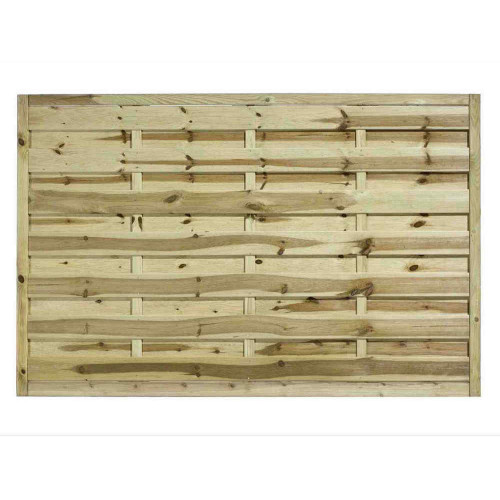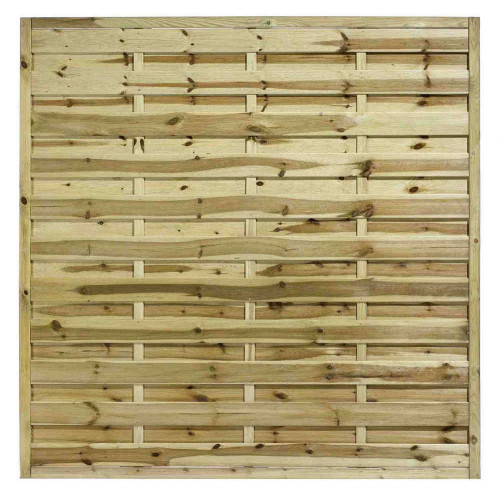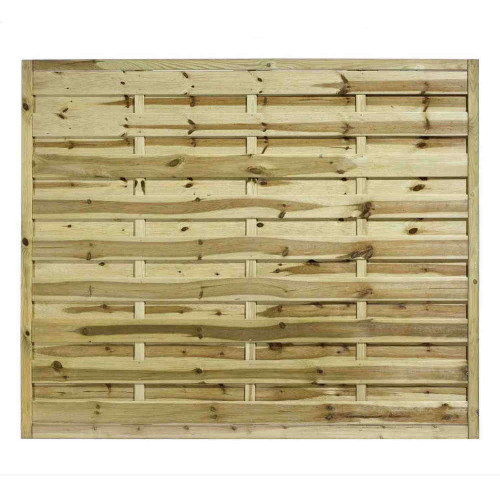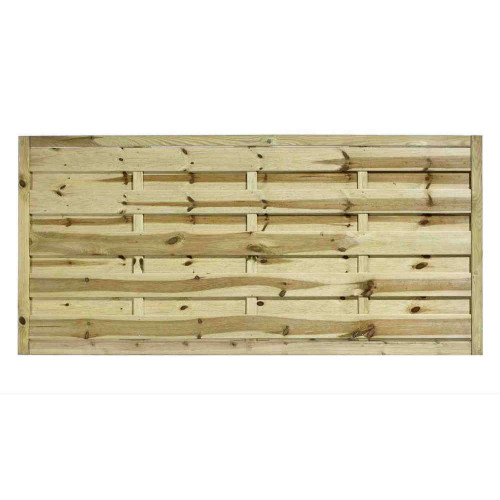


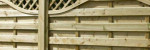

Quick answer: Hit & Miss fencing is a strong option for windy gardens because its alternating board construction allows more air to pass through than a predominantly solid panel. This can reduce the barrier effect created by solid fencing, while still providing useful screening. It is not windproof, however. Panel height, post strength, foundations, ground conditions and exposure still matter. For an exposed garden where you want both privacy and airflow, Hit & Miss is often worth considering.
Wind is one of the biggest practical considerations when choosing a garden fence.
A fence that works perfectly well in a sheltered suburban garden may behave very differently on an exposed plot, at the top of a hill or beside open countryside.
That is where Hit & Miss fencing becomes particularly interesting.
Unlike a predominantly solid Closeboard panel, Hit & Miss construction deliberately leaves routes for air to move through the fence. The result is a boundary that can provide substantial screening without behaving like one continuous timber wall.
That does not mean you can ignore posts, foundations or installation quality. A badly supported Hit & Miss fence can still fail in strong weather.
This guide explains why Hit & Miss fencing can work well in windy gardens, how it compares with solid and slatted panels, what height to choose and what else needs to be considered when fencing an exposed site.
What Are Hit & Miss Fence Panels?
Hit & Miss panels use timber boards arranged alternately across the fence.
The construction provides overlapping visual screening while leaving openings that allow air to pass through the panel.
This creates a useful compromise between:
- Privacy
- Airflow
- Contemporary appearance
- Boundary definition
East Coast Fencing Horizontal Hit & Miss panels are nominally 6ft wide and available in 3ft, 4ft, 5ft and 6ft heights.
They are pressure treated in green.
Why Does Wind Matter When Choosing A Fence?
Wind creates pressure against a fence.
A predominantly solid panel blocks most of the air moving towards it, so that force has to be transferred through:
- The panel
- Fixings
- Posts
- Post foundations
As wind speed and exposure increase, those loads become more significant.
A more open fence allows some of the moving air to continue through the boundary rather than forcing all of it around or over the fence.
This is the principle behind considering Hit & Miss fencing for exposed gardens.
Why Are Hit & Miss Fence Panels Good For Windy Gardens?
The alternating boards create gaps through which air can move.
Compared with a largely solid panel, this reduces the extent to which the fence acts as a complete barrier to the wind.
This can be useful in:
- Exposed rear gardens
- Elevated properties
- Gardens beside open fields
- Properties with long exposed boundaries
- Areas where previous solid panels have repeatedly suffered storm damage
The key benefit is not that the fence becomes immune to wind. It is that the panel design allows greater airflow.
Are Hit & Miss Fence Panels Windproof?
No.
No ordinary garden fence should be described as windproof.
A Hit & Miss fence can still be affected by strong weather, particularly if:
- The posts are undersized
- The posts are rotten
- The foundations are inadequate
- The fence is exceptionally tall
- The site is unusually exposed
- The ground is soft or unstable
The panel design can help with airflow, but it does not replace sound fence construction.
Do Hit & Miss Panels Let Wind Through?
Yes.
That is one of the practical advantages of the design.
The boards provide overlapping screening rather than forming one continuous solid surface.
Air can therefore move through the openings within the panel.
The amount of airflow should not be interpreted as meaning the fence is extremely open. Hit & Miss still provides useful visual screening and is substantially more enclosed than lattice or Picket fencing.
How Does Hit & Miss Compare With Closeboard In Wind?
Closeboard is a predominantly solid fencing style.
Its overlapping vertical boards create strong privacy, but they also form a substantial barrier to moving air.
Hit & Miss provides more airflow.
| Feature | Hit & Miss | Closeboard |
|---|---|---|
| Airflow | Good | Limited |
| Privacy | Moderate to high | High |
| Wind barrier effect | Reduced by openings | Greater |
| Appearance | Contemporary horizontal | Traditional vertical |
If maximum privacy is the overriding requirement, Closeboard may still be preferable.
If exposure and airflow are major concerns, Hit & Miss deserves serious consideration.
How Does Hit & Miss Compare With Double Slatted Fencing In Wind?
Both are contemporary horizontal fencing styles, but they place the emphasis in slightly different places.
Double slatted fencing generally provides stronger screening.
Hit & Miss places greater emphasis on airflow.
A simple way to think about the choice is:
- Choose double slatted when privacy has higher priority
- Choose Hit & Miss when airflow has higher priority
That does not make one universally better.
The correct choice depends on the individual garden.
How Does Hit & Miss Compare With Lattice In Wind?
Lattice is considerably more open and therefore allows much more air through.
However, it also provides far less privacy.
Hit & Miss sits between solid fencing and very open decorative fencing.
That makes it useful when you want:
- Meaningful screening
- Better airflow than solid panels
- A substantial garden boundary
How Does Hit & Miss Compare With Picket Fencing In Wind?
Picket fencing is also highly open because of the regular gaps between its vertical pales.
It can perform well where airflow is desirable, but most Picket panels are intended for lower and more open boundaries.
Hit & Miss is the better comparison when you need a taller rear garden fence with substantially more screening.
Does Hit & Miss Fencing Reduce Wind Pressure?
Its openings allow some of the airflow to pass through the fence, reducing the solid barrier effect.
However, the exact wind loading of any finished fence depends on many factors, including:
- Panel construction
- Fence height
- Site exposure
- Spacing and orientation
- Terrain
For ordinary domestic decision-making, the practical point is that Hit & Miss is more permeable to air than a predominantly solid fence.
Does Fence Height Matter In A Windy Garden?
Yes.
Taller fencing presents more surface area to moving air.
A 6ft panel will therefore create a more substantial boundary than a 3ft version of the same design.
If you only need 4ft or 5ft of height, there can be little benefit in choosing 6ft automatically.
A lower fence can provide:
- Less wind exposure
- More light
- A less enclosed garden
What Heights Do Hit & Miss Panels Come In?
East Coast Fencing Horizontal Hit & Miss panels are available in nominal:
- 3ft
- 4ft
- 5ft
- 6ft
They are nominally 6ft wide.
This gives you useful flexibility when balancing privacy against wind exposure.
Is 3ft Hit & Miss Fencing Good In Wind?
Three-foot panels present the lowest profile within the range.
They can work particularly well for:
- Internal garden divisions
- Lower exposed boundaries
- Patio zoning
- Areas where privacy is not essential
The lower height means they create less of a physical barrier than full-height fencing.
Is 4ft Hit & Miss Fencing Good In Wind?
Four-foot panels can provide a useful compromise between boundary height and exposure.
They are worth considering where you want:
- A noticeable garden boundary
- Some screening
- Good airflow
- Less height than a conventional full privacy fence
Is 5ft Hit & Miss Fencing Good In Wind?
Five-foot panels provide significantly more screening while remaining below full 6ft height.
This can be a useful choice where:
- Privacy is important
- The garden is exposed
- 6ft of fencing is not genuinely necessary
For many gardens, selecting 5ft instead of automatically choosing 6ft can be a sensible compromise.
Is 6ft Hit & Miss Fencing Good In Wind?
It can be, provided the supporting system is suitable.
The panel still allows airflow, but 6ft fencing creates the greatest overall boundary area within the range.
Pay particular attention to:
- Posts
- Foundations
- Ground conditions
- Exposure
Do not rely on the open panel design as a substitute for robust installation.
Is Lower Fencing Better In Very Exposed Gardens?
Often, reducing unnecessary height is sensible.
If privacy does not require a full-height fence, lower panels can reduce how much material is exposed to the wind.
Before choosing 6ft, ask whether:
- 5ft would provide enough privacy
- 4ft would adequately define the boundary
- Only one section actually needs full screening
Are Hit & Miss Panels Good For Coastal Gardens?
The airflow characteristics can make the design worth considering for an exposed coastal garden.
However, coastal sites can experience severe weather and difficult exposure.
Consider the entire fence system, including:
- Post specification
- Fixings
- Ground conditions
- Fence height
- Maintenance
Do not assume panel choice alone solves the challenges of an exposed coastal site.
Are Hit & Miss Panels Good Beside Open Fields?
Yes, they can be a strong option.
A boundary beside open land may receive more direct wind because there are fewer buildings, hedges or other structures to provide shelter.
Hit & Miss fencing can retain useful privacy while allowing some of that air to move through the boundary.
Are Hit & Miss Panels Good On Hilltop Properties?
Potentially.
Elevated sites can be highly exposed, so permeability to airflow can be advantageous.
However, hilltop conditions can also place significant demands on posts and foundations.
A site that has repeatedly lost fences during storms deserves particular attention to the complete installation.
Are Hit & Miss Panels Good In Gardens With Wind Tunnels?
They can help where wind is channelled between buildings.
Narrow gaps between houses, extensions, garages and walls can accelerate or concentrate gusts.
A more permeable boundary can be preferable to installing another solid obstruction directly across that airflow.
Observe where the strongest gusts actually travel through the garden before deciding on the fence design.
Can Solid Fencing Make A Windy Garden Feel Worse?
In some situations, a solid barrier changes how air moves around the garden.
Wind can be forced:
- Over the top
- Around the ends
- Through gaps elsewhere
This can create turbulence around the boundary.
A more permeable fence allows some air through rather than attempting to block it completely.
Does Hit & Miss Fencing Stop The Garden Feeling Windy?
No.
Allowing air through the fence does not mean the area behind it becomes completely sheltered.
In fact, the purpose is partly to avoid treating the fence as a solid barrier.
If creating a sheltered seating area is the objective, consider the position and scale of the shelter rather than expecting the boundary fence alone to solve the problem.
Are Hit & Miss Fence Panels Private?
They provide useful screening, but they should not automatically be considered completely opaque.
The alternating boards interrupt direct sightlines while retaining spaces for airflow.
How private the fence feels depends on:
- Viewing angle
- Viewing distance
- Fence height
- Relative ground levels
Can You See Through Hit & Miss Fencing?
Some sightlines may be possible from certain angles.
From ordinary positions across neighbouring gardens, the alternating boards can provide substantial screening.
From very close to the fence, openings may be more apparent.
This is the trade-off that allows greater airflow.
Is Hit & Miss Private Enough For A Rear Garden?
For many gardens, yes.
If you want meaningful screening without the completely solid appearance of Closeboard, it can be an excellent option.
If absolute privacy is essential, assess the panel from the real viewing positions before deciding.
Is Hit & Miss Good For Overlooked Gardens?
It can help with ordinary ground-level views.
For stronger privacy around a particular area, such as a patio, you may prefer:
- A taller Hit & Miss panel
- A more privacy-focused Double Slatted panel
- Solid fencing
Overlooking from upper-storey windows is a separate issue because ordinary garden fencing may sit below the relevant sightline.
Is Hit & Miss Good Around A Patio?
Yes, particularly where the patio would otherwise feel too enclosed by a solid boundary.
It can provide:
- Screening
- Air movement
- A modern horizontal backdrop
- A less solid appearance
This is particularly useful in a warm, sheltered garden where some airflow around the seating area is welcome.
Is Hit & Miss Good Around Outdoor Dining Areas?
Yes.
It can create useful separation without enclosing the dining area too heavily.
If privacy is more important than airflow, Double Slatted fencing may be the stronger alternative.
Is Hit & Miss Good Around A Garden Room?
Yes.
The horizontal design can complement a modern garden room while retaining greater airflow around the structure.
Leave enough space for:
- Maintenance
- Drainage
- Air movement
rather than installing the fence unnecessarily close to the building.
Is Hit & Miss Good For Small Gardens?
It can be particularly useful.
Small gardens can feel enclosed when surrounded by tall solid fencing.
The additional airflow and visual breaks within Hit & Miss fencing can help the boundary feel less heavy.
The strong horizontal lines can also emphasise the width of the garden.
Is Hit & Miss Good For Narrow Gardens?
Yes.
A narrow garden with solid 6ft fencing on both sides can sometimes feel corridor-like.
Hit & Miss can soften that effect while still providing substantial separation from neighbouring properties.
Is Hit & Miss Good For Large Gardens?
Yes.
Across a long boundary, the horizontal boards can become a strong landscaping feature.
The greater airflow can also be useful where a large plot is exposed to prevailing winds.
Consider whether you want the horizontal pattern to remain visible or whether planting will eventually cover much of the fence.
Does Hit & Miss Fencing Let More Light Through?
It can allow more light through the boundary than a predominantly solid panel.
The exact effect depends on:
- Fence orientation
- Panel height
- Sun position
- Nearby buildings
- Planting
This can make the design useful in gardens where both airflow and light are concerns.
Will Hit & Miss Fencing Make A Small Garden Dark?
A tall fence of any substantial construction can create shade.
However, Hit & Miss is less visually solid than conventional privacy fencing and allows some light through the panel.
If the garden already struggles for light, consider whether 5ft is sufficient rather than automatically installing 6ft panels.
Does Hit & Miss Fencing Look Modern?
Yes.
The repeated horizontal boards create a contemporary appearance that works particularly well with:
- Modern paving
- Garden rooms
- Raised beds
- Rendered walls
- Contemporary furniture
It can provide a less formal alternative to Double Slatted fencing while retaining strong horizontal lines.
Can Hit & Miss Work With A Traditional House?
Yes.
A contemporary fence can contrast effectively with an older property.
Planting can also soften the horizontal lines and help the boundary sit naturally within a traditional garden.
Are Hit & Miss Panels Attractive From Both Sides?
One reason alternating-board designs are popular is that they can create a more considered appearance than fencing with a clearly defined front and exposed structural rear.
However, the exact appearance depends on the individual panel construction.
If both sides of the boundary are highly visible, inspect the actual panel design before ordering.
Are Hit & Miss Panels Good For Shared Boundaries?
They can be visually attractive where both neighbouring gardens see the fence.
As with any shared boundary project, establish what can actually be altered and agree practical arrangements where another property is involved.
From a design perspective, the balanced appearance of Hit & Miss can be useful where both sides matter.
What Posts Should You Use In A Windy Garden?
The appropriate post depends on the complete installation.
Factors include:
- Fence height
- Exposure
- Ground conditions
- Panel design
- Post spacing
East Coast Fencing timber posts are available in common sections including 75 x 75mm and 100 x 100mm, with lengths including 1.8m, 2.4m and 3.0m.
More exposed and taller fencing generally warrants particular attention to post specification rather than simply reusing whatever was previously installed.
Are 100 x 100mm Posts Better For Windy Gardens?
A 100 x 100mm timber post is more substantial than a 75 x 75mm post, but post size cannot be considered in isolation.
The final performance also depends on:
- Post length
- Installation depth
- Foundation
- Ground conditions
- Fence height
A substantial post installed badly can still move.
Can Hit & Miss Fencing Use Concrete Posts?
Compatibility should be checked for the specific framed panel and post system.
Do not assume that a nominal 6ft panel will automatically fit every existing slotted concrete post.
Check:
- Actual panel width
- Panel thickness
- Post slot
- Existing gravel board arrangement
Should Old Fence Posts Be Reused?
Only if they remain structurally sound and suitable for the new fence.
Inspect existing posts for:
- Movement
- Rot
- Splitting
- Leaning
- Failed foundations
Installing a wind-friendly panel onto already failing posts does not address the underlying weakness.
Why Do Fence Posts Fail In Wind?
Common causes include:
- Decay at or near ground level
- Insufficient support
- Poor foundations
- Soft or waterlogged ground
- Repeated movement over time
- Excessive loads from a tall solid fence
If previous fences have failed, inspect the posts and foundations rather than assuming the panels were the only problem.
Do Hit & Miss Panels Need Gravel Boards?
Suitable gravel boards are worth considering where compatible with the fencing system.
They can help separate the main timber panel from:
- Soil
- Wet grass
- Mulch
- Ground-level debris
This can help protect the lower part of the panel from persistent moisture.
Do Gravel Boards Affect Wind?
A gravel board adds another component to the finished fence and can reduce the open area near ground level.
However, its primary purpose is not wind control.
Choose it according to the fencing system, ground conditions and desired appearance.
Does A Gravel Board Increase Fence Height?
Yes, where the panel is installed above a visible gravel board.
The overall finished enclosure will then be taller than the nominal panel height alone.
This can affect:
- Wind exposure
- Privacy
- Appearance
- Post selection
Can Hit & Miss Panels Be Installed On A Slope?
Yes.
Rigid panels are generally stepped as the ground rises or falls.
Because the boards run horizontally, changes in level can be particularly noticeable.
Plan the step pattern before setting the posts.
Does A Slope Make A Fence More Exposed?
Sometimes.
Properties on elevated or sloping ground can receive greater exposure depending on surrounding terrain.
Do not assume the slope itself is the problem, but consider:
- Prevailing wind direction
- Nearby buildings
- Trees and hedges
- Open land
Can Wind Get Under A Stepped Fence?
Stepping can create gaps beneath the downhill side of a panel.
Those gaps may increase airflow locally, but they can also affect:
- Pet containment
- Privacy
- Appearance
The lower edge of the fence should therefore be planned as carefully as the top.
Are Hit & Miss Panels Good For Dogs?
Potentially.
The fence can provide useful visual screening while maintaining airflow.
For containment, also consider:
- Fence height
- Openings within the panel
- Ground clearance
- Gate gaps
- The dog's jumping ability
No panel style should automatically be assumed suitable for every dog.
Will A Dog Be Able To See Through Hit & Miss Fencing?
Some limited sightlines may remain depending on the panel and viewing angle.
If reducing visual stimulation is particularly important, a more heavily screened design may suit the garden better.
Are Hit & Miss Panels Good For Plants?
Yes.
The airflow through the fence can be beneficial around garden planting, particularly compared with creating one continuous solid surface.
The horizontal timber also provides an attractive backdrop for:
- Ornamental grasses
- Shrubs
- Raised beds
- Modern planting schemes
Can Climbers Grow On Hit & Miss Fencing?
They can grow near the fence, but substantial climbers may be better provided with independent support.
Dense mature vegetation can:
- Add weight
- Increase wind loading
- Trap moisture
- Reduce the airflow advantage of the panel
This last point is especially important in an exposed garden.
Can A Hedge Reduce The Airflow Benefit?
Dense vegetation immediately against the fence can alter the way air moves through it.
If the reason for choosing Hit & Miss is improved airflow, completely covering the panel with dense growth may reduce some of that advantage.
Allow appropriate space between substantial planting and the fence where practical.
Can Hit & Miss Panels Be Painted?
Pressure-treated timber can generally be given a suitable exterior decorative coating once it is sufficiently dry and correctly prepared.
Follow the coating manufacturer's instructions.
The overlapping horizontal construction means coating can require care around:
- Board edges
- Recesses
- Frames
Are Hit & Miss Panels Difficult To Clean?
They require slightly more detailed cleaning than a simple flat surface because dirt and algae can collect around board edges and recesses.
A sensible process is:
- Remove loose leaves and vegetation.
- Brush away surface dirt.
- Use a suitable mild timber cleaner where necessary.
- Treat persistent algae with a timber-safe product if required.
- Allow the timber to dry.
Can You Pressure Wash Hit & Miss Fence Panels?
Use caution.
Excessive pressure can damage timber fibres and edges.
It can also remove decorative coatings unevenly.
Gentle cleaning is usually a better starting point.
Does Algae Affect Wind Performance?
A normal surface layer of algae does not fundamentally change the panel design.
However, heavy vegetation and accumulated debris can begin to block openings and hold moisture against the timber.
Keeping the fence reasonably clear helps maintain both its appearance and its intended airflow.
How Long Do Hit & Miss Panels Last?
There is no single lifespan that applies to every fence.
Long-term performance depends on:
- Timber treatment
- Panel construction
- Installation
- Posts
- Exposure
- Moisture
- Ground clearance
- Maintenance
Wind-friendly panel design cannot compensate for prolonged damp or a failing support system.
Can Hit & Miss Panels Still Blow Out Of The Posts?
Potentially, if the fence is incorrectly installed or the support system fails.
Check that panels are properly secured according to the intended installation method.
Strong gusts can expose weaknesses in:
- Fixings
- Posts
- Foundations
Is A Panel Fence Better Than Individual Boards In Wind?
There is no universal answer.
Prefabricated panels provide convenience and consistent construction.
A site-built fence can sometimes offer greater flexibility on:
- Sloping ground
- Irregular bay sizes
- Complex boundaries
What matters most is whether the complete system is suitable for the site.
What If My Previous Fence Blew Down?
Do not simply replace the panels without investigating why the previous fence failed.
Check:
- Did the posts snap?
- Did the foundations move?
- Did the panels come away from sound posts?
- Was the fence unusually tall?
- Was the location heavily exposed?
- Had the timber already decayed?
The answer helps determine whether changing to Hit & Miss will address the real problem.
Should I Replace Solid Panels With Hit & Miss After Storm Damage?
It can be a sensible option if wind pressure against solid panels contributed to repeated problems.
But first check the posts.
If the existing posts are rotten or loose, changing panel style alone is unlikely to provide a reliable repair.
Can Hit & Miss Panels Fit Existing Posts?
Potentially, but compatibility should be checked rather than assumed.
Measure:
- Clear bay width
- Panel thickness
- Post condition
- Existing gravel boards
- Fixing arrangement
Nominally similar panel widths do not guarantee that every panel fits every existing post system.
Can You Mix Hit & Miss With Solid Fencing?
Yes.
This can be a particularly practical strategy for exposed gardens.
You might use:
- Hit & Miss along the most exposed boundary
- Closeboard where maximum privacy is required
- Double slatted around the main patio
Use corners, gates or changes in garden use as natural transition points.
Can You Mix Hit & Miss With Double Slatted Fencing?
Yes.
The two share a contemporary horizontal appearance, which makes them easier to combine than completely unrelated panel styles.
A useful arrangement might be:
- Double slatted beside a private seating area
- Hit & Miss along the exposed remainder of the boundary
Should You Put Hit & Miss On The Windiest Boundary Only?
You can.
There is no requirement to use the same fencing style around an entire garden.
Different boundaries can face different conditions.
The rear may be exposed to prevailing wind while one side is sheltered by neighbouring houses.
Choose the fence according to the conditions and purpose of each section.
How Do You Identify The Windiest Boundary?
Observe the garden during windy weather.
Look for:
- Which fence moves most
- Where leaves and debris collect
- Which direction plants bend
- Where gusts accelerate between buildings
- Which previous fence sections have failed
Local exposure can be very different even within the same garden.
Do Nearby Trees Protect A Fence From Wind?
Trees and hedges can provide some shelter, but they can also create turbulence and moving branches.
Do not assume that a nearby tree makes the fence safe from strong gusts.
Also keep branches from repeatedly striking the panels.
Can A Hedge Be Better Than A Solid Fence In Wind?
Dense vegetation can filter wind rather than behaving exactly like a solid wall.
However, a hedge and a fence serve different purposes and require different maintenance.
Hit & Miss can provide a timber boundary while retaining some of the permeability that makes filtered airflow useful.
Are Hit & Miss Panels Worth It For A Windy Garden?
They can be particularly worthwhile where you need a substantial fence but do not want a completely solid barrier.
The design provides a useful combination of:
- Screening
- Airflow
- Contemporary appearance
The value comes from choosing a panel suited to the conditions rather than simply replacing a failed solid fence with another identical one.
Do Hit & Miss Panels Cost More Than Standard Fencing?
Purchase prices vary according to panel design, size and construction.
Compare the complete fencing project rather than panel price alone.
Include:
- Panels
- Posts
- Gravel boards
- Fixings
- Installation
- Gate requirements
If a particular panel design is more suitable for an exposed site, that suitability may matter more than choosing the lowest initial panel cost.
Hit & Miss vs Other Fence Types For Windy Gardens
| Fence Style | Airflow | Privacy | Useful Starting Point |
|---|---|---|---|
| Hit & Miss | Good | Moderate to high | Privacy and airflow balance |
| Double Slatted | Moderate | High | Contemporary privacy |
| Closeboard | Limited | High | Solid traditional privacy |
| Picket | High | Low | Low open boundaries |
| Lattice | High | Low | Planting and open screening |
Common Mistakes When Fencing A Windy Garden
- Choosing panel style without inspecting the existing posts
- Assuming Hit & Miss is windproof
- Choosing 6ft panels automatically when less height would work
- Using weak posts with substantial panels
- Ignoring poor ground conditions
- Replacing storm-damaged panels without finding the original cause of failure
- Blocking the panel openings with dense vegetation
- Adding large amounts of extra screening later
- Ignoring gaps created by sloping ground
- Assuming nominally similar panels will fit existing posts
- Considering the panel without considering the entire fence system
Hit & Miss Fence Panels Buying Checklist For Windy Gardens
- Identify the most exposed boundary.
- Decide how much privacy you require.
- Choose only as much panel height as you need.
- Measure the complete fence run.
- Check existing posts for movement or decay.
- Choose suitable posts for a new installation.
- Assess ground conditions.
- Plan gravel boards where appropriate.
- Check changes in ground level.
- Consider whether dense planting will restrict airflow.
- Check access for full-size panels.
- Consider whether different boundaries need different panel styles.
FAQs
Are Hit & Miss Fence Panels Good For Windy Gardens?
Yes. Their alternating-board construction allows more air through than predominantly solid fencing, making them a strong option where exposure is a concern.
Are Hit & Miss Fence Panels Windproof?
No. Posts, foundations, height, ground conditions and the severity of the weather still affect the fence.
Does Wind Pass Through Hit & Miss Fencing?
Yes. Openings within the design allow air to move through the boundary.
Are Hit & Miss Panels Better Than Closeboard In Wind?
They allow greater airflow than Closeboard. Closeboard provides stronger straightforward privacy, so the better choice depends on the garden.
Are Hit & Miss Panels Better Than Double Slatted In Wind?
They generally place greater emphasis on airflow, while Double Slatted fencing places greater emphasis on screening.
Which Is Better For Wind, Hit & Miss Or Lattice?
Lattice is much more open, but it provides considerably less privacy. Hit & Miss gives a stronger balance between privacy and airflow.
Can Hit & Miss Panels Still Blow Down?
Yes. A poorly supported fence or exceptionally severe weather can still cause failure.
Do Hit & Miss Panels Need Strong Posts?
Yes. The fact that air can pass through the panels does not remove the need for suitable posts and foundations.
What Height Hit & Miss Fencing Is Best For Wind?
Use the lowest height that still achieves the required boundary and privacy. Lower fencing generally presents less surface area to the wind.
Do Hit & Miss Panels Come In 3ft?
Yes. East Coast Fencing Horizontal Hit & Miss panels are available in nominal 3ft height.
Do Hit & Miss Panels Come In 4ft?
Yes. A nominal 4ft option is available.
Do Hit & Miss Panels Come In 5ft?
Yes. A nominal 5ft option is available.
Do Hit & Miss Panels Come In 6ft?
Yes. A nominal 6ft option is available.
How Wide Are Hit & Miss Panels?
The panels discussed here are nominally 6ft wide.
Are Hit & Miss Panels Private?
They provide useful screening, although some sightlines can remain depending on viewing angle and distance.
Can You See Through Hit & Miss Panels?
Potentially, from some angles. This partial openness is part of how the panel maintains airflow.
Are Hit & Miss Panels Good For Coastal Gardens?
They can be worth considering because of their airflow, although coastal exposure still requires careful attention to the complete fence structure.
Are Hit & Miss Panels Good Beside Open Fields?
Yes. They can be particularly useful where the boundary receives unobstructed wind.
Are Hit & Miss Panels Good On Hills?
Potentially. Elevated sites can be highly exposed, making panel permeability and robust support important considerations.
Are Hit & Miss Panels Good For Patios?
Yes. They provide screening while retaining more airflow than solid fencing.
Are Hit & Miss Panels Good For Small Gardens?
Yes. Their greater visual openness can help prevent a small garden from feeling excessively enclosed.
Are Hit & Miss Panels Good For Dogs?
Potentially, but check panel openings, height, ground clearance, gates and the individual dog's behaviour.
Can Hit & Miss Panels Be Used With Timber Posts?
Yes, where the posts are appropriately specified for the complete fence.
Can Hit & Miss Panels Be Used With Concrete Posts?
Compatibility should be checked for the specific panel and concrete post system.
Do Hit & Miss Panels Need Gravel Boards?
Suitable gravel boards can help keep the main timber panel away from soil and persistent ground-level moisture where compatible with the installation.
Can Hit & Miss Panels Be Installed On A Slope?
Yes. Rigid panels are usually stepped as the ground level changes.
Can Hit & Miss Panels Be Painted?
Pressure-treated timber can generally be given a suitable exterior decorative coating when sufficiently dry and correctly prepared.
Can Plants Grow Against Hit & Miss Fencing?
Yes, but avoid extremely dense growth that traps moisture or blocks much of the airflow through the panel.
Should I Replace My Solid Fence With Hit & Miss After Storm Damage?
It may be worth considering if exposure contributed to the failure, but inspect the posts and foundations first.
Are Hit & Miss Fence Panels The Right Choice For Your Windy Garden?
If you need a substantial garden boundary but are concerned about wind exposure, Hit & Miss fencing is one of the strongest options to consider.
Its main advantage is straightforward: air can pass through the panel.
That gives it an important distinction from predominantly solid styles such as Closeboard, while retaining far more screening than very open fencing such as lattice or Picket panels.
It is particularly useful where you want a balance between privacy and airflow.
However, panel design is only part of the solution.
A reliable fence in an exposed garden also depends on suitable posts, sound foundations, appropriate height, good ground conditions and careful installation.
If your previous fence has blown down, investigate why before simply replacing the panels. Rotten posts or failed foundations will not be fixed by changing panel style alone.
Also resist choosing the tallest panel automatically. A 5ft Hit & Miss fence may provide all the screening you need while presenting less surface area than a 6ft boundary.
If maximum privacy matters more than airflow, Double Slatted or Closeboard may be preferable. If openness matters more than privacy, lattice or lower Picket fencing may be worth considering.
Where the goal is a modern-looking fence that provides useful privacy without creating one continuous barrier to the wind, Hit & Miss is an excellent middle ground.