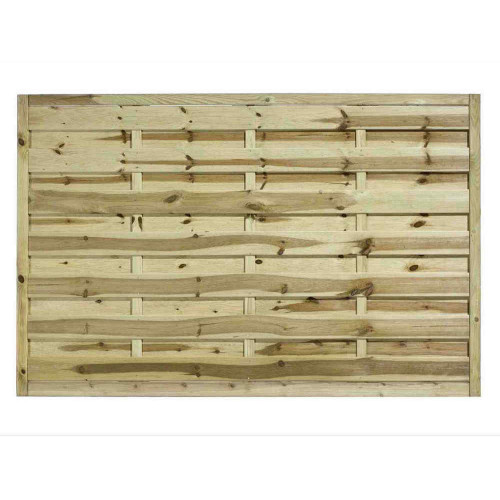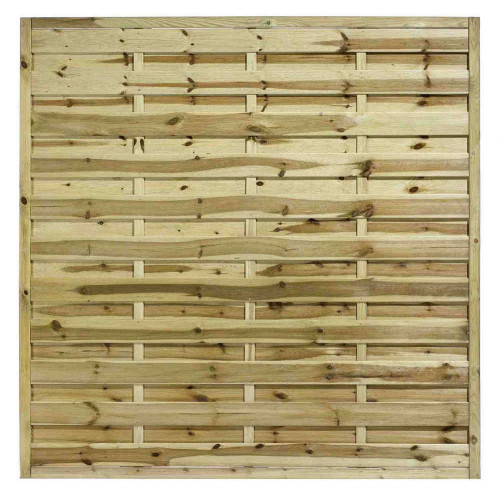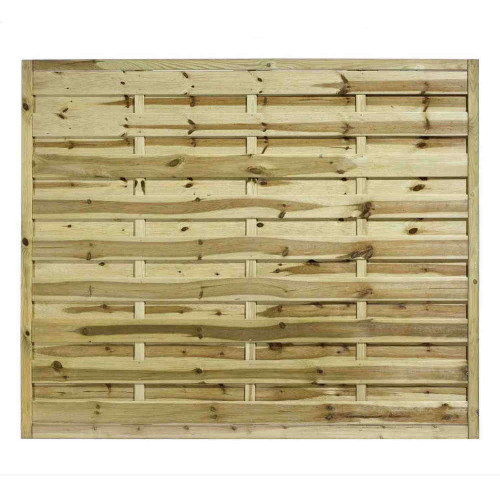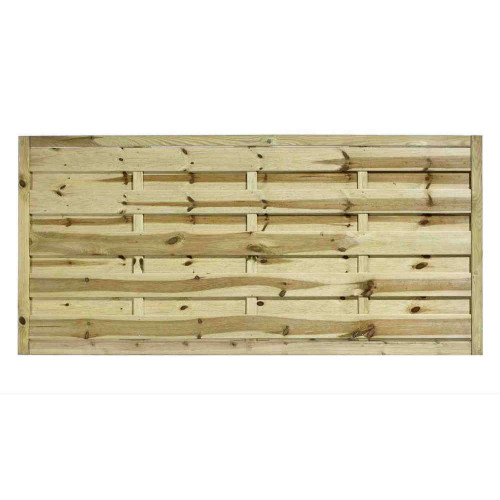


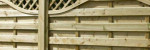

Quick answer: Hit & Miss Fence Panels are a good choice when both sides of a boundary will be visible because their boards alternate between the two faces of the panel. This gives each side a finished timber appearance rather than creating one obvious front and one plain rear face. They are particularly useful between neighbouring gardens, around patios and for internal garden divisions. The two sides are not necessarily visually identical, but both are designed to be presentable.
Some fence panels have a very obvious front and back.
One side displays the main boards, while the opposite side exposes more of the structural framing. That may not matter along a boundary where only one face is regularly seen, but it becomes much more noticeable when both gardens overlook the fence.
Hit & Miss Fence Panels solve this differently.
The horizontal boards are arranged alternately across opposite sides of the panel framework. As a result, both faces contain visible finished boards and the fence has a more balanced appearance from either direction.
This makes hit and miss fencing particularly interesting for shared-looking boundaries, internal garden screens, patios and anywhere the reverse face of the fence matters almost as much as the front.
Do Hit & Miss Fence Panels Have a Front and Back?
Not in the same obvious way as many conventional timber fence panels.
Hit and miss construction deliberately places boards on both faces of the framework.
A typical pattern alternates:
- One board on one face
- The next board on the opposite face
- Then back to the first face
This repeated arrangement continues across the panel.
As a result, neither side consists solely of an exposed structural back.
Do Both Sides Look Exactly the Same?
Not necessarily.
Both sides are designed to be presentable, but alternating construction means the visible sequence of boards is reversed from one face to the other.
From one garden you see one set of boards in the foreground.
From the other garden, the alternate set becomes more prominent.
The overall character remains similar:
- Horizontal timber lines
- Layered construction
- Controlled gaps
- A contemporary finish
but the exact view is not a mirror image.
Why Are Hit & Miss Fence Panels Good for Shared Boundaries?
Appearance from both sides is one of their main practical advantages.
On a boundary between neighbouring gardens, both households may spend considerable time looking at the fence.
A panel with a pronounced structural rear can create a situation where one side receives the decorative face and the other receives the less finished view.
Hit and miss fencing reduces that contrast.
Both sides see:
- Finished horizontal boards
- A repeated timber pattern
- A layered decorative structure
This can make it a useful choice where the visual quality of both faces matters.
What Does Hit and Miss Construction Actually Look Like?
The boards do not sit in one completely flat plane.
Instead, alternating boards are fixed on opposing sides of the internal framework.
This gives the panel visual depth.
From an angle, you can see how the boards overlap one another rather than forming one simple flat screen.
The layered effect is part of what gives Hit & Miss Fence Panels their distinctive appearance.
Why Are the Boards Alternated?
The arrangement performs more than one job.
Alternating boards help:
- Interrupt direct sightlines
- Allow air through the panel
- Create a presentable appearance on both sides
- Add visual depth
This gives hit and miss fencing a different balance from completely solid or single-sided fencing.
Does the Design Still Provide Privacy?
Yes, but it should be considered partial screening rather than complete opacity.
The alternating boards overlap many ordinary viewing angles, reducing direct views through the boundary.
However, openings remain so that air can pass through.
At certain angles, limited visibility through those gaps is possible.
This means the design balances:
- Privacy
- Airflow
- Appearance on both sides
rather than maximising privacy alone.
Can Neighbours See Through Hit & Miss Fence Panels?
Potentially, from particular angles.
The amount of visibility depends on:
- Viewing angle
- Distance from the fence
- Panel height
- Lighting
- Ground levels
From many normal positions, the alternate boards interrupt the direct line of sight.
Move sideways relative to the panel and some openings may become more visible.
Are Hit & Miss Panels Suitable When Privacy Is Essential?
That depends on what you mean by privacy.
If you want useful screening while retaining airflow, Hit & Miss Fence Panels can work very well.
If your requirement is that virtually no direct view should remain through the fence, a more solid design may be preferable.
Closeboard Fence Panels provide a more continuously solid boundary, while Double Slatted Fence Panels provide stronger screening with a contemporary horizontal appearance.
Why Can Hit & Miss Fencing Feel Less Enclosed?
The spaces within the panel allow some air and light through the boundary.
This can make a garden feel less boxed in than a similarly tall solid fence.
The difference can be particularly noticeable in:
- Narrow gardens
- Small patios
- Courtyard-style spaces
- Gardens with tall fencing on several sides
You still get a strong visual boundary, but not the same continuous wall of timber.
Are Hit & Miss Fence Panels Good Between Two Patios?
They can be.
When neighbouring patios sit close to the boundary, both sides of the fence may be highly visible.
Hit and miss construction provides:
- A decorative face towards both patios
- Useful screening
- Air movement
- A contemporary appearance
If either patio requires complete privacy, consider whether the openings are acceptable before choosing the design.
Are They Good for a Boundary Seen From the House?
Yes.
If a fence sits directly opposite:
- Patio doors
- Kitchen windows
- Dining areas
- Garden rooms
its appearance becomes a significant part of the garden.
The layered horizontal design gives Hit & Miss Fence Panels a more decorative character than a basic utility boundary.
Are Hit & Miss Panels Good for Internal Garden Screens?
Yes, and this is another situation where the two-sided appearance becomes useful.
An internal screen is normally visible from both areas it separates.
Possible uses include dividing:
- A patio from a lawn
- A seating area from a utility area
- A garden room from the rest of the garden
- An outdoor dining area from a path
A panel that looks finished from both directions makes sense in these locations.
Can Lower Hit & Miss Panels Be Used for Garden Zoning?
Yes.
The current range includes nominal 3ft and 4ft heights that can create visual divisions without becoming full-height privacy boundaries.
Lower panels work particularly well where the purpose is to define a space while maintaining:
- Views
- Light
- Airflow
- Connection between different parts of the garden
What Hit & Miss Fence Panel Heights Are Available?
The current East Coast Fencing range is approximately 6ft wide, around 1.83m, and includes:
- 3ft panels
- 4ft panels
- 5ft panels
- 6ft panels
The panels are pressure treated and currently supplied in a green/natural finish.
| Height | Typical Role | Screening |
|---|---|---|
| 3ft | Low garden divisions | Light |
| 4ft | Patios and garden zoning | Low to moderate |
| 5ft | Seating areas and boundaries | Moderate |
| 6ft | Rear and side boundaries | Strongest in the range |
Which Height Is Best for a Shared Boundary?
Choose the height according to what the boundary needs to achieve.
A 3ft panel can define the edge of two gardens but provides limited privacy.
A 4ft panel creates a clearer visual division while preserving openness.
A 5ft panel can provide useful screening around patios and seating.
A 6ft panel gives the strongest garden-level screening within the current range.
The tallest option is not automatically the best option.
Consider Ground Levels on Both Sides
A fence can appear very different from two neighbouring gardens if the ground levels are not equal.
For example, one property may have:
- A raised patio
- Decking
- A lower lawn
- A sloping garden
The same 5ft panel may therefore feel relatively tall from one side and significantly lower from the other.
Assess the required screening from the areas people actually use.
Do Hit & Miss Panels Look Good With Wooden Posts?
Yes.
Wooden posts create an all-timber boundary and work naturally with the horizontal panel design.
The posts form regular vertical breaks between the horizontal boards.
This can produce a clean repeated pattern along the fence run.
Do They Look Good With Concrete Posts?
They can.
Compatible slotted concrete posts create a more functional contrast between the decorative timber and structural supports.
This may suit gardens where:
- Durability is important
- The existing fence already uses concrete posts
- Easy future panel replacement is desirable
Check panel-frame and post-slot compatibility before installation.
Which Post Style Gives the Most Balanced Look From Both Gardens?
This is largely an appearance preference.
Timber posts maintain one consistent material across the whole fence.
Concrete posts remain equally visible from both gardens and can give the boundary a more structured appearance.
The panel itself remains the main reason for choosing hit and miss fencing where both faces matter.
Should the Same Post Face Both Gardens?
Fence posts form part of the overall design, but there is no need to invent a decorative front and rear for Hit & Miss Fence Panels themselves.
Plan the complete run so the posts, panel heights and gravel boards form a consistent boundary.
Can Hit & Miss Panels Use Gravel Boards?
Yes.
Gravel boards can help keep the lower timber panel frame away from:
- Wet soil
- Grass
- Mulch
- Leaves
- Rain splash
Wooden gravel boards can maintain an all-timber appearance, while concrete gravel boards work naturally with compatible concrete post systems.
Do Gravel Boards Look the Same From Both Sides?
A straight gravel board creates a consistent lower strip beneath the fence from either direction.
This can help visually anchor the alternating construction above.
Keep the gravel board level within each bay so the horizontal lines of the completed fence appear controlled.
Why Is Alignment Important With Hit & Miss Fence Panels?
The horizontal design makes small installation differences noticeable.
If one panel is positioned higher than another, the repeated board pattern can appear interrupted.
Check:
- Post verticality
- Panel level
- Gravel board height
- Top-line consistency
as each bay is installed.
Do Both Gardens See Installation Errors?
Yes.
One of the consequences of a presentable two-sided design is that poor alignment is visible from either direction.
A leaning post or panel can disrupt the horizontal pattern on both faces.
Accurate installation therefore matters as much as panel choice.
How Should Hit & Miss Panels Be Installed?
Support the panel using its surrounding frame rather than individual horizontal boards.
With suitable wooden posts, use exterior fixings, clips or brackets that secure the structural frame.
With compatible slotted concrete posts, lower the panel evenly between the post slots.
Do not:
- Carry the panel by one board
- Force it into an undersized bay
- Fix the whole panel through a decorative board alone
Which Way Round Should Hit & Miss Panels Be Installed?
Because the boards alternate between both faces, there is no conventional decorative front that must always face one particular garden.
The panel should instead be installed according to:
- Its frame construction
- The intended support system
- Correct orientation specified for the individual product
- Consistent alignment with adjoining panels
Do not randomly rotate individual panels within one run if doing so creates inconsistent framing or board patterns.
Should All Panels Face the Same Direction?
Yes, consistency is generally preferable.
Even though both sides are presentable, install neighbouring panels in the same orientation unless the construction specifically requires otherwise.
This keeps:
- Frame details consistent
- Board sequencing consistent
- The overall fence line neater
Can One Hit & Miss Panel Be Used as a Feature Screen?
Yes.
A single panel or short run can create an attractive screen around:
- A bench
- An outdoor sofa
- A dining table
- A garden room
- A utility area
Because both sides are decorative, the screen does not have to sit directly against the outer garden boundary.
Are They Good Around Garden Rooms?
Yes.
The horizontal timber pattern suits many contemporary garden buildings.
A panel can be used to define:
- A terrace
- An entrance
- A seating area
- A side screening zone
while still looking considered from the garden on the opposite side.
Can Hit & Miss Panels Hide Bins or Utility Areas?
They can provide useful screening, particularly with taller panels.
However, small views may remain through the alternating gaps.
If complete concealment is essential, a solid panel may be more suitable.
For ordinary garden screening, the layered construction can make utility areas significantly less prominent.
Are They Good for Narrow Side Passages?
They can be.
A tall solid fence on both sides of a narrow passage can make the area feel heavily enclosed.
Hit and miss construction allows some light and air movement through the boundary.
That can make a narrow space feel less severe while retaining useful screening.
How Does Hit & Miss Compare With Double Slatted Panels From Both Sides?
Both are decorative horizontal panel styles, but they prioritise different things.
Hit & Miss Fence Panels use boards on alternating faces and place greater emphasis on:
- Airflow
- A layered appearance
- Presentation from both sides
Double Slatted Fence Panels use a closer arrangement that generally provides stronger screening.
| Feature | Hit & Miss | Double Slatted |
|---|---|---|
| Appearance from both sides | A major design strength | Decorative framed design |
| Airflow | Higher | More restricted |
| Privacy | Moderate | Higher |
| Visual effect | Layered | Closer slatted screen |
How Does Hit & Miss Compare With Closeboard From the Neighbour's Side?
Traditional Closeboard Fence Panels are designed primarily around creating a strong, solid privacy screen.
The construction can make the two sides look more obviously different because structural framing is more prominent from one face.
Hit and miss fencing deliberately incorporates visible boards across both faces.
Choose Closeboard where:
- Maximum privacy matters most
- A traditional solid appearance is preferred
Choose hit and miss where:
- Both faces matter visually
- Airflow matters
- A contemporary horizontal design is preferred
How Does Hit & Miss Compare With Waney Lap?
Waney Lap Fence Panels use overlapping horizontal boards to create a largely solid traditional boundary.
The supporting frame is generally more noticeable from the rear.
Hit and miss construction is more deliberately two-sided.
Waney Lap may be the more straightforward option where:
- Basic solid screening is the priority
- A traditional boundary is wanted
Hit and miss fencing offers a more decorative solution where both neighbouring views are important.
Are Hit & Miss Fence Panels Better for Wind as Well?
The gaps created by the alternating boards allow more air through than a completely solid fence.
This reduces the size of the continuous timber surface presented to the wind.
That makes hit and miss fencing worth considering for exposed boundaries.
It does not make the fence windproof.
The complete installation still relies on:
- Suitable posts
- Secure foundations
- Correct panel installation
Does Planting Ruin the Two-Sided Appearance?
Not necessarily.
Planting can soften the fence from either garden.
However, dense climbers may eventually hide the alternating panel design and make one side appear very different from the other.
Heavy vegetation can also:
- Increase weight
- Increase wind resistance
- Trap moisture
- Make inspection difficult
Keep vigorous planting controlled.
Can You Paint Both Sides of Hit & Miss Fence Panels?
A compatible exterior timber coating can be applied once the pressure-treated timber is sufficiently dry and appropriately prepared.
Because the boards alternate across both faces, coating the complete panel properly involves more work than simply painting one flat surface.
You need to reach:
- Both board faces
- Edges
- Frame sections
- Recessed areas between alternating boards
Should Both Sides Be the Same Colour?
Using one finish across the whole panel generally creates the cleanest result.
Different colours on opposing sides would be difficult to execute neatly because the alternating construction means parts of the boards are visible through the gaps from different angles.
A single coordinated finish is normally simpler.
Do Hit & Miss Panels Need Immediate Painting?
No.
The current East Coast Fencing panels are pressure treated for outdoor use and supplied in a green/natural finish.
The treatment colour will gradually soften as the timber is exposed to sunlight and weather.
A decorative coating can be added later if desired.
Will Both Sides Weather at the Same Rate?
Not necessarily.
One face may receive more:
- Sunlight
- Rain
- Shade
- Vegetation
than the other.
This can lead to slightly different weathering even though the original panel construction and treatment are the same.
Can One Side Turn Greener Than the Other?
Yes.
A damp, shaded side can develop more surface algae than a sunnier face that dries quickly.
This is an environmental difference rather than evidence that one side of the panel was manufactured as the inferior side.
Keep dense planting controlled and remove debris trapped around the boards.
Can One Damaged Panel Be Replaced?
Yes, provided the posts and gravel boards remain sound.
Measure:
- Actual bay width
- Panel height
- Frame thickness
- Board arrangement
before ordering.
Hit and miss patterns can differ between manufacturers, so a physically compatible replacement may still look noticeably different from adjoining panels.
Will a New Panel Match the Existing Fence on Both Sides?
Not immediately in every case.
New pressure-treated timber may look brighter than older weathered panels.
Also compare:
- Board spacing
- Board dimensions
- Frame arrangement
- Overall panel construction
Those differences can matter more visually than temporary colour variation.
When Are Hit & Miss Fence Panels a Particularly Good Choice?
They are worth strong consideration where:
- Both sides of the fence are frequently visible
- The boundary sits between two patios
- You want a presentable shared-looking boundary
- Airflow matters
- Complete opacity is not essential
- A contemporary horizontal appearance suits the garden
- The panel will be used as an internal garden screen
When Might Another Fence Panel Be Better?
Choose another style when your main requirement points clearly elsewhere.
Closeboard Fence Panels may be better when:
- Maximum solid privacy is required
- A traditional appearance is preferred
Double Slatted Fence Panels may be better when:
- You want stronger screening
- You still want a contemporary horizontal appearance
Omega Lattice Fence Panels may be better when:
- A curved decorative top is preferred
- Climbing plants are an important part of the design
Common Mistakes With Two-Sided Hit & Miss Fencing
- Assuming both faces are mathematically identical
- Expecting complete privacy because the boards overlap
- Installing neighbouring panels in inconsistent orientations
- Ignoring panel level because both sides look decorative
- Using individual boards as lifting handles
- Forcing a panel into an incorrectly sized post bay
- Allowing the lower frame to sit in wet soil
- Using heavy climbing plants without considering the additional load
- Assuming treatment colour will remain unchanged
- Replacing one panel without checking whether its board pattern matches the existing fence
Hit & Miss Fence Panels Buying Checklist
- Decide how much privacy the boundary requires.
- Check whether both sides of the panel will be highly visible.
- Assess whether airflow is important.
- Choose 3ft, 4ft, 5ft or 6ft height according to the job.
- Measure ground levels from both gardens where relevant.
- Choose suitable wooden or compatible concrete posts.
- Consider gravel boards where the lower panel would be close to damp ground.
- Measure every existing fence bay before replacement.
- Keep adjoining panels in a consistent orientation.
- Compare board patterns when replacing individual panels.
- Plan climbing plants before allowing them to cover the fence.
- Choose a more solid panel if complete privacy is essential.
FAQs
Do Hit & Miss Fence Panels Look Good on Both Sides?
Yes. Their boards alternate between opposite faces, giving both sides a finished horizontal timber appearance.
Do Hit & Miss Fence Panels Have a Bad Side?
They do not have the same obvious decorative front and structural rear found on some conventional panel designs.
Are Both Sides of Hit & Miss Fence Panels Identical?
No. The alternating board pattern is reversed from one face to the other, although both sides have a similar finished character.
Which Way Should Hit & Miss Fence Panels Face?
Install the panels consistently according to their framing and support arrangement. There is no conventional decorative front that always needs to face one particular garden.
Should All Hit & Miss Panels Face the Same Way?
Generally, yes. Consistent orientation helps maintain a neat board pattern and framing arrangement across the complete run.
Are Hit & Miss Fence Panels Good for Shared Boundaries?
They can be particularly suitable where both gardens have a clear view of the fence because both faces are designed to look presentable.
Are Hit & Miss Fence Panels Private?
They provide useful partial screening, but they are not completely opaque.
Can You See Through Hit & Miss Fence Panels?
Limited visibility is possible through the gaps from particular viewing angles.
Do Hit & Miss Fence Panels Allow Air Through?
Yes. The alternating construction allows more airflow than a fully solid Closeboard or Waney Lap panel.
Are Hit & Miss Fence Panels Good for Windy Gardens?
They are often considered for exposed locations because they allow more air through, although strong posts and foundations are still essential.
Are Hit & Miss Panels Better Than Double Slatted Panels?
Neither is universally better. Hit & Miss panels place more emphasis on airflow and their layered two-sided design, while Double Slatted panels generally provide stronger screening.
Are Hit & Miss Panels Better Than Closeboard for Shared Boundaries?
They can provide a more balanced appearance from both gardens. Closeboard is the stronger option where solid privacy matters more than the appearance of both faces.
Can Hit & Miss Fence Panels Be Used With Wooden Posts?
Yes. Suitable wooden posts provide straightforward fixing points and create an all-timber fence.
Can Hit & Miss Fence Panels Be Used With Concrete Posts?
Yes, where the panel frame and dimensions are compatible with the particular slotted concrete post system.
Can Gravel Boards Be Used With Hit & Miss Panels?
Yes. Gravel boards can help keep the lower timber frame away from wet soil and garden debris.
Can Hit & Miss Panels Be Painted?
A compatible exterior timber coating can be applied once the pressure-treated timber is sufficiently dry and properly prepared.
Can Both Sides Be Painted Different Colours?
It is technically possible but difficult to achieve neatly because alternating boards can remain visible through the gaps from different angles. One consistent finish is normally simpler.
Can One Hit & Miss Fence Panel Be Replaced?
Yes, provided the existing posts and gravel board remain sound and the replacement dimensions and board arrangement are compatible.
What Sizes Are Hit & Miss Fence Panels Available In?
The current East Coast Fencing range is approximately 6ft wide and includes nominal 3ft, 4ft, 5ft and 6ft heights.
Are Hit & Miss Fence Panels Pressure Treated?
Yes. The current panels are pressure treated for outdoor use and supplied in a green/natural finish.
Should You Choose Hit & Miss Fence Panels When Both Sides Matter?
Yes, this is one of the situations where their construction makes particularly good sense.
The alternating boards mean both gardens receive a finished timber face rather than one side receiving all of the decorative boards and the other seeing a clearly structural rear.
The two sides are not identical, but they share the same horizontal, layered character.
That makes Hit & Miss Fence Panels useful for boundaries between neighbouring gardens, screens between patios and internal garden divisions where both faces remain visible.
You also gain the other main characteristic of the design: airflow.
The gaps between alternating boards allow more air through than a solid Closeboard or Waney Lap panel. The trade-off is that the fence does not provide complete visual privacy from every viewing angle.
If both appearance and airflow matter, hit and miss fencing provides a useful balance. If complete privacy is the overriding requirement, a more solid panel should be considered instead.
Whichever option you choose, keep adjoining panels level and consistently orientated. The repeated horizontal pattern is one of the strongest visual features of the design, and accurate installation allows both sides of the fence to benefit from it.