


Quick answer: Most timber garden gates need a suitable pair of hinges and a latch, with a pad bolt or drop bolt added where extra restraint or lockable security is required. Choose Garden Gate Furniture according to the gate's width, weight, frame construction, opening direction and frequency of use. Heavier solid gates need stronger support than low open picket gates, and all fittings should fix into substantial gate framing rather than thin boards or decorative slats.
A garden gate can be well made from good timber and still perform badly if the ironmongery is wrong.
Hinges carry the gate every time it opens. The latch has to line up correctly every time it closes. Bolts provide additional restraint or security. All of those components rely on sound gate posts and correctly positioned fixings.
This is why choosing gate furniture should not be an afterthought.
A low Picket gate, a solid Feather Edge gate and a tall Decorative gate can place very different demands on their fittings.
This guide explains the main types of gate furniture, what each component does, how to choose between hinges, ring latches, pad bolts and drop bolts, and the common installation mistakes that cause garden gates to sag, rattle or stop closing properly.
What Is Garden Gate Furniture?
Gate furniture is the collective term for the metal fittings used to hang, operate and secure a gate.
Typical components include:
- Tee hinges
- Ring latches
- Pad bolts
- Drop bolts
- Associated exterior fixings
Different fittings perform different jobs.
The hinges carry the moving gate. The latch holds it closed during normal use. A bolt can provide additional restraint or a lockable closing point.
What Garden Gate Furniture Does East Coast Fencing Supply?
The current East Coast Fencing range includes:
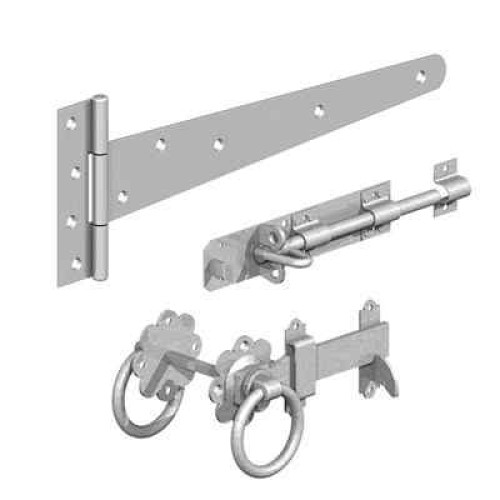
- A complete gate furniture pack
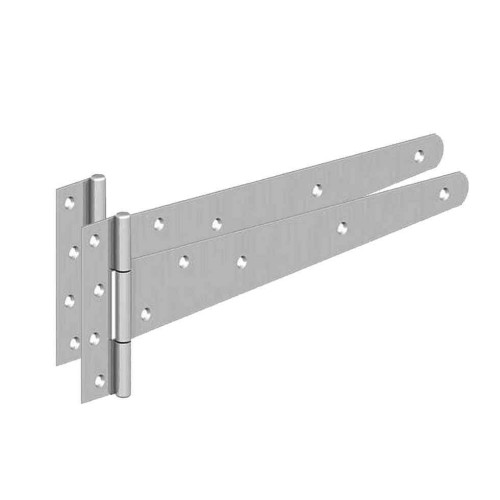
- 450mm medium tee hinges supplied as a pair
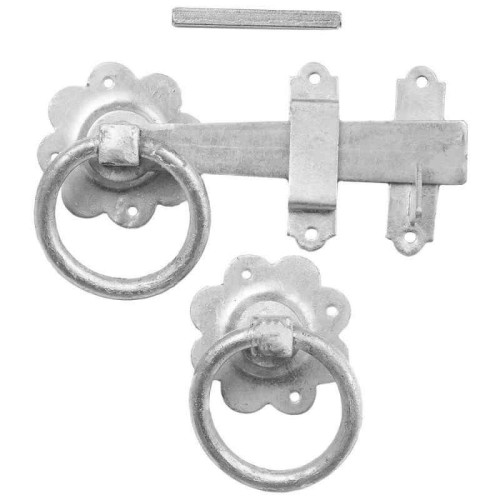
- A 150mm ring latch
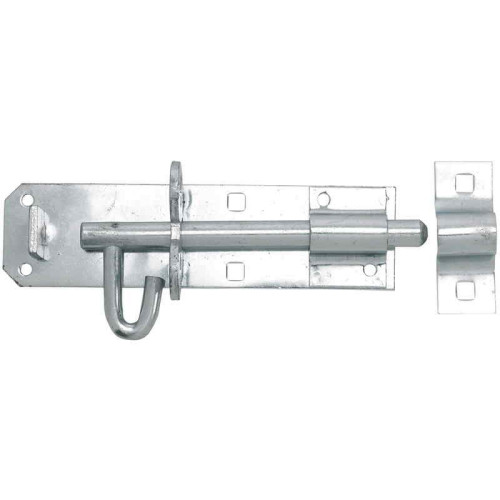
- A 150mm pad bolt
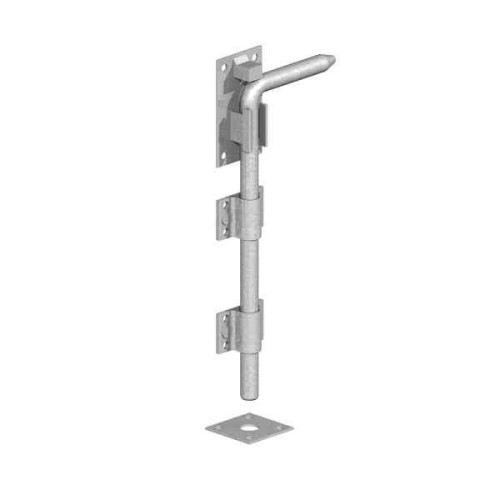
- A 300mm traditional door drop bolt
The individual tee hinges, ring latch and pad bolt use a bright zinc-plated finish.
The available gate furniture pack combines the main fittings required for a typical timber garden gate, including tee hinges, a ring latch and a padlock-able bolt.
What Gate Furniture Does A Basic Garden Gate Need?
A straightforward pedestrian timber gate will commonly require:
- A suitable pair of hinges
- A latch for everyday opening and closing
You may then add a bolt if:
- The gate needs locking
- You want additional restraint
- The gate needs securing when not regularly used
- Wind causes the gate to move against the latch
Do not add hardware simply because there is room for it.
Each fitting should have a purpose and should be positioned so it does not interfere with the gate frame or other components.
What Are Tee Hinges?
Tee hinges are commonly used on timber garden gates.
They consist of a long horizontal strap attached to the gate and a shorter vertical section fixed to the supporting post or frame.
The long strap spreads the load across a larger area of the gate.
This makes them well suited to traditional timber gates where the hinge strap can align with substantial horizontal framing.
Why Are Tee Hinges Common On Garden Gates?
A garden gate behaves differently from an ordinary fence panel.
A fence panel is supported continuously between posts.
A gate hangs from one side.
Its weight therefore creates leverage on:
- The hinges
- The gate frame
- The hinge post
- The post foundation
A long tee hinge helps distribute some of that load across the gate frame instead of concentrating it around a small hinge plate.
Are 450mm Tee Hinges Suitable For A Garden Gate?
They can be suitable for many ordinary pedestrian garden gates.
East Coast Fencing's current medium tee hinges have an approximate strap length of 450mm and are supplied as a pair.
However, hinge suitability should never be judged from length alone.
Also consider:
- Gate width
- Gate height
- Gate weight
- Frame construction
- Wind exposure
- Frequency of use
- Supporting post strength
A tall solid gate places greater demands on its fittings than a low open gate.
How Long Should Garden Gate Hinges Be?
The hinge strap needs to engage with substantial gate framing.
It should not simply be screwed through a thin outer board because that board may not be designed to carry the full weight of the gate.
When selecting hinge length, assess how the strap will sit against the gate.
Look for:
- A substantial ledge or rail
- Enough fixing positions
- Clearance from braces
- Enough room for the hinge to sit flat
Where Should Tee Hinges Be Fixed?
The hinge straps should normally align with substantial horizontal framing within the gate.
This allows the load to transfer into the gate structure rather than relying on decorative facing timber.
Avoid fixing the main hinge only through:
- Thin Feather Edge boards
- Picket pales
- Decorative slats
- Light trellis components
The visible boards form the gate's appearance, but the frame should carry the load.
Should A Garden Gate Have Two Hinges?
Many ordinary pedestrian timber gates use two appropriately sized hinges.
The upper hinge carries a large proportion of the force trying to pull the gate away from the post, while the lower fitting helps maintain alignment.
What matters is that the hinges are suitable for the gate rather than simply meeting a particular number.
Should A Heavy Garden Gate Have Three Hinges?
A third hinge may be considered for some tall, heavy or heavily used gates.
However, adding another small hinge does not correct:
- An undersized gate post
- A weak gate frame
- Incorrectly positioned main hinges
- A failing post foundation
The whole support system needs to work together.
Which Hinge Should Go At The Top?
Where a matching pair of tee hinges is used, position each hinge so it fixes securely into suitable gate framing.
Accurate alignment matters.
Misaligned hinge pins can cause:
- Binding
- Stiff operation
- Uneven wear
- The gate trying to twist as it opens
Do not position hinges purely by eye.
What Is A Ring Latch?
A ring latch is a traditional gate-closing fitting operated using a circular handle.
Turning the ring operates the latch mechanism so the gate can be opened.
Many ring latch designs allow operation from both sides of the gate, making them particularly practical for frequently used pedestrian access.
The current East Coast Fencing ring latch measures approximately 150mm.
When Is A Ring Latch A Good Choice?
Ring latches work well where you want convenient everyday access rather than a permanently locked gate.
They are particularly suited to:
- Side gates
- Rear garden entrances
- Picket gates
- Feather Edge gates
- Decorative timber gates
The latch should operate smoothly without needing the gate to be lifted or forced into position.
Does A Ring Latch Lock A Garden Gate?
A standard ring latch should primarily be considered a closing mechanism rather than a high-security lock.
If the gate needs to be secured against unauthorised access, additional lockable hardware may be required.
A pad bolt can provide a separate point of restraint where the design permits a padlock.
What Is A Pad Bolt?
A pad bolt is a sliding metal bolt fitted across the gate and closing post or frame.
The bolt slides into a keeper to hold the gate shut.
Many designs include a provision for adding a padlock.
The current East Coast Fencing pad bolt measures approximately 150mm.
What Is A Pad Bolt Used For?
A pad bolt can provide:
- Additional gate restraint
- A lockable closing point
- A secondary closure alongside a latch
- A simple way to secure a gate when access is not required
It is particularly useful on side and rear gates where the homeowner wants the convenience of a normal latch plus the option to secure the gate more firmly.
Is A Pad Bolt Better Than A Ring Latch?
They perform different jobs.
A ring latch is convenient for everyday opening and closing.
A pad bolt provides stronger deliberate restraint and may permit the use of a padlock.
| Feature | Ring Latch | Pad Bolt |
|---|---|---|
| Everyday access | Very convenient | More deliberate operation |
| Automatic closure when gate swings shut | Possible with correct alignment | No |
| Padlock facility | Not normally its main purpose | Often available |
| Secondary restraint | Limited | Good |
Can You Use A Ring Latch And Pad Bolt Together?
Yes.
This is a practical arrangement for many garden gates.
The ring latch handles normal daily access.
The bolt can then be engaged when:
- The garden is left unattended
- The gate should not be opened casually
- Additional restraint is useful
The two fittings should be positioned so that they do not interfere with each other's operation.
What Is A Drop Bolt?
A drop bolt moves vertically rather than horizontally.
It is commonly used to secure a gate or door into a suitable receiver below.
The current East Coast Fencing range includes a 300mm traditional door drop bolt.
When Is A Drop Bolt Useful?
A drop bolt can be useful where a gate leaf needs firm restraint in a particular position.
Applications depend on the gate arrangement, but the principle is straightforward: the bolt drops down into a suitable receiving point.
The receiver needs to be:
- Correctly aligned
- Secure
- Positioned where it will not become constantly blocked with soil or debris
What Is The Difference Between A Pad Bolt And A Drop Bolt?
A pad bolt normally slides horizontally into a keeper.
A drop bolt operates vertically.
This affects where each fitting is useful.
| Fitting | Movement | Typical Role |
|---|---|---|
| Pad bolt | Horizontal | Additional closure and possible padlocking |
| Drop bolt | Vertical | Holding a gate leaf securely in position |
What Is A Gate Furniture Pack?
A gate furniture pack combines several fittings required for a typical gate installation.
The current East Coast Fencing pack includes:
- Two 450mm tee hinges
- A 150mm ring latch
- A padlock-able bolt
This can simplify purchasing when those components suit the gate being installed.
Is A Gate Furniture Pack Suitable For Every Gate?
No.
Convenience does not remove the need to check suitability.
Before choosing a pack, consider:
- Gate dimensions
- Gate weight
- Gate construction
- Hinge strap position
- Supporting post
- Exposure
A pack designed around ordinary garden gates should not automatically be assumed suitable for an unusually wide or heavy gate.
What Does BZP Mean On Gate Furniture?
BZP means bright zinc plated.
The zinc coating helps provide corrosion resistance to the steel fitting.
It is commonly used on outdoor ironmongery.
Outdoor exposure still means fittings should be inspected periodically.
Can Bright Zinc-Plated Gate Furniture Rust?
It can eventually show corrosion if the protective coating becomes worn, damaged or heavily exposed.
Pay particular attention to:
- Scratched areas
- Hinge pins
- Fixing holes
- Moving latch parts
- Areas that remain wet
Coastal and persistently damp environments can be more demanding for metal fittings.
Which Gate Furniture Is Best For A Feather Edge Gate?
Feather Edge gates are solid timber gates, so their weight and wind resistance deserve careful consideration.
A typical arrangement may use:
- Suitable tee hinges
- A ring latch
- A pad bolt where additional security is wanted
The hinge straps should fix through the substantial gate frame rather than relying on the individual Feather Edge boards.
Which Gate Furniture Is Best For A Picket Gate?
Picket gates are more open and are often lower than solid privacy gates.
A pair of suitable tee hinges and a ring latch can provide a straightforward traditional arrangement.
A pad bolt can be added if the entrance needs to be lockable.
Because picket gates are open, avoid fixing hinges only to the individual pales. Use the gate framing.
Which Gate Furniture Is Best For A Decorative Gate?
The same functional principles apply:
- Hinges carry the gate
- A latch provides normal closure
- A bolt provides additional restraint where required
The challenge with a decorative gate is often finding suitable fixing positions that do not interfere with the design.
Plan hardware positions before drilling the timber.
Does A Heavier Gate Need Stronger Hinges?
Yes.
Gate weight directly affects the load carried by the hinges and hinge post.
A heavy gate can cause undersized fittings to:
- Loosen
- Bend
- Wear prematurely
- Allow the gate to sag
However, stronger hinges alone will not solve a weak gate post.
Why Does Gate Width Matter?
As a gate gets wider, its centre of mass moves farther away from the hinge post.
This increases leverage on the hinges and supporting post.
That means two gates of similar weight can still place different loads on their fittings if one is considerably wider.
Why Does A Solid Gate Need More Support?
A solid gate has more timber and can catch more wind than an open gate.
Wind can push or pull repeatedly against:
- The hinges
- The latch
- The gate post
This is particularly relevant for exposed side passages and boundaries.
Why Are Gate Posts So Important?
Gate furniture can only work properly if the post holding it remains stable.
A hinge post that moves even slightly can cause the opposite edge of the gate to:
- Drop
- Drag on the ground
- Miss the latch
- Rub against the closing post
Choose a suitably substantial gate post for the size and weight of the gate.
Can You Hang A Garden Gate From An Ordinary Fence Post?
Sometimes a suitable substantial timber fence post may be capable of supporting a light gate, but do not assume every fencing post is appropriate.
Gates impose moving and cantilevered loads that fixed fence panels do not.
Where a gate is planned, it is better to design the supporting posts around the gate rather than trying to adapt an undersized post afterwards.
Can You Hang A Gate From A Concrete Fence Post?
Concrete fence posts are less straightforward to use for conventional gate furniture than timber posts.
Drilling can encounter reinforcement or damage the post.
A suitably substantial timber gate post or another purpose-designed arrangement is generally easier to work with.
Do not casually drill reinforced concrete posts to attach gate hinges.
Can You Hang A Garden Gate From A Wall?
Potentially, but the wall needs to be capable of carrying repeated moving load.
Before using masonry as a gate support, consider:
- Brick or block condition
- Whether the surface is only render
- Suitable masonry fixings
- Gate weight
- Gate width
- Repeated opening and closing
A weak garden wall or loose brick pier should not automatically be treated as a gate post.
Which Way Should A Garden Gate Open?
Choose the opening direction before fitting the hinges and latch.
Consider:
- Available garden space
- Paths
- Steps
- Bins
- Planting
- The direction people normally approach from
- Ground slope
- Wind exposure
Changing the opening direction after installing the furniture can require substantial reworking.
Should A Garden Gate Open Inwards Or Outwards?
There is no single best direction for every garden.
Inward opening can work well where the outside of the gate leads to a path or access route and there is enough room inside the garden.
Outward opening may be useful where internal space is restricted, provided the gate can open safely without obstructing access.
Does A Sloping Path Affect Gate Furniture?
Yes.
The hinges may function perfectly while the bottom of the gate strikes rising ground.
Before choosing the opening direction, swing an imaginary gate through its full arc and consider the ground level underneath.
You may need:
- More ground clearance
- A different opening direction
- A different gate position
How Much Clearance Does A Garden Gate Need?
A timber gate needs enough space to move without scraping the posts, paving or ground.
Allowances depend on:
- Hinge type
- Gate width
- Post alignment
- Timber movement
- Ground level
Do not build the opening exactly the same width as the gate and assume the ironmongery will somehow fit around it.
Should You Measure The Gate Before Buying The Furniture?
Yes.
Record:
- Gate width
- Gate height
- Frame positions
- Hinge-side construction
- Closing-side construction
- Post dimensions
This lets you identify where each fitting will actually be mounted.
Should You Fit The Hinges Before The Latch?
Usually, it makes sense to hang and align the gate before finalising the latch position.
The latch needs to meet its keeper accurately when the gate is resting naturally on its hinges.
If the latch is installed first, even a small difference in final gate position can create poor alignment.
How Do You Position A Ring Latch?
Choose a comfortable operating height and make sure the latch mechanism aligns with suitable solid timber.
The keeper on the closing post must match the latch accurately.
If the gate has to be:
- Lifted
- Pushed down
- Forced sideways
to make the latch engage, correct the alignment rather than accepting it as normal.
Where Should A Pad Bolt Be Fitted?
Fit the pad bolt where:
- It reaches a sound keeper
- It does not interfere with the latch
- There is substantial timber behind the fixings
- It is practical to operate
If a padlock will be used, make sure there is enough clearance to fit and remove it comfortably.
Should A Bolt Be At The Top Or Bottom Of A Gate?
The correct position depends on its purpose and design.
A horizontal pad bolt is commonly fitted at a practical hand-operated height.
A vertical drop bolt naturally operates towards a receiver below.
Do not place frequently used hardware where it is unnecessarily awkward to reach.
What Fixings Should Be Used For Gate Furniture?
Use exterior fixings suitable for:
- The fitting
- The gate timber
- The supporting post
- The expected load
Gate hardware is repeatedly loaded, so fixing quality matters.
A strong hinge secured with unsuitable screws remains a weak installation.
Should You Use Every Fixing Hole In A Tee Hinge?
The available fixing holes are there to spread load through the fitting.
Use an appropriate fixing arrangement that secures the hinge properly into substantial framing.
Do not deliberately omit most fixing points simply to make installation quicker.
Should You Pre-Drill A Timber Gate?
Pre-drilling can be useful when fitting substantial screws, particularly near timber edges and ends.
It can help:
- Reduce splitting
- Improve screw positioning
- Keep hinge straps accurately aligned
Select the pilot hole according to the fixing and timber being used.
Can Gate Furniture Be Fitted Into Feather Edge Boards?
Do not rely on the Feather Edge board itself as the main support for a hinge.
The hinge should connect to the structural gate frame behind the boards.
The same principle applies to other decorative facing materials.
Can Gate Furniture Be Fitted Into Picket Pales?
The main load-bearing hardware should fix into the gate frame rather than depending only on an individual pale.
Pales are visible fencing components, not necessarily structural hinge rails.
How Do You Keep A Garden Gate Level While Fitting Hinges?
Support the gate at the correct finished height while positioning the hinges.
Use suitable blocks or temporary supports so the gate does not need to be held manually while measurements are taken.
Check:
- Top clearance
- Bottom clearance
- Hinge-side gap
- Latch-side gap
- Gate level
before drilling final fixing holes.
Why Does A Gate Sag After Installation?
Common causes include:
- A weak hinge post
- Insufficient gate bracing
- Undersized hinges
- Loose hinge fixings
- Fixings installed only into thin boards
- Timber movement
Identify the actual cause before moving the latch to compensate.
Should You Move The Latch If A Gate Starts Sagging?
Not as the first response.
Moving the latch lower may make a sagging gate close temporarily, but it does not correct the reason the gate dropped.
Inspect:
- Hinge screws
- Hinge condition
- Gate frame
- Gate bracing
- Hinge post movement
Repair the underlying fault before realigning the latch.
Why Does A Gate Latch Stop Lining Up?
A latch that previously worked but no longer meets its keeper can indicate:
- Gate sag
- Post movement
- Loose hinges
- Seasonal timber movement
- A loose keeper
Check the complete gate rather than adjusting one component blindly.
Why Does A Garden Gate Rattle In The Wind?
Rattling commonly occurs when there is movement between the latch and keeper.
Possible causes include:
- Excessive clearance
- Loose gate furniture
- Post movement
- Gate movement
A correctly positioned bolt may provide additional restraint where appropriate, but first confirm that the gate itself is properly aligned.
Can A Pad Bolt Help Stop A Gate Blowing Open?
Yes, when engaged it can provide additional restraint.
However, a gate repeatedly being forced by wind may also indicate that:
- The latch is unsuitable
- The gate needs stronger support
- The hinges are loose
- The installation is unusually exposed
Do not rely on one small fitting to compensate for a structurally inadequate gate installation.
Can Gate Furniture Improve Security?
Yes, but security depends on the complete gate.
A padlock-able bolt is only as useful as:
- The gate frame
- The gate post
- The bolt fixings
- The keeper
- The padlock
A heavy lock attached to weak timber does not create a strong security barrier.
Is A Ring Latch Secure Enough For A Side Gate?
A ring latch is convenient for everyday closure.
If preventing unauthorised access is important, consider whether an additional lockable fitting is appropriate.
The answer depends on how the gate is used and what level of restraint is required.
Can Garden Gate Furniture Be Used Around Children?
Gate hardware should be installed so that it operates safely and consistently.
Check for:
- Sharp protruding fixings
- Pinch points
- Loose fittings
- A gate that can swing unexpectedly
If a gate performs a genuine child-safety function, ordinary garden gate furniture should not automatically be assumed to meet specialist safety requirements.
What Gate Furniture Is Best If You Have A Dog?
For an ordinary garden boundary, reliable closure is essential.
Choose a latch that:
- Engages consistently
- Cannot easily be pushed open by gate movement
- Works with the gate's actual alignment
A secondary bolt may be useful where additional restraint is needed.
Remember that containment also depends on the gate height and gap underneath.
Should Gate Furniture Match The Fence?
Gate furniture does not need to be visually identical to other fence fixings, but a coordinated finish can create a neater appearance.
Consider how the fittings work with:
- Gate timber
- Fence panels
- Posts
- Other visible ironmongery
Function should still take priority over appearance.
Should Gate Furniture Be Painted?
Do not automatically coat moving metal hardware with ordinary fence paint.
Paint can interfere with:
- Hinge movement
- Latch mechanisms
- Bolt operation
If a decorative metal coating is desired, it needs to be appropriate for the existing finish and the moving component.
Does Gate Furniture Need Maintenance?
Yes.
Check gate fittings periodically, particularly on frequently used gates.
Inspect:
- Hinge screws
- Hinge pins
- Latch alignment
- Bolt movement
- Keepers
- Signs of corrosion
Small adjustments made early can prevent larger gate problems later.
How Often Should You Check Gate Hinges?
There is no need for a complicated maintenance schedule.
Check them whenever you notice:
- Gate movement
- Squeaking
- Dragging
- Difficulty latching
- Loose screws
It is also sensible to inspect the gate after severe weather.
Should Gate Hinges Be Lubricated?
Some hinge designs can benefit from appropriate lubrication at moving contact points.
Use a product suitable for the fitting and avoid coating surrounding timber unnecessarily.
If the hinge is stiff because it is bent or badly aligned, lubrication will not correct the structural problem.
What Causes Rust Around Gate Fixings?
Outdoor metalwork is exposed to moisture and changing weather.
Corrosion can be encouraged by:
- Damage to protective coatings
- Persistent damp
- Salt exposure
- Standing water
Inspect rust early rather than waiting for a hinge or bolt to become difficult to operate.
Can You Replace Gate Furniture Without Replacing The Gate?
Yes, where the timber gate remains sound.
Replacing worn ironmongery can be worthwhile when:
- Hinges have worn
- A latch no longer operates reliably
- A bolt is damaged
- The gate is being refurbished
Inspect the fixing areas carefully before attaching replacement fittings.
Can New Hinges Use The Old Screw Holes?
Only if the holes remain sound and align correctly with the new fittings.
Repeated fixing into worn or enlarged holes can result in a weak connection.
If the old timber around the fixing point is damaged, the gate may need repair before new hardware is installed.
Should You Replace Both Hinges At The Same Time?
If one hinge is badly worn, inspect the other closely.
A matching pair often shares the same age, loading and weather exposure.
Replacing both may produce more consistent operation, but sound fittings do not need to be discarded without reason.
Can You Upgrade A Ring Latch Without Changing The Hinges?
Yes.
The latch and hinges perform separate functions.
If the gate hangs correctly but the closing hardware is worn or unsuitable, the latch can potentially be replaced independently.
Can You Add A Pad Bolt To An Existing Gate?
Yes, where there is suitable timber and a suitable keeper position.
Before fitting it, check:
- The gate closes correctly
- The bolt can align naturally
- There is enough structural timber behind the fixings
- The fitting does not interfere with the latch
Can You Fit New Gate Furniture To An Old Gate?
Yes, if the gate itself remains structurally sound.
Check:
- Gate frame
- Braces
- Boards or pales
- Hinge-side timber
- Gate post
New metalwork will not solve a gate frame that is already loose or rotten.
When Should You Replace The Gate Instead?
Replacement may be more sensible where:
- The frame is significantly rotten
- The gate is badly twisted
- Several structural joints have failed
- Hinge fixings no longer have sound timber to grip
Ironmongery works best when attached to a structurally sound gate.
How Do You Measure For Replacement Gate Furniture?
Do not assume the old fitting size was necessarily correct.
Measure:
- Existing hinge strap length
- Available gate frame width
- Position of horizontal rails
- Latch position
- Keeper position
- Available bolt fixing area
Then choose replacement hardware that suits the gate as it exists now.
What Should You Check Before Buying Gate Furniture?
| Check | Why It Matters |
|---|---|
| Gate width | Affects leverage on hinges |
| Gate weight | Determines support required |
| Gate framing | Determines suitable fixing positions |
| Gate post | Must resist repeated moving load |
| Opening direction | Changes hinge and latch arrangement |
| Security requirement | Determines whether a bolt or lockable fitting is needed |
| Exposure | Wind can increase stress on solid gates |
Common Garden Gate Furniture Mistakes
- Choosing hinges purely by appearance
- Using hinges that are too small for the gate
- Fixing hinge straps only into thin facing boards
- Hanging a heavy gate from a weak fence post
- Fitting the latch before the gate has been properly aligned
- Moving the latch repeatedly instead of correcting gate sag
- Using unsuitable indoor fixings outside
- Installing a bolt where there is no substantial timber behind it
- Ignoring the direction the gate needs to open
- Forgetting clearance over sloping ground
- Assuming a hardware pack suits every gate
- Adding a strong lock to a structurally weak gate
- Ignoring loose screws until the gate has dropped significantly
- Drilling reinforced concrete fence posts without an appropriate fixing method
Garden Gate Furniture Buying Checklist
- Measure the gate width and height.
- Assess the approximate gate weight and construction.
- Identify substantial framing for the hinge straps.
- Check the hinge post is suitable and secure.
- Decide which direction the gate will open.
- Check the swing path for slopes, steps and obstructions.
- Select hinges appropriate to the gate.
- Choose a latch for everyday operation.
- Decide whether a lockable pad bolt is required.
- Consider whether a drop bolt suits the gate arrangement.
- Use exterior fixings suited to the fittings and timber.
- Plan fixing positions before drilling.
- Check hardware periodically after installation.
FAQs
What Is Garden Gate Furniture?
It is the ironmongery used to hang, operate and secure a garden gate, including hinges, latches and bolts.
What Does A Garden Gate Need?
Most pedestrian timber gates need suitable hinges and a latch. A pad bolt or other securing fitting can be added where additional restraint or lockable security is required.
What Hinges Are Best For A Timber Garden Gate?
Tee hinges are commonly used because their long straps can spread the load across substantial gate framing.
Are 450mm Tee Hinges Suitable For A Garden Gate?
They may suit many ordinary pedestrian gates. Suitability also depends on the gate's width, weight, frame, post and exposure.
How Many Hinges Does A Garden Gate Need?
Many ordinary garden gates use two suitable hinges. A tall or heavy gate may require a different arrangement depending on its construction and hardware.
Does A Heavy Gate Need Three Hinges?
Sometimes a third hinge may be appropriate, but it does not compensate for undersized main hinges, a weak frame or an inadequate gate post.
Where Should Tee Hinges Be Fixed?
Fix them into substantial gate framing rather than relying only on thin boards, pales or slats.
What Is A Ring Latch?
A ring latch is a traditional gate-closing mechanism operated by turning a ring handle.
Can A Ring Latch Open From Both Sides?
Many ring latch arrangements allow operation from both sides, depending on the specific design and installation.
Does A Ring Latch Lock A Gate?
It is primarily an everyday closing mechanism. If lockable security is required, an additional suitable fitting may be needed.
What Is A Pad Bolt?
A pad bolt is a horizontal sliding bolt that holds a gate closed and may include provision for a padlock.
Can You Use A Pad Bolt With A Ring Latch?
Yes. The latch can provide everyday access while the bolt provides additional restraint when required.
What Is A Drop Bolt?
A drop bolt operates vertically into a suitable receiver and can be used to hold a gate securely in position.
What Is The Difference Between A Pad Bolt And A Drop Bolt?
A pad bolt normally slides horizontally into a keeper, while a drop bolt moves vertically.
What Comes In A Gate Furniture Pack?
The current East Coast Fencing pack includes two 450mm tee hinges, a 150mm ring latch and a padlock-able bolt.
Is A Gate Furniture Pack Suitable For Every Gate?
No. Check the gate's dimensions, weight, frame, post and exposure before selecting the hardware.
What Does BZP Mean?
BZP means bright zinc plated, a finish used on steel fittings to improve corrosion resistance.
Can BZP Gate Furniture Rust?
It can eventually corrode if the coating becomes damaged or is subjected to demanding conditions, so outdoor fittings should still be inspected periodically.
What Gate Furniture Should I Use On A Feather Edge Gate?
Suitable tee hinges and a ring latch provide a common arrangement, with a pad bolt added where additional security or restraint is required.
What Gate Furniture Should I Use On A Picket Gate?
A pair of suitable tee hinges and a latch commonly work well. A bolt can be added where lockable closure is required.
Do Decorative Gates Need Different Hinges?
The hinges still need to suit the gate's size, weight and frame. Decorative construction can affect where the fittings can be positioned.
Can I Hang A Garden Gate From A Fence Post?
Only if the post is sufficiently substantial and securely installed for the gate. Gates place more demanding moving loads on posts than fixed fence panels.
Can I Hang A Gate From A Concrete Fence Post?
It is less straightforward than using a timber gate post. Avoid casually drilling reinforced concrete posts without confirming an appropriate method.
Can I Hang A Garden Gate From A Wall?
Potentially, provided the masonry and fixing arrangement are capable of carrying the gate's repeated load.
Should A Garden Gate Open Inwards?
It can, but choose the direction according to available space, paths, ground levels, access and other obstructions.
How Much Clearance Does A Garden Gate Need?
Enough to open smoothly without scraping the posts, paving or ground while allowing for normal timber movement.
Why Is My Gate Sagging?
Possible causes include a moving gate post, loose hinges, weak fixings, inadequate bracing or worn gate framing.
Should I Move The Latch If My Gate Sags?
Not before checking why the gate has dropped. Correct the hinge, frame or post problem first.
Why Does My Gate Latch Not Line Up?
Gate sag, post movement, loose hinges, timber movement or a loose keeper can all cause latch misalignment.
Can A Pad Bolt Stop A Gate Blowing Open?
When engaged, it can provide additional restraint, but repeated wind problems may also indicate weak hinges, posts or an unsuitable latch arrangement.
Can A Garden Gate Be Locked?
Yes. A suitable pad bolt or other lockable arrangement can provide additional security where required.
Can I Add A Pad Bolt To An Existing Gate?
Yes, provided there is sound timber for the fixings and the bolt can align properly with a suitable keeper.
Can I Replace Gate Furniture Without Replacing The Gate?
Yes, if the timber gate and supporting posts remain structurally sound.
Should I Replace Both Gate Hinges Together?
Inspect both. A matching worn pair may be worth replacing together, but a sound fitting does not need replacement solely because the other has failed.
Does Gate Furniture Need Maintenance?
Yes. Check hinges, screws, latch alignment, bolts and signs of corrosion periodically and after severe weather.
Can Gate Hinges Be Lubricated?
Some moving hinge components may benefit from a suitable lubricant, but lubrication will not correct bent or badly aligned fittings.
What Is The Most Important Part Of Garden Gate Furniture Installation?
Matching the hardware to a sound gate frame and suitably substantial supporting post is more important than simply choosing the largest or most expensive fitting.
Which Garden Gate Furniture Should You Choose?
Start with the gate rather than the ironmongery.
Look at its width, weight, height and frame construction. Then check the post that will carry it.
For many ordinary pedestrian timber gates, a suitable pair of tee hinges and a ring latch provide the basic components needed for smooth everyday operation.
If the gate also needs additional restraint or the ability to accept a padlock, add an appropriate pad bolt. A drop bolt can be useful where the gate arrangement requires vertical restraint.
Do not rely on the visible boards to carry the fittings. Hinges and security hardware should connect to substantial timber within the gate frame.
Likewise, do not try to solve a weak post by fitting increasingly heavy ironmongery. The gate, hinges, latch, bolts, post and fixings all form one system.
When those components are matched correctly, the result should be simple: the gate remains level, swings freely and closes without needing to be lifted, kicked or forced into position.