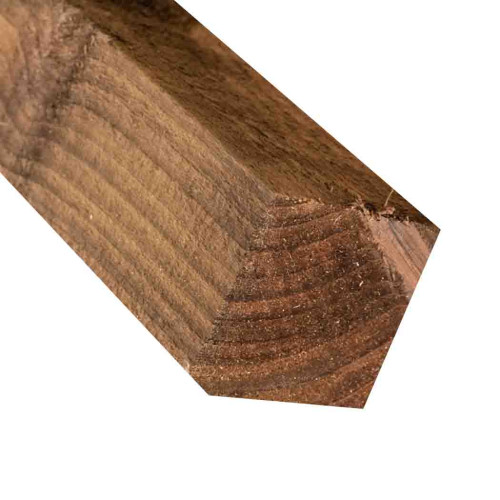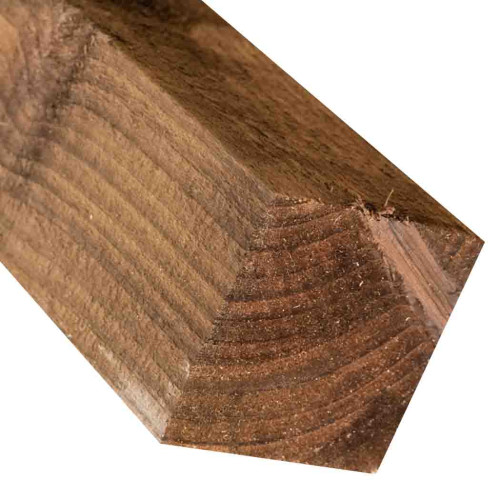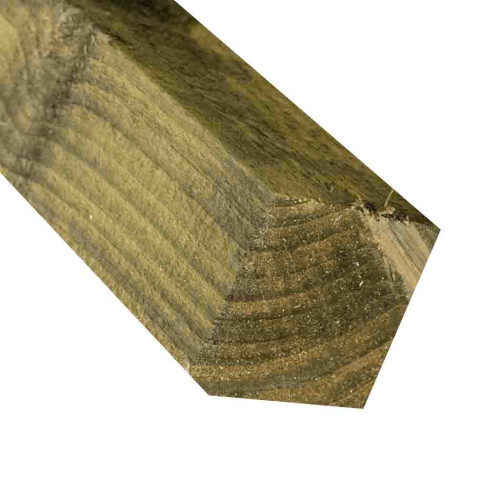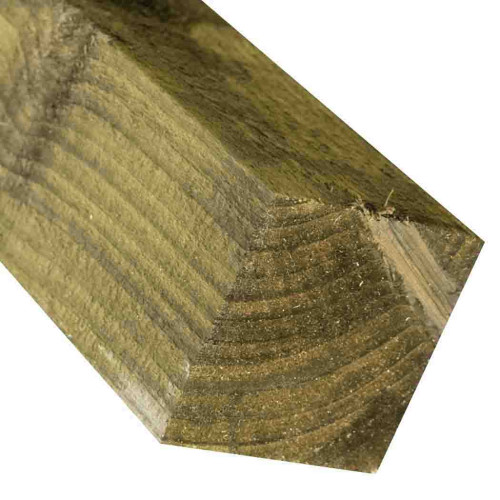




Quick answer: Yes, pressure-treated wooden fence posts can be cut to length. If the post will be installed directly in the ground, keep the factory-treated ground-contact end intact where possible and shorten the post from the top. Freshly exposed timber should receive a suitable cut-end preservative where required. Cutting a post changes its length, not its structural section, so a 75 x 75mm post does not become suitable for a heavier fence simply because you started with a longer piece.
Wooden fence posts rarely arrive at exactly the finished height required for every garden.
Ground levels vary. Fence panels come in several heights. Gravel boards change the overall fence height. Trellis can add another section above the main panel.
It is therefore normal to need some adjustment.
The important question is not simply whether a pressure-treated fence post can be cut. It is where to make the cut, what the cut means for the treatment, and whether you selected the correct post in the first place.
East Coast Fencing's current wooden fence post range includes common 75 x 75mm and 100 x 100mm sections in 1.8m, 2.4m and 3.0m lengths. Choosing the closest suitable combination before installation usually produces a better result than buying an unsuitable post and relying on extensive cutting afterwards.
Can You Cut A Pressure-Treated Wooden Fence Post?
Yes.
A normal pressure-treated softwood fence post can be cross-cut using suitable woodworking tools.
Cutting may be required when:
- The supplied post is slightly taller than the required finished height
- The ground level changes along the fence
- A stepped fence needs different visible post heights
- The post is being used with lower fence panels
- You need a neat finished top line
- A standard post length is the closest practical size for the project
What matters is that the alteration does not undermine the reason you selected that post.
If a fence requires a substantial 100 x 100mm post with enough length below ground, cutting should only remove genuinely surplus timber. It should not reduce the installation depth merely to make the post easier to handle.
Should You Cut The Top Or Bottom Of A Fence Post?
If a pressure-treated wooden post will be installed directly into the ground, it is generally better to retain the factory-treated end intended for ground contact and make necessary shortening cuts at the top.
This is particularly important because the buried section of a timber post experiences demanding conditions.
It can be exposed to:
- Soil moisture
- Rainwater moving through the ground
- Periods of poor drainage
- Changing wet and dry conditions
Cutting the bottom exposes fresh timber at exactly the part of the post where dependable preservative protection matters most.
If shortening from the top is practical, that is normally the more sensible approach.
Why Does The Factory-Treated Ground End Matter?
Pressure treatment is carried out industrially. Preservative is driven into suitable timber under controlled conditions rather than simply brushed onto its visible surface.
Cutting through the post exposes timber that was previously inside the section.
A brush-applied cut-end product can provide useful local protection to that exposed area, but it does not recreate the original industrial pressure-treatment process throughout the timber.
That distinction matters most where the cut is going to be buried.
Where possible, leave the factory-treated lower end alone and remove excess length from the exposed top.
Do You Need To Treat The Cut End Of A Pressure-Treated Post?
Freshly cut surfaces should receive suitable cut-end protection where required by the treatment or product guidance.
This applies particularly to exposed end grain because timber can absorb moisture readily through cut ends.
Use a product intended for treating freshly cut exterior treated timber and follow its application instructions.
Do not assume that:
- Ordinary fence paint provides the same protection
- A decorative wood stain replaces preservative treatment
- The rest of the post being pressure treated means the new cut can be ignored
The aim is to protect the newly exposed area appropriately while recognising that cut-end treatment is not identical to the original pressure treatment.
Does Cut-End Preservative Restore The Original Pressure Treatment?
No.
This is an important distinction.
Pressure treatment forces preservative into suitable timber under controlled industrial conditions. Applying preservative with a brush to a sawn end provides local protection, but it does not reproduce the same penetration throughout the section.
This is another reason to minimise unnecessary cutting, especially to parts of posts intended for ground contact.
How Much Can You Cut Off A Wooden Fence Post?
There is no useful universal figure because the correct answer depends on the fence design.
Before cutting, calculate how much post is required for:
- The visible fence height
- Any gravel board
- Any trellis
- The desired amount of post above the fence
- The section installed below ground
Only the genuine surplus should be removed.
For example, if your fence design requires almost the full length of a 2.4m post, cutting 300mm off because it appears too tall before the post has been set could leave too little timber for the required below-ground support.
Measure the complete system first.
What If A Fence Post Is Too Long?
A post that is longer than necessary is usually straightforward to deal with.
First establish the finished height.
Then decide whether it is better to:
- Cut the post before installation
- Install it and mark the final height afterwards
Pre-cutting can make the post lighter and easier to handle. Cutting after the posts have been installed can make it easier to create a consistent top line, particularly where ground levels vary.
Whichever method you choose, make sure the installation depth has already been allowed for.
What If A Fence Post Is Too Short?
Cutting cannot solve a post that is too short.
If the selected post does not provide enough length for both the visible fence and its required support below ground, use a longer post.
Do not compensate by deliberately setting the post shallower simply because you have already bought it.
A fence post that is too short can contribute to:
- Movement in wind
- Leaning
- Loose panels
- Foundation failure
This is why post length should be chosen before digging starts.
Should You Buy 1.8m, 2.4m Or 3.0m Posts?
The appropriate length depends on the finished fence.
East Coast Fencing's current wooden post range includes 1.8m, 2.4m and 3.0m lengths in suitable 75 x 75mm and 100 x 100mm configurations.
| Post Length | Common Use | Before Cutting |
|---|---|---|
| 1.8m | Lower fencing, picket fencing and garden divisions | Check there is still sufficient length below ground |
| 2.4m | Many standard domestic fencing arrangements | Include gravel boards and total visible height in the calculation |
| 3.0m | Taller structures, changing levels and installations needing additional length | Do not buy it simply to remove a large section unnecessarily |
Using the closest appropriate standard length reduces waste and unnecessary alteration.
Can You Cut A 3m Fence Post Down To 2.4m?
Yes, physically you can.
But if the project only requires a standard 2.4m post, starting with a 2.4m product is normally more sensible.
Cutting 600mm from every 3.0m post means:
- More timber to purchase and handle
- More cutting
- More offcuts
- More freshly exposed ends to protect
A 3.0m post makes sense when its additional length solves an actual installation requirement, not merely because longer sounds better.
Can You Cut A 100 x 100mm Fence Post?
Yes.
A 100 x 100mm pressure-treated timber post can be cross-cut in much the same way as a smaller post, using tools appropriate for its section.
The larger size may require a saw with sufficient cutting capacity or cutting carefully from more than one face.
Its structural role still matters.
Current 100 x 100mm wooden posts provide a more substantial section than 75 x 75mm posts and are commonly considered where the fence is taller, heavier or more exposed.
Shortening the post does not change its 100 x 100mm section, but excessive shortening can still leave insufficient length for the installation.
Can You Cut A 75 x 75mm Fence Post?
Yes.
The same principles apply.
Current 75 x 75mm posts are commonly suited to lighter or lower fencing where that section is appropriate.
Cutting a 3.0m 75 x 75mm post shorter does not turn it into the structural equivalent of a 100 x 100mm post.
Length and section solve different parts of the fence design.
How Do You Make A Straight Cut Across A Fence Post?
Marking matters more than many people expect.
A visibly angled post top can make an otherwise straight fence look untidy.
A simple method is:
- Measure the required finished length carefully.
- Mark one face with a square.
- Continue the line around the remaining faces.
- Check that the marks meet accurately.
- Support the post securely before cutting.
- Make the cut with a suitable sharp saw.
- Protect the newly exposed timber as required.
Do not attempt to hold a heavy post in one hand while cutting it with the other.
Support it properly so the offcut cannot trap the blade or break away unpredictably.
Can You Cut Fence Posts After They Have Been Installed?
Yes.
In some installations this gives a neater result because you can establish the final top line after every post has been set.
This can be particularly useful on:
- Stepped fencing
- Slightly uneven ground
- Long straight runs
- Fences where consistent post projection matters visually
Mark each installed post from a string line or carefully established level rather than measuring independently from uneven ground at every position.
Take care not to damage completed panels, gravel boards or nearby surfaces while sawing.
Should Every Fence Post Finish At The Same Height?
Not necessarily.
On flat ground with identical panels, a consistent post top generally looks neat.
On a sloping garden, trying to force all post tops onto one horizontal line may produce awkward proportions.
A stepped fence may instead have posts that relate consistently to each individual panel.
The important thing is that the changes appear planned.
Set out the complete run before cutting several installed posts.
Can You Angle The Top Of A Wooden Fence Post?
Yes.
A sloping or shaped top can encourage rainwater to run away rather than remain on a completely flat surface.
However, decorative cutting exposes more fresh timber.
If you shape the top:
- Make clean cuts
- Avoid deep hollows that hold water
- Protect exposed timber appropriately
- Keep the shape consistent across visible posts
Another option is to retain a straightforward square-cut top and fit a suitable post cap.
Should You Fit A Post Cap After Cutting?
A post cap can provide both a visual finish and some protection to the exposed top of a wooden post.
It can help reduce direct rain exposure to the end grain and encourage water to shed away.
A post cap does not replace preservative treatment and does not solve moisture problems at the base of a fence post.
It is a finishing detail rather than a substitute for correct timber specification and installation.
Can You Notch A Pressure-Treated Fence Post?
Timber posts can be notched for some construction details, but removing material from the side of a post is different from simply shortening it.
A notch reduces the remaining structural section.
A substantial notch close to:
- Gate hinges
- Rail fixings
- Panel brackets
- High-load areas
can leave less timber available to resist the forces on the post.
Do not remove large sections merely to make incompatible components fit.
If the installation requires major alteration to the post, reconsider whether the components and fixing method are correctly specified.
Can You Drill Pressure-Treated Fence Posts?
Yes.
Wooden posts are commonly drilled for bolts, screws and other exterior fixings.
One advantage of timber posts over concrete is that they are straightforward to work with using normal woodworking equipment.
However, avoid unnecessary large holes or several fixings concentrated in a small area.
This is especially relevant with 75 x 75mm posts because there is naturally less timber surrounding a large fixing than there is in a 100 x 100mm section.
Use exterior-grade fixings suitable for the materials being joined.
Can You Cut A Twisted Fence Post Straight?
Shortening a twisted post does not normally correct the underlying twist.
Timber movement occurs through the section, so removing a small amount from one end is unlikely to make a visibly distorted post straight.
If a new post is significantly twisted before installation, assess whether it can still be used appropriately rather than trying to correct the problem by repeatedly cutting it.
Minor natural movement is different from a post that can no longer be installed plumb or provide suitable fixing faces.
Can You Cut The Rotten Part Off A Fence Post And Reuse It?
Usually not as a simple structural repair.
Rot at the base of a fence post is particularly significant because that is the part responsible for transferring the fence load into the ground and foundation.
Cutting away the rotten lower section leaves a shorter post and does not recreate the missing support.
Depending on the condition of the remaining timber, possible solutions may include:
- Replacing the post
- Using an appropriate concrete repair spur where the upper timber remains sound
- Rebuilding the affected fence bay
Do not bury a freshly shortened upper section and assume that a coat of preservative turns it into a new ground-contact post.
Can You Reuse Fence Post Offcuts?
Sound pressure-treated timber offcuts may be useful for suitable small garden jobs, blocking or temporary setting-out work.
Whether an offcut is appropriate depends on:
- Its dimensions
- Its treatment
- Whether it has been split or damaged
- Whether the proposed use is structural
- Whether it will be in ground contact
A short leftover section should not automatically be used as a structural post simply to avoid waste.
Dispose of treated timber that cannot be reused responsibly and in accordance with local waste guidance.
Should You Burn Pressure-Treated Timber Offcuts?
No.
Do not use treated fencing timber as firewood or burn offcuts on a garden bonfire.
Pressure-treated timber contains preservative chemicals intended to remain within the wood. Burning it is not an appropriate disposal method.
Keep treated timber offcuts separate from ordinary firewood and dispose of unwanted material responsibly.
What Safety Precautions Should You Take When Cutting Treated Posts?
Cutting any substantial timber post requires sensible precautions.
Use:
- Eye protection
- Suitable gloves when handling rough-sawn timber
- Appropriate dust protection when producing timber dust
- A stable work surface
- A sharp, suitable saw
Work in a well-ventilated area and avoid unnecessarily breathing sawdust.
Wash your hands after handling treated timber and before eating or drinking.
If using powered cutting equipment, follow the tool manufacturer's safety instructions and make sure the timber is supported securely.
Can You Cut A Fence Post To Make A Gravel Board Fit?
Be careful with the order of the calculation.
A gravel board adds to the visible height of the complete fence.
If you add a 150mm gravel board beneath a panel, the post needs to accommodate that additional 150mm as well as the panel and below-ground section.
The answer is normally not to shorten the post simply because the panel itself sits higher.
Instead, calculate:
panel height + gravel-board height + required post projection + below-ground length.
Then choose and cut the post accordingly.
What About Trellis Above The Fence?
Trellis should also be included before any posts are shortened.
Suppose you install the posts and cut them neatly just above the Fence Panels, then later decide to add 300mm of Fence Topper Trellis.
You may discover there is very little post remaining to support it properly.
If trellis is part of the planned fence, include it when choosing and cutting the posts from the start.
The same applies to Privacy Square Trellis, Horizontal Slatted Trellis and other full or partial screening arrangements.
Do Gate Posts Need Different Treatment When Cutting?
The same general treatment principles apply to timber Gate Posts, but the structural consequences of shortening them deserve additional attention.
A gate creates repeated leverage on its hinge post every time it opens and closes.
Current substantial East Coast Fencing timber Gate Posts are approximately 3.0m long with a 150 x 150mm section.
If a substantial gate post appears excessively long, calculate the required:
- Visible gate height
- Hinge positions
- Below-ground support
- Ground conditions
before removing material.
Do not shorten a gate post simply to match the length of ordinary neighbouring fence posts.
Common Mistakes When Cutting Wooden Fence Posts
- Cutting posts before calculating the complete fence height
- Forgetting to include gravel boards
- Forgetting planned trellis
- Cutting the ground-contact end unnecessarily
- Leaving fresh cut timber unprotected where treatment is required
- Assuming brush-on preservative recreates industrial pressure treatment
- Buying 3.0m posts when a suitable 2.4m option would avoid large offcuts
- Using a longer 75 x 75mm post instead of choosing a suitable 100 x 100mm section
- Setting a post too shallow after accidentally cutting it short
- Making every cut from uneven ground rather than establishing a consistent finished line
- Removing large notches to force unsuitable fittings to fit
- Burning treated timber offcuts
FAQs
Can You Cut Pressure-Treated 4x4 Fence Posts?
Yes. A nominal 4x4-style timber fence post can be cut to length. East Coast Fencing's substantial square timber post option is 100 x 100mm. Keep the factory-treated ground-contact end intact where possible and shorten from the top.
Can You Cut A Treated Fence Post With A Circular Saw?
Yes, provided the saw is suitable for the timber and used safely. Depending on the saw's cutting depth and the post section, a 100 x 100mm post may need to be cut accurately from more than one face.
Can You Use A Hand Saw To Cut A Fence Post?
Yes. A sharp hand saw can make a clean cross-cut through a wooden fence post, although a substantial 100 x 100mm section requires more effort than a 75 x 75mm post.
Do You Have To Treat The Top After Cutting A Fence Post?
Freshly exposed treated timber should receive suitable cut-end protection where required by the product or treatment guidance. A post cap may then provide an additional finishing detail and help shed rainwater.
Can You Cut The Bottom Off A Pressure-Treated Post?
It is physically possible, but avoid doing so where the bottom will be installed in the ground. Retaining the factory-treated ground-contact end and cutting from the top is generally preferable.
Can You Cut A Wooden Post After Concreting It In?
Yes. Cutting installed posts can make it easier to create a consistent finished top line. Mark carefully and protect nearby panels and surfaces while working.
Does Cutting A Pressure-Treated Post Make It Untreated?
No. The whole post does not suddenly become untreated, but the new cut exposes timber from inside the section. Protect that exposed area appropriately where required.
Can You Cut A 2.4m Post Into Two 1.2m Posts?
You can physically divide the timber, but the resulting pieces are not automatically suitable as ground-contact fence posts. One section will have a newly cut end and both pieces may be too short for the required installation. Choose posts according to their intended structural use rather than simply dividing lengths to minimise waste.
Choose The Right Length First, Then Cut Only What You Need
Pressure-treated wooden fence posts are straightforward to cut, which is one of the practical advantages of timber fencing.
That flexibility should still be used carefully.
Start by calculating the complete fence height, including the Fence Panel, Gravel Board, Trellis and intended post projection. Allow enough post for the required installation below ground. Then choose the closest suitable standard length and post section.
If shortening is necessary, keep the factory-treated ground-contact end intact wherever practical and cut from the top. Protect freshly exposed timber with suitable cut-end treatment where required.
Most importantly, do not use cutting to correct the wrong specification. A post that is too short cannot be made structurally suitable by installing it shallower, and a long 75 x 75mm post does not become equivalent to a 100 x 100mm post.
Choose the post for the fence first. Use the saw only for the final adjustment.