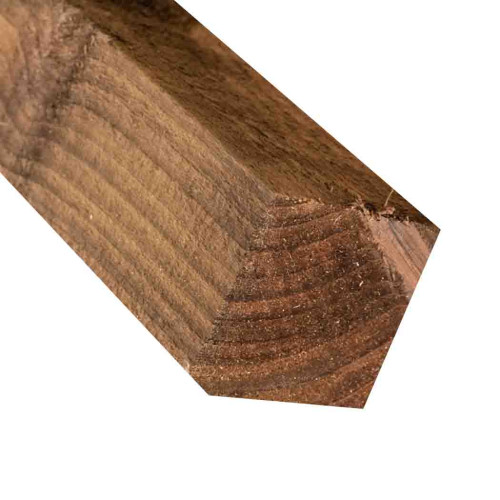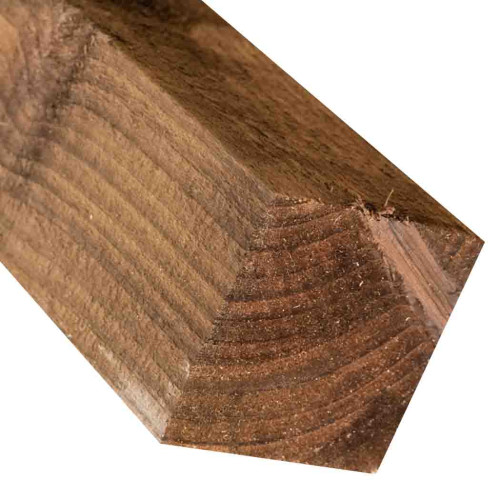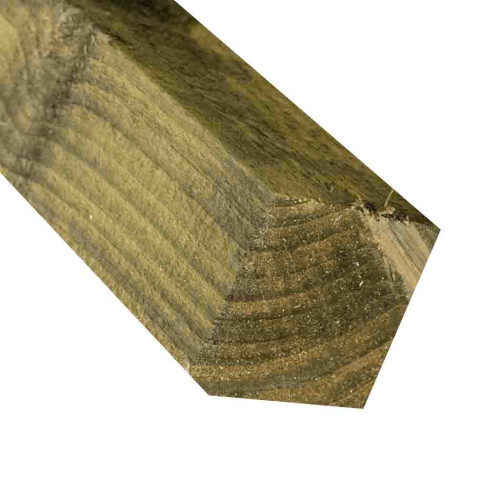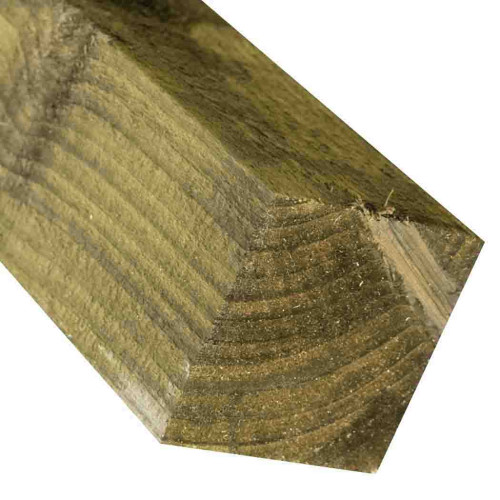




Quick answer: 75 x 75mm wooden fence posts are generally suited to lighter fencing, picket panels, trellis and lower garden boundaries. A 100 x 100mm post provides a more substantial section and wider fixing face, making it the better starting point for taller panels, heavier fencing and more exposed locations. Post section is only part of the decision. You must also choose enough overall post length for the required above-ground height and secure below-ground installation.
Choosing between a 75mm and 100mm wooden fence post can look like a small decision.
It is not.
The post is the structural support for everything fitted between it. Increasing the size of the fence panel without considering the posts can leave you with a boundary that looks substantial but relies on comparatively light supports.
At the same time, specifying the largest available post for every low fence or trellis project adds unnecessary bulk.
The sensible approach is to match the post section and length to the fencing, its height, the site and the loads the post will carry.
What Is The Difference Between 75mm And 100mm Fence Posts?
The numbers refer to the nominal square section of the timber.
- 75 x 75mm is commonly described as a 3 x 3-inch fence post.
- 100 x 100mm is commonly described as a 4 x 4-inch fence post.
A 100mm post is 25mm wider on each face than a 75mm post.
That does not sound dramatic until you compare the complete cross-section.
A 75 x 75mm section contains 5,625 square millimetres of cross-sectional area. A 100 x 100mm section contains 10,000 square millimetres.
That is approximately 78% more cross-sectional area.
This should not be interpreted as saying the post is automatically 78% stronger. Timber species, grade, defects, moisture, post length, foundations and loading all affect performance.
It does illustrate why the two posts should not be treated as interchangeable versions of the same product.
When Is A 75 x 75mm Fence Post Suitable?
A 75mm post is a useful general-purpose size for relatively light fencing.
Typical applications include:
- Picket Fence Panels
- Trellis Panels
- Lower garden boundaries
- Light timber screens
- Simple garden divisions
- Selected lighter fence panels in sheltered locations
The slimmer section keeps the post line less visually dominant.
This can be particularly useful with low Picket Fence Panels or open trellis where a very substantial post would look disproportionate to the fencing itself.
East Coast Fencing currently offers 75 x 75mm pressure-treated wooden fence posts in 1.8m, 2.4m and 3.0m lengths.
The availability of a long 75mm post does not mean the section automatically becomes suitable for every tall fence.
Length and section perform different jobs.
When Should You Choose A 100 x 100mm Fence Post?
A 100mm post provides a more substantial support and a broader face for fixing rails, panels and other timber components.
It is worth considering where the fence is:
- Taller
- Heavier
- More solid
- Installed in an exposed location
- Carrying substantial rails or panels
- Likely to experience greater wind loading
Current East Coast Fencing 100 x 100mm posts are available in the same main lengths of 1.8m, 2.4m and 3.0m.
This allows the section and overall length to be chosen separately.
For example, a 2.4m x 100mm post is not simply a longer version of a 1.8m x 75mm post. Both its length and its section have changed.
75mm vs 100mm Fence Posts At A Glance
| Consideration | 75 x 75mm Post | 100 x 100mm Post |
|---|---|---|
| Common Description | 3 x 3-inch | 4 x 4-inch |
| Appearance | Slimmer | More substantial |
| Typical Fencing | Light or lower fencing | Taller or heavier fencing |
| Picket Fencing | Often suitable | Useful where heavier support is wanted |
| Trellis | Often suitable for lighter screens | Consider for taller or heavily planted screens |
| Full-Height Solid Panels | Assess carefully | More substantial starting point |
| Exposed Garden | May be too light for some layouts | Often more appropriate |
| Current ECF Lengths | 1.8m, 2.4m and 3.0m | 1.8m, 2.4m and 3.0m |
What Size Fence Post Should You Use For A 6ft Fence?
Fence height alone is not enough to specify a post.
A 1.8m high boundary could use a solid Closeboard Fence Panel, a relatively open Hit & Miss panel, Double Slatted fencing or a combination of lower fencing and Trellis Panels.
Those arrangements present different loads.
For a full-height solid timber boundary, a 100 x 100mm wooden post is generally the more substantial option to consider.
You must then choose enough overall post length to provide both the required finished height and an appropriate amount of timber below ground.
A 1.8m-long post cannot support a 1.8m-high fence while also having a meaningful section buried in the ground.
This is why 2.4m posts are commonly relevant to full-height domestic fencing.
The exact installation still depends on ground conditions, fence design and exposure.
Is A 2.4m Fence Post Suitable For A 6ft Fence?
A 2.4m post gives considerably more installation flexibility than a 1.8m post when the visible fence is around 1.8m high.
It provides additional timber that can be divided between:
- The visible fence height
- The section below ground
- Any change in ground level
- The required finished post height
Do not work backwards from a rule that every fence post must have exactly the same amount buried.
Ground type, exposure, post section, fence type and foundation design all matter.
The important point is that the post must be long enough for both parts of the job.
When Would You Need A 3.0m Wooden Fence Post?
A 3.0m post gives additional length where 2.4m would leave insufficient timber.
That can be useful for:
- Changing ground levels
- Taller structures
- Installations needing greater below-ground allowance
- Selected fencing layouts where extra overall post length is required
A 3.0m post is not automatically better simply because it is longer.
Extra length adds weight and can create additional leverage when a greater amount remains above ground.
Match the post to the actual design rather than buying the longest available product and assuming that solves every structural question.
Can You Use 75mm Posts For Closeboard Fence Panels?
Potentially, but the complete fence needs assessing.
Closeboard Fence Panels create a relatively solid surface.
A full-height Closeboard panel therefore behaves very differently from a low Picket Fence Panel when exposed to wind.
East Coast Fencing manufactures standard and Ultra Heavy Duty Closeboard Fence Panels, with the heavier specifications using additional backing-rail support at selected heights.
Putting a substantial panel onto comparatively light posts can undermine the logic of choosing the heavier panel construction in the first place.
For tall or heavy Closeboard fencing, 100 x 100mm posts are usually the more logical timber size to consider.
That does not mean a 100mm post makes every Closeboard installation automatically suitable. Post depth, foundations, spacing and site exposure still matter.
What About Waney Lap Fence Panels?
Waney Lap Fence Panels are generally lighter than substantial Closeboard panels.
That may make a 75mm post suitable for some sheltered or lower installations.
For taller Waney Lap boundaries, exposed gardens or situations where a more substantial support is preferred, a 100mm post may still be the better choice.
Do not choose the post solely because the panel itself feels relatively light when you pick it up.
Wind acts across the surface area of the installed fence, not simply on its lifting weight.
What Size Post Is Best For Picket Fence Panels?
Picket fencing is one of the clearest applications for 75 x 75mm posts.
Current East Coast Fencing Picket Fence Panels are approximately 1.83m wide and available in nominal heights around:
- 0.6m
- 0.9m
- 1.2m
The open spaces between the pales also mean the panel does not form the same continuous surface as solid privacy fencing.
A 75mm post can therefore provide a proportionate support for many normal picket installations.
A 100mm post may still be chosen where the fencing is particularly exposed, where a heavier appearance is wanted or where other parts of the installation require more fixing area.
What Size Post Is Best For Trellis?
Light Trellis Panels can often be supported by 75 x 75mm posts.
The decision becomes more complicated once climbing plants are added.
A bare trellis panel may be relatively open.
Several years later it may be carrying:
- Dense foliage
- Woody stems
- Wet leaves
- Additional wind resistance
A taller privacy screen or heavily planted trellis may therefore justify a more substantial post than a small decorative panel.
Think about what the structure may eventually support rather than only how light the trellis feels on installation day.
Do Decorative Fence Panels Need 100mm Posts?
Not automatically.
Decorative Fence Panels differ considerably in construction.
Current Double Slatted, Hit & Miss and Omega Lattice Fence Panels use substantial 45 x 45mm outer frames but contain different arrangements of slats and openings.
The amount of airflow through each design varies.
Post choice should consider:
- Panel height
- Panel weight
- How open or solid the design is
- Garden exposure
- Post spacing
- The fixing method
A tall framed panel in an exposed garden may justify 100mm supports even where a smaller post would appear visually sufficient.
Should A Gate Use The Same Posts As The Fence?
Do not assume so.
A fence panel sits between supports.
A garden gate hangs from one side and repeatedly applies leverage to its hinge post every time it is opened, closed or caught by wind.
This means the gate post may need to be more substantial than the posts used along the adjoining fence.
A 100 x 100mm post may suit some gate installations, but larger and heavier gates can require dedicated gate posts with substantially larger sections.
Choose the gate and its supporting posts together rather than building the fence first and treating the gate as another panel-sized opening.
Does A 100mm Post Hold Screws Better Than A 75mm Post?
A 100mm post provides a wider timber section and more material around the fixing area.
That can be useful where rails, brackets or substantial panels need secure fixing.
Fixing performance still depends on:
- Screw diameter
- Screw length
- Edge distance
- Timber condition
- Pre-drilling where appropriate
- The load being carried
Do not compensate for an undersized or damaged post by simply installing larger screws.
Does A Bigger Fence Post Always Last Longer?
No.
Section size and durability are separate questions.
A 100mm post contains more timber than a 75mm post, but either can deteriorate if installed badly or exposed to unsuitable conditions.
Current East Coast Fencing wooden fence posts are pressure treated to improve resistance to fungal decay, rot and insect attack.
Pressure treatment does not make the post waterproof.
Ground conditions, drainage, treatment specification, installation quality and physical damage all remain important.
Are Brown And Green Fence Posts Structurally Different?
Treatment colour should not be used as a method of choosing structural post size.
Current 75mm and 100mm posts are available in brown and green or natural pressure-treated finishes across suitable products.
The colours mainly affect the initial appearance.
Choose the section and length for structural reasons first.
Then choose a treatment colour that coordinates with the Fence Panels, Timber or other visible components where appearance matters.
Do Windy Gardens Need Larger Fence Posts?
Exposure is an important reason to consider a larger post section.
A tall solid panel can act like a sail.
Wind force is then transferred through the panel fixings into the posts and ultimately into the foundations and surrounding ground.
In an exposed garden, consider the complete system:
- Fence Panel style
- Panel height
- Post section
- Post length
- Post spacing
- Foundation
- Ground strength
- Fixings
Choosing a 100mm post is useful only if the foundation and installation are also suitable.
Does An Open Fence Need Smaller Posts?
Not necessarily, although openness can reduce the amount of continuous surface presented to the wind.
Hit & Miss, Picket and some slatted designs allow more airflow than fully solid panels.
That is one factor in post selection, but it should not be considered in isolation.
A tall framed decorative panel can still be substantial in weight and size even if it includes openings.
Can You Mix 75mm And 100mm Posts In The Same Fence?
Technically, different sections can be used where the design genuinely requires them.
For example, a lightweight fence run might use one post size while an adjacent gate requires a more substantial support.
Randomly changing post size from bay to bay is less desirable.
It can create:
- An inconsistent appearance
- Different fixing positions
- Changes in post centres
- More complicated setting out
Decide the structure of the complete run before digging the first hole.
Does Fence Post Width Affect Your Fence Measurements?
Yes.
A wider post occupies more space along the boundary.
Suppose a fence uses ten posts.
Ten 75mm posts occupy a combined nominal width of 750mm.
Ten 100mm posts occupy 1,000mm.
That is a difference of 250mm across the post positions alone.
This is why calculating the number of panels by dividing the boundary length by 1.83m is incomplete.
The posts also take up space.
Should You Choose The Post Before The Fence Panel?
Choose them together.
A practical order is:
- Decide what the fence needs to do: Privacy, low boundary, screening, planting support or something else.
- Choose the panel or timber construction: Consider height, solidity and weight.
- Assess the location: Look at wind exposure, ground conditions and changes in level.
- Select the post section: Decide whether 75mm or 100mm provides an appropriate support.
- Select the post length: Allow enough timber for both visible height and the below-ground installation.
- Plan gravel boards: Include their height in the finished fence calculation.
- Set post centres: Work from the actual panel or rail dimensions.
Common Fence Post Size Mistakes
- Choosing 75mm posts simply because they cost less
- Choosing 100mm posts for every project without considering whether the additional bulk is necessary
- Buying posts based only on fence height
- Forgetting that part of the post must be below ground
- Using a longer 75mm post as though length compensates for section size
- Using a larger post to compensate for an inadequate foundation
- Ignoring wind exposure
- Using ordinary fence posts for a substantial gate without checking the additional load
- Setting posts before checking the actual panel width
- Ignoring Gravel Board or Trellis height when calculating the complete fence
FAQs
Is A 75mm Fence Post The Same As A 3 x 3 Post?
Approximately, yes. 75 x 75mm is the metric size commonly referred to as a 3 x 3-inch timber fence post.
Is A 100mm Fence Post The Same As A 4 x 4 Post?
Approximately. A 100 x 100mm timber post is commonly described as a 4 x 4-inch fence post.
Are 100mm Fence Posts Better Than 75mm?
Not for every job. A 100mm post is more substantial and provides a broader fixing face, but a 75mm post can be entirely appropriate for low Picket Fencing, Trellis Panels and other lighter structures.
Can You Use 75mm Posts For A 6ft Fence?
Possibly in some installations, but a full-height solid fence places more demand on its supports. A 100 x 100mm post is generally the more substantial option to consider for tall or heavy fencing, particularly in exposed gardens.
What Lengths Do Wooden Fence Posts Come In?
East Coast Fencing's current 75 x 75mm and 100 x 100mm Wooden Fence Posts are available in 1.8m, 2.4m and 3.0m lengths across suitable brown and green or natural pressure-treated options.
Is A 1.8m Post Long Enough For A 1.8m Fence?
No if the post also needs to be installed into the ground. The overall post must provide enough length for the required visible height and the below-ground section.
Should Gate Posts Be Bigger Than Fence Posts?
Often. A gate places repeated leverage on its hinge post, so substantial gates may require a larger dedicated gate post rather than simply matching the ordinary posts along the fence run.
Do 100mm Posts Need Bigger Holes?
A larger post affects the foundation arrangement, but there is no single hole size that is correct for every installation. Ground type, fence height, post length and exposure all affect the required foundation.
Choose The Post For The Fence It Actually Has To Support
There is no universal rule that every garden fence needs a 100mm post.
There is equally no reason to treat 75mm posts as suitable for every timber boundary simply because they are commonly available.
Use 75 x 75mm posts where the fencing is relatively light, low or open and the installation conditions are suitable.
Move towards 100 x 100mm posts where the boundary becomes taller, heavier, more solid or more exposed and a broader, more substantial support is justified.
Then choose the correct length independently. East Coast Fencing currently offers both sections in 1.8m, 2.4m and 3.0m lengths because post width and post length solve different parts of the installation problem.
Finally, look at the whole fence. Panels, rails, Gravel Boards, Trellis Panels, fixings, foundations and posts all work together. A strong fence comes from matching those components properly rather than relying on one oversized part to compensate for weaknesses elsewhere.