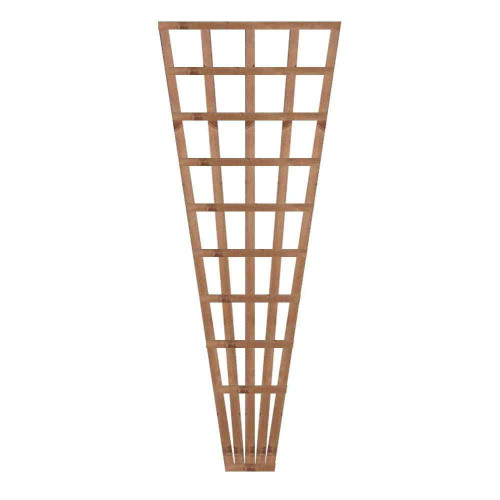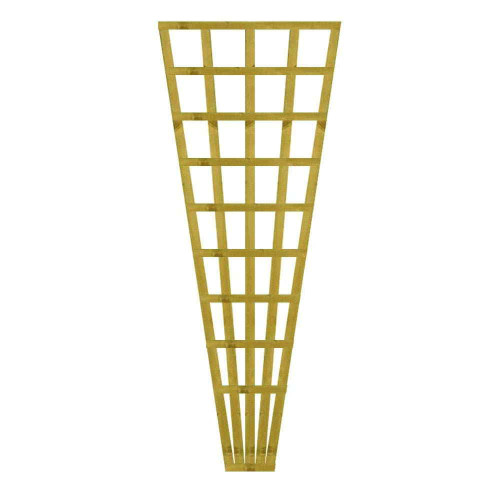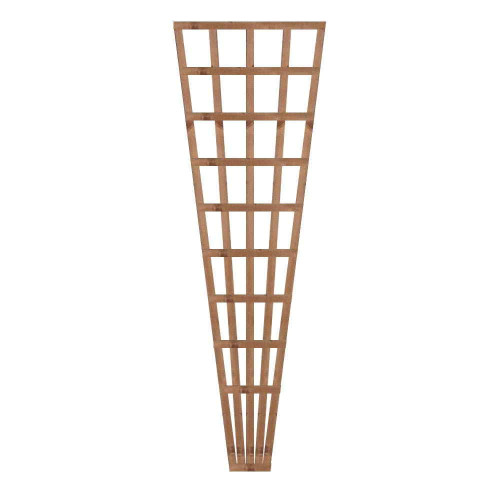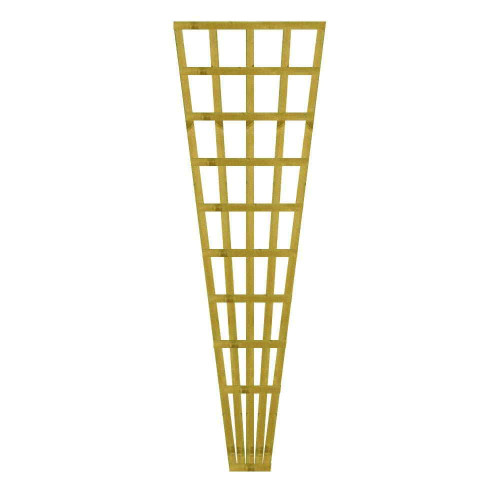


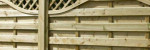

Quick answer: Fan Trellis can start leaning, bowing or pulling away because the wall or fence fixings have loosened, the supporting surface has deteriorated, the timber has moved naturally or climbing plants have become heavier than when the trellis was installed. Current East Coast Fencing Fan Trellis is approximately 1.83m high in 900mm and 1.2m widths, so even though it is an open structure, mature foliage can create substantial leverage. Check the support and plant load before trying to straighten the timber with extra screws.
Fan Trellis has a distinctive tapered shape, which makes movement easy to notice.
If the centre is no longer vertical, one side begins dropping or the top starts moving away from the wall, the problem can appear to be the trellis itself.
Sometimes it is.
Just as often, the underlying problem is a loose wall fixing, weak fence support, uneven plant growth or movement in the timber structure carrying the trellis.
The best repair starts by identifying what has actually moved.
What Problems Can Affect Fan Trellis?
The most common visible problems include:
- The whole fan leaning to one side
- The top pulling away from the wall
- One side sitting farther forward than the other
- Individual trellis battens bowing
- The fan shape becoming uneven
- Fixings becoming loose
- The supporting fence moving with the trellis
- Heavy plants pulling one area down
These symptoms can look similar but have different causes.
Is It Normal For Timber Fan Trellis To Move Slightly?
Some movement can occur because Fan Trellis is made from natural timber.
Current East Coast Fencing Fan Trellis is manufactured in-house from pressure-treated rough-sawn trellis timber.
Natural timber can respond to changing moisture conditions by:
- Shrinking slightly
- Swelling slightly
- Developing small surface checks
- Moving from its original position
This is different from the complete trellis pulling away from its support.
If the whole structure moves when touched, investigate the fixings rather than assuming ordinary timber movement is responsible.
Why Does Pressure-Treated Fan Trellis Still Move?
Pressure treatment improves the timber's suitability for exterior use and helps protect it against decay.
It does not turn timber into a dimensionally fixed material.
Pressure-treated wood can still react to:
- Rain
- Dry weather
- Seasonal humidity
- Sun exposure
A small amount of movement is therefore not automatically evidence that the trellis has failed.
How Can You Tell What Has Actually Moved?
Inspect the installation in a logical order.
| What You See | Likely Area To Check |
|---|---|
| Whole fan leans sideways | Fixing positions and supporting surface |
| Top pulls away | Upper fixings and plant loading |
| One side moves | Local fixing or uneven plant weight |
| Individual timber bends | Natural timber movement or local damage |
| Fence and trellis move together | Fence Posts, rails and panel condition |
| Wall fixing becomes loose | Masonry, plug, screw or supporting batten |
Do not start by adding more fixings.
Find the component that has actually lost its support first.
Why Does Fan Trellis Pull Away From A Wall?
The wall connection may no longer be carrying the load properly.
Possible causes include:
- Unsuitable wall plugs
- Fixings installed into weak material
- Loose or damaged masonry
- A supporting timber batten becoming loose
- Climbing plants increasing the load
- Wind repeatedly moving the planted trellis
A fixing that held a bare Fan Trellis initially may be tested much more severely after several growing seasons.
Why Does The Top Pull Away Before The Bottom?
The upper section of Fan Trellis is wider than the base.
Current panels are approximately 1.83m high and widen towards the top to around 900mm or 1.2m depending on the chosen size.
This upper area provides more space for plant growth.
It can therefore carry:
- More foliage
- More stems
- Greater wind exposure
The upper fixings can experience considerable leverage if the mature plant becomes dense.
If only the top is pulling forward, check both the upper support and the plant weight around that area.
Can Climbing Plants Pull Fan Trellis Off A Wall?
They can contribute if the support is inadequate.
A small climber may weigh very little when first planted.
Over time, the trellis may carry:
- Woody growth
- Dense leaves
- Flowers
- Dead stems
- Water after rainfall
The plant also catches wind.
This means the mature load can be very different from the bare Fan Trellis installed several years earlier.
Can Uneven Plant Growth Make Fan Trellis Lean?
Yes.
One of the purposes of the fan shape is to encourage growth to spread across the widening upper area.
If most stems are allowed to develop on one side, the loading becomes uneven.
This can:
- Pull one side forward
- Twist the fan visually
- Place more strain on one fixing
Regularly guide and prune suitable plants so growth is distributed more evenly across the support.
Can A Climbing Rose Make Fan Trellis Lean?
Yes, particularly as the rose matures.
Climbing roses develop woody stems and normally require deliberate training and tying.
If several substantial stems are attached to one side, they can create an unbalanced load.
Spread the plant across the available fan where appropriate and inspect the support as the rose develops.
A very large mature rose may ultimately require more substantial support than ordinary Fan Trellis alone.
Can Honeysuckle Or Jasmine Overload Fan Trellis?
Vigorous climbing growth can become considerably denser than expected.
The issue is not simply the weight of one stem.
It is the accumulated mass of:
- Repeated stems
- Foliage
- Dead growth
Keep vigorous plants maintained so that the trellis and its fixings remain accessible.
What About Wisteria?
Mature wisteria should not normally rely on lightweight decorative Fan Trellis as its complete structural support.
It can develop substantial woody stems and considerable long-term weight.
A stronger purpose-designed support is normally more appropriate.
If wisteria is already loading a Fan Trellis that is pulling away, address the plant support before simply tightening the trellis back against the wall.
Why Does Fan Trellis Pull Away From A Fence?
The underlying fence may not provide a strong enough connection.
Possible causes include:
- Fixings installed only into thin fence boards
- A weak Fence Panel frame
- Loose rails
- A moving Wooden Fence Post
- Rot or deterioration around fixing points
If the fence itself moves when the trellis is gently tested, repair the fence structure first.
Can A Loose Fence Post Make Fan Trellis Look Warped?
Yes.
If the supporting Fence Post leans, the Fan Trellis may move with it.
This can make the trellis appear to be the problem even if its timber remains serviceable.
Check whether the post is:
- Plumb
- Stable in the ground
- Sound near ground level
- Securely connected to the fence structure
Do not attempt to compensate for a leaning post by fixing the Fan Trellis at an opposing angle.
Could The Trellis Have Been Installed Out Of Vertical?
Yes.
The tapered profile can make a small alignment error obvious.
Do not use existing fence boards, brick courses or sloping paving as the only visual reference.
Check the centre of the Fan Trellis with a spirit level.
If it has always leaned but the fixings remain secure, the original installation may simply have been out of alignment.
Can A Supporting Batten Come Loose?
Yes.
Wall-mounted trellis is often held away from masonry using timber battens or another stand-off arrangement.
If the Fan Trellis remains firmly attached to the batten but the complete assembly pulls away from the wall, the real problem is the batten-to-wall connection.
Inspect:
- Wall plugs
- Screws
- Batten condition
- Masonry behind the batten
Do not add extra screws through the Fan Trellis if the layer behind it is what has failed.
Can Fixing Into Render Cause Problems?
Yes, if the fixing relies on the surface finish rather than a suitable structural substrate.
Render itself should not automatically be treated as sufficient to carry a trellis and mature climbing plant.
If the fixing is becoming loose:
- Check whether the render has cracked
- Check whether the fixing reaches sound material behind it
- Check whether the underlying surface is stable
A loose wall surface needs appropriate repair before the trellis is refitted.
Can Loose Mortar Cause Fan Trellis To Pull Away?
Potentially.
A fixing depends on the condition of the material around it.
If the installation was made into weak or deteriorating material, the connection can loosen as wind and plant movement repeatedly load it.
Move the fixing arrangement to suitable sound support rather than repeatedly using an already failed location.
Why Does Fan Trellis Sometimes Bow Away From The Wall In The Middle?
Possible causes include:
- Too few effective support points
- A central support becoming loose
- Plant stems growing behind the trellis
- Natural timber movement
Check the gap behind the trellis.
A thick woody stem trapped between the wall and lattice can gradually push the timber forward.
Can Plants Growing Behind Fan Trellis Push It Off The Wall?
Yes.
A small clearance is useful for stems and ties, but uncontrolled woody growth behind the support can become a problem.
As stems thicken, they can exert pressure against both:
- The wall
- The trellis
Do not allow permanent woody stems to become tightly wedged into spaces that are too small for their mature diameter.
Does Fan Trellis Need A Gap Behind It?
Usually, yes, when used for climbing plants.
The gap should provide room for:
- Stems
- Ties
- Airflow
- Maintenance
However, a larger gap is not automatically better.
Moving the Fan Trellis farther from the wall increases leverage on the fixings.
The stand-off should be only as large as the planting and support arrangement reasonably requires.
Can Fan Trellis Warp Because It Was Stored Badly?
Potentially.
Timber trellis should be supported sensibly before installation.
Leaving it:
- Bent over another object
- Leaning awkwardly for long periods
- Under uneven weight
- Sitting repeatedly in standing water
can contribute to distortion.
The tapered construction makes uneven storage particularly noticeable because the upper section is broader than the base.
Can Fan Trellis Warp After Installation?
Individual timber components can move as outdoor moisture conditions change.
Minor movement may be cosmetic.
More significant distortion deserves investigation, particularly if accompanied by:
- Loose joints
- Cracks
- Fixings pulling out
- The complete structure becoming unstable
Do not confuse natural rough-sawn timber variation with structural failure.
What Does Rough-Sawn Fan Trellis Normally Look Like?
Current East Coast Fencing Fan Trellis is manufactured from rough-sawn timber.
Normal characteristics can include:
- Visible grain
- Knots
- Saw texture
- Treatment shade variation
- Small natural timber differences
A rough surface or irregular grain line is not the same thing as a warped structural component.
Can Brown And Green Fan Trellis Both Move?
Yes.
Current Fan Trellis is available in brown and green or natural-looking pressure-treated finishes across suitable products.
The initial treatment colour does not prevent normal timber movement.
Both versions remain natural outdoor timber.
The colour will also weather after installation.
Can You Straighten Fan Trellis With Extra Screws?
Do not use extra fixings until you know why it moved.
If a loose fixing is the actual fault and the surrounding timber and support remain sound, refixing may solve the problem.
If the trellis is being distorted by:
- A leaning fence
- Heavy plant growth
- Thick stems behind the lattice
- A badly warped timber component
forcing it flat with screws may simply create new stress elsewhere.
Should You Use Larger Screws If Fan Trellis Is Pulling Away?
Not automatically.
A larger screw does not repair:
- Weak masonry
- Rotten fence timber
- A loose supporting batten
- Excessive plant weight
The correct repair depends on why the existing fixing failed.
Use suitable exterior-grade fixings for the actual support once a sound fixing location has been established.
Can Overtightening Fixings Warp Fan Trellis?
Yes.
Fixings should hold the trellis securely without crushing or dragging narrow timber sections out of alignment.
Overtightening can:
- Compress timber fibres
- Split narrow sections
- Pull one side closer than the other
Secure fixings firmly, but do not use screw tension to reshape the complete fan.
What If One Timber Section Has Split?
Inspect how important that component is to the overall structure.
A small isolated split may not justify replacing the complete Fan Trellis if:
- The surrounding timber remains sound
- The panel is still securely supported
- The split is not progressing
More significant damage may justify repair or replacement where the split:
- Runs through an important fixing location
- Allows part of the fan to move independently
- Affects several connected members
Can Fan Trellis Be Repaired?
Local damage may be repairable.
Examples include:
- A loose fixing
- A sound trellis that has moved on its wall supports
- A small isolated timber fault
Repair becomes less attractive where much of the tapered structure has become distorted.
Because the fan shape relies on the complete arrangement of its timber components, extensive rebuilding can be more difficult than repairing rectangular trellis.
When Should You Replace Fan Trellis?
Replacement is worth considering when:
- Several timber components are broken
- The complete fan is badly distorted
- Multiple joints have failed
- The timber can no longer hold fixings securely
- Widespread deterioration is present
Do not install the new Fan Trellis until the wall, fence or supporting frame has also been checked.
Should You Remove The Climbing Plant Before Repairing Fan Trellis?
Not always completely, but you need enough access to work safely.
A substantial plant may need to be:
- Pruned
- Untied in selected areas
- Temporarily supported
Do not remove a trellis that is currently supporting a large mature climber without first considering what will hold the plant.
Can You Save The Plant When Replacing Fan Trellis?
Potentially.
This is easier when substantial stems have been tied to the support rather than tightly woven through numerous timber sections.
The plant can potentially be temporarily supported while the old trellis is removed and a replacement installed.
This is one reason to think about future maintenance when training the plant originally.
How Can You Stop Fan Trellis Pulling Away Again?
- Fix into sound material: Do not rely on loose render, damaged timber or weak masonry.
- Support the complete fan: Do not depend on one fixing near the base.
- Keep the trellis vertical: Check alignment with a spirit level.
- Use a sensible wall gap: Provide plant clearance without excessive stand-off.
- Train plants evenly: Avoid loading one side heavily.
- Prune excessive growth: Keep mature climbers manageable.
- Inspect periodically: Tighten or repair loose components before movement becomes severe.
- Keep timber clear of persistent wet soil: Do not bury the bottom beneath mulch or compost.
How Often Should You Check A Planted Fan Trellis?
There is no fixed inspection interval required for every installation.
A useful habit is to check it whenever significant plant maintenance is carried out.
Also inspect after periods of severe weather if the planted feature is exposed.
Look for:
- Movement at wall fixings
- Loose fence supports
- Timber splits
- Plant stems pressing behind the trellis
- Heavy growth concentrated at the top
Small problems are easier to correct while the trellis remains largely secure.
Does A 1.2m Fan Trellis Need More Attention Than A 900mm Fan?
The 1.2m version provides a broader upper planting area.
That means it can potentially carry more plant growth across the wall.
This does not mean the wider product is inherently problematic.
It means the installation should be planned for the larger finished planted area.
The same principles apply to both widths:
- Sound support
- Secure fixings
- Balanced plant growth
- Regular inspection
Common Mistakes When Repairing Leaning Fan Trellis
- Adding bigger screws without checking why the original fixings failed
- Trying to straighten trellis attached to a leaning fence
- Ignoring a loose wall batten
- Assuming pressure-treated timber cannot move
- Confusing rough-sawn texture with structural warping
- Using screw tension to force badly distorted timber flat
- Ignoring thick stems trapped behind the trellis
- Leaving all climbing growth concentrated on one side
- Repairing the trellis without reducing excessive plant load
- Fixing back into the same failed piece of masonry or rotten timber
- Replacing the trellis without checking its supporting surface
- Removing a plant-loaded trellis without temporarily supporting the climber
FAQs
Why Is My Fan Trellis Pulling Away From The Wall?
Common causes include loose wall fixings, weak masonry, a failed supporting batten or increased weight and wind resistance from mature climbing plants.
Is It Normal For Fan Trellis To Warp?
Minor timber movement can occur as moisture conditions change. Significant distortion, loose joints or movement of the complete trellis should be investigated.
Can Climbing Plants Pull Trellis Off A Wall?
They can contribute if the support is inadequate. Mature plants add stem weight, foliage, rainwater load and extra wind resistance.
Why Is My Fan Trellis Leaning To One Side?
Check whether the installation was originally vertical, whether one fixing has loosened and whether most of the climbing plant has become concentrated on one side.
Can You Straighten Fan Trellis With Screws?
A loose but otherwise sound installation may be refixed, but badly distorted timber should not simply be forced flat with extra screws. Identify the cause first.
Can Fan Trellis Be Repaired?
Local fixing problems and minor timber damage may be repairable. Replacement is more sensible where several parts of the tapered structure are broken or badly distorted.
Can A Loose Fence Cause Fan Trellis To Lean?
Yes. If the Fan Trellis is attached to a Fence Panel, rail or Wooden Fence Post that has moved, the trellis can lean even though its own timber remains usable.
Does 1.2m Fan Trellis Catch More Wind Than 900mm Fan Trellis?
The wider version provides a broader area for plant growth, so the completed planted feature can potentially present more area to the wind. The mature plant and fixing arrangement matter more than width alone.
Find What Moved Before You Try To Straighten It
A leaning Fan Trellis is not always a warped Fan Trellis.
Start with the supporting structure.
If it is wall mounted, check the trellis-to-batten and batten-to-wall connections separately. If it is fence mounted, check the Fence Panel, rails and Fence Posts before adjusting the trellis.
Then inspect the plant.
Current Fan Trellis is approximately 1.83m high and available in widths around 900mm and 1.2m. Its widening upper shape gives climbing plants useful room to spread, but it can also carry a substantial volume of mature growth.
Uneven foliage, thick stems behind the lattice and accumulated woody growth can all change how the support behaves.
Finally, assess the timber itself.
Some movement is normal in pressure-treated rough-sawn timber. Loose joints, major distortion and widespread damage are different.
Repair local fixing problems where the structure remains sound. Replace badly damaged trellis when restoring it would mean reconstructing much of the fan.
Most importantly, correct the cause as well as the symptom. A new or straightened Fan Trellis will simply move again if it is returned to the same weak wall fixing, unstable fence or overloaded climbing plant.