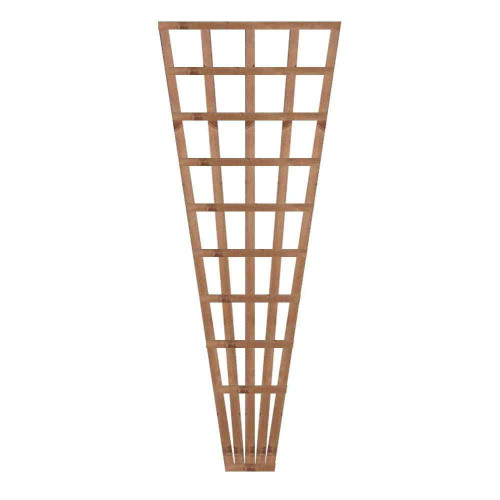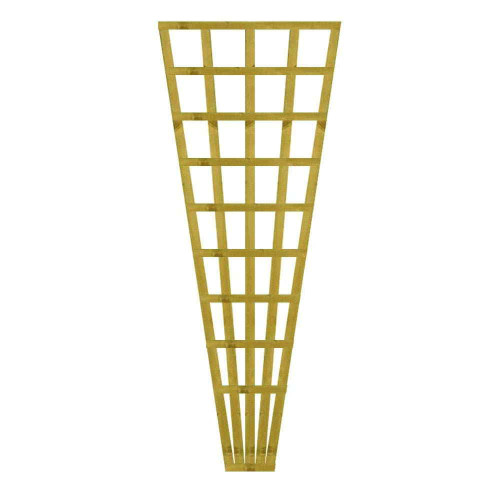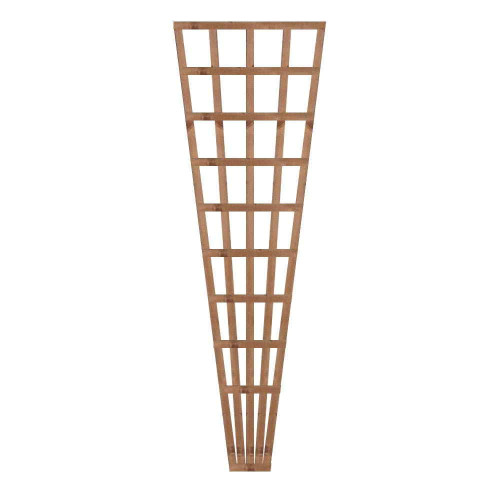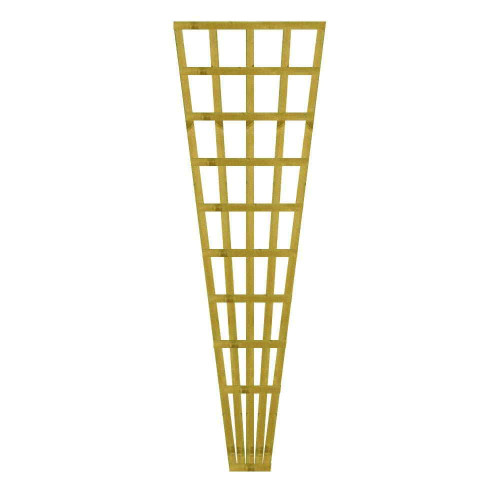


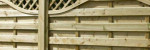

Quick answer: Fan Trellis should be fixed securely to a sound wall or suitable timber support before climbing plants are trained onto it. Leave enough clearance behind the trellis for stems, plant ties, airflow and future maintenance rather than pressing it completely flat against the surface. Current East Coast Fencing Fan Trellis is approximately 1.83m high and available in widths around 900mm and 1.2m. Measure the widest upper part of the fan before fixing it beside windows, doors or other wall features.
Fan Trellis is designed for a different job from a conventional rectangular trellis panel.
Its lower section is relatively narrow, then the timber spreads out towards the top. This gives an individual climbing plant more room to develop laterally as it grows.
That shape makes Fan Trellis particularly useful against house walls, garages, sheds and other vertical garden surfaces where a full 1.83m-wide rectangular panel would be unnecessarily large.
Correct installation matters because the trellis needs room behind it for plants while remaining securely attached as those plants become larger and heavier.
The most important steps are measuring the full fan outline, identifying what the wall is made from, creating sensible clearance behind the trellis and using fixings appropriate to the supporting material.
What Is Fan Trellis Designed For?
Fan Trellis is primarily a climbing-plant support and decorative garden feature.
It is not intended to perform the same job as a rectangular privacy screen or conventional Fence Panel.
The shape works particularly well for:
- A single clematis
- Honeysuckle
- Jasmine
- Managed climbing roses
- Narrow planting beds
- Walls between windows
- Areas beside doors
- Shed walls
- Compact patio planting
The narrow lower section allows the trellis to begin close to one plant, while the wider upper section provides more room for stems to spread.
What Size Is Fan Trellis?
Current East Coast Fencing Fan Trellis is approximately 1.83m high.
Useful current widths include approximately:
- 900mm
- 1.2m
Both are tall vertical plant supports rather than horizontal fence topper sections.
| Fan Trellis Size | Best Suited To | Main Measurement To Check |
|---|---|---|
| Approx. 1.83m x 900mm | Narrow wall sections and individual climbers | Available width around the top of the fan |
| Approx. 1.83m x 1.2m | Broader climbing displays | Clearance from windows, doors and fittings |
The 1.2m version gives a plant more lateral room and creates a more prominent decorative feature.
The 900mm version is better where wall space is restricted.
Why Must You Measure The Widest Part Of Fan Trellis?
Because the base does not represent the final width.
A common mistake is positioning the narrow bottom section comfortably between two features and only later discovering that the fan spreads into a:
- Window frame
- Door opening
- Drainpipe
- Outside light
- Vent
- Neighbouring trellis
Measure the complete outline before drilling anything.
You also need to allow additional space for the plant itself.
Leaves and stems will often extend beyond the timber support once established.
Where Should Fan Trellis Be Positioned On A Wall?
Position it where the plant has enough space to grow without interfering with parts of the building that need regular access.
A good location should consider:
- The mature width of the plant
- The widest point of the Fan Trellis
- Window opening
- Door movement
- Drainpipes
- Air bricks and vents
- Outdoor lighting
- Future wall maintenance
A trellis that technically fits the bare wall can still be badly positioned once foliage fills it.
How High Should Fan Trellis Be Mounted?
The exact position depends on the planting arrangement.
The bottom does not normally need to be buried in the soil or rest directly on the ground.
Instead, position the trellis so the plant can be guided onto the lower section without creating unnecessary contact between the timber and wet soil.
Keeping the timber slightly clear of the planting surface also makes it easier to:
- Remove leaves
- Add mulch without burying the trellis
- Inspect the lower timber
- Maintain the wall
Do not mount the trellis so high that the young plant has a large unsupported gap before reaching it.
Should Fan Trellis Sit Flat Against The Wall?
No, not ideally for most climbing applications.
Some working clearance behind the trellis is useful for:
- Plant stems
- Plant ties
- Air circulation
- Pruning access
- Cleaning
- Future maintenance
A trellis fixed completely flat against masonry can be awkward to use because there is nowhere to pass a tie behind the timber.
Stems may also become trapped tightly between the trellis and the wall.
How Large Should The Gap Behind Fan Trellis Be?
There is no single universal measurement for every wall, plant and fixing arrangement.
The practical goal is to create enough space to work behind the trellis without moving it unnecessarily far from the wall.
An excessive stand-off increases leverage on the wall fixings.
The gap should be sufficient for:
- Passing suitable plant ties
- Guiding stems
- Allowing some airflow
- Inspecting the support
Use suitable timber battens, spacers or another properly planned support where required.
Why Does Wall Type Matter?
The trellis is only as secure as the material carrying the fixings.
A fixing suitable for sound brickwork may be unsuitable for:
- Weak mortar
- Rendered masonry
- Lightweight blockwork
- Timber cladding
- A shed wall
Identify the actual supporting material before choosing anchors or screws.
Do not base the fixing system solely on the relatively low weight of the bare trellis.
The climbing plant will add load later.
Can Fan Trellis Be Fixed To A Brick Wall?
Yes, provided the brickwork is sound and the fixings are suitable for the masonry.
Before installation, inspect for:
- Loose bricks
- Damaged mortar
- Cracks
- Unstable repairs
Position the supporting fixings so they hold the trellis securely without unnecessarily damaging the wall.
Where battens are used to create the stand-off, those battens need to be securely fixed to the wall first.
Can Fan Trellis Be Fixed To A Rendered Wall?
Potentially.
The important point is that decorative render alone should not be assumed to provide structural fixing strength.
The fixing system generally needs to engage with a suitable supporting substrate behind the surface finish.
Take care not to:
- Crack surrounding render unnecessarily
- Rely on a loose surface layer
- Create poorly sealed fixing points
If the wall construction is uncertain, determine what lies behind the render before choosing the fixing method.
Can Fan Trellis Be Fixed To A Shed?
Yes, if the shed provides suitable structural timber for fixing.
Do not assume thin exterior cladding can carry the complete mature plant.
Where possible, connect the trellis support into:
- Structural studs
- Framing
- Other substantial shed timber
rather than relying only on thin boards.
Also make sure climbing growth does not block ventilation or interfere with the roof covering.
Can Fan Trellis Be Fixed To A Wooden Fence?
Potentially, provided the fence is sound and you own it or have permission to alter it.
The best fixing points are normally substantial structural timber rather than thin individual boards.
Before attaching Fan Trellis, check:
- The Fence Posts are sound
- The Fence Panel is secure
- The timber is not rotten
- The added plant will not overload the structure
A fence that already moves noticeably should be repaired before extra trellis and climbing growth are added.
What Tools Do You Need To Install Fan Trellis?
The exact tools depend on the wall and fixing system, but typical equipment may include:
- Tape measure
- Pencil
- Spirit level
- Drill or driver
- Appropriate drill bits
- Suitable wall anchors where required
- Exterior-grade fixings
- Supporting battens or spacers where required
- Eye protection
Use access equipment appropriate to the working height and ground conditions.
How Do You Install Fan Trellis On A Wall?
- Measure the wall: Confirm the full 1.83m height and maximum trellis width will fit.
- Check nearby features: Allow for windows, doors, drainpipes, vents and lights.
- Check the wall condition: Do not fix into loose or obviously damaged material.
- Choose the stand-off arrangement: Decide how the trellis will be kept away from the wall for plant growth and airflow.
- Mark the position: Hold or temporarily position the trellis and check its overall appearance.
- Use a spirit level: Check the centre and main vertical alignment rather than judging against uneven brick courses or paving.
- Install the supporting fixings or battens: Match these to the wall construction.
- Secure the trellis: Fix through suitable substantial parts of the Fan Trellis rather than relying on one light lattice member.
- Check stability: The panel should be secure before any plant is attached.
- Train the plant: Spread stems gradually across the widening shape using suitable ties where required.
Should Fan Trellis Be Perfectly Vertical?
Yes, unless a particular bespoke design deliberately requires otherwise.
The central axis of the fan should appear upright.
If it leans, the widening pattern can make the error particularly noticeable.
Use a spirit level rather than judging its position against:
- Sloping paving
- Uneven ground
- Old brick courses
Should The Fan Be Centred Behind The Plant?
Usually.
The narrow lower area is designed to begin near the planting position, then provide more room higher up.
If the plant is significantly offset from the trellis base, the first stems may need to travel sideways before they can be trained onto the support.
That can create an unbalanced display.
Where possible, position the plant and trellis as one planned feature.
How Do You Install Fan Trellis Between Two Windows?
Measure much more than the gap at ground level.
Because the trellis widens towards the top, the crucial measurement is the available wall width at the widest section.
Also leave room for:
- Window opening
- Cleaning access
- Frames and sills
- Mature plant foliage
The approximately 900mm-wide Fan Trellis is particularly useful where the wall section is too narrow for the wider 1.2m version.
How Do You Install Fan Trellis Beside A Door?
Position it far enough away that neither the timber nor mature plant growth can interfere with the door.
Check:
- The full door swing
- Handles
- Locks
- Exterior lights
- Door canopies
Remember that a plant can extend significantly beyond the original Fan Trellis outline.
Allowing extra space now is easier than continually pruning stems away from the doorway later.
Can Fan Trellis Be Installed Beside A Drainpipe?
Yes, but leave access.
Do not position the trellis or plant so tightly around the drainpipe that routine maintenance becomes impossible.
Drainpipes may eventually need:
- Cleaning
- Repair
- Replacement
A mature climber woven completely around the pipe can make a simple maintenance job unnecessarily difficult.
Should Fan Trellis Cover Air Bricks Or Vents?
No.
Keep building ventilation points unobstructed.
The timber itself may be open, but dense foliage can eventually cover the area much more completely.
Plan for the mature plant, not merely the empty trellis.
How Do You Train A Climbing Plant Onto Fan Trellis?
Begin while stems are young and flexible.
The shape is intended to encourage growth to spread as it rises.
A practical approach is:
- Guide initial stems towards the lower trellis: Avoid leaving a long unsupported section.
- Spread suitable stems apart: Use different parts of the fan rather than one central route.
- Tie where necessary: Use appropriate soft plant ties.
- Leave room for growth: Do not tighten ties around stems.
- Review the plant regularly: Redirect new shoots while they remain manageable.
Early training usually produces a more balanced display than trying to rearrange several years of tangled growth later.
Which Plants Need Tying To Fan Trellis?
Not all climbing plants attach themselves in the same way.
Some use twining growth or leaf stems to work around supports.
Others need more active help.
Climbing roses, for example, generally require deliberate tying and training.
Young growth from other climbers may also benefit from guidance until it begins using the trellis effectively.
Can Clematis Grow On Fan Trellis?
Yes.
Fan Trellis is particularly well suited to an individual clematis where a full rectangular panel would be unnecessarily large.
The tall approximately 1.83m form gives the plant vertical space, while the widening top provides room for growth to spread.
Guide young stems onto the support rather than assuming they will immediately find it themselves.
Can Honeysuckle Grow On Fan Trellis?
Yes.
The widening form gives suitable honeysuckle growth room to spread laterally.
Manage vigorous plants so they do not become an excessively dense mass around the upper part of the fan.
Pruning also helps retain access to the wall and fixings.
Can Jasmine Grow On Fan Trellis?
Suitable jasmine can work well where the wall conditions suit the plant.
The Fan Trellis provides a defined growing area rather than allowing the plant to spread unchecked across an entire building elevation.
Continue training new stems across both sides of the fan so the display remains reasonably balanced.
Can Climbing Roses Grow On Fan Trellis?
Yes, particularly when the rose is intended to remain within a relatively defined area.
Climbing roses need tying and can develop substantial woody growth.
As the plant matures:
- Spread stems across the support
- Use multiple ties
- Prune excessive growth
- Check the trellis fixings periodically
A very large climbing rose may eventually justify a broader or more substantial support than one Fan Trellis.
Can Fan Trellis Support Wisteria?
Ordinary lightweight trellis should not be assumed to provide the complete long-term structural support required by mature wisteria.
Wisteria can become exceptionally substantial and woody.
A purpose-designed heavy support is generally more appropriate for the mature plant.
Fan Trellis may potentially form part of a decorative training arrangement, but it should not be expected to carry unrestricted mature wisteria growth by itself.
Why Does Mature Plant Weight Matter?
The bare Fan Trellis may be relatively light.
The mature plant can eventually add:
- Woody stems
- Leaves
- Flowers
- Dead growth
- Water after rainfall
The wall fixings therefore carry more than the timber trellis.
Choose the support arrangement for the finished planted feature.
Does A Climbing Plant Increase Wind Load?
Yes.
The open Fan Trellis itself allows substantial air through.
As foliage fills the spaces, the planted structure becomes less permeable.
Wind can then place greater force on:
- The plant
- The Fan Trellis
- The wall fixings
- Supporting battens
This is another reason to secure the trellis properly before planting rather than relying on a couple of lightweight fixings.
Can The Plant Hold Fan Trellis Against The Wall?
No.
Do not use plant stems as structural fixings.
The trellis should be independently secure before anything is trained onto it.
A plant can move significantly in windy conditions, so allowing it to hold an inadequately fixed panel can damage both the plant and the trellis.
Should You Weave Thick Stems Through Fan Trellis?
Avoid trapping large permanent woody stems too tightly through the lattice.
This can make future maintenance extremely difficult.
You may eventually need to:
- Remove the trellis
- Repaint the wall
- Repair masonry
- Replace a damaged plant support
Where practical, keeping substantial stems tied to the face of the support can make later removal easier than weaving them permanently through multiple openings.
Can Fan Trellis Be Cut To Fit A Narrower Wall?
It is generally better to choose the appropriate standard width rather than cutting the fan shape.
Unlike a rectangular panel, the widening outline is an important part of the design.
Cutting it can:
- Distort the fan shape
- Leave unsupported timber ends
- Make one side visually unbalanced
- Reduce the useful plant-training area
If approximately 1.2m is too wide, the approximately 900mm version is normally the better starting point.
Can Fan Trellis Be Shortened In Height?
Again, modification is generally best avoided unless there is a specific reason and the structure can be properly rebuilt.
The approximately 1.83m height is part of the intended fan profile.
Cutting the top away would remove the widest and most distinctive part of the design.
If only a low climbing support is required, another trellis format may be more appropriate.
Should Fan Trellis Touch The Soil?
Keep ordinary timber trellis clear of unnecessary wet ground contact where practical.
Current Fan Trellis is pressure treated for exterior use, but allowing the lower timber to remain buried beneath wet soil or mulch serves little purpose.
Maintain enough clearance to inspect the base and prevent gardening materials gradually covering it.
Can A Raised Bed Be Placed In Front Of Fan Trellis?
Yes.
This can create a useful arrangement for a climbing plant where the Fan Trellis is fixed to a wall behind the bed.
The raised bed should retain its own soil.
Do not:
- Bank soil against the trellis
- Bury the lower timber
- Block access to the wall completely
Think about how the trellis or wall could be reached later if maintenance is required.
Should Fan Trellis Be Painted Before Installation?
If you intend to apply a suitable exterior decorative coating, doing so before the plant becomes established is considerably easier.
Current Fan Trellis is pressure treated and available in brown and green or natural-looking finishes across suitable products.
These are treatment colours rather than uniform paint finishes.
Expect:
- Knots
- Visible grain
- Saw texture
- Treatment variation
- Natural weathering
If applying another finish, follow the coating manufacturer's requirements for treated timber preparation and moisture condition.
Does Fan Trellis Need Maintenance?
Inspect both the trellis and the plant periodically.
Look for:
- Loose wall fixings
- Movement in supporting battens
- Broken trellis sections
- Overloaded areas
- Dense dead growth
- Plant stems interfering with windows or pipes
- Mulch building up around the bottom
The support is easiest to maintain when the plant is kept under reasonable control.
What If The Fan Trellis Starts Pulling Away From The Wall?
Do not simply drive larger screws through the existing fixing points without identifying the cause.
Possible reasons include:
- An unsuitable original wall anchor
- Weak masonry
- A damaged supporting batten
- Excessive plant weight
- Increased wind loading
Reduce the plant load safely if necessary and inspect the complete support arrangement.
The repair needs to address the wall connection rather than merely pulling the trellis back temporarily.
What If One Side Of The Fan Starts Sagging?
Check whether:
- A fixing has loosened
- A timber section has split
- The plant is concentrated heavily on one side
- The trellis has been pulled out of alignment
If one side carries substantially more growth, prune or retrain the plant where appropriate so the support is not unnecessarily unbalanced.
Can Fan Trellis Be Used For Privacy?
Only to a limited extent.
The fan-shaped structure does not form a complete rectangular screen.
It is designed around individual climbing plants rather than privacy.
A mature plant can soften or partially obscure the wall behind it, but Fan Trellis is not the right starting product if the primary objective is to screen:
- A complete patio
- A long boundary
- Bins
- A neighbour's garden
A rectangular privacy or screening product is more suitable for those applications.
Common Fan Trellis Installation Mistakes
- Measuring only the narrow base instead of the widest upper section
- Installing the trellis too close to a window
- Forgetting to allow room for mature foliage
- Pressing the trellis completely flat against the wall
- Choosing wall fixings without identifying the substrate
- Relying on loose render or damaged mortar
- Fixing to thin shed cladding instead of suitable framing
- Installing the fan out of vertical alignment
- Allowing the bottom to become buried beneath soil or mulch
- Assuming the climbing plant will secure the trellis
- Choosing fixings only for the weight of the bare timber
- Ignoring mature plant weight and wind loading
- Weaving thick permanent stems so tightly that future removal becomes impossible
- Cutting the fan shape unnecessarily when a suitable standard width is available
FAQs
How Do You Fix Fan Trellis To A Wall?
Secure it to sound masonry or suitable supporting battens using exterior fixings appropriate to the wall construction. Leave enough space behind the trellis for plant growth, ties, airflow and maintenance.
What Size Is Fan Trellis?
Current East Coast Fencing Fan Trellis is approximately 1.83m high and available in widths around 900mm and 1.2m.
How Far Should Fan Trellis Be From A Wall?
Leave enough working clearance for stems, ties and airflow without positioning the trellis unnecessarily far from the wall. The precise gap depends on the trellis, plant and fixing arrangement.
Can Fan Trellis Be Fixed To Brick?
Yes, where the brickwork is sound and suitable masonry fixings are used. Check the wall condition before installing the support.
Can Fan Trellis Be Fixed To A Fence?
Potentially, if the fence is yours, structurally sound and suitable for the additional plant load. Fix to substantial structural timber rather than relying on weak or rotten boards.
Can Fan Trellis Be Cut To Size?
Cutting is generally best avoided because the tapered shape is fundamental to the design. Current approximately 900mm and 1.2m widths provide two useful choices for different wall spaces.
Is Fan Trellis Good For Clematis?
Yes. Its narrow base and widening upper shape make it particularly useful for an individual clematis growing against a wall or other suitable vertical surface.
Can Climbing Roses Grow On Fan Trellis?
Yes, when they are tied and trained and the support is securely fixed. Large mature climbing roses can become heavy, so broader or additional structural support may eventually be appropriate.
Measure The Top Of The Fan Before You Drill The Wall
Installing Fan Trellis successfully is mainly about planning the space around its unusual shape.
Current panels are approximately 1.83m high and available in widths around 900mm and 1.2m. The lower section is narrow, but the trellis becomes progressively wider towards the top.
That means the most important measurement is often not at the plant pot. It is higher up the wall, where the timber and mature foliage may approach windows, doors, pipes or other fittings.
Once the position is established, use a suitable support arrangement for the actual wall construction and leave practical clearance behind the trellis.
The trellis should be independently secure before the plant is attached.
Then train suitable stems gradually across the widening shape rather than allowing all the growth to collect in the centre.
Fan Trellis works best when it is treated as a focused support for one climbing display. Give the plant enough room, keep the wall accessible and design the fixings for the mature planted feature rather than the lightweight trellis on installation day.