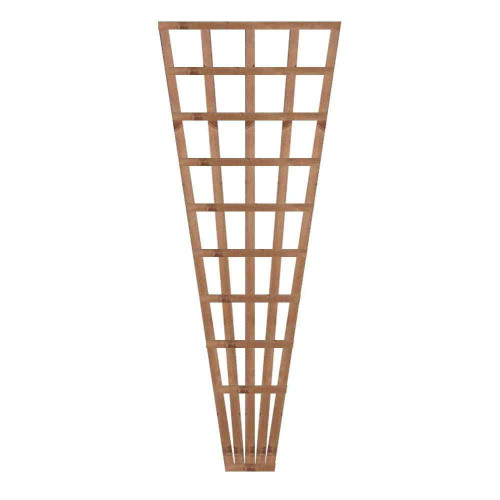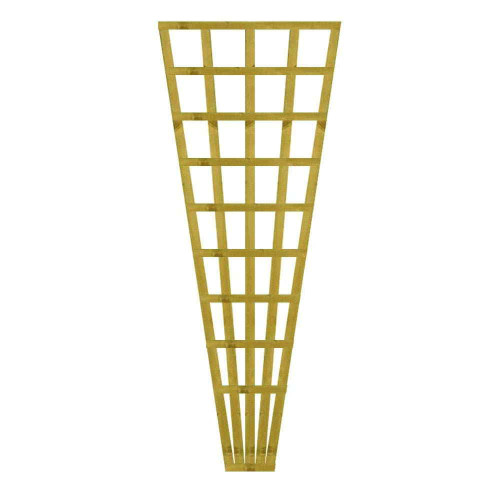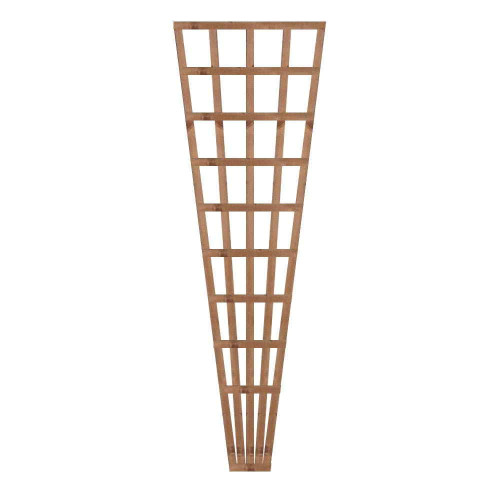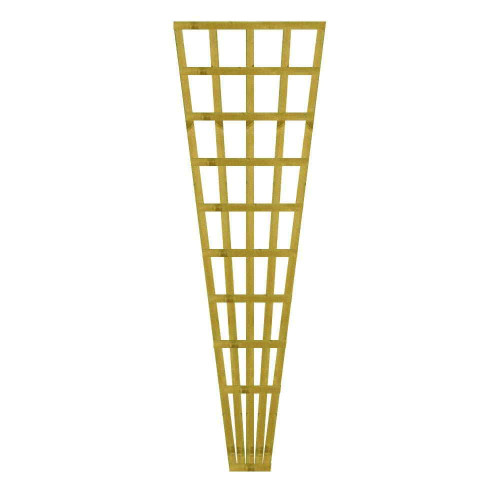


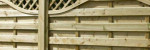

Quick answer: Yes, Fan Trellis can be fixed to a suitable wooden fence, but it should be attached to sound structural timber rather than relying on thin or loose fence boards alone. Current East Coast Fencing Fan Trellis is approximately 1.83m high and available in widths around 900mm and 1.2m. Check the condition of the fence, locate posts or substantial framing, allow some space behind the trellis for stems and plant ties, and plan for the additional weight and wind resistance of the mature climber.
A fence can provide a useful background for climbing plants without needing a complete rectangular trellis panel.
Fan Trellis is particularly suited to this type of installation because it concentrates the plant support around one growing position.
The narrow base can sit behind the plant, while the trellis spreads wider towards the top as the climbing growth develops.
The important question is not simply whether screws can be driven through the trellis into a fence.
You need to establish which part of the fence will actually carry the trellis and what happens when the plant becomes larger, heavier and more exposed to wind.
Can Fan Trellis Be Attached To Wooden Fencing?
Yes, where the fence is structurally sound and provides suitable fixing points.
Fan Trellis can work particularly well against a timber boundary where you want to:
- Train one climbing plant
- Soften a plain Fence Panel
- Add planting beside a patio
- Create a decorative feature within a long fence run
- Use vertical growing space in a narrow border
The trellis should remain independently secure before plants are attached to it.
Do not expect climbing stems to hold loose trellis against the fence.
What Size Is Fan Trellis?
Current East Coast Fencing Fan Trellis is approximately 1.83m high.
Current widths include approximately:
- 900mm
- 1.2m
The trellis is deliberately narrower at the bottom and wider towards the top.
Both dimensions are important when planning a fence installation.
A 900mm or 1.2m maximum width does not mean the lower part of the fan occupies the same width.
Where On A Fence Should Fan Trellis Be Fixed?
Where possible, use substantial structural timber as the main support.
Suitable fixing positions may include:
- Wooden Fence Posts
- Substantial rails
- A strong framed section of a Fence Panel
- A separately installed support frame
The exact arrangement depends on how the existing fence was constructed.
A fixing into a solid post is very different from a screw driven only into a thin board.
| Possible Support | Suitability | Main Consideration |
|---|---|---|
| Wooden Fence Post | Good structural fixing point | Post must remain sound and stable |
| Substantial timber rail | Potentially suitable | Check rail condition and connection to posts |
| Strong panel frame | Potentially suitable | Panel construction varies |
| Thin individual fence board | Poor primary support | May split or move under load |
| Separate timber frame | Useful where fence is unsuitable | Frame itself needs sound support |
Why Is Fixing Fan Trellis Only To Fence Boards A Problem?
Many Fence Panels contain relatively thin individual boards.
Those boards are intended primarily to form the fence surface.
They may not be the best places to carry a tall planted trellis.
Possible problems include:
- Boards splitting around screws
- Boards pulling away from their rails
- The Fan Trellis moving in wind
- The climbing plant pulling the board outwards
A screw can feel secure on installation day and still be a poor long-term structural connection.
Look for the structural components behind the visible boards.
Is Fixing Fan Trellis To A Wooden Fence Post Better?
A sound Wooden Fence Post provides a much more substantial fixing point than a thin board.
Current East Coast Fencing Wooden Fence Posts include 75 x 75mm and 100 x 100mm sections across suitable products.
If the Fan Trellis can be positioned so part of its structure aligns with a post, that can help transfer load into the main fence support.
However, one post may not support the complete width of a fan.
Additional suitable support may still be required across the wider upper section.
Can You Fix Fan Trellis Across Two Fence Posts?
Potentially, but remember that Fan Trellis is narrower than a standard approximately 1.83m fencing bay.
The current maximum widths of around 900mm and 1.2m may not naturally reach two conventionally spaced Fence Posts.
If the fan sits mainly between posts, consider using a suitable timber support fixed back to the fence structure.
This gives you properly positioned fixing points without forcing the trellis to sit somewhere unsuitable simply to reach a post.
Can You Add Timber Battens To A Fence For Fan Trellis?
Yes, where a suitable structural arrangement can be created.
Timber battens can serve two useful purposes:
- Providing known fixing points
- Holding the Fan Trellis away from the Fence Panel
The battens themselves need to connect to something substantial.
Fixing a heavy supporting batten into one thin loose fence board does not solve the underlying problem.
Where possible, connect the supporting arrangement back into posts, rails or a sound panel frame.
Should Fan Trellis Have A Gap Behind It?
Some clearance is normally useful when climbing plants will be trained across it.
The gap gives room for:
- Plant stems
- Plant ties
- Airflow
- Pruning access
- Future trellis maintenance
If the Fan Trellis is screwed completely flat against a solid fence surface, threading ties and managing stems behind it becomes more awkward.
Do not create an unnecessarily large gap, however.
The farther the trellis projects from the fence, the greater the leverage on its fixings.
How Far Should Fan Trellis Sit From A Fence?
There is no universal spacing that suits every trellis, plant and fence construction.
The practical requirement is enough clearance for plant management without making the trellis unnecessarily stand away from its support.
Consider:
- Stem thickness
- Plant ties
- Trellis construction
- Supporting battens
- Fence condition
The complete fixing arrangement matters more than choosing an arbitrary stand-off measurement.
How High Should Fan Trellis Be Positioned On A Fence?
Current Fan Trellis is approximately 1.83m high, so position it around the intended plant rather than simply aligning its bottom with the bottom of the Fence Panel.
The lower end should generally be close enough for young growth to reach without leaving a large unsupported section.
At the same time, keep ordinary timber trellis away from unnecessary:
- Wet soil
- Standing water
- Mulch build-up
The correct position may therefore begin slightly above the planting surface.
Can Fan Trellis Extend Above The Top Of The Fence?
Physically, an installation can be arranged so the trellis extends above a lower fence, but that changes the structural demands substantially.
The unsupported upper section becomes more exposed to wind.
Plant growth above the fence line can increase that effect further.
A Fan Trellis that sits largely against a solid panel is better supported than one with a significant section projecting above the boundary without suitable framing.
If additional boundary height is actually the objective, a dedicated Fence Topper Trellis system may be more appropriate than trying to make Fan Trellis perform that job.
Is Fan Trellis A Fence Topper?
No, that is not its primary purpose.
Fan Trellis is approximately 1.83m high and is designed mainly as a vertical support for individual climbing plants.
Fence topper products are normally shallow horizontal panels designed to extend across a fence bay.
Fan Trellis is:
- Tall
- Tapered
- Relatively narrow
- Focused around one plant
Use the two products for different jobs.
Can Fan Trellis Be Fixed To Closeboard Fencing?
Potentially.
The key is identifying the substantial timber within the particular fence construction.
A closeboard fence built from individual Feather Edge Boards, rails and posts provides different fixing opportunities from a pre-made framed Fence Panel.
Where possible, transfer the Fan Trellis load into:
- Sound rails
- Fence Posts
- Additional suitable framing
rather than relying solely on individual Feather Edge Boards.
Can Fan Trellis Be Fixed To Waney Lap Fence Panels?
Potentially, but inspect the panel carefully first.
Waney Lap panels contain overlapping timber boards supported by a frame.
The visible boards themselves are not necessarily the best structural fixing points.
Look for sound frame members capable of taking the trellis fixing.
If the panel is old, loose or already distorted, repair or replace the fencing before adding more components and climbing plants.
Can Fan Trellis Be Fixed To Picket Fencing?
It may be possible to create a support arrangement, but Fan Trellis is often visually and structurally mismatched with low open picket fencing.
Picket boundaries are generally intended to remain:
- Low
- Open
- Visually lightweight
A 1.83m-high Fan Trellis rising from a low picket fence can require substantial independent support.
If you want a tall climbing feature behind low fencing, separate posts or a wall may provide a more appropriate structure.
Can Fan Trellis Be Fixed To A Fence With Concrete Posts?
The timber Fence Panel may sit between Concrete Fence Posts, but that does not mean the reinforced posts should automatically be drilled for the Fan Trellis.
Concrete Fence Posts are structural components and need more care when modifications are considered.
If the Fan Trellis is being positioned against the timber panel area, a suitable timber support arrangement may be possible.
Avoid casually drilling or cutting reinforced concrete simply to create a convenient fixing point.
Should You Attach Fan Trellis To An Old Fence?
Only after checking the fence condition.
Inspect:
- Fence Posts
- Rails
- Panel frames
- Loose boards
- Existing fixings
Adding Fan Trellis to a fence that already moves in moderate wind can make the weakness more noticeable once plants establish.
Deal with structural faults first.
How Can You Tell If A Fence Post Is Sound Enough?
Look at the complete post rather than only the visible upper section.
Warning signs include:
- Leaning
- Movement when the fence is gently pushed
- Severe cracking around fixing areas
- Deterioration near ground level
- Movement in the foundation
A climbing plant does not reduce any of these problems.
It adds another load to the structure.
Why Does Mature Plant Weight Matter?
The trellis may be light when first fitted.
A climbing plant can become considerably heavier over the following years.
The mature structure can include:
- Woody stems
- Dense foliage
- Flowers
- Dead accumulated growth
- Water held after rain
That entire planted mass ultimately transfers load into the fence or support carrying the Fan Trellis.
Does Planting Make The Fence Catch More Wind?
Yes.
Fan Trellis begins as an open timber structure.
As foliage spreads across it, the planted area becomes less open.
Wind then places force on:
- The leaves
- Stems
- Trellis
- Fixings
- Fence structure
This is particularly important where the Fan Trellis projects above the Fence Panel or where evergreen planting keeps dense foliage through winter.
Which Plants Work Well On Fan Trellis Fixed To A Fence?
Fan Trellis is suited to individual climbing plants that can be trained across its widening shape.
Common examples include:
- Clematis
- Honeysuckle
- Jasmine
- Managed climbing roses
Plant selection should also take account of the site's light, soil and growing conditions.
From the trellis perspective, the important distinction is the eventual size and weight of the plant.
Is Fan Trellis Good For Clematis On A Fence?
Yes.
A Fan Trellis can create a focused framework for one clematis without covering an entire Fence Panel with rectangular lattice.
Guide young growth towards the lower section, then spread suitable stems into the wider upper part.
This helps the plant occupy more of the available support.
Is Fan Trellis Good For Honeysuckle On A Fence?
Yes, provided vigorous growth is kept under control.
Honeysuckle can develop a substantial mass of stems and foliage.
Regular maintenance helps prevent:
- Heavy growth collecting at the top
- The plant spreading into neighbouring fence bays
- Fixings becoming inaccessible
Can You Grow Jasmine On Fan Trellis Attached To A Fence?
Suitable jasmine can be trained across Fan Trellis where the planting conditions suit it.
The tapered format works well when the plant starts from one relatively narrow position and is intended to spread higher up.
Use suitable ties where needed while growth becomes established.
Can Climbing Roses Be Grown On Fan Trellis Attached To A Fence?
Yes, but climbing roses require active training.
Do not simply allow all of the rose's mature weight to hang from one small lattice section.
Spread substantial stems across the available support and check periodically that the fence and trellis remain secure.
A large mature climbing rose can eventually need a broader or more substantial support system than one Fan Trellis.
Can Wisteria Be Supported This Way?
Do not assume ordinary Fan Trellis attached to a Fence Panel is sufficient as the complete long-term support for mature wisteria.
Wisteria can develop substantial woody growth and considerable weight.
A purpose-designed structural support is generally more appropriate for a large mature plant.
The Fan Trellis may form a decorative training element, but it should not be treated as unlimited structural plant support.
Do Climbing Plants Need To Be Tied To Fan Trellis?
Many plants benefit from initial guidance, and some require continued tying.
Climbing roses in particular should be tied and trained.
Use ties that:
- Are suitable for plants
- Do not cut into stems
- Leave room for growth
- Can be adjusted later
Do not overtighten a stem directly against the timber.
Should You Weave Plant Stems Through The Fan Trellis?
Flexible young stems can sometimes be guided around or through the trellis.
Be cautious with permanent stems that will become thick and woody.
If they become heavily intertwined through the timber, future trellis replacement can require:
- Cutting the plant
- Cutting the trellis
- Disturbing several established stems
Keeping major stems tied to accessible parts of the support can make future maintenance easier.
Why Should You Plan For Fence Panel Replacement?
A climbing plant and the fence behind it may not need replacing at the same time.
If every major plant stem is permanently woven through Fan Trellis that is itself fixed only to one Fence Panel, replacing the panel becomes difficult.
A better arrangement can transfer more of the plant support into:
- Fence Posts
- Substantial rails
- Independent framing
This can reduce how dependent the plant becomes on one replaceable panel.
Can You Replace A Fence Panel Without Removing Fan Trellis?
It depends entirely on how the trellis was installed.
If Fan Trellis is fixed directly to the Fence Panel, it will generally need to be dealt with before that panel can be removed.
If the trellis is independently supported from posts or separate framing, panel replacement may be considerably easier.
This is worth thinking about before the climbing plant becomes established.
How Do You Fix Fan Trellis To A Wooden Fence?
A practical installation sequence is:
- Inspect the fence: Make sure the posts, rails and panels are sound.
- Choose the Fan Trellis width: Decide whether 900mm or 1.2m fits the available space.
- Measure the widest upper section: Check clearance from posts, gates and other garden features.
- Locate structural timber: Identify posts, substantial rails or sound panel framing.
- Plan any battens or spacers: Create useful plant clearance without excessive projection.
- Position the trellis: Keep the lower section close enough for the plant to reach while avoiding unnecessary ground contact.
- Check it is vertical: Use a spirit level rather than relying on the fence boards as the visual reference.
- Use appropriate exterior fixings: Secure the trellis or support frame to sound timber.
- Check stability: Make sure the trellis does not move significantly before planting.
- Train the plant gradually: Spread suitable stems across the widening shape.
Why Might The Fence Boards Not Be Vertical?
Older fences are not always perfectly level or plumb.
Individual boards can:
- Warp
- Twist
- Move slightly
If you align Fan Trellis only by eye against those boards, the fan itself can end up leaning.
Use a spirit level to establish the trellis position independently.
What Type Of Fixings Should Be Used?
Use exterior-grade fixings suitable for treated timber and the actual supporting structure.
The correct fixing length depends on:
- The Fan Trellis construction
- Any spacer or batten thickness
- The supporting timber
- The location of the fixing
Do not choose a fixing solely because it worked for a different fence component.
Make sure there is enough sound timber behind the trellis to provide meaningful grip.
Should You Predrill Fan Trellis?
Predrilling can be useful where fixings are close to narrow timber edges or where splitting is a concern.
The pilot hole should suit the fixing rather than being unnecessarily large.
Avoid placing multiple large screws close together in small trellis components.
Can You Overtighten The Fixings?
Yes.
Overtightening can:
- Crush timber fibres
- Split narrow sections
- Pull the trellis out of alignment
The fixing only needs to hold the trellis securely against the intended support.
Can Fan Trellis Be Installed On A Sloping Fence?
The fan itself should normally remain upright.
If the ground slopes but the fence posts remain vertical, align the Fan Trellis vertically rather than copying the ground angle.
The lower end can be positioned to suit the planting level while remaining clear of persistent wet soil.
Do not rotate the entire fan simply because the garden slopes.
Can Fan Trellis Sit Behind A Raised Bed?
Yes.
A raised bed against a fence can provide a useful planting location for Fan Trellis.
Keep the two functions separate.
The raised bed should retain its own soil.
The Fan Trellis should support the plant.
Avoid piling soil against:
- The trellis
- The Fence Panel
- Ordinary timber that was not intended to retain wet soil
Can Fan Trellis Be Painted To Match The Fence?
Yes, where a suitable exterior timber coating is compatible with the treated timber and the product is sufficiently dry and prepared.
Current Fan Trellis is pressure treated and available in brown and green or natural-looking versions across suitable products.
The treatment colour is not a uniform painted finish.
Normal timber characteristics include:
- Knots
- Grain
- Saw texture
- Treatment shade variation
- Natural weathering
If you intend to decorate it, completing the work before a mature climber covers the trellis is normally easier.
Should The Fan Trellis Match The Fence Colour?
It does not have to.
A matching treated colour can make the new trellis blend with other garden timber.
A contrasting finish can make the Fan Trellis more of a deliberate feature.
Remember that new and older treated timber may not match exactly because the existing fence has already weathered.
What Maintenance Does Fence-Mounted Fan Trellis Need?
Inspect the complete planted structure periodically.
Check:
- The fence remains stable
- The trellis stays firmly fixed
- Supporting battens remain secure
- The plant is not heavily loading one side
- Woody stems are not forcing lattice components apart
- The lower trellis remains clear of soil and debris
The supporting fence is just as important as the trellis itself.
What If Fan Trellis Starts Pulling Away From The Fence?
Investigate the cause before installing larger fixings.
Possible reasons include:
- The original fixing only entered a thin board
- A panel frame has deteriorated
- A support batten has become loose
- The climbing plant has become too heavy
- Wind loading has increased as foliage developed
Reduce or temporarily support heavy growth where necessary.
Then repair the actual supporting connection.
What If The Fence Panel Itself Starts Moving?
The trellis may not be the primary problem.
Check:
- Fence Post stability
- Panel-to-post connections
- Panel frame condition
A moving Fence Panel should be dealt with before trying to stabilise the Fan Trellis on top of it.
When Is An Independent Support Better Than Fixing To The Fence?
Consider a separate supporting structure where:
- The fence is old
- The visible boards are too light
- Fence Posts are poorly positioned for the trellis
- The climber will become substantial
- You want to replace Fence Panels independently later
An independent timber frame can keep the plant support separate from the fence surface.
That frame still needs appropriate structural posts or other secure support.
Common Mistakes When Fixing Fan Trellis To A Fence
- Screwing only into thin fence boards
- Installing trellis on an already loose fence
- Failing to locate posts or substantial framing
- Pressing the trellis completely flat against the Fence Panel
- Measuring only the narrow base instead of the widest part of the fan
- Positioning a 1.2m fan where mature growth will obstruct a gate or path
- Allowing the lower timber to become buried beneath mulch
- Assuming climbing plants will secure loose trellis
- Choosing fixings only for the weight of the bare Fan Trellis
- Ignoring mature plant weight
- Ignoring increased wind resistance as foliage fills the support
- Allowing all plant growth to collect on one side
- Weaving permanent woody stems so tightly that the Fence Panel cannot later be replaced
- Using Fan Trellis as though it were a conventional fence topper
FAQs
Can Fan Trellis Be Screwed To A Wooden Fence?
Yes, where suitable structural timber is available. Fixing into sound posts, rails or substantial panel framing is preferable to relying solely on thin individual fence boards.
Can Fan Trellis Be Fixed Directly To A Fence Panel?
Potentially, depending on the panel construction. Identify the substantial frame or rails rather than assuming every visible board is a suitable structural fixing point.
Should Fan Trellis Have A Gap Behind It?
A small practical gap is useful for plant stems, ties, airflow and maintenance. Avoid positioning the trellis unnecessarily far from the fence because this increases leverage on the fixings.
What Size Is Fan Trellis?
Current East Coast Fencing Fan Trellis is approximately 1.83m high and available in maximum widths around 900mm and 1.2m.
Can Fan Trellis Be Added To Closeboard Fencing?
Yes, where the fence is sound and the trellis is secured to suitable structural timber such as posts, rails or an appropriate support frame rather than depending solely on individual Feather Edge Boards.
Can Fan Trellis Be Added To Waney Lap Fence Panels?
Potentially. Check the panel frame and Fence Posts carefully first, particularly on older fencing. Do not use loose or deteriorated boards as the main support.
Can You Grow Climbing Roses On Fan Trellis Fixed To A Fence?
Yes. Climbing roses require tying and training, and mature plants can become substantial. Spread growth across the support and make sure the trellis load transfers into a sound fence structure.
Is Fan Trellis Suitable As A Fence Topper?
It is not primarily designed for that purpose. Fan Trellis is a tall tapered plant support, while dedicated topper trellis uses shallow horizontal panels intended to extend along the fence line.
Use The Fence Structure, Not Just The Fence Surface
Fan Trellis can work very well against wooden fencing.
The tapered shape allows one climber to begin from a relatively narrow planting position and spread across a wider area as it grows.
The important part of the installation sits behind the visible trellis.
Find the substantial parts of the fence and use those to carry the support. Wooden Fence Posts, strong rails, suitable panel framing or an independently installed timber frame are better starting points than thin individual boards.
Leave enough clearance behind the trellis for stems and plant ties, but do not project the panel unnecessarily far from the fence.
Then consider what happens after planting.
A clematis, honeysuckle, jasmine or climbing rose can eventually add considerable foliage and stem weight. As the plant fills the open trellis, it can also increase the amount of wind force transferred into the fence.
Current Fan Trellis is approximately 1.83m high with 900mm and 1.2m width options, so it creates a substantial vertical growing feature even though it is narrower than a conventional Fence Panel.
Secure it for the mature planted display, not just the lightweight timber support you are holding on installation day.