





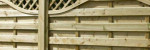

Quick answer: Good Decorative Fence Panels depend on more than appearance. Check the outer frame, timber section sizes, slat arrangement, spacing, pressure treatment, overall panel depth and how accurately the components are assembled. In the current East Coast Fencing range, Double Slatted, Hit & Miss and Omega Lattice panels all use 45 x 45mm framed construction, but the timber inside those frames is arranged differently. Those construction differences directly affect privacy, airflow, stiffness, appearance and how the panel should be installed.
Decorative fencing is often bought because of how it looks, but appearance is only half the story.
A panel can have attractive horizontal lines or an ornate lattice top and still be a poor choice if its construction does not suit the garden.
Understanding how Decorative Fence Panels are actually assembled gives you a much better way to compare them.
The current East Coast Fencing decorative range includes Double Slatted Fence Panels, Hit & Miss Fence Panels and Omega Lattice Fence Panels. All three use pressure-treated timber and framed construction, but the internal layout is very different.
What Should You Look at When Judging Decorative Fence Panel Quality?
Start with the construction rather than the pattern.
The most useful details to examine are:
- Outer frame section
- Panel depth
- Slat or batten dimensions
- Spacing between boards
- Whether boards are fitted to one or both faces
- How decorative sections are integrated into the frame
- Pressure treatment
- Overall panel width
- Accuracy of assembly
These details explain much more about the panel than a broad description such as "modern", "premium" or "decorative".
Why the Frame Matters
The frame is the main structural perimeter of these decorative panels.
It:
- Holds the internal slats or decorative sections in position
- Provides stiffness around the panel perimeter
- Gives installers a substantial area to support and handle
- Helps the complete panel retain its shape
The current Double Slatted, Hit & Miss and Omega Lattice products use a 45 x 45mm semi-planed timber frame and have an overall depth of approximately 45mm.
That common frame dimension also helps explain why the three ranges can feel related even though their internal designs are very different.
Why Framed Decorative Panels Behave Differently From Closeboard
Closeboard Fence Panels gain much of their stiffness from vertical feather edge boards attached across substantial horizontal backing rails.
These Decorative Fence Panels use a perimeter frame containing thinner slats, battens or lattice components.
That means their construction is better understood as:
- A structural outer frame
- A carefully arranged decorative screen inside it
rather than a traditional board-and-rail fence panel.
How Double Slatted Fence Panels Are Constructed
The current Double Slatted Fence Panels use a 45 x 45mm outer frame.
Inside that frame are horizontal semi-planed timber battens measuring approximately 8 x 45mm.
The battens are arranged on both faces of the panel, with gaps of roughly 40mm.
This double-sided arrangement is the key to how the panel works.
Why Put Slats on Both Sides?
A single row of widely spaced battens would provide limited screening.
By arranging battens on both faces, one layer helps interrupt the sightlines through the openings in the other.
This creates:
- More screening than simple open slats
- A layered appearance
- A finished look from both sides
- Openings that still allow some light and airflow
The result is deliberately different from a solid privacy panel.
Why the 40mm Gaps Are Part of the Design
The gaps should not be treated as missing timber.
They are fundamental to the way Double Slatted Fence Panels perform.
The openings allow:
- Light to filter through
- Air to pass through the boundary
- The panel to retain a visually lighter character
If complete opacity is required, this is not the construction to choose.
Reducing every opening would turn the panel into a fundamentally different product.
Why Thin Battens Can Still Make an Effective Screen
The individual Double Slatted battens are only one part of the construction.
Judging the panel from the thickness of one batten misses the important point that the battens work as a repeated two-sided arrangement within a substantial frame.
It is the combination of:
- 45 x 45mm frame
- 8 x 45mm battens
- Two-sided positioning
- Regular spacing
that creates the completed screen.
How Hit & Miss Fence Panels Are Constructed
Hit & Miss Fence Panels use the same broad 45 x 45mm framed format, but the internal timber is considerably wider.
The current panels use approximately 100 x 5mm grooved horizontal slats.
Those boards are fixed alternately to opposite faces.
This creates the characteristic hit and miss arrangement.
What Does Alternating the Boards Actually Achieve?
Imagine looking directly through a gap between two boards on the front face.
A board positioned on the rear face interrupts much of that direct line of sight.
The result is a screen that:
- Provides meaningful privacy from normal viewpoints
- Still contains openings
- Allows more airflow than solid fencing
- Presents timber on both faces
This construction is particularly useful where privacy and airflow both matter.
Why Hit & Miss Uses Wider Boards Than Double Slatted
The two products are aiming for a different visual effect.
Double Slatted uses relatively narrow battens to create fine repeated horizontal lines.
Hit & Miss uses broader 100mm slats to create a more substantial layered screen.
| Construction | Double Slatted | Hit & Miss |
|---|---|---|
| Outer frame | 45 x 45mm | 45 x 45mm |
| Internal timber | Approx. 8 x 45mm battens | Approx. 100 x 5mm grooved slats |
| Arrangement | Battens on both faces | Boards alternate between faces |
| Main effect | Fine contemporary screening | Broader layered screening |
Does Hit & Miss Have a Front and Back?
Not in the same way as a conventional one-sided panel.
Because boards are positioned on both faces, the design is intended to present a finished timber appearance from either side.
This is one reason Hit & Miss Fence Panels work particularly well on:
- Shared-looking boundaries
- Internal garden divisions
- Patios
- Areas where both faces remain visible
How Omega Lattice Fence Panels Are Constructed
Omega Lattice Fence Panels are the most structurally varied of the three decorative designs.
They combine two different types of screening within one frame.
The lower section uses approximately 100 x 5mm grooved horizontal boards arranged in a hit and miss pattern.
Above that is an integrated curved diamond-lattice section approximately 300mm deep.
The complete assembly sits within a 45 x 45mm semi-planed frame.
Why the Lattice Is Integrated Rather Than Added Afterwards
This is an important quality detail.
The curved diamond lattice is part of the manufactured panel design.
It is not simply a rectangular panel with a loose trellis panel screwed to the top after production.
Integrating the lattice allows the manufacturer to create:
- The curved Omega profile
- A consistent relationship between lower screen and lattice
- A continuous outer frame
- A more finished decorative appearance
Why Omega Lattice Uses Hit & Miss Construction Below
The lower part still needs to provide useful screening.
Using alternating horizontal boards gives the lower section:
- Partial privacy
- Some airflow
- A decorative appearance on both faces
The lattice then makes the upper part considerably more open.
This gives Omega Lattice Fence Panels a very different privacy profile from either a fully solid fence or a Double Slatted panel.
How the Three Decorative Constructions Compare
| Feature | Double Slatted | Hit & Miss | Omega Lattice |
|---|---|---|---|
| Frame | 45 x 45mm | 45 x 45mm | 45 x 45mm |
| Main screen | 8 x 45mm battens | 100 x 5mm grooved boards | 100 x 5mm grooved boards |
| Board arrangement | Double-sided slatting | Alternating faces | Hit & miss lower body |
| Open decorative section | No separate section | No separate section | Approx. 300mm curved diamond lattice |
| Visual character | Fine and contemporary | Layered and substantial | Decorative and traditional-modern |
| Openness | Filtered throughout | Airflow throughout | Most open at the top |
Why Consistent Spacing Is a Quality Issue
Decorative panels rely heavily on repetition.
When the design contains dozens of horizontal slats, small spacing errors are much easier to notice than they would be on a rustic overlap fence.
Poor spacing can create:
- Uneven sightlines
- Inconsistent privacy
- A visibly distorted pattern
- Misalignment between neighbouring panels
This is why accurate cutting and assembly matter particularly strongly with decorative fencing.
Horizontal Lines Expose Manufacturing Errors
The human eye is very good at spotting a line that suddenly changes direction.
On Double Slatted and Hit & Miss panels, the repeated horizontal timber effectively forms dozens of reference lines.
If:
- A board is noticeably out of level
- Spacing changes suddenly
- The frame is distorted
the defect can become obvious from several metres away.
Installation Accuracy Matters for the Same Reason
A perfectly assembled decorative panel can still look poor if the fence posts are badly set.
If one panel sits 20mm higher than the next, the horizontal lines may visibly jump at the post.
When installing a decorative run:
- Keep posts plumb
- Maintain consistent panel levels
- Check each bay before fixing permanently
- Stand back periodically and inspect the overall line
Why Omega Panels Need an Additional Alignment Check
Omega Lattice Fence Panels have both shoulders and a raised central curve.
This gives you more visual reference points than a straight-topped panel.
Across a continuous run, check:
- Shoulder height
- Centre height
- Frame level
- Spacing between panels
A small installation error that might be relatively inconspicuous on Closeboard fencing can become very noticeable when several repeated curves sit beside one another.
Why Panel Width Is an Important Quality and Compatibility Detail
The current imported Decorative Fence Panels are produced at 1.828m wide.
That is a true nominal UK 6ft width.
This distinction matters because many imported decorative panels are manufactured at 1.8m instead.
The difference is only 28mm per panel, but it can matter significantly when replacing fencing in existing traditional UK-width bays.
Why 28mm Can Matter on a Replacement Fence
Imagine an existing opening originally intended for an approximately 6ft panel.
If a substantially narrower replacement is installed, you may need:
- Additional packing
- Modified brackets
- Visible gaps
Using a panel designed around the traditional 1.828m format can make replacement work more straightforward.
You should still measure the actual opening because existing posts frequently move over time.
Measure Existing Bays at More Than One Height
Do not take one measurement at ground level and assume the complete opening is parallel.
Measure:
- Near the bottom
- At approximately mid-height
- Near the top
If the measurements differ significantly, one or both posts may be leaning.
Correct the structural problem rather than forcing a framed decorative panel into an unsuitable opening.
Why Panel Depth Matters
The current decorative panels have an overall depth of approximately 45mm.
This matters when installing into:
- Slotted concrete posts
- Existing timber-post bays
- Metal channels
- Custom retaining systems
Width alone does not establish compatibility.
A panel can have the correct overall width while being too thick for a particular post slot or fixing arrangement.
Can Decorative Fence Panels Be Used With Concrete Posts?
Potentially, where the post slots and actual panel dimensions are compatible.
Before ordering, check:
- Panel width
- Panel depth
- Concrete post slot width
- Clear distance between posts
- Available height above any gravel board
Do not assume compatibility from the phrase "6ft panel" alone.
Can Decorative Panels Be Used With Wooden Posts?
Yes.
Suitable wooden posts provide straightforward fixing points for framed panels and maintain a coordinated timber appearance.
Secure the panel through appropriate structural parts of the frame using exterior fixings suitable for the chosen installation method.
Do not rely on thin decorative slats as the main fixing points.
Why You Should Lift Decorative Panels by the Frame
The outer frame is the substantial perimeter component.
Individual internal slats are not designed to act as lifting handles for the entire panel.
When moving a panel:
- Support the outer frame
- Use enough people for larger panels
- Avoid dragging the lower edge
- Do not lift an Omega panel by its lattice top
Incorrect handling can damage an otherwise sound panel before it is even installed.
Why the Omega Lattice Top Needs Particular Care
Lattice is intentionally more open and delicate than the main structural frame.
The Omega top creates the decorative shape, but it should not be expected to carry the weight of a full-sized panel during handling.
Support the panel through the main frame and lower body.
This is particularly important with taller panels where the complete product is larger and more awkward to manoeuvre.
How Pressure Treatment Fits Into Quality
The current Decorative Fence Panels are pressure treated for outdoor use.
Pressure treatment improves the timber's resistance to biological deterioration compared with untreated timber.
It does not:
- Make the panel waterproof
- Prevent all timber movement
- Remove the need for ground clearance
- Make poor installation acceptable
A good fence combines treated timber with sensible detailing.
Why the Lower Frame Should Be Kept Clear of Soil
The bottom of a fence receives repeated exposure to:
- Rain splash
- Damp grass
- Wet soil
- Mulch
- Leaves
Keeping the lower frame away from persistent ground contact helps it dry more effectively.
A suitable gravel board can provide separation where the design requires one.
Should Decorative Panels Always Have Gravel Boards?
No.
The correct detail depends on the installation.
A gravel board is particularly worth considering where:
- The fence runs beside soil
- Ground levels are uneven
- Vegetation regularly reaches the panel base
- A concrete-post system already incorporates a gravel board
On a well-drained paved boundary, the priority may simply be maintaining sensible clearance and drainage.
Does a Gravel Board Affect the Appearance?
Yes.
Decorative fencing is often selected specifically for its proportions, so adding a substantial base changes the visual result.
A gravel board also raises the panel.
That affects:
- Total fence height
- Privacy
- The relationship between the panels and nearby walls or gates
Plan the complete fence rather than choosing the panel in isolation.
Why Semi-Planed Timber Is Used
The current imported decorative panels use semi-planed timber.
This gives the visible components a cleaner and more refined surface than rough sawn fencing timber while still retaining the natural characteristics of wood.
That makes sense for panels intended to be seen at close range around:
- Patios
- Seating areas
- Garden rooms
- Landscaped boundaries
Semi-Planed Does Not Mean Perfectly Uniform
Timber remains a natural material.
Expect some variation in:
- Grain
- Knots
- Shade
- Texture
A natural knot is not automatically a manufacturing defect.
The more useful question is whether the component remains structurally appropriate and securely integrated into the panel.
Where Are the Current Decorative Panels Manufactured?
The current Double Slatted, Hit & Miss and Omega Lattice ranges are manufactured in Poland and imported by East Coast Fencing.
This is different from East Coast Fencing's Closeboard, Waney Lap and Picket Fence Panels, which are manufactured in-house.
Knowing the distinction matters because genuine product expertise includes being clear about which products are made internally and which are produced to specification by external manufacturers.
Why Import Specification Matters
An imported panel does not have to use the most common dimensions found elsewhere in the European market.
The current decorative ranges are specified at 1.828m wide so they align with the traditional UK nominal 6ft panel format.
That is a practical product decision rather than a purely cosmetic one.
Compatibility with existing UK fence bays can be just as important as the pattern on the front of the panel.
What Does Good Decorative Panel Manufacturing Look Like?
Across a well-made framed decorative panel, you should expect the design to appear deliberate and repeatable.
Look for:
- A square, coherent outer frame
- Regular horizontal spacing
- Slats securely retained within the assembly
- Consistent board arrangement
- A lattice section that follows the intended pattern
- No major distortion through the panel
The more geometric the design, the more obvious poor assembly tends to become.
What Is Normal Timber Variation?
Normal characteristics can include:
- Knots
- Small shade differences
- Natural grain variation
- Minor surface texture differences
- Gradual colour change outdoors
These are different from structural defects.
What Should Cause More Concern?
Inspect more carefully if you find:
- A badly distorted outer frame
- Several loose slats
- Broken structural frame members
- A damaged Omega lattice section
- Major separation at joints
- A panel that cannot sit square within the intended bay
The condition of the structural assembly matters more than minor natural variation in individual timber pieces.
Does a Thicker Slat Automatically Mean a Better Decorative Panel?
No.
The Double Slatted and Hit & Miss ranges demonstrate why.
Double Slatted uses approximately 8 x 45mm battens.
Hit & Miss uses approximately 100 x 5mm slats.
Those dimensions are very different because the components perform differently within the design.
Neither can sensibly be judged from thickness alone.
Why Complete Construction Matters More Than One Dimension
A meaningful quality assessment considers:
- Frame section
- Internal timber dimensions
- Board orientation
- Spacing
- Number of layers
- Treatment
- Overall assembly
Picking the largest individual dimension from a specification sheet and declaring that panel strongest is rarely useful.
Does a Heavier Decorative Panel Mean Better Quality?
Not necessarily.
Weight is influenced by:
- The quantity of timber
- Panel height
- Moisture content
- Construction style
A heavier Omega panel, for example, performs a different job from a lower Double Slatted panel.
Quality should be judged against the intended use.
Which Construction Gives the Most Privacy?
Within decorative fencing, privacy depends on how effectively the timber interrupts sightlines.
Double Slatted Fence Panels provide substantial filtered screening through the layered batten arrangement.
Hit & Miss Fence Panels use wider alternating boards, giving substantial screening while intentionally retaining airflow.
Omega Lattice Fence Panels provide good screening through the lower hit and miss section but become considerably more open through the lattice top.
None should be treated as a completely solid equivalent to Closeboard Fence Panels.
Which Construction Allows the Most Light?
Omega Lattice Fence Panels allow particularly obvious light transmission through the open upper lattice.
Hit & Miss allows light through gaps distributed across the panel.
Double Slatted allows filtered light between its repeated horizontal battens.
The location of the openness therefore differs as much as the overall amount.
Which Construction Allows the Most Airflow?
Hit and miss construction is deliberately designed around airflow through alternating boards.
Double Slatted Fence Panels also retain gaps throughout the panel.
Omega combines an open lattice top with openings through the hit and miss lower section.
All three therefore permit more air movement than a fully solid panel, but none should be thought of as having no wind load.
Why Open Panels Still Need Strong Posts
Allowing air through does not make a panel immune to wind.
The frame, slats and lattice still present surface area.
At full height, a decorative fence needs suitable:
- Posts
- Post lengths
- Foundations
- Fixings
especially on exposed boundaries.
How Does Height Change the Importance of Construction?
A 3ft decorative screen and a 6ft decorative boundary may use the same design language, but the structural demands are different.
A taller panel has:
- More exposed area
- Greater leverage above ground
- More timber mass
- Greater sensitivity to poor post alignment
The taller the panel, the more important the complete fence system becomes.
Why Full-Height Horizontal Panels Need Accurate Post Setting
A slight lean may be difficult to notice beside a low screen.
Across a 1.8m-high decorative fence, that same error can create:
- A visibly sloping top line
- Misaligned horizontal slats
- Uneven gaps at posts
Accurate post installation is therefore part of the final perceived quality of the panel.
Can Decorative Fence Panels Be Repaired?
Minor repairs may be possible depending on the component and extent of the damage.
However, these panels are manufactured as integrated framed assemblies.
A repair becomes less attractive when:
- The main frame has failed
- Numerous slats are damaged
- The lattice has suffered widespread breakage
- The panel has become badly distorted
In those situations, replacing the complete panel may provide the cleaner result.
Why Replacing One Slat Is Not Always Straightforward
Decorative slats form part of a repeated pattern.
A replacement needs to match:
- Section size
- Profile
- Position
- Spacing
- Finish
An improvised board of approximately similar dimensions may remain visually obvious even if it closes the damaged area.
How Should You Inspect Older Decorative Fence Panels?
Look at the whole assembly.
Check:
- The outer frame for movement or breakage
- Individual slats for looseness
- Connections around the corners
- The lower frame for prolonged moisture exposure
- The Omega lattice for broken intersections
- The supporting posts for movement
Do not assume a panel has failed simply because the treatment colour has weathered.
Why Weathered Colour Is Not the Same as Structural Failure
Pressure-treated timber naturally changes colour outdoors.
The original green/natural appearance will not remain unchanged indefinitely.
Colour change alone tells you very little about:
- Frame integrity
- Slat security
- Post stability
- Overall panel strength
Inspect the timber physically rather than judging only from colour.
Can Decorative Fence Panels Be Painted?
Yes, once the pressure-treated timber is sufficiently dry and prepared for a compatible exterior coating.
Painting or staining changes appearance rather than construction.
It cannot:
- Strengthen a broken frame
- Repair loose slats
- Correct leaning posts
- Replace inadequate foundations
Repair structural problems before applying decorative finishes.
Which Decorative Construction Should You Choose?
Choose Double Slatted Fence Panels where you want:
- Fine horizontal lines
- A contemporary appearance
- Useful layered screening
- Some light and airflow
Choose Hit & Miss Fence Panels where you want:
- Wider horizontal boards
- Screening from both sides
- Greater emphasis on airflow
- A robust layered appearance
Choose Omega Lattice Fence Panels where you want:
- Useful lower screening
- A curved decorative profile
- An open upper section
- More compatibility with climbing plants and softer garden styles
Do Not Choose Decorative Fencing on Appearance Alone
A garden photograph can tell you whether you like the pattern.
It cannot tell you whether the panel suits your boundary.
Before choosing, consider:
- Required privacy
- Wind exposure
- Existing post spacing
- Post slot compatibility
- Required height
- Ground conditions
- Whether both faces will be visible
Decorative Fence Panel Quality Checklist
- Check the actual panel width.
- Check the overall panel depth.
- Look at the outer frame section.
- Identify the size and arrangement of the internal slats.
- Understand where the panel is intentionally open.
- Check that horizontal spacing is consistent.
- Inspect the frame for major distortion.
- Check how decorative lattice sections are incorporated.
- Confirm that the timber is pressure treated.
- Measure existing bays rather than relying on nominal dimensions.
- Check concrete-post slots where relevant.
- Keep the lower timber clear of persistent soil contact.
- Support the panel through the main frame during handling.
- Use posts and foundations suitable for the height and exposure.
FAQs
What Makes Decorative Fence Panels Good Quality?
Good-quality decorative fencing combines a suitable structural frame with accurately spaced internal timber, secure assembly, appropriate pressure treatment and dimensions that work with the intended fence system. Consistency becomes especially important with repeated horizontal or lattice patterns.
How Thick Are the Current Decorative Fence Panels?
The current Double Slatted, Hit & Miss and Omega Lattice panels have an overall depth of approximately 45mm.
What Size Frame Is Used?
The current ranges use a 45 x 45mm semi-planed timber outer frame.
How Are Double Slatted Fence Panels Made?
The current design uses approximately 8 x 45mm horizontal battens arranged on both faces within a 45 x 45mm frame, with gaps of roughly 40mm between battens.
How Are Hit & Miss Fence Panels Made?
The current panels use approximately 100 x 5mm grooved horizontal slats positioned alternately on the two faces of a 45 x 45mm frame.
How Are Omega Lattice Fence Panels Made?
The lower section uses approximately 100 x 5mm grooved horizontal slats in a hit and miss arrangement, while an integrated curved diamond-lattice section approximately 300mm deep forms the decorative top. The complete panel uses a 45 x 45mm outer frame.
Are Decorative Fence Panels Pressure Treated?
Yes. The current East Coast Fencing decorative panel ranges discussed here are pressure treated in a green/natural finish for outdoor use.
Are East Coast Fencing Decorative Fence Panels Made In-House?
The current Double Slatted, Hit & Miss and Omega Lattice ranges are manufactured in Poland and imported by East Coast Fencing. This differs from East Coast Fencing's Closeboard, Waney Lap and Picket Fence Panels, which are manufactured in-house.
How Wide Are the Decorative Fence Panels?
The current Double Slatted, Hit & Miss and Omega ranges use a true nominal 6ft width of approximately 1.828m.
Why Is 1.828m Important?
It corresponds with the traditional UK 6ft fence panel format and can be particularly useful for replacement work in existing UK-width bays. Actual openings should still be measured before ordering.
Are Decorative Fence Panels Completely Private?
No. Double Slatted and Hit & Miss panels intentionally retain openings, while Omega panels have an open lattice upper section. They provide different levels of screening rather than the solid face associated with Closeboard fencing.
Which Decorative Fence Panel Allows the Most Airflow?
Hit & Miss is specifically designed around alternating boards that allow air to pass through. Double Slatted and Omega designs also contain openings and allow airflow to varying degrees.
Which Decorative Panel Is Best for Climbing Plants?
Omega Lattice Fence Panels provide an integrated open lattice top that can support suitable manageable climbing plants. Heavy mature planting should still be controlled because it adds weight and wind resistance.
Can Decorative Fence Panels Fit Concrete Posts?
Potentially, provided the 45mm panel depth, actual width and frame dimensions are compatible with the slots and clear opening of the post system.
Should You Lift a Decorative Panel by the Slats?
No. Support the panel through its main outer frame. Omega panels should never be lifted by the decorative lattice top.
Are Knots a Sign of Poor Quality?
Not automatically. Knots, grain differences and colour variation are normal features of natural timber. Structural frame damage, widespread loose slats or severe distortion are more significant concerns.
Does Painting Improve Panel Strength?
No. A decorative coating changes the appearance and may provide additional surface weather protection depending on the product, but it does not repair structural defects.
What Really Separates One Decorative Fence Panel From Another?
Look inside the frame.
The current Double Slatted, Hit & Miss and Omega Lattice Fence Panels all share a 45 x 45mm framed format and pressure-treated timber, but that is where the similarity ends.
Double Slatted panels use relatively narrow 8 x 45mm battens on both faces with approximately 40mm gaps. That produces the fine horizontal pattern and filtered screening associated with the design.
Hit & Miss panels use much wider 100 x 5mm grooved boards, alternating them between the front and rear faces. The wider boards create a more substantial screen while intentionally retaining routes for airflow.
Omega Lattice panels use that same broad hit and miss principle through the lower body, then integrate an approximately 300mm-deep curved diamond lattice into the upper frame. That changes both the appearance and where light passes through the panel.
These are real construction differences, not simply different decorative names applied to similar fencing.
They affect what you can see through the panel, how open the boundary feels, how carefully the horizontal lines need to be aligned and how the panel should be handled during installation.
Quality therefore comes from choosing a panel whose construction suits the job and then installing it correctly.
If you understand the frame, the timber sections, the spacing and the way the boards are arranged, choosing between Decorative Fence Panels becomes much easier than judging them from appearance alone.