





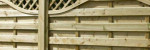

Quick answer: Feather edge and closeboard are closely related, but they are not technically identical terms. Feather edge describes the tapered vertical timber boards used to create the face of the fence. Closeboard describes the complete fencing system, typically made from overlapping feather edge boards fixed to horizontal rails between posts. In everyday use, people often say "feather edge fencing" and "closeboard fencing" to mean the same style of solid timber boundary.
Feather edge and closeboard are two terms you will encounter repeatedly when shopping for traditional timber fencing.
They are often used interchangeably, which is understandable because feather edge boards are the main visible component of a traditional closeboard fence. However, saying that feather edge and closeboard are literally the same thing misses an important distinction.
A feather edge board is an individual tapered timber board. Closeboard fencing is the complete fence construction created by overlapping those boards and supporting them with rails, posts and usually a gravel board.
You can also buy closeboard fence panels that recreate the same familiar overlapping-board appearance in a prefabricated panel format.
Understanding these differences makes it much easier to choose between individual fencing components and ready-made panels, calculate materials and identify exactly what you need for a new boundary.
What Is A Feather Edge Board?
A feather edge board is a long vertical timber board that is thicker along one edge and thinner along the other.
That tapered profile allows neighbouring boards to overlap.
Instead of placing boards edge to edge, each feather edge board covers part of the previous board. The result is a continuous timber face with very little direct visibility through the fence.
Feather edge boards are commonly used for:
- Traditional closeboard fencing
- Closeboard fence panels
- Custom-width fence sections
- Boundaries on sloping ground
- Repairs to existing closeboard fences
The board itself is only one component. It still needs rails, posts and appropriate fixings to become a complete fence.
What Is Closeboard Fencing?
Closeboard fencing is a traditional timber fencing system constructed from overlapping vertical boards.
A typical closeboard fence consists of:
- Fence posts
- Horizontal rails
- Feather edge boards
- A gravel board
- Suitable exterior fixings
- Optional capping
The rails span horizontally between the posts. Feather edge boards are then fixed vertically across the rails with each board overlapping the next.
The finished fence provides a solid boundary suitable for privacy, security and general garden separation.
Are Feather Edge And Closeboard The Same Thing?
In everyday conversation, the two terms are frequently used to describe the same style of fence.
Technically, however:
- Feather edge refers to the tapered timber boards.
- Closeboard refers to the fencing system that uses overlapping boards.
A useful comparison is bricks and a brick wall.
A brick is a component. A brick wall is the completed structure.
In much the same way, feather edge boards are components used to construct closeboard fencing.
That said, the term "feather edge fencing" is widely understood to mean a closeboard-style fence made with feather edge boards, so homeowners will commonly see both descriptions used for similar products and installations.
What Does A Traditional Closeboard Fence Look Like?
A traditional closeboard fence has a strong vertical appearance.
The visible surface is formed by rows of overlapping feather edge boards running from the lower gravel board towards the top of the fence.
Behind those boards are horizontal support rails.
Depending on the installation, the fence may use:
- Timber posts
- Concrete posts with suitable arrangements
- Wooden gravel boards
- Concrete gravel boards
Capping can also be added along the top to provide a more finished appearance.
How Do Feather Edge Boards Create Privacy?
The privacy comes from the overlap.
If vertical boards were simply placed beside one another without overlap, small gaps could appear as the timber moved and dried.
Feather edge construction allows each board to cover part of its neighbour.
This creates a more continuous screen and helps accommodate some of the normal movement that occurs in exterior timber.
For this reason, closeboard fencing is widely used around:
- Back gardens
- Patios
- Family gardens
- Side boundaries
- Sheds and utility areas
Which Way Should Feather Edge Boards Overlap?
The thick edge of each board overlaps the thinner edge of the neighbouring board.
This repeated arrangement creates the characteristic closeboard appearance.
The overlap should remain reasonably consistent along the fence.
Too little overlap can create gaps as the boards move. Excessive overlap uses more timber than necessary and can make calculating materials difficult.
When constructing a complete run, establish the intended effective cover of each board before calculating how many boards will be required.
What Is A Closeboard Fence Panel?
A closeboard fence panel is a prefabricated panel that uses feather edge boards to produce the same general appearance as traditional closeboard fencing.
The important difference is where the assembly happens.
Traditional closeboard fencing is constructed along the boundary from individual components.
A closeboard panel arrives as a completed framed section and is installed between posts.
| Feature | Traditional Closeboard | Closeboard Panels |
|---|---|---|
| Construction | Built from individual components | Prefabricated framed panel |
| Main facing | Feather edge boards | Feather edge boards |
| Width flexibility | Highly flexible | Based around panel bays |
| Sloping ground | Can follow slope more closely | Usually stepped |
| Installation | More individual assembly | Faster panel-by-panel fitting |
Is Traditional Closeboard Better Than Closeboard Panels?
Neither format is automatically better.
Traditional closeboard offers greater flexibility because the fence is constructed specifically for the boundary.
Closeboard panels make installation more modular because the feather edge boards, framing and rails are already assembled into individual sections.
Your choice depends largely on:
- Boundary length
- Ground slope
- Existing post positions
- Available installation time
- Whether unusual bay widths are involved
- How much on-site carpentry you want to undertake
When Is Traditional Closeboard Fencing Useful?
Building from individual feather edge boards is particularly useful where a boundary does not divide conveniently into standard panel bays.
Examples include:
- Irregular garden widths
- Short final sections
- Boundaries around structures
- Changing ground levels
- Long fencing runs
Because the fence is assembled on site, the spacing and board coverage can be adapted to the actual garden.
When Are Closeboard Fence Panels Useful?
Panels are useful where you want the familiar closeboard appearance in a straightforward modular system.
They work particularly well for:
- Straight garden boundaries
- Replacement panel fencing
- Concrete post systems
- Timber post systems
- Projects where rapid installation is useful
Standard closeboard panels are commonly supplied in nominal 6ft widths and a selection of heights.
Heavier-duty closeboard panels are also available where a more substantial panel construction is preferred.
What Are Feather Edge Boards Made From?
Feather edge boards are generally manufactured from softwood timber.
The board is sawn so that one side is noticeably thicker than the other.
Typical feather edge boards are available in a range of lengths to suit different fence heights.
Pressure-treated boards are particularly appropriate for external fencing because they are intended for outdoor exposure.
East Coast Fencing feather edge boards are nominally 125 x 22mm 2EX and are available in lengths including:
- 0.9m
- 1.2m
- 1.5m
- 1.65m
- 1.8m
- 2.1m
Pressure-treated brown and green options are available.
What Rails Are Used For Closeboard Fencing?
Horizontal rails provide the structure to which the feather edge boards are fixed.
Cant rails are commonly used for traditional closeboard fencing.
These rails span between the fence posts and create the horizontal framework behind the boards.
Pressure-treated cant rails are available in useful lengths including 2.4m and 3.0m.
The number and arrangement of rails should suit the height and construction of the fence.
Why Are Cant Rails Shaped?
Cant rails have an angled profile rather than being simple rectangular rails.
This shape helps shed water rather than providing a broad flat horizontal surface where moisture can sit.
The rail still performs the same fundamental structural role: supporting the vertical boards and transferring loads towards the posts.
Do Closeboard Fences Need Gravel Boards?
A gravel board is strongly recommended where the bottom of the timber fence would otherwise sit close to the ground.
It creates a sacrificial or durable lower section beneath the feather edge boards.
This helps separate the main fence from:
- Wet soil
- Grass
- Mulch
- Mud splash
- Garden debris
Both wooden and concrete gravel boards can be used depending on the overall fencing system.
Wooden Or Concrete Gravel Boards For Closeboard Fencing?
Wooden gravel boards provide a consistent all-timber appearance.
They are also lighter and easy to cut where a non-standard bay is required.
Concrete gravel boards provide greater resistance to prolonged ground-level moisture because they do not rot.
They are especially suitable when closeboard panels are being installed between slotted concrete posts.
Choose the gravel board as part of the complete post and panel system rather than treating it as an independent accessory.
What Fence Posts Work With Closeboard Fencing?
Traditional closeboard fencing is commonly constructed using timber posts.
Typical pressure-treated timber post sizes include:
- 75 x 75mm
- 100 x 100mm
Post size and length should be selected according to:
- Fence height
- Exposure
- Ground conditions
- Bay length
- Gate loads
Closeboard fence panels can also be used within compatible slotted concrete post systems.
Are Concrete Posts Better For Closeboard Panels?
Concrete posts have several practical advantages.
They do not suffer from timber rot and allow compatible panels and gravel boards to sit within slots.
If a panel becomes damaged later, it can often be lifted out and replaced while the posts remain in place.
However, concrete posts are substantially heavier than timber and create a more visibly structural boundary.
Timber posts may suit homeowners who prefer an all-timber appearance or want easier cutting and fixing during installation.
How Strong Is Closeboard Fencing?
Closeboard is widely regarded as a substantial traditional fencing design.
Its performance comes from the complete system rather than the feather edge boards alone.
A strong fence depends on:
- Suitable posts
- Secure foundations
- Correct rail spacing
- Appropriate feather edge overlap
- Exterior fixings
- Good installation
A heavy panel fitted to weak or badly installed posts will not create a strong boundary.
Is Closeboard Fencing Good For Privacy?
Yes.
Privacy is one of the main reasons homeowners choose closeboard.
The overlapping vertical boards produce a much more continuous screen than open fencing styles such as picket panels or trellis.
It works particularly well around:
- Rear gardens
- Patios
- Hot tubs
- Outdoor dining areas
- Neighbouring boundaries
Finished fence height should still comply with relevant planning rules.
Is Closeboard Fencing Good For Security?
Closeboard creates a solid physical boundary and provides fewer obvious openings than decorative or open fencing.
This can make it a good general garden-security option.
Security still depends on the whole boundary.
Check:
- Gate strength
- Gate hinges
- Latches and bolts
- Post stability
- Panel fixings
- Gaps beneath the fence
A strong fence combined with a weak garden gate does not create a secure enclosure.
Is Closeboard Fencing Good For Dogs?
It can be.
The overlapping boards provide a largely solid visual boundary, which can be useful for dogs that react to movement in neighbouring gardens.
Check the complete fence for:
- Gaps underneath
- Loose boards
- Damaged gravel boards
- Gate clearance
- Potential climbing points
The required height depends on the dog's size and behaviour.
Is Closeboard Fencing Good For Windy Gardens?
Closeboard fencing is solid, which means it presents a considerable surface area to the wind.
That does not mean it cannot be used in exposed gardens, but the supporting structure becomes particularly important.
Consider:
- Post dimensions
- Post depth
- Foundation size
- Fence height
- Exposure
- Condition of existing posts
Where airflow through the boundary is a priority, a more open design such as hit and miss fencing may be worth considering.
Can Closeboard Fencing Follow A Sloping Garden?
Yes.
This is one of the advantages of building traditional closeboard fencing from individual components.
The boards can be arranged so the top of the fence follows the slope more gradually than rigid rectangular panels.
Closeboard panels can also be installed on slopes, but they are normally stepped from one bay to the next.
The better approach depends on:
- Severity of the slope
- Desired top line
- Panel versus component construction
- Changes in ground level
Can Feather Edge Boards Be Used For Non-Standard Fence Widths?
Yes.
This is one of the strongest reasons to build a closeboard fence on site.
Instead of trying to squeeze a standard panel into an unusual opening, individual boards and rails can be arranged to suit the available run.
This is useful:
- Beside garages
- Against garden walls
- Near gate openings
- At the end of a fencing run
- Around irregular garden shapes
Can A Closeboard Panel Be Cut Down?
It is sometimes possible to shorten framed timber panels, but doing so is more complicated than simply cutting individual feather edge boards.
The panel frame and rails still need to remain adequately supported.
For a single narrow final bay, site-built closeboard fencing can sometimes offer a cleaner solution.
How Many Feather Edge Boards Do You Need?
The quantity depends on:
- Total fence length
- Board width
- Chosen overlap
Do not calculate the number of boards by dividing the fence length by the full nominal width of each board because part of every board is hidden by the overlap.
Instead, determine the effective visible cover of each board after overlap.
For example, if your chosen installation arrangement means each board effectively covers a particular width of fence, divide the total run by that effective cover and allow appropriately for ends, corners and waste.
Consistency matters more than trying to maximise the visible width of every board.
Should Feather Edge Boards Touch The Ground?
Ideally, the main feather edge boards should be kept away from wet ground.
A gravel board provides the lower edge of the fence and allows the feather edge boards to begin above it.
This reduces direct exposure to:
- Wet soil
- Standing water
- Grass
- Mulch
Even pressure-treated timber benefits from sensible detailing that avoids unnecessary prolonged moisture.
Should Feather Edge Boards Be Nailed Or Screwed?
Both fixing methods can be used where suitable exterior-grade fixings and an appropriate installation method are selected.
Nailing is traditionally common for large runs of feather edge because it can be efficient.
Screws make individual boards easier to remove later but can require more installation time.
Whichever method is used:
- Use fixings suitable for exterior timber
- Avoid damaging the timber by overdriving fixings
- Fix into the supporting rails rather than relying on neighbouring boards
- Keep the board overlap consistent
Should You Fix Through Both Feather Edge Boards?
Allowing timber to move naturally is an important part of exterior timber construction.
Avoid unnecessarily pinning overlapping boards tightly together with a fixing passing through multiple layers where the chosen construction method does not require it.
The boards should be securely attached to the supporting rails while retaining their intended overlapping arrangement.
Why Do Feather Edge Boards Move?
Timber is a natural material.
Its moisture content changes as weather conditions change, which can cause boards to:
- Shrink
- Swell
- Twist slightly
- Develop surface checks
This normal timber movement is one reason the overlapping feather edge design works so well.
The fence does not depend on every board remaining exactly the same width throughout its life.
Is Pressure-Treated Feather Edge Better?
Pressure treatment is appropriate for exterior fencing because preservative is introduced into the timber to improve resistance to biological deterioration.
It reduces the need to rely on frequent surface treatment as the primary protection system.
Pressure-treated timber can still:
- Weather in colour
- Develop small surface splits
- Move as moisture changes
These characteristics do not automatically indicate failure.
What Is The Difference Between Green And Brown Feather Edge?
The main visible difference is the treatment colour.
Green-treated timber has the familiar greenish appearance associated with many pressure-treated garden products.
Brown treatment gives the timber a warmer brown appearance.
Both colours will alter as the timber is exposed to sunlight and weather.
Choose the initial colour that works best with your posts, panels, gravel boards and surrounding garden.
Can You Paint Feather Edge Fencing?
Yes.
Once the timber is suitably dry and prepared, feather edge fencing can be coated with an appropriate exterior timber product.
Painting or staining can be used to:
- Change the colour
- Coordinate the fence with sheds or garden buildings
- Create a darker backdrop for planting
Follow the coating manufacturer's instructions regarding timber preparation and application.
Do You Need To Paint Pressure-Treated Closeboard Fencing?
Not simply to make the initial preservative treatment work.
Pressure-treated fencing can be left to weather naturally.
Decorative coatings are optional and can be used when a particular appearance is desired.
If you choose to coat the fence, future maintenance of that decorative finish will become part of the upkeep.
How Do You Maintain Closeboard Fencing?
A sensible maintenance routine is relatively straightforward.
Inspect the fence periodically for:
- Loose boards
- Damaged rails
- Leaning posts
- Failed gravel boards
- Vegetation pressing against the fence
- Loose gate hardware
Deal with structural problems early.
A loose feather edge board is generally a much simpler repair than a fence that has been allowed to move until rails and posts are also damaged.
Should You Pressure Wash Feather Edge Fencing?
High-pressure cleaning can damage the surface of timber if used aggressively.
For routine dirt and algae, begin with gentler cleaning methods.
If powered cleaning equipment is used, use a cautious setting and technique appropriate for exterior timber rather than directing an unnecessarily powerful jet at close range.
Should Plants Be Kept Away From Closeboard Fencing?
Some planting around a fence is perfectly normal, but dense vegetation directly against timber can retain moisture and make inspection difficult.
Leave enough access to:
- Inspect boards
- Repair fixings
- Replace damaged sections
- Control climbing plants
Heavy climbers should have suitable support rather than relying entirely on individual feather edge boards.
Can Individual Feather Edge Boards Be Replaced?
Yes.
This is one of the practical advantages of traditional closeboard construction.
If an isolated board becomes damaged, it may be possible to replace that individual component rather than rebuilding the entire fence section.
Before doing so, also inspect the rails behind it.
A damaged board can sometimes be the visible symptom of a larger structural issue.
Can Closeboard Fence Panels Be Repaired?
Minor panel damage can sometimes be repaired, depending on the construction and condition of the frame.
However, if the panel frame or main support rails are extensively deteriorated, complete panel replacement may be the more practical option.
This is another distinction between prefabricated panels and site-built closeboard fencing.
How Long Does Closeboard Fencing Last?
There is no single lifespan that applies to every closeboard fence.
Service life depends on the entire installation, including:
- Timber treatment
- Post type
- Ground conditions
- Drainage
- Wind exposure
- Installation quality
- Maintenance
The posts are particularly important because a perfectly serviceable panel or run of boards cannot remain upright if its supports fail.
What Usually Fails First On A Closeboard Fence?
There is no universal answer, but common areas to inspect include:
- Timber posts around ground level
- Lower rails
- Gravel boards
- Individual boards around failed fixings
In exposed locations, wind movement can also loosen components over time.
Regular inspection helps identify small defects before they affect the wider fence.
Can Concrete Repair Spurs Be Used With Closeboard Fencing?
Concrete repair spurs can sometimes be used to support a failed timber fence post without dismantling the complete fence.
The suitability of a repair spur depends on:
- Condition of the remaining timber post
- Fence height
- Ground conditions
- Cause of the failure
A repair spur is not a solution for every badly deteriorated fence.
Is Feather Edge Fencing Cheaper Than Fence Panels?
There is no reliable universal answer because the comparison depends on the complete specification.
Traditional closeboard requires individual:
- Boards
- Rails
- Posts
- Gravel boards
- Fixings
It can also involve more on-site labour.
Panels arrive preassembled but still require posts, gravel boards and installation.
Compare the complete installed system rather than the price of feather edge boards against the price of one fence panel.
Which Is Better For DIY Installation?
Closeboard panels are often simpler for a straightforward DIY boundary because much of the timber assembly has already been completed.
Traditional closeboard gives greater flexibility but requires more measuring, cutting and individual fixing.
Building from feather edge boards may suit someone comfortable with:
- Setting out rails
- Maintaining board overlap
- Cutting timber
- Working around non-standard bays
Which Is Better For A Long Boundary?
Both systems can work.
Traditional closeboard can be attractive for long runs because it is not restricted to repeated prefabricated panel widths.
Panel fencing can make installation more modular and individual future panel replacement straightforward.
For either system, spend time getting the posts straight and accurately aligned.
A long fence exaggerates small inconsistencies.
Can You Add Trellis To Closeboard Fencing?
Yes, where the posts and overall construction can support it.
Trellis can be used to:
- Add decorative detail
- Support climbing plants
- Create filtered screening above the solid fence
Remember that permanent trellis contributes to the overall height of the enclosure for planning purposes.
Can You Add Capping To Feather Edge Fencing?
Yes.
Capping creates a cleaner visual line along the top of the fence.
It can be particularly effective on a long straight closeboard boundary where a consistent top edge is visually prominent.
Pressure-treated fence capping is available to coordinate with other treated timber components.
What Height Feather Edge Boards Do You Need?
The appropriate board length depends on the desired fence height and construction.
Do not choose the board length by looking only at the intended finished height.
Also consider:
- Gravel-board height
- Position of the rails
- Required board coverage
- Top finishing detail
- Changes in ground level
For panel fencing, the nominal panel height and gravel-board height together determine much of the completed boundary height.
Does A Gravel Board Increase The Fence Height?
Yes.
If a gravel board raises the main fencing above ground level, it contributes to the overall height of the enclosure.
This is important because planning rules apply to the complete fence, not simply the feather edge boards or nominal panel height.
Include:
- Visible gravel board
- Main fence
- Trellis
- Permanent top features
when checking the final height.
Is Closeboard The Same As Waney Lap?
No.
Both provide traditional timber screening, but their construction is different.
Closeboard uses vertical overlapping feather edge boards.
Waney lap panels use horizontal overlapping boards.
The visual difference is therefore easy to identify:
- Closeboard: strong vertical lines
- Waney lap: horizontal overlapping boards
Is Closeboard The Same As Hit And Miss?
No.
Hit and miss fencing uses boards arranged alternately on opposite sides of the supporting framework.
This creates more airflow and filtered visibility through the boundary.
Closeboard is intended to create a more continuously screened surface.
Is Closeboard The Same As Picket Fencing?
No.
Picket fencing intentionally leaves gaps between individual pales.
It is primarily used for:
- Lower boundaries
- Front gardens
- Internal garden divisions
- Decorative fencing
Closeboard is generally chosen where privacy is considerably more important.
What Are The Advantages Of Feather Edge And Closeboard Fencing?
- Excellent privacy
- Traditional appearance
- Strong vertical design
- Individual boards can be used for custom-width fencing
- Suitable for sloping boundaries
- Available as both components and prefabricated panels
- Works with timber or compatible concrete systems
- Individual components can often be repaired
What Are The Disadvantages?
No fencing system is perfect for every site.
Points to consider include:
- Solid fencing catches more wind than open designs
- Site-built closeboard requires more labour than installing prefabricated panels
- Timber posts require appropriate treatment and installation
- Regular inspection is still required
- Individual boards need consistent overlap
- Very exposed gardens may benefit from a more open design
What Should You Buy For Traditional Closeboard Fencing?
A typical material list may include:
- Feather edge boards
- Timber fence posts
- Cant rails
- Wooden or appropriate gravel boards
- Suitable exterior fixings
- Post mix
- Capping if required
Gate openings require separate consideration because the gate should be supported by suitable gate posts and appropriate ironmongery.
What Should You Buy For Closeboard Panel Fencing?
A typical panel installation may require:
- Closeboard fence panels
- Timber or concrete fence posts
- Compatible gravel boards
- Panel clips or appropriate brackets where required
- Suitable fixings
- Post mix
- Gate components where applicable
Confirm compatibility before ordering, particularly when combining new panels with existing posts.
Common Feather Edge And Closeboard Mistakes
- Assuming feather edge and closeboard are technically identical terms
- Buying individual boards when a panel system was intended
- Buying panels when an irregular boundary would suit site-built fencing better
- Calculating boards using their full width without allowing for overlap
- Letting feather edge boards sit directly in wet soil
- Using weak posts for a tall solid fence
- Ignoring wind exposure
- Forgetting gravel-board height when calculating total fence height
- Using incompatible panels, posts and gravel boards
- Failing to plan gate posts separately
- Allowing dense vegetation to overload the fence
Feather Edge And Closeboard Buying Checklist
Before ordering, check:
- Do I want traditional site-built closeboard or ready-made panels?
- How long is the complete boundary?
- Does the garden slope?
- Are there non-standard bays?
- What finished fence height do I need?
- Will gravel boards be used?
- Do I want timber or concrete posts?
- How exposed is the garden?
- Where will gates be positioned?
- Will trellis or capping be added?
- Are existing posts being reused?
- Have I checked the complete system for compatibility?
FAQs
Are Feather Edge And Closeboard Fencing The Same?
They are closely related but not technically identical terms. Feather edge describes the tapered boards. Closeboard describes the complete fencing system made using overlapping boards. In everyday use, "feather edge fencing" is commonly used to mean closeboard fencing.
What Is A Feather Edge Board?
It is a tapered timber board with one thicker edge and one thinner edge, designed to overlap neighbouring boards.
What Is Closeboard Fencing?
Closeboard is a solid timber fencing system made from overlapping vertical boards supported by horizontal rails and posts.
What Is A Closeboard Fence Panel?
It is a prefabricated framed panel using feather edge boards to create the traditional closeboard appearance.
Is Feather Edge Fencing The Same As A Closeboard Panel?
Not exactly. Feather edge fencing can describe a fence constructed from individual feather edge boards, while a closeboard panel is a completed framed section.
Is Closeboard Stronger Than Feather Edge?
The comparison is misleading because feather edge boards are normally part of a closeboard fence. Strength depends on the complete construction, including posts, rails, boards, foundations and fixings.
Is Closeboard Fencing Good For Privacy?
Yes. The overlapping boards create a largely solid visual screen.
Is Closeboard Fencing Good For Security?
It provides a substantial physical boundary with few obvious gaps, although gates, posts and fixings also need to be secure.
Is Closeboard Fencing Good For Windy Gardens?
It can be used in exposed gardens, but because it is solid it catches considerable wind. Strong posts, foundations and suitable installation are particularly important.
Can Closeboard Fencing Go On A Slope?
Yes. Site-built closeboard can be adapted to follow a slope, while rigid closeboard panels are commonly stepped.
Can Feather Edge Boards Be Cut?
Yes. Individual boards are straightforward to cut to suit the required height or installation detail.
Can Closeboard Panels Be Cut Down?
Potentially, but shortening a framed panel requires more care because the framing and rails must remain properly supported.
Do Feather Edge Boards Need To Overlap?
Yes. The overlap is a fundamental part of the closeboard design and creates the continuous screened face.
Which Edge Of Feather Edge Goes Over The Other Board?
The thicker edge overlaps the thinner edge of the neighbouring board.
How Much Should Feather Edge Boards Overlap?
The overlap should be consistent and sufficient to maintain screening while allowing for normal timber movement. Follow the specification appropriate to the boards and fence design being used.
How Many Feather Edge Boards Do I Need?
Calculate the quantity from the total fence run and the effective cover of each board after overlap, rather than using the full nominal board width.
Do Feather Edge Boards Need Gravel Boards?
A gravel board is strongly recommended where the timber would otherwise sit close to wet ground.
Can I Use Concrete Gravel Boards With Closeboard?
Yes, particularly with compatible closeboard panels and slotted concrete posts.
Can I Use Wooden Gravel Boards?
Yes. Wooden boards work especially well with timber posts and create an all-timber appearance.
Can I Use Concrete Posts With Closeboard?
Compatible closeboard panels can be installed between slotted concrete posts. Traditional site-built arrangements need to be planned according to the chosen post and rail system.
Are Timber Posts Good For Closeboard Fencing?
Yes. Pressure-treated timber posts are a traditional choice and create an all-timber boundary.
Can You Paint Closeboard Fencing?
Yes, once the timber is sufficiently dry and properly prepared for the chosen exterior coating.
Does Pressure-Treated Closeboard Need Painting?
No. Painting is optional for decorative purposes rather than automatically required for the initial preservative treatment.
Can You Replace One Feather Edge Board?
Yes. Individual damaged boards in traditional closeboard fencing can often be replaced without rebuilding the complete fence.
Can You Add Trellis To Closeboard Fencing?
Yes, where the posts and structure can support it. The trellis contributes to the overall fence height.
Is Closeboard The Same As Waney Lap?
No. Closeboard uses vertical overlapping feather edge boards, while waney lap uses horizontal overlapping boards.
Is Closeboard Better Than Waney Lap?
Closeboard generally provides a more substantial construction, while waney lap offers a simpler traditional panel. The best choice depends on the garden, budget, exposure and desired appearance.
Is Closeboard The Same As Hit And Miss?
No. Hit and miss fencing has a more open alternating-board construction, while closeboard creates a more solid visual screen.
Should I Choose Closeboard Panels Or Build From Feather Edge?
Choose panels for straightforward modular installation. Build from individual feather edge boards where you want greater flexibility over bay width, slope and construction.
Choose Between Components And Panels, Not Between Feather Edge And Closeboard
The most useful way to understand the terminology is simple: feather edge is the board, while closeboard is the fencing system.
The two terms are often used interchangeably because feather edge boards create the familiar face of a closeboard fence, but the distinction matters when you start ordering materials.
If you want a traditional fence constructed specifically for the boundary, individual pressure-treated feather edge boards can be combined with suitable posts, cant rails, gravel boards and exterior fixings. This approach offers excellent flexibility for unusual widths and sloping gardens.
If you prefer a quicker modular installation, ready-made closeboard panels provide the same characteristic overlapping-board appearance in framed nominal 6ft sections. These can be combined with compatible timber or concrete posts and suitable gravel boards.
Whichever route you choose, plan the complete fencing system before buying individual components. Match the feather edge boards or panels with suitable posts, rails, gravel boards, gate components, capping and fixings, and account for the finished fence height and site exposure from the beginning.