





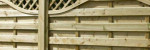

Quick answer: Both wooden and compatible slotted concrete posts can be used with Decorative Fence Panels. Wooden posts usually give Double Slatted, Hit & Miss and Omega Lattice panels the most coordinated appearance and provide flexible fixing points. Concrete posts create a durable, rigid support system and can make individual panel replacement easier. The right choice depends on appearance, panel height, ground conditions, exposure and compatibility. Always check the actual panel width and frame thickness before fitting decorative panels into existing concrete post slots.
Decorative fencing tends to attract more attention than an ordinary garden boundary.
That means the posts matter visually as well as structurally.
A row of Double Slatted Fence Panels between timber posts creates a very different finished garden from the same panels installed between concrete posts. Likewise, an Omega Lattice boundary can feel softer and more traditional with timber supports, while concrete posts create a more practical and defined framework.
Neither choice is automatically right or wrong.
The important question is which post system works best with the particular Decorative Fence Panels, garden conditions and appearance you want.
Which Decorative Fence Panels Are We Talking About?
The current East Coast Fencing Decorative Fence Panels range includes three main designs:
- Double Slatted Fence Panels
- Hit & Miss Fence Panels
- Omega Lattice Fence Panels
All three are pressure treated timber panels designed for outdoor garden use, but their appearance and construction differ.
Double Slatted Fence Panels use clean horizontal lines and have the most distinctly contemporary character.
Hit & Miss Fence Panels use alternating boards positioned on opposite faces, creating a layered horizontal boundary with increased airflow.
Omega Lattice Fence Panels combine a screened main body with a curved open lattice top, creating a softer and more traditional decorative appearance.
All three can work with suitable wooden posts, while compatible slotted concrete post systems can also be used where the panel dimensions and frame suit the slots.
Wooden vs Concrete Posts at a Glance
| Consideration | Wooden Posts | Concrete Posts |
|---|---|---|
| Appearance | Natural all-timber finish | More structural and functional |
| Fixing flexibility | High | Depends on slot compatibility |
| DIY handling | Generally easier | Heavier to handle |
| Ground-level decay | Correct timber specification matters | Concrete does not rot |
| Panel replacement | Remove clips or fixings | Panels can often be lifted from compatible slots |
| Custom positioning | Very flexible | Requires accurate post spacing |
Why Wooden Posts Suit Decorative Fence Panels So Well
The biggest advantage of wooden posts is visual continuity.
The panel and post are both timber, so the completed fence can read as one coordinated structure rather than timber sections separated by contrasting supports.
This is particularly attractive where the fence is highly visible from:
- A patio
- Outdoor seating
- Kitchen windows
- Patio doors
- A garden room
Decorative panels are often chosen specifically because appearance matters in these locations.
Wooden Posts Also Give You Flexible Fixing Points
Timber is straightforward to drill and fix into.
Depending on the panel and installation method, suitable exterior:
- Screws
- Fence clips
- Brackets
can be used to secure the panel frame to the post.
This flexibility is useful in gardens where the fence needs to deal with:
- Changes in level
- Walls
- Gates
- Short end sections
- Non-standard details
Why Concrete Posts Are Still Worth Considering
Concrete posts offer a different set of advantages.
They provide a rigid support system and do not suffer from timber decay at ground level.
With a compatible slotted system, decorative timber panels can be lowered between the posts rather than permanently screwed to them.
This can make future panel replacement relatively straightforward.
If a panel is damaged but the posts remain sound, the panel may be replaceable without rebuilding the whole fence.
Do Concrete Posts Ruin the Look of Decorative Fence Panels?
Not necessarily.
They create a stronger material contrast, but whether that looks attractive depends on the garden.
Concrete posts can work particularly well where the landscaping already includes:
- Grey paving
- Rendered walls
- Concrete edging
- Contemporary hard landscaping
In a softer garden dominated by timber and planting, wooden posts may blend more naturally.
This is an appearance decision rather than a structural rule.
Which Posts Look Best With Double Slatted Fence Panels?
Wooden posts are a particularly natural match for Double Slatted Fence Panels.
The straight horizontal slats already create a clean contemporary pattern. Timber posts introduce regular vertical breaks without changing material.
This works well alongside:
- Modern paving
- Garden rooms
- Raised beds
- Rendered walls
- Structured planting
Compatible concrete posts can also be used.
The result is more architectural and functional because the concrete becomes a clearly visible part of the fence design.
Can Double Slatted Panels Fit Into Concrete Posts?
They may be installed between compatible slotted concrete posts.
Compatibility is the important word.
Before ordering, check:
- Actual panel width
- Frame thickness
- Clear opening between posts
- Width of the post slots
- Available height above any gravel board
Do not assume a decorative panel will fit simply because both the existing fence and replacement panel are described as nominally 6ft wide.
Which Posts Work Best With Hit & Miss Fence Panels?
Hit & Miss Fence Panels work well with both post materials.
Wooden posts complement the layered timber construction and maintain the contemporary all-timber appearance.
They also allow the panel frame to be secured directly using suitable exterior fixings.
Compatible concrete posts offer a rigid slotted system and can be particularly practical where durability and future panel replacement matter more than achieving an entirely timber appearance.
Why Post Alignment Matters With Hit & Miss Panels
Hit and miss panels use repeated horizontal boards.
If one post leans, the panel pattern can immediately appear uneven relative to neighbouring bays.
Check every post for:
- Vertical alignment
- Correct spacing
- Consistent position along the fence line
This applies whether the post is timber or concrete.
Which Posts Suit Omega Lattice Fence Panels?
Wooden posts create perhaps the most traditional combination with Omega Lattice Fence Panels.
The curved lattice, timber frame and timber posts work naturally alongside:
- Mixed borders
- Climbing plants
- Cottage-style gardens
- Traditional patios
- Established planting
Compatible slotted concrete posts can also be used where their appearance suits the garden.
Do Omega Lattice Panels Fit Concrete Post Slots?
They can fit compatible slotted systems.
Again, check the exact frame dimensions before ordering.
Omega panels require an additional handling consideration because the curved lattice top is decorative rather than a lifting handle.
When lowering a panel between concrete posts, support it through the substantial surrounding frame rather than pulling or lifting from the lattice.
Concrete Posts Can Make the Omega Curve More Noticeable
The straight vertical lines of concrete posts contrast strongly with the curved upper profile of an Omega panel.
This can emphasise the decorative shape.
Whether that is desirable comes down to garden style.
Timber posts usually make the overall fence softer, while concrete posts make the individual curved panel shapes more visually distinct.
Which Post Material Is Best for a Modern Garden?
There is no automatic winner.
Wooden posts with Double Slatted or Hit & Miss panels create a warm contemporary appearance.
Concrete posts create stronger geometric breaks and can suit modern landscaping where contrasting materials are already part of the design.
Think about the materials elsewhere in the garden.
If you already have:
- Timber cladding
- Timber pergolas
- Wooden planters
wooden posts may create greater continuity.
If the garden uses:
- Grey porcelain
- Rendered walls
- Concrete features
concrete posts may feel more deliberate.
Which Posts Are Better for a Traditional Garden?
Wooden posts usually provide the softer traditional appearance.
This can be particularly effective with Omega Lattice Fence Panels and established planting.
Concrete posts can still be used if practical durability is a higher priority.
Planting can also soften the visual contrast between concrete supports and timber panels over time.
Which Posts Are Better for a Small Garden?
Appearance becomes especially important in a small garden because the posts may sit close to patios and seating.
Timber posts can make the boundary feel more visually unified.
Concrete posts create stronger interruptions between bays.
Neither necessarily makes the garden look larger or smaller on its own.
The bigger influence usually comes from:
- Panel height
- Panel openness
- Fence colour
- Planting
Which Posts Are Better in a Damp Garden?
Concrete posts have a clear advantage in one respect: the post material itself cannot rot at ground level.
That makes them worth considering where the fence line regularly experiences:
- Damp ground
- Heavy soil
- Shaded conditions
- Wet vegetation around the boundary
The foundation still needs to be correctly installed.
A concrete post can lean if the surrounding ground or foundation moves.
Can Wooden Posts Be Used in Damp Ground?
Yes, provided the post is correctly specified for its intended use and installed properly.
Do not choose a timber post purely because it matches the panels visually.
The post is a structural component and its treatment needs to suit the exposure it will receive.
Good drainage around the fence line also remains important.
Which Posts Are Best for an Exposed Garden?
Wind resistance cannot be determined by post material alone.
You need to consider:
- Panel height
- Panel design
- Post specification
- Foundation
- Ground conditions
- Length of the fence run
- Local exposure
A correctly installed substantial timber post can support decorative fencing effectively.
A concrete post can provide a rigid support system, but its foundation still needs to resist the forces transferred into the ground.
The Decorative Panel Style Matters in Wind Too
The three decorative designs behave differently.
Hit & Miss Fence Panels allow the greatest emphasis on airflow because the alternating boards leave openings across the panel.
Double Slatted Fence Panels also allow some light and air through, although their closer construction provides stronger screening.
Omega Lattice panels have an open upper section but a more substantially screened main body.
The more exposed the site, the more important it is to think about the complete fence rather than the posts in isolation.
Are Concrete Posts Stronger Than Wooden Posts?
This question is too broad to answer from material alone.
A correctly specified and installed post system needs to suit the:
- Fence height
- Panel weight
- Wind exposure
- Ground conditions
Concrete posts are rigid and resistant to ground-level decay.
Wooden posts are available in different sections and can also create substantial fencing systems when correctly selected and installed.
The weakest fence is often the one where post choice and installation were treated as an afterthought.
Which Posts Are Easier to Install?
Wooden posts are generally easier to handle.
They are lighter and can be:
- Cut
- Drilled
- Fixed into
- Adjusted on site
Concrete posts are substantially heavier and require more careful handling and positioning.
Accurate spacing is particularly important because the panels need to fit between fixed post slots.
Are Concrete Posts Better for Future Panel Replacement?
They can be.
With a compatible slotted system, a damaged panel can often be lifted vertically and replaced while the posts remain in position.
This is useful for decorative fencing because a single panel may suffer:
- Accidental impact
- Storm damage
- Plant-related damage
without the entire fence needing replacement.
Can Decorative Panels Be Replaced Between Wooden Posts?
Yes.
The fixings or brackets holding the panel can be removed and a compatible replacement installed.
This is straightforward where the old posts remain:
- Secure
- Vertical
- Correctly spaced
Do not automatically reuse a post simply because it is still standing.
Inspect Existing Posts Before Upgrading to Decorative Panels
A common project is replacing ordinary fence panels with a more decorative design while keeping the existing posts.
This can work, but check the posts first.
With wooden posts, look for:
- Movement at ground level
- Significant decay
- Leaning
- Damaged fixing areas
With concrete posts, look for:
- Movement
- Leaning
- Significant cracks
- Damage to the slots
Can You Put Decorative Fence Panels Into Existing Concrete Posts?
Potentially.
This can be a useful way to upgrade an older fence where the posts remain sound.
But measure the empty bay before ordering.
Check:
- Clear opening at the bottom
- Clear opening near the top
- Post slot width
- Panel frame thickness
- Available panel height
Older concrete posts can lean towards each other, leaving enough room at the bottom but too little at the top.
Why Frame Thickness Matters With Decorative Panels
Decorative panels often use a substantial surrounding timber frame to hold their design together.
That frame needs to fit comfortably into the post slot.
Do not:
- Hammer the panel into place
- Plane substantial material from the frame
- Force a decorative panel between leaning posts
Correct the compatibility problem instead.
Which Post System Gives the Neatest Panel Alignment?
Either can produce a very accurate result.
The key is the installation.
Decorative panels make mistakes particularly noticeable because they contain strong repeated patterns.
Double Slatted and Hit & Miss panels use horizontal lines that reveal changes in level immediately.
Omega Lattice panels use repeating curved tops that can look uneven if one post or gravel board sits higher than the next.
Check every bay as you progress.
Should Decorative Panels Be Fixed Directly to Wooden Posts?
Suitable exterior fixings can be used where appropriate.
Fence clips or brackets can also create convenient fixing points.
The important principle is to secure the substantial surrounding frame rather than relying on individual decorative boards or lattice sections.
Never Use Decorative Slats as Structural Fixing Points
The visible slats or lattice form the panel design, but they are not necessarily the correct places to carry the entire panel load.
With Double Slatted and Hit & Miss panels, use the main frame.
With Omega Lattice panels, avoid treating the curved lattice as the structural support.
Supporting the frame helps reduce unnecessary stress on decorative components.
How Should Panels Be Fitted Into Concrete Posts?
Where the posts and panel are compatible, the decorative panel is normally lowered evenly into the slots.
Use sufficient people to handle larger panels safely.
Support the panel by its frame and avoid:
- Dropping it into place
- Twisting it between the posts
- Lowering one side dramatically before the other
- Pulling on individual slats
- Lifting an Omega panel by its lattice top
Should Decorative Fence Panels Use Gravel Boards?
Gravel boards are worth considering with either post material.
They sit beneath the timber panel and help keep the lower frame away from:
- Damp soil
- Wet grass
- Mulch
- Leaves
- Rain splash
This can help create better conditions for the pressure-treated timber to dry after wet weather.
Which Gravel Boards Work Best With Wooden Posts?
Wooden gravel boards create the most visually consistent all-timber system.
They can work particularly well where the objective is a natural-looking decorative boundary.
Other combinations may also be possible where the complete support system has been properly designed.
Which Gravel Boards Work Best With Concrete Posts?
Concrete gravel boards pair naturally with compatible slotted concrete posts.
They create a non-timber lower section beneath the decorative panel.
This keeps the main panel away from the dampest part of the boundary and can make individual panel replacement easier later.
Does a Gravel Board Change the Appearance?
Yes.
Concrete gravel boards create a visible strip beneath the timber.
This can suit contemporary gardens but may feel more functional in a very natural planting scheme.
Wooden gravel boards create a less contrasting base.
Decide whether you want the gravel board to:
- Blend into the fence
- Create a clear contrasting base
Remember That Gravel Boards Increase the Finished Height
The finished boundary height is not simply the nominal panel height.
If a gravel board is installed underneath, the panel begins correspondingly higher.
Plan:
- Panel height
- Gravel board height
- Post length
- Ground level
together.
Can Wooden and Concrete Posts Be Mixed in One Fence?
They can, but there should be a clear reason.
Randomly switching between the two can make a decorative boundary look unfinished.
A mixed arrangement may make sense where:
- One section of the garden is more exposed
- An existing concrete-post boundary is being retained
- A decorative timber screen begins at a separate patio area
- Timber Gate Posts are required around a gate
Use a logical transition point.
Good Places to Change Post Material
Suitable transition points include:
- A garden gate
- A corner
- The end of a patio
- A garden room
- A change in fence direction
This gives the material change a visual reason.
Can You Use Timber Gate Posts With Concrete Fence Posts?
Potentially.
A gate places different loads on its support because it opens, closes and pulls on the hinge side repeatedly.
Timber Gate Posts can provide straightforward fixing points for:
- Hinges
- Latches
- Bolts
The gate post needs to be selected for the gate itself rather than simply matched to the adjacent decorative fence.
What About Decorative Fence Panels on a Slope?
Both wooden and concrete posts can support stepped decorative fencing.
Rigid panels should generally remain square and level within each bay.
The next bay then begins higher or lower as the ground changes.
Wooden posts provide greater flexibility for custom fixing heights.
Concrete posts can also work effectively where their position and slot levels have been carefully planned.
Which Decorative Panels Need the Most Care on a Slope?
Omega Lattice panels require particularly careful visual planning because the curved upper profile already changes height across each individual panel.
Large steps between adjoining panels can therefore create a very pronounced pattern.
Double Slatted and Hit & Miss panels have straight tops, making the individual steps simpler visually, although accurate horizontal alignment still matters.
What If the Fence Runs Beside a Raised Bed?
Do not rely on the decorative panel itself to retain the soil.
If a significant depth of ground needs to be held back, use a suitable independent retaining structure.
This applies whether the panel uses wooden or concrete posts.
Soil piled directly against a timber panel can:
- Keep the frame damp
- Apply unwanted pressure
- Make replacement difficult
Which Posts Require Less Maintenance?
Concrete posts require relatively little surface maintenance.
They should still be checked for:
- Movement
- Leaning
- Cracking
- Slot damage
Wooden posts should be checked for:
- Movement
- Decay
- Splitting
- Fixing damage
Neither system should be completely ignored once installed.
Does Pressure Treatment Mean Wooden Posts Need No Care?
No.
Pressure treatment improves timber durability, but good installation and drainage remain important.
A treated timber post should still be appropriate for the location where it is being used.
Avoid allowing water to collect unnecessarily around the base.
Can the Decorative Panels Be Painted While the Posts Stay Natural?
Yes.
A compatible exterior timber coating can be applied to pressure-treated panels once the timber is sufficiently dry and prepared.
If wooden posts are also used, you can choose whether to:
- Finish the complete fence consistently
- Leave the posts in their natural treated appearance
- Create a deliberate contrast
Consider how the result will weather rather than judging only from the first day.
Can Concrete Posts Be Hidden With Planting?
Planting can reduce their visual prominence.
Shrubs, grasses and climbers can soften the vertical concrete lines.
Do not allow dense vegetation to make the fence impossible to inspect.
Keep enough clearance to reach:
- Panel edges
- Post slots
- Gravel boards
- Lower frames
Can Climbers Be Grown on Decorative Panels With Either Post Type?
Yes, where the panel and plant are suitable.
Post material does not remove the need to control mature plant weight.
This is particularly relevant to Omega Lattice panels, where the upper lattice can support manageable climbing growth.
Vigorous woody plants may need additional independent support.
Do Heavy Climbers Put More Pressure on the Posts?
They can.
A mature plant adds:
- Weight
- Wind resistance
- Additional moisture around the fence
The effect can become significant when a tall decorative fence is almost completely covered.
Control growth rather than assuming substantial posts make unlimited plant weight harmless.
Which Post System Is Better for DIY Installation?
Wooden posts are generally more manageable for DIY installation because they are lighter and easier to adjust.
They also provide direct fixing points if small changes are required during installation.
Concrete posts require:
- More careful lifting
- Accurate positioning
- Precise bay spacing
The final result can be very durable, but installation is less forgiving of measurement errors.
How Do You Measure for Wooden Posts?
Check the actual panel width first.
The required post centres depend on:
- Panel width
- Post dimensions
- Fixing arrangement
Do not install every post using an assumed nominal 6ft measurement without checking the actual components.
How Do You Measure for Concrete Posts?
The clear opening between the slots is critical.
Check the actual panel and allow it to fit correctly without excessive force.
If you are using existing concrete posts, measure each bay individually because older posts may have moved.
Measure Existing Bays at More Than One Height
Measure near:
- The bottom
- The middle
- The top
If the gap becomes significantly narrower higher up, the posts may be leaning towards one another.
This matters particularly when fitting rigid framed decorative panels.
What If the Concrete Post Bay Is Too Narrow?
Do not force the panel into the slots.
First identify whether:
- The posts have moved
- The original spacing was incorrect
- The new panel frame is incompatible
Removing substantial material from a decorative panel frame simply to make it fit can weaken or distort the panel.
What If the Bay Is Too Wide?
A small fitting allowance is different from a substantial unsupported gap.
With wooden posts, appropriate packing or a custom fixing detail may sometimes solve a minor discrepancy.
Slotted concrete systems are less flexible because the panel edges need to engage correctly with the slots.
Can One Decorative Panel Be Replaced Without Changing the Posts?
Yes, provided the existing supports remain sound and a compatible replacement panel is available.
Before ordering, compare:
- Width
- Height
- Frame thickness
- Slat pattern
- Lattice shape where relevant
Decorative panels from different manufacturers can look similar online while using noticeably different framing or spacing.
Will a New Decorative Panel Match the Old Ones?
Not necessarily at first.
New pressure-treated timber may appear brighter than panels that have weathered outdoors.
Natural variation in:
- Grain
- Knots
- Shade
should also be expected.
For decorative fencing, construction details often matter more than temporary colour differences.
Which Post Option Is Better Value?
Value should be considered across the whole fence rather than simply comparing the purchase cost of individual posts.
Think about:
- Installation
- Handling
- Expected maintenance
- Replacement flexibility
- Appearance
- Suitability for the ground
An inexpensive support system that does not suit the garden is poor value regardless of its initial cost.
When Wooden Posts Are Usually the Better Choice
Wooden posts are particularly attractive when:
- You want an all-timber decorative fence.
- Appearance is a major priority.
- You need flexible fixing positions.
- The fence contains custom details or changes in level.
- You are installing the fence yourself and easier handling matters.
When Concrete Posts Are Usually the Better Choice
Compatible concrete posts are particularly worth considering when:
- Ground-level timber decay is a concern.
- You want a rigid slotted fence system.
- Future panel replacement is important.
- The existing boundary already has sound concrete posts.
- The more structural appearance suits the garden.
Common Mistakes When Choosing Posts for Decorative Fence Panels
- Choosing posts purely on appearance
- Choosing posts purely on price
- Assuming every decorative panel fits standard concrete slots
- Setting concrete posts before checking actual panel width
- Ignoring decorative panel frame thickness
- Reusing leaning existing posts
- Using underspecified posts for tall panels
- Ignoring wind exposure
- Using individual slats or lattice as structural fixing points
- Forcing a panel between incorrectly spaced posts
- Forgetting gravel board height when planning the posts
- Letting soil build up against the lower timber frame
- Mixing timber and concrete posts randomly within one visible run
- Allowing heavy planting to hide movement or damage
Decorative Fence Panels Post Checklist
- Choose the decorative panel style first.
- Check the actual panel width.
- Check the frame thickness.
- Choose the required panel height.
- Assess wind exposure.
- Assess ground conditions.
- Decide how important an all-timber appearance is.
- Choose wooden posts where fixing flexibility is valuable.
- Consider compatible concrete posts where a durable slotted system is preferred.
- Measure every existing bay before reusing posts.
- Check concrete slot compatibility carefully.
- Consider gravel boards with the post system.
- Calculate the complete finished fence height.
- Plan gates separately with suitable Gate Posts.
- Keep panels level and posts vertical during installation.
FAQs
Can Decorative Fence Panels Be Used With Wooden Posts?
Yes. Wooden posts work particularly well with decorative timber panels and provide straightforward fixing points for suitable exterior brackets, clips or screws.
Can Decorative Fence Panels Be Used With Concrete Posts?
Yes, where the particular panel dimensions and frame are compatible with the slotted concrete post system.
Do Double Slatted Fence Panels Fit Concrete Posts?
They may be installed between compatible slotted concrete posts. Check the actual panel width and frame thickness against the slots before ordering.
Do Hit & Miss Fence Panels Fit Concrete Posts?
They can be used with compatible slotted concrete post systems. Measure the bay and panel frame carefully first.
Do Omega Lattice Fence Panels Fit Concrete Posts?
Yes, where the concrete slots are compatible with the panel frame. Support the panel through its main frame when lowering it into position rather than lifting it by the lattice.
Which Posts Look Best With Decorative Fence Panels?
Wooden posts usually create the most coordinated all-timber appearance. Concrete posts provide a stronger visual contrast that can also work well in contemporary or practical garden designs.
Are Concrete Posts Better Than Wooden Posts?
Neither is universally better. Concrete posts resist ground-level decay and suit slotted systems, while wooden posts offer easier handling, flexible fixing and a natural timber appearance.
Which Posts Are Best With Double Slatted Fence Panels?
Wooden posts create a particularly coordinated contemporary timber finish, while compatible concrete posts provide a durable contrasting support system.
Which Posts Are Best With Omega Lattice Panels?
Wooden posts complement the softer traditional appearance particularly well, although compatible concrete posts can also provide an effective support system.
Which Posts Are Best With Hit & Miss Fence Panels?
Both options work. Timber posts maintain the all-timber horizontal design, while compatible concrete posts provide rigid support and easier panel replacement.
Can I Put New Decorative Panels Into Old Concrete Posts?
Potentially. Measure the clear opening, post slots and panel frame before ordering, and make sure the existing posts are still vertical and secure.
Should Decorative Fence Panels Have Gravel Boards?
Gravel boards are worth considering because they help separate the lower timber panel frame from damp soil, wet vegetation and rain splash.
Can Wooden Posts Be Used With Concrete Gravel Boards?
Mixed systems may be possible when the gravel board is properly supported and the posts are suitable for the arrangement. Plan the complete structure rather than assuming components are interchangeable.
Are Wooden Posts Easier to Install?
Generally, yes. They are lighter and easier to drill, cut and adjust than concrete posts.
Are Concrete Posts Easier for Replacing Fence Panels?
They can be. In a compatible slotted system, individual panels can often be lifted out and replaced while sound posts remain in place.
Do Concrete Fence Posts Rot?
No. Concrete does not rot like timber, although concrete posts can still move, lean, crack or suffer physical damage.
Can Decorative Fence Panels Be Installed on a Slope With Concrete Posts?
Yes. Rigid panels can be stepped between accurately installed concrete posts where the system is properly planned.
Can Decorative Fence Panels Be Installed on a Slope With Wooden Posts?
Yes. Wooden posts provide particularly flexible fixing positions when individual panels need to be stepped as the ground level changes.
Can You Mix Wooden and Concrete Posts?
Yes, but use a logical transition point so the change looks intentional rather than accidental.
Should Decorative Fence Panels Be Fixed Through the Slats?
The substantial panel frame should normally provide the main handling and fixing points rather than individual decorative slats or lattice sections.
So Should You Choose Wooden or Concrete Posts?
Start with the Decorative Fence Panels you actually want rather than choosing the posts in isolation.
If you are installing Double Slatted Fence Panels and want a clean all-timber contemporary boundary, wooden posts are a natural choice. They preserve the timber appearance and provide flexible fixing points.
The same is true for Hit & Miss Fence Panels, particularly where their layered horizontal design is intended to be a major visual feature.
With Omega Lattice Fence Panels, wooden posts complement the curved lattice and planting particularly well, creating the softer traditional appearance these panels are often chosen for.
Concrete posts become attractive when practical durability, resistance to ground-level decay and straightforward panel replacement are higher priorities. All three decorative styles may be used with compatible slotted systems, but exact panel dimensions and frame thickness need to be checked first.
Whichever post material you choose, do not compromise on the structural basics.
The posts need to suit the height and exposure of the fence, their foundations need to be secure, and the bays need to be measured accurately. Gravel boards should also be considered where they help keep the decorative timber panels away from damp ground.
For the most natural appearance and greatest installation flexibility, wooden posts are usually the obvious partner for Decorative Fence Panels. For a more rigid, low-maintenance support system where the dimensions are compatible, concrete posts can be an equally practical choice.