





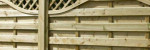

Quick answer: Choose Decorative Fence Panels when you want a substantial finished boundary that provides useful screening as soon as it is installed. Choose Trellis Panels when openness, climbing-plant support, fence-top height or a lighter garden division matters more. Decorative panels such as Double Slatted, Hit & Miss and Omega Lattice are complete framed fence panels. Trellis is generally a more open framework, so it relies more heavily on its pattern, installation and any planting for screening.
Decorative fencing and trellis can look similar in a garden photograph, particularly when both use horizontal slats or lattice patterns.
They are not interchangeable products.
A Decorative Fence Panel is primarily a finished fencing panel. Trellis is primarily an open timber framework that can provide screening, plant support, garden division or additional height above another fence.
Understanding that distinction makes it much easier to choose between them.
What Is the Main Difference Between Decorative Fence Panels and Trellis?
The simplest distinction is their starting purpose.
Decorative Fence Panels are designed to form substantial sections of a garden boundary while also contributing to its appearance.
Trellis Panels are more open and versatile. Depending on the style, they can be used:
- Between posts as an open screen
- Above existing fencing
- Against walls
- For climbing plants
- For internal garden zoning
There is some overlap between the two categories, but the construction and level of screening can be very different.
What Counts as a Decorative Fence Panel?
The current East Coast Fencing Decorative Fence Panels range centres on three distinct designs:
- Double Slatted Fence Panels
- Hit & Miss Fence Panels
- Omega Lattice Fence Panels
Each is pressure treated for outdoor use and designed as a complete framed fencing panel.
The current products use an approximately 45 x 45mm outer frame and are manufactured at approximately 1.828m wide, corresponding with the traditional nominal UK 6ft panel format.
The difference lies inside that frame.
How Double Slatted Fence Panels Work
Double Slatted Fence Panels use narrow horizontal battens arranged on both faces of the panel.
The current construction uses approximately 8 x 45mm battens with gaps of roughly 40mm.
Putting battens on both sides helps interrupt direct sightlines while retaining openings through the panel.
The result is:
- Contemporary horizontal styling
- Useful screening
- Some light transmission
- Some airflow
- A finished appearance from both sides
This makes Double Slatted fencing considerably more boundary-like than most open trellis designs.
How Hit & Miss Fence Panels Work
Hit & Miss Fence Panels use broader horizontal boards positioned alternately on opposite faces of the frame.
The current boards are approximately 100 x 5mm and have a grooved surface.
The alternating arrangement blocks many direct lines of sight while deliberately leaving routes for air to pass through.
Hit & Miss therefore works particularly well when the customer wants a balance between:
- Privacy
- Airflow
- Appearance from both sides
How Omega Lattice Fence Panels Work
Omega Lattice Fence Panels combine two ideas within one panel.
The lower section uses approximately 100 x 5mm grooved boards arranged in a hit and miss pattern.
The upper section is an integrated curved diamond lattice approximately 300mm deep.
This creates:
- Useful lower screening
- A much more open upper section
- A distinctive curved top
- A framework that can accommodate suitable climbing plants
Omega is therefore the Decorative Fence Panel that comes closest to combining conventional fencing and trellis in one manufactured product.
What Counts as a Trellis Panel?
Trellis covers a wider range of open timber patterns.
The current East Coast Fencing range includes styles such as:
- Traditional square trellis
- Diamond trellis
- Privacy square trellis
- Horizontal slatted trellis
- Fence topper trellis
- Fan trellis
Most of the wooden trellis range is manufactured in-house by East Coast Fencing using pressure-treated timber.
Unlike the decorative fence-panel range, trellis can range from a shallow fence-top strip to a full-height open screen.
Why Trellis Is Usually More Open
Trellis is fundamentally based around gaps.
Traditional square trellis, for example, uses an open grid that allows substantial light, visibility and airflow through.
That makes it useful for:
- Training climbing plants
- Softening walls
- Adding height without another solid panel
- Creating garden divisions without enclosure
Those same openings mean ordinary trellis should not be expected to provide the same immediate screening as a Decorative Fence Panel.
Decorative Fence Panels vs Trellis Panels at a Glance
| Priority | Decorative Fence Panels | Trellis Panels |
|---|---|---|
| Immediate screening | Generally stronger | Generally more open |
| Climbing plants | Possible on suitable designs | Core use |
| Fence-top use | Usually not the main purpose | Many suitable options |
| Complete boundary | Primary use | Possible with suitable support |
| Light transmission | Varies by design | Usually high |
| Airflow | Designed into slatted styles | Usually high when unplanted |
| Structural form | Substantial framed fence panel | Open timber framework |
Which Is Better for Immediate Privacy?
Decorative Fence Panels are generally the better starting point when screening is required immediately.
That does not mean every decorative panel is private.
Double Slatted and Hit & Miss designs intentionally retain gaps, while Omega Lattice becomes much more open through its upper section.
However, they contain considerably more screening timber than a typical open square or diamond trellis.
If you want the boundary to reduce overlooking from the day it is installed, the Decorative Fence Panel category is usually the more logical place to start.
Can Privacy Trellis Replace a Decorative Fence Panel?
Sometimes, but the finished effect remains different.
Privacy Square Trellis uses smaller openings than traditional open trellis, giving it more visual coverage.
It can work well for:
- Filtered screening
- Patios
- Garden dividers
- Climbing plants
It is still an open lattice rather than a close-boarded fence.
If someone standing nearby should not be able to see through the boundary easily, choose the actual pattern according to that requirement rather than relying on the word "privacy".
Which Is Better for Climbing Plants?
Trellis usually wins when planting support is the main purpose.
Its open framework gives stems and ties many potential support points without covering the garden with unnecessary timber.
Traditional Square Trellis is particularly straightforward for climbing plants because the open grid creates repeated fixing and training points.
Diamond Trellis performs a similar role with a more decorative diagonal pattern.
Can Plants Grow on Decorative Fence Panels?
Yes, but suitability varies by design.
Omega Lattice Fence Panels provide the clearest example because the upper section already incorporates open diamond lattice.
Double Slatted and Hit & Miss panels can sit attractively behind planting, but the fencing itself does not need to become the main structural support for heavy mature vegetation.
For vigorous climbers, consider whether separate plant support would reduce long-term load on the fence.
Why Mature Plants Change the Comparison
An empty trellis and a trellis covered in mature foliage behave differently.
As plants develop they can add:
- Weight
- Wind resistance
- Moisture around the timber
A highly open trellis can eventually become a dense planted screen.
The posts and supporting framework therefore need to accommodate the mature installation, not just the lightweight bare panel fitted on day one.
Which Is Better for a Patio?
That depends on whether you want the patio enclosed or softened.
Choose Decorative Fence Panels where the aim is to:
- Screen neighbouring views
- Create a finished architectural boundary
- Give the seating area a stronger sense of enclosure
Choose trellis where the aim is to:
- Grow climbers beside the patio
- Filter views rather than block them
- Keep the area bright and open
- Create a light division within the garden
A combination can also work well.
When Does Double Slatted Work Better Than Horizontal Slatted Trellis?
These two products can appear particularly similar because both use horizontal timber lines.
The construction is quite different.
Double Slatted Fence Panels use battens on both faces within a substantial 45 x 45mm framed panel.
Horizontal Slatted Trellis is a more open trellis product and is useful for filtered screening, plant support and garden zoning.
Choose Double Slatted where the feature needs to behave primarily as fencing.
Choose Horizontal Slatted Trellis where openness and versatility are more important.
Why Surface Finish Can Be Different Too
The current Decorative Fence Panels use semi-planed timber components, helping create the cleaner appearance expected from a feature fence panel.
Much of East Coast Fencing's in-house trellis is manufactured from pressure-treated rough-sawn trellis timber.
The rough-sawn texture is intentional.
It is a practical fencing-grade finish rather than smooth decorative joinery.
This can matter significantly when the panel is positioned immediately beside a seating area or other close viewing point.
Which Is Better Beside a Garden Room?
A Decorative Fence Panel usually makes more sense where you want the screening itself to feel like part of the architecture around a garden room.
Double Slatted panels in particular can work naturally beside:
- Modern cladding
- Horizontal building lines
- Contemporary paving
- Structured planting
Trellis becomes more attractive where you want planting to soften the building.
For example, a separate open trellis can carry climbing plants without visually extending a solid fence around the whole garden room.
Which Is Better for Dividing a Garden?
For internal garden division, the answer depends heavily on how strongly you want the division to read.
Use Decorative Fence Panels when you want to create clearly separated zones such as:
- A private seating area
- A screened utility area
- A garden-room enclosure
Use trellis when you want to suggest a division while retaining visual connection between the spaces.
That can work particularly well between:
- A patio and lawn
- A kitchen garden and ornamental garden
- A path and planted border
Which Makes a Small Garden Feel Larger?
More open products generally preserve sightlines better.
That can make trellis useful in compact spaces where a heavy visual barrier would divide the garden too strongly.
However, a full open trellis is not the only option.
Double Slatted or Hit & Miss Fence Panels can provide more screening than trellis while retaining some light and airflow.
The right balance depends on whether the problem is lack of privacy or lack of perceived space.
Which Is Better for a Full Garden Boundary?
Decorative Fence Panels are generally the more straightforward solution.
They are designed as complete fencing sections and available in common boundary heights.
Trellis can form a full boundary when properly supported, but ask what you expect that boundary to do.
A full-height open lattice will:
- Clearly mark the boundary
- Support planting
- Allow substantial light and visibility through
It will not behave like a conventional privacy fence unless planting or another screening element changes the result.
Which Is Better Above an Existing Fence?
Trellis is usually the appropriate product.
Fence Topper Trellis is specifically intended to add:
- Height
- Decoration
- Partial screening
- Plant support
above existing fencing.
A full Decorative Fence Panel should not normally be treated as an oversized fence topper.
Adding another large framed panel above an existing fence would substantially increase height, weight and wind loading.
Why Existing Posts Matter When Adding Trellis
Trellis may look light, but adding it above an existing boundary increases the exposed area of the fence.
Before installing a topper, check:
- Post condition
- Post height
- Existing fence stability
- The depth of trellis being added
This becomes even more important if climbing plants will eventually cover the trellis.
Which Is Better in a Windy Garden?
Neither category should be selected using the simplistic idea that "gaps mean wind cannot affect it".
Openings can allow more airflow than a fully solid fence, but:
- Frames still present surface area
- Slats still catch wind
- Full-height trellis can be large
- Plant growth can eventually close many of the openings
Hit & Miss Fence Panels are deliberately useful where increased airflow is wanted while retaining screening.
Open trellis allows even more air through when bare.
The correct choice still depends on the posts, foundations and actual site exposure.
Why a Planted Trellis Can Become Much Less Wind-Open
This is easily overlooked.
An empty square trellis may have large open spaces.
Cover it with dense evergreen growth and the effective wind-catching area changes considerably.
When designing a planted screen, think several years ahead.
The support system needs to cope with the finished garden feature rather than the panel exactly as it arrives.
Which Is Easier to Replace?
A standard-width Decorative Fence Panel can often be replaced as one complete unit between suitable posts.
The current decorative ranges use an approximately 1.828m nominal UK 6ft width.
Trellis replacement varies more because it may be:
- Fixed above another fence
- Attached to a wall
- Partly covered by mature plants
- Installed within its own post framework
A bare panel may be simple to replace. An established planted trellis can require considerably more work because the vegetation may need pruning or independent support first.
Can Decorative Fence Panels Fit Existing Concrete Posts?
Potentially.
The current decorative panel ranges have an overall depth of approximately 45mm.
For existing slotted concrete posts, check:
- Actual panel width
- Frame depth
- Clear bay width
- Post slot width
- Available height above the gravel board
Do not rely purely on the phrase "6ft panel".
Can Trellis Fit Concrete Posts?
Some trellis can be supported between suitable posts, but the installation needs to match the product and support system.
Many trellis installations are more naturally suited to:
- Timber posts
- Timber framing
- Wall fixing
because those arrangements provide straightforward fixing points for an open framework.
Why Width Differences Matter
The current Decorative Fence Panels are approximately 1.828m wide.
Much of the current East Coast Fencing trellis is approximately 1.83m wide.
Those dimensions are close, but installation should still be planned around actual product dimensions.
This is particularly important when combining several different products within an existing fence system.
Can You Combine Decorative Fence Panels and Trellis?
Yes, and in some gardens that is the better answer than choosing one product throughout.
Examples include:
- Decorative Fence Panels along the main boundary with trellis around planting
- Hit & Miss panels around a seating area with open trellis elsewhere
- Double Slatted panels beside a garden room with trellis for climbing plants
- Solid or screened panels below with Fence Topper Trellis above
The important point is to give each product a clear job.
When Omega Lattice Already Gives You Both
Omega Lattice Fence Panels can remove the need to combine separate full panels and trellis in some installations.
The lower hit and miss section provides more screening.
The integrated lattice provides:
- More light at the top
- A decorative curved profile
- Planting support
This can be useful where you want a single manufactured panel rather than constructing a separate lower fence and upper trellis arrangement.
When Separate Trellis Is Still Better Than Omega
Separate trellis provides more flexibility.
It may be better where:
- You only need a 300mm or 450mm topper
- The existing fence is already satisfactory
- Planting is the main purpose
- You want square rather than diamond openings
- You need trellis against a wall rather than as a fence panel
Omega should be chosen because you want the complete Omega panel design, not simply because you need some lattice somewhere in the garden.
Which Is Easier to Maintain?
A Decorative Fence Panel generally has fewer plant-related maintenance complications if it remains unplanted.
Trellis itself is straightforward, but mature climbing plants can make access more difficult.
Over time you may need to:
- Prune stems
- Replace ties
- Prevent excessive weight
- Clear dead growth
- Inspect hidden timber
The maintenance requirement therefore depends as much on what grows on the trellis as on the timber panel itself.
Does Pressure Treatment Remove the Need for Maintenance?
No.
Both the current Decorative Fence Panels and the relevant timber trellis products are pressure treated for exterior use.
Pressure treatment improves durability, but natural timber still benefits from sensible installation.
Keep lower timber away from persistent wet soil where practical and inspect the supporting structure periodically.
Which Is Better Value?
There is no useful answer based purely on which product contains less timber.
Compare what you need the installation to achieve.
A cheaper open trellis is poor value if you actually need immediate screening and later have to add another layer.
A substantial Decorative Fence Panel is unnecessary if all you need is a light framework for clematis against a wall.
The most economical solution is usually the product that performs the required job without unnecessary construction.
Choose by Function Before Choosing by Pattern
A useful order of decisions is:
- Decide how much privacy you need immediately.
- Decide how much light you want to retain.
- Consider wind exposure.
- Decide whether climbing plants are central to the design.
- Determine whether the product forms the main boundary or sits above another fence.
- Measure the available width and height.
- Check the supporting posts or framework.
- Then choose the pattern you prefer.
This avoids choosing an attractive panel and then trying to make it perform a job it was never intended to do.
Which Product Suits Which Job?
| Garden Requirement | Good Starting Point |
|---|---|
| Modern screened boundary | Double Slatted Fence Panels |
| Privacy with increased airflow | Hit & Miss Fence Panels |
| Screening with decorative lattice top | Omega Lattice Fence Panels |
| Climbing plants | Traditional or Diamond Trellis |
| Closer planted screening | Privacy Square Trellis |
| Contemporary open screen | Horizontal Slatted Trellis |
| Extra height above existing fence | Fence Topper Trellis |
| Single climber against wall | Fan Trellis |
Common Mistakes When Choosing Between Decorative Fencing and Trellis
- Assuming all attractive timber panels provide similar privacy
- Buying open trellis when immediate screening is required
- Using a full Decorative Fence Panel as a fence topper
- Assuming privacy trellis is equivalent to a solid fence
- Forgetting how heavy mature climbing plants can become
- Ignoring the posts when adding trellis above an existing fence
- Choosing solely from appearance without checking panel dimensions
- Assuming Double Slatted fencing and Horizontal Slatted Trellis are the same product
- Trying to use decorative slats as unrestricted support for heavy plants
- Failing to consider how the boundary will look before planting becomes established
Decorative Fence Panels or Trellis: Buying Checklist
- Choose Decorative Fence Panels if the product needs to function primarily as a finished fence.
- Choose trellis if plant support or openness is the primary requirement.
- Compare actual sightlines rather than relying only on product names.
- Consider Double Slatted for contemporary layered screening.
- Consider Hit & Miss where airflow is an important part of the decision.
- Consider Omega Lattice where you want screening and integrated decorative lattice in one panel.
- Use Traditional or Diamond Trellis where climbing plants are central to the design.
- Use Privacy Square Trellis when closer filtered screening is preferred.
- Use Fence Topper Trellis when adding a separate open section above existing fencing.
- Measure the actual fence bays and post system before ordering.
- Plan for the mature weight of climbing plants.
- Keep pressure-treated timber sensibly clear of persistent ground moisture.
FAQs
Are Decorative Fence Panels the Same as Trellis Panels?
No. Decorative Fence Panels are generally complete framed fencing panels designed to provide a substantial boundary and useful screening. Trellis is usually more open and is commonly used for climbing plants, filtered screening, garden division and fence-top height.
Which Gives More Privacy?
Decorative Fence Panels generally provide more immediate screening. Double Slatted and Hit & Miss panels interrupt sightlines across most of their height, while ordinary square or diamond trellis remains much more open.
Is Privacy Trellis Completely Private?
No. Privacy Square Trellis uses smaller openings to provide closer screening, but it remains an open timber lattice rather than a solid barrier.
Which Is Better for Climbing Plants?
Trellis is usually better when plant support is the primary purpose. Its open framework provides repeated points for training stems and using plant ties.
Can Climbing Plants Grow on Decorative Fence Panels?
Yes, although heavy mature plants should not automatically be allowed to load decorative slats heavily. Omega Lattice Fence Panels are particularly suited to combining a screened lower boundary with an open lattice section for suitable planting.
Can You Put Decorative Fence Panels on Top of an Existing Fence?
A complete Decorative Fence Panel is generally intended to form a main fence section rather than a topper. Purpose-made Fence Topper Trellis is usually the more appropriate product for adding an open section above an existing fence.
Is Double Slatted Fencing the Same as Slatted Trellis?
No. Current Double Slatted Fence Panels use approximately 8 x 45mm battens arranged on both faces within a 45 x 45mm framed panel. Horizontal Slatted Trellis is a more open trellis product intended for filtered screening, planting and garden zoning.
What Is the Difference Between Omega Lattice and Separate Trellis?
Omega Lattice Fence Panels incorporate an approximately 300mm curved diamond-lattice section into the manufactured panel itself. Separate trellis is an independent product that can be fitted between posts, above fencing or against other suitable structures.
Are Decorative Fence Panels Pressure Treated?
Yes. The current East Coast Fencing Decorative Fence Panels discussed here are pressure treated for outdoor use.
Are Trellis Panels Pressure Treated?
The current East Coast Fencing timber trellis ranges discussed here are also supplied pressure treated for outdoor use.
Which Is Better for a Small Garden?
Trellis can preserve more sightlines and light where maximum openness is wanted. Double Slatted or Hit & Miss Fence Panels can be a useful middle ground where more screening is required without creating the visual mass of a completely solid fence.
Which Is Better Around a Patio?
Decorative Fence Panels are useful where the patio needs immediate screening and a defined boundary. Trellis is often better where climbing plants, light and a softer division are more important.
Can Trellis Be Used as a Full Fence?
Yes, when properly supported, but it remains an open structure. It is most appropriate where garden division, planting and light transmission matter more than complete privacy.
Does Trellis Catch Less Wind Than Decorative Fencing?
Open trellis allows substantial airflow when bare, but it still requires suitable supports. Once dense climbing plants cover the openings, the wind loading of the completed planted screen can increase considerably.
Which Should You Choose?
Choose according to what the timber needs to do before deciding which pattern looks best.
If you need a substantial ready-made boundary with useful screening from the moment it is installed, start with Decorative Fence Panels.
Double Slatted Fence Panels provide a contemporary layered screen using narrow battens on both faces. Hit & Miss Fence Panels use wider alternating boards to combine screening with airflow. Omega Lattice Fence Panels combine a screened lower section with integrated curved lattice at the top.
If your priority is climbing plants, openness, a light garden division or additional height above another fence, Trellis Panels are usually the more appropriate starting point.
Traditional and Diamond Trellis provide open frameworks for planting. Privacy Square Trellis creates closer filtered screening. Horizontal Slatted Trellis offers a more linear contemporary appearance, while Fence Topper Trellis is specifically useful for adding an open upper section to an existing fence.
The two categories are therefore complementary rather than interchangeable.
Decorative Fence Panels are primarily fencing that has been designed to look distinctive. Trellis Panels are primarily open frameworks that can become screens, plant supports or decorative features depending on how they are installed and used.
Once that distinction is clear, the choice becomes considerably simpler.