





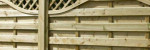

Quick answer: Yes, Decorative Fence Panels can be mixed within the same garden, and doing so can be more practical than using one panel style everywhere. The best results come from giving each style a clear purpose. You might use Double Slatted panels around a modern seating area, Hit & Miss panels where airflow matters and Omega Lattice panels beside planting. Keep post positions, panel widths, treatment appearance and key height changes consistent so the garden looks deliberately designed rather than patched together.
Using the same fence panel around every part of a garden is simple, but it is not always the best solution.
A rear boundary may need strong screening. A patio may benefit from a more decorative backdrop. An exposed side of the garden may need greater airflow, while a planted area might look better with lattice and climbing plants.
This is where Decorative Fence Panels can be particularly useful.
Instead of treating the fence as one uninterrupted product, you can use different panel styles to respond to different parts of the garden.
The challenge is making those changes look intentional.
Can You Mix Decorative Fence Panels?
Yes.
There is no practical requirement for every fence panel in a garden to use exactly the same design.
Different sections can perform different jobs.
For example:
- A patio might use Double Slatted Fence Panels for contemporary screening.
- An exposed boundary might use Hit & Miss Fence Panels for increased airflow.
- A planted feature area might use Omega Lattice Fence Panels.
- A less visible utility boundary might use a simpler panel style.
The key is to create a reason for each change.
When Does Mixing Fence Panel Styles Work Best?
Mixing works particularly well when the garden already contains clearly defined areas.
These might include:
- Patio
- Dining area
- Garden room
- Lawn
- Planting area
- Vegetable garden
- Side passage
- Utility area
A change in fencing can reinforce the transition between those spaces.
The fence then becomes part of the garden layout rather than simply the structure around its perimeter.
What Decorative Fence Panel Styles Are Available?
The current East Coast Fencing Decorative Fence Panels range includes three main designs:
- Double Slatted Fence Panels
- Hit & Miss Fence Panels
- Omega Lattice Fence Panels
All three create a more considered appearance than basic traditional boundary panels, but they behave differently.
| Panel Style | Visual Character | Privacy | Airflow |
|---|---|---|---|
| Double Slatted | Contemporary horizontal | Moderate to high | Moderate |
| Hit & Miss | Layered horizontal | Moderate | Higher |
| Omega Lattice | Curved and decorative | Strong lower screening | More open at the top |
Why Use More Than One Fence Panel Style?
The main advantage is that one garden can have several different fencing requirements.
A single panel style always involves compromises.
A very solid panel may provide excellent privacy but feel heavy beside a small patio.
A very open panel may perform well in an exposed location but provide less screening beside outdoor seating.
Mixing carefully chosen styles allows you to prioritise different characteristics where they matter most.
Use Double Slatted Fence Panels Around Modern Seating Areas
Double Slatted Fence Panels work particularly well where the fence will be seen at close range.
The straight horizontal timber lines suit:
- Patios
- Outdoor dining areas
- Garden rooms
- Modern paving
- Raised beds
- Contemporary furniture
They provide useful screening while retaining controlled gaps through the panel.
If only one part of the garden needs a more premium decorative backdrop, using Double Slatted panels in that section can create a clear focal area without requiring the whole boundary to use the same style.
Use Hit & Miss Fence Panels Where Airflow Matters
Hit & Miss panels use alternating horizontal boards on opposite faces of the panel.
This construction allows more air to pass through than a completely solid fence.
That can make them useful for:
- More exposed boundaries
- Open parts of the garden
- Areas where a solid fence would feel too enclosed
- Internal garden divisions
They also have a finished-looking appearance from both sides, which can be useful on highly visible shared boundaries.
Use Omega Lattice Fence Panels Around Planting
Omega Lattice Fence Panels combine a screened lower section with a curved open lattice top.
This makes them particularly suited to:
- Flower beds
- Traditional patios
- Cottage-style gardens
- Areas with climbing plants
- Decorative feature boundaries
The lattice allows additional light through the upper part of the boundary and provides useful points for training manageable climbing plants.
They can therefore create a softer transition between fencing and planting than a completely straight solid panel.
Can You Mix Double Slatted and Hit & Miss Fence Panels?
Yes.
These are actually two of the easier Decorative Fence Panel styles to combine because both use strong horizontal lines.
The visual language is similar even though the construction differs.
You might use:
- Double Slatted panels around the main patio for greater screening
- Hit & Miss panels farther down the garden where airflow becomes more important
The transition works best at a logical point such as a post, planting feature or change in garden use.
Can You Mix Double Slatted and Omega Lattice Fence Panels?
Yes, although the contrast is stronger.
Double Slatted panels are distinctly contemporary.
Omega Lattice panels have a softer curved profile and more traditional character.
This can work if the garden itself contains contrasting areas.
For example:
- Double Slatted panels beside a modern paved dining area
- Omega Lattice panels around a mature planted section
The result is less successful if the styles alternate randomly from one bay to the next.
Can You Mix Hit & Miss and Omega Lattice Fence Panels?
Yes.
Hit & Miss panels can provide the more open functional boundary, while Omega panels can introduce decorative features around planting or seating.
Again, use the change to mark a meaningful transition in the garden.
Do not alternate the two styles simply to create variety.
Can Decorative Fence Panels Be Mixed With Closeboard Fence Panels?
Yes, and this can be a very practical combination.
Closeboard fencing is a strong option where solid privacy is the main requirement.
Decorative panels can then be introduced where appearance becomes more important.
For example:
- Closeboard along a less visible rear boundary
- Double Slatted panels around a patio
- Omega panels beside a planted feature
This can avoid using more decorative fencing in parts of the garden where it provides little visual benefit.
Can Decorative Fence Panels Be Mixed With Waney Lap Fence Panels?
Yes.
Waney Lap Fence Panels can provide straightforward traditional boundary fencing, while Decorative Fence Panels can be reserved for areas seen from the house, patio or garden room.
The biggest challenge is visual transition.
Waney Lap uses overlapping horizontal boards but has a simpler construction.
A clean transition at a post or garden feature will normally look better than mixing styles randomly along one uninterrupted run.
Should Different Fence Styles Be Used on the Same Boundary?
They can be, but the change needs more care than using different styles on separate sides of the garden.
When several styles appear within one straight boundary, differences in:
- Board direction
- Frame thickness
- Top profile
- Openness
- Height
become easier to notice.
A deliberate transition point helps.
Where Should You Change From One Panel Style to Another?
Good transition points include:
- A garden gate
- A change in ground level
- The end of a patio
- A garden room
- A large shrub or tree
- A raised bed
- A change in direction
These features give the eye a reason for the fence design to change.
A random style change in the middle of an otherwise featureless straight run can appear accidental.
Use Fence Posts to Separate Different Styles
Posts provide natural visual breaks between panels.
When changing from one design to another, make the transition at a post rather than trying to merge two panel constructions together within one bay.
This keeps:
- Each panel structurally independent
- Installation simpler
- Future replacement easier
Should Mixed Fence Panels Be the Same Width?
Using the same nominal width simplifies the layout considerably.
The current main Decorative Fence Panel ranges are supplied in nominal 6ft widths, which makes it easier to plan compatible post bays.
Even so, check actual dimensions and frame thickness before assuming different panel ranges can be exchanged directly within the same support system.
Should Mixed Fence Panels Be the Same Height?
They do not have to be, but matching heights produce the simplest visual result.
Using panels of equal nominal height can maintain a consistent overall top line while changing the design beneath it.
This can work particularly well when switching between:
- Double Slatted
- Hit & Miss
because both have straight horizontal upper profiles.
What Happens When You Mix Straight and Curved Panels?
Omega Lattice panels introduce a curved upper profile.
That means the top of the fence will no longer form one continuous straight line.
This can look attractive when the curved panel is used intentionally as a feature.
For example, Omega panels might be used:
- Behind a seating area
- Either side of a garden feature
- Within one complete planted section
The effect is usually cleaner than inserting one isolated curved panel randomly into a long run of straight panels.
Can You Use Different Fence Heights in Different Parts of the Garden?
Yes.
Different heights can be useful where privacy requirements change.
You might use taller panels:
- Around a patio
- Beside neighbouring seating
- Along a rear boundary
and lower panels:
- Near planting
- For internal garden divisions
- Where you want to preserve views
The height changes should follow the layout of the garden rather than appearing arbitrary.
What Heights Are Available in the Decorative Range?
The current Omega Lattice, Hit & Miss and Double Slatted ranges are available in nominal 6ft widths with several common heights, including:
- 3ft
- 4ft
- 5ft
- 6ft
This makes it possible to combine different designs while retaining similar overall proportions.
Should You Use the Same Height Around a Patio?
Usually, a consistent height around one defined area gives the cleanest result.
If a seating area needs screening, changing height halfway through that immediate zone can weaken the visual enclosure.
Finish the main seating section first, then change height at a logical transition farther along the boundary.
Can Mixing Panel Heights Make a Small Garden Feel Bigger?
Sometimes.
A tall solid-looking fence around every side of a compact garden can feel visually dominant.
Lower or more open decorative panels in carefully chosen areas can preserve:
- Light
- Longer views
- A sense of depth
while taller sections remain where privacy is genuinely required.
Should the Most Decorative Panels Be Closest to the House?
This is often a sensible approach.
Panels beside patios and seating areas are viewed at close range and for longer periods.
They are also visible from:
- Kitchen windows
- Patio doors
- Garden rooms
- Outdoor dining areas
Using a more refined panel in these areas can have more visual impact than placing it behind a shed or at the far end of a rarely used boundary.
Can Decorative Panels Be Used as Feature Panels?
Yes.
You do not necessarily need an entire boundary made from Decorative Fence Panels.
One complete section can act as a garden feature.
Good locations include:
- Behind outdoor seating
- Behind a specimen plant
- Around a garden room
- At the end of a visual axis
This can introduce decorative timberwork without changing the entire fencing system.
Can You Use One Decorative Panel Behind a Bench?
Yes.
A single feature panel can create a useful backdrop.
However, it should still be properly supported between suitable posts.
Do not treat a decorative panel as a lightweight ornamental screen simply because it is being used away from the main boundary.
Which Decorative Fence Panels Work Best Around Patios?
All three current styles can work, but they create different effects.
| Style | Patio Effect |
|---|---|
| Double Slatted | Clean contemporary backdrop with useful screening |
| Hit & Miss | More open screening with increased airflow |
| Omega Lattice | Decorative planted backdrop with lighter upper section |
Which Style Works Best Around a Garden Room?
Double Slatted Fence Panels are a natural match for many contemporary garden rooms because both use clean straight lines.
Hit & Miss panels can also work well where the area needs more airflow.
Omega Lattice can provide an effective contrast if the garden room sits within a more traditional planted setting.
Which Decorative Panel Is Best Around Planting?
Omega Lattice is particularly well suited to planting because its upper lattice section can support manageable climbers.
It also allows more light through the top of the boundary.
Double Slatted and Hit & Miss panels can create attractive backgrounds for shrubs and ornamental grasses, but vigorous climbers may be better given independent support.
Can Planting Help Connect Different Fence Styles?
Yes.
Planting can make transitions between different panels feel much softer.
Useful options include:
- Shrubs
- Ornamental grasses
- Small trees
- Climbers with suitable support
A large planting bed placed near a panel transition can visually connect otherwise contrasting fencing styles.
Should You Grow the Same Plants Along Every Panel?
Not necessarily.
The fencing style can influence the planting.
For example:
- Omega Lattice can suit flowering climbers.
- Double Slatted panels can provide a clean backdrop for structured planting.
- Hit & Miss panels can complement grasses and planting that move in the wind.
This can reinforce the intended character of each garden zone.
Can You Mix Decorative Fence Panels on a Sloping Garden?
Yes, but the design needs additional planning.
Rigid panels are generally stepped as ground levels change.
If you are also changing panel style, avoid making every variable change at the same point unless that is intentional.
A boundary that changes:
- Height
- Panel style
- Ground level
all at once can become visually busy.
Use the Slope to Create a Natural Transition
A significant change in ground level can provide a logical point to introduce another fence style.
For example, a lower planted part of the garden could use Omega panels while a raised paved area uses Double Slatted panels.
The change in landscape makes the change in fencing easier to understand visually.
Can Different Decorative Panels Use the Same Fence Posts?
Potentially, where the panel dimensions and fixing system are compatible.
With wooden posts, there is generally greater flexibility because panels can be fixed mechanically to the post faces.
With slotted concrete posts, check:
- Panel width
- Panel frame thickness
- Slot dimensions
before assuming different decorative ranges can simply be exchanged.
Should You Use the Same Posts Throughout the Garden?
Using one post style can help unify mixed panels.
For example, a continuous run of matching timber posts can visually connect several different decorative designs.
The posts act as a repeated element even when the material between them changes.
Can Concrete Posts Work With Decorative Fence Panels?
Compatible framed panels may be used within suitable slotted concrete post systems.
The more decorative the panel, the more important it is to check frame compatibility before installation.
Do not force a framed panel into a slot that is too narrow.
Should You Use the Same Gravel Boards Under Different Panels?
Using one gravel board type can help create a consistent lower line across a mixed fence.
This is particularly useful where the upper panel designs differ significantly.
The gravel board can provide one repeated base beneath:
- Double Slatted panels
- Hit & Miss panels
- Compatible Omega panels
Check the complete dimensions of each bay before installation.
Do Gravel Boards Make Mixed Fencing Look Neater?
They can.
A consistent lower line helps anchor the fence visually.
This becomes particularly useful when:
- Panel tops vary
- Some panels have curved details
- The ground is slightly uneven
They also help keep the lower timber panel frames away from damp soil and garden debris.
Should All Mixed Panels Have the Same Treatment Colour?
A consistent starting colour generally creates a more coordinated appearance.
Natural timber will always show variations in:
- Grain
- Knots
- Shade
and treated timber will change as it weathers.
Exact colour matching between panels should therefore not be expected indefinitely.
Can You Paint Different Panel Styles the Same Colour?
A compatible exterior timber coating can be useful if you want to visually connect different designs.
One colour across several panel styles can make them feel like parts of one scheme.
Make sure pressure-treated timber is sufficiently dry and properly prepared before applying a decorative finish, and follow the coating manufacturer's instructions.
Can You Use Different Colours for Different Garden Zones?
You can, but this creates a much stronger visual change.
If the panels already differ in:
- Style
- Height
- Board pattern
adding several colours can make the boundary unnecessarily busy.
In most gardens, varying either the panel design or the colour provides enough contrast without changing both repeatedly.
Can Decorative Fence Panels Be Added to an Existing Fence Run?
Yes, where the existing posts and dimensions allow it.
This can be useful when:
- A patio has been added
- A garden room has been built
- A section of old fencing needs replacement
- You want a more attractive feature area
Inspect the existing support system first.
Do You Need to Replace Every Panel to Upgrade the Fence?
No.
If only part of the boundary is highly visible, changing a defined section may be enough.
For example, you might replace three panels beside a patio with Double Slatted panels while leaving sound existing fencing farther down the garden.
The transition should be deliberate and the existing posts need to be compatible.
Should Old Panels and New Decorative Panels Be the Same Height?
Matching the height usually makes a partial upgrade look cleaner.
If the new section intentionally needs more privacy, a height change can work, but it should occur at a clear transition point.
Can You Mix New Decorative Panels With Weathered Existing Fencing?
Yes, although the colour difference may initially be noticeable.
New pressure-treated timber often appears brighter or more strongly coloured than timber that has weathered outdoors.
The contrast normally changes as the new timber weathers.
Can You Use Decorative Fence Panels for Only One Side of the Garden?
Yes.
This is one of the simplest ways to mix fencing.
For example:
- The patio-facing boundary could use Double Slatted panels.
- The rear boundary could use Closeboard panels.
- A planted side could use Omega Lattice panels.
Because each side of the garden has a separate visual direction, the differences often feel natural.
Should Opposite Sides of the Garden Match?
They do not have to.
Matching boundaries create a symmetrical appearance, but many gardens are not symmetrical.
One side may:
- Receive more wind
- Need more privacy
- Contain more planting
- Be viewed more often
Using the same panel everywhere can ignore those differences.
Is Mixing Fence Panel Styles More Expensive?
Not necessarily.
The overall purchase cost depends on the panels and quantities selected.
Mixing styles can sometimes allow more decorative panels to be concentrated where they provide the greatest visual benefit rather than purchasing them for every boundary.
Compare the complete fencing system, including:
- Panels
- Posts
- Gravel boards
- Fixings
- Installation
rather than comparing panel purchase cost alone.
Should You Mix Panels Just to Reduce Cost?
Cost can influence the decision, but the design should still make sense.
Using decorative panels where they are highly visible and a simpler compatible panel elsewhere can be practical.
Randomly changing styles solely according to whichever panel happens to be cheaper can produce a disjointed boundary.
How Many Decorative Feature Panels Should You Use?
There is no fixed number.
One panel may be enough behind a bench or planting feature.
A patio might need two, three or more panels to create a complete backdrop.
The feature section should correspond to the size of the space it serves.
Should Feature Panels Be Centred?
They can be where the garden design is symmetrical.
However, the most useful position is often determined by:
- Seating
- Views from the house
- Planting
- Existing posts
A deliberately off-centre feature can work perfectly well in an asymmetrical garden.
Can Decorative Panels Make a Garden Look More Designed?
Yes, particularly when the fence responds to the layout rather than simply surrounding it.
A good mixed-panel scheme can reinforce:
- Garden zones
- Focal points
- Planting styles
- Patio areas
- Changes from traditional to contemporary landscaping
The fence becomes another design material rather than a background necessity.
When Does Mixed Fencing Look Messy?
The most common problem is too many unrelated changes.
A boundary can become visually confused when every bay has a different:
- Panel style
- Height
- Colour
- Post
- Gravel board
Variation works best when several elements remain consistent.
How Do You Make Mixed Fence Panels Look Intentional?
Use repetition.
Keep at least some elements consistent across the scheme, such as:
- Post style
- Gravel board type
- Timber finish
- Main panel height
- Repeated panel groups
Then use panel style changes sparingly at meaningful points.
A Simple Rule for Mixing Decorative Fence Panels
Think in zones rather than individual panels.
For example:
- Three Double Slatted panels around the patio
- Four Hit & Miss panels along the exposed side boundary
- Two Omega Lattice panels around the planted seating area
This looks more deliberate than alternating all three styles repeatedly.
Should You Mix More Than Two Decorative Styles?
You can, particularly in a large garden with clearly separate areas.
In a small garden, two styles are often easier to coordinate.
The more designs you introduce, the more important it becomes to keep:
- Posts
- Finish
- Height
- Landscaping materials
consistent.
What Is the Easiest Decorative Panel Combination?
Double Slatted and Hit & Miss panels are among the easiest combinations because both have straight horizontal designs.
You can use one where screening is stronger and the other where airflow matters more without completely changing the visual language of the fence.
What Is the Strongest Visual Contrast?
Combining Omega Lattice with Double Slatted fencing creates one of the clearest contrasts.
One uses:
- A curved top
- Lattice
- A softer traditional character
while the other uses:
- Straight lines
- Horizontal slats
- A contemporary appearance
Use this combination where the landscaping itself also changes character.
Common Mistakes When Mixing Decorative Fence Panels
- Changing panel style every single bay
- Using different styles without a practical reason
- Ignoring differences in actual panel dimensions
- Assuming every nominal 6ft panel fits the same post system
- Using too many different heights
- Changing style, height and colour at the same point without a clear design reason
- Using one isolated curved Omega panel in the middle of a long straight run without making it a feature
- Forgetting that different panel styles provide different levels of privacy
- Using solid-looking panels in exposed areas where airflow is important
- Using highly open panels where strong privacy is required
- Reusing weak existing posts when upgrading part of a boundary
- Ignoring gravel board and lower-frame alignment
Decorative Fence Panels Mixing Checklist
- Divide the garden into clear functional zones.
- Decide where privacy matters most.
- Identify areas where airflow matters.
- Identify planting areas that suit lattice.
- Choose Double Slatted panels for contemporary screening.
- Choose Hit & Miss panels for greater airflow.
- Choose Omega Lattice panels for curved decorative detailing and planting.
- Use logical transition points between styles.
- Keep posts consistent where practical.
- Keep gravel boards consistent where practical.
- Check actual panel dimensions before setting posts.
- Consider maintaining one common height across mixed sections.
- Use planting to soften stronger transitions.
- Avoid introducing too many different styles into a small space.
FAQs
Can You Mix Different Decorative Fence Panels?
Yes. Different decorative styles can be used within the same garden where each one has a clear purpose.
Can You Mix Double Slatted and Hit & Miss Fence Panels?
Yes. Both use strong horizontal lines, so they can work particularly well together while providing different balances of screening and airflow.
Can You Mix Double Slatted and Omega Lattice Fence Panels?
Yes, although the visual contrast is stronger because Double Slatted panels are contemporary and Omega panels use a curved lattice design.
Can You Mix Omega Lattice and Hit & Miss Panels?
Yes. Omega can be used around planting or feature areas while Hit & Miss fencing provides a more open boundary elsewhere.
Can Decorative Fence Panels Be Mixed With Closeboard?
Yes. Closeboard can provide solid privacy in practical areas while Decorative Fence Panels are used where appearance is more important.
Can Decorative Fence Panels Be Mixed With Waney Lap?
Yes. Use clear transition points so the change from basic boundary fencing to decorative fencing looks intentional.
Should Mixed Fence Panels Be the Same Height?
They do not have to be, but matching heights usually creates a cleaner and easier-to-coordinate fence line.
Should Mixed Fence Panels Be the Same Width?
Using common widths makes post planning easier, but actual panel dimensions and frame thickness should always be checked before installation.
What Decorative Fence Panel Styles Does East Coast Fencing Sell?
The current range includes Double Slatted Fence Panels, Horizontal Hit & Miss Fence Panels and Omega Lattice Fence Panels.
What Sizes Are Decorative Fence Panels Available In?
The main current ranges use nominal 6ft widths with 3ft, 4ft, 5ft and 6ft height options.
Which Decorative Panel Is Best for Modern Gardens?
Double Slatted Fence Panels have the strongest contemporary appearance, while Hit & Miss panels also work naturally within modern landscaping.
Which Decorative Panel Is Best for Traditional Gardens?
Omega Lattice Fence Panels have a softer curved profile that works particularly well with traditional planting.
Which Decorative Panel Is Best for Airflow?
Hit & Miss Fence Panels place the greatest emphasis on airflow among the main current Decorative Fence Panel styles.
Which Decorative Panel Is Best for Privacy?
The answer depends on viewing angle and required screening. Double Slatted panels provide strong filtered screening, while Omega panels provide stronger lower-level screening with an open lattice above.
Can Decorative Fence Panels Be Used Only Around a Patio?
Yes. A defined run of decorative panels can create a feature around a patio without requiring the whole garden boundary to use the same style.
Can You Replace Only Part of a Fence With Decorative Panels?
Yes, provided the existing posts and support system remain sound and the new panels are dimensionally compatible.
Should Decorative Panels Match on Both Sides of a Garden?
No. Different boundaries may have different requirements for privacy, airflow, planting and appearance.
Can Different Decorative Panels Use the Same Posts?
Potentially. Timber posts provide considerable flexibility, while slotted concrete post systems require careful checks for frame and slot compatibility.
Should You Use the Same Gravel Boards With Mixed Panels?
A consistent gravel board can help visually connect different panel styles while providing a neat lower fence line.
Can Mixed Decorative Fence Panels Be Painted the Same Colour?
Yes, using a suitable exterior timber coating once the treated timber is sufficiently dry and prepared. One colour can help visually unify different panel designs.
Can You Use Three Decorative Panel Styles in One Garden?
Yes, particularly in a larger garden with clearly defined zones. In smaller gardens, fewer panel styles are usually easier to coordinate.
Should You Mix Decorative Fence Panels?
Mixing Decorative Fence Panels works best when the decision starts with the garden rather than the products.
Look at what each part of the space needs.
A contemporary patio may benefit from the cleaner screening of Double Slatted Fence Panels. An exposed boundary may suit the additional airflow of Hit & Miss fencing. A planted seating area may look better with the softer curved profile of Omega Lattice panels.
You do not need to choose one style and force it to perform every job.
The most important design rule is restraint.
Use panel styles in groups, change them at logical points and keep other elements such as posts, gravel boards, treatment appearance or overall height consistent where practical.
When those details are controlled, mixing Decorative Fence Panels can make the garden look more considered while allowing each section of fencing to perform the job it is actually there to do.