





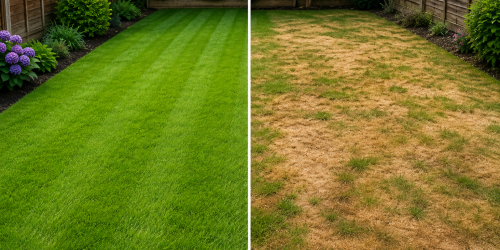
Quick answer: If you have applied too much iron sulphate and the grass has turned dark brown or black, stop applying lawn treatments and assess how severe the damage is. If the application was recent, follow the product label and, where appropriate, water the affected lawn evenly to reduce the concentration on the grass. Do not automatically add lime, fertiliser or other chemicals. Mild scorch can recover as new grass grows, while severely damaged patches may eventually need raking and overseeding.
Iron sulphate can produce a noticeably darker, greener lawn when it is used correctly, but applying too much can damage the grass.
The difficult part is that a lawn becoming darker after an iron treatment is not necessarily a problem.
Iron naturally deepens grass colour, while iron-containing moss treatments can turn moss black as it dies. Neither should be confused automatically with grass that has been scorched by an excessive application.
If the grass blades themselves have become brown or black shortly after treatment, particularly in obvious stripes, patches or heavily treated areas, over-application becomes much more likely.
The best response is usually restraint. Avoid trying to correct one lawn treatment with several more products at once. Establish what was applied, how much was used and whether the grass itself is damaged before deciding what to do next.
What Is Iron Sulphate?
Iron sulphate, also called ferrous sulphate or sulphate of iron, is a source of iron used in horticulture and turf management.
For lawns, iron can produce a darker green appearance without functioning in exactly the same way as a conventional high-nitrogen lawn fertiliser.
Iron is involved in processes associated with chlorophyll production, which is why adequately supplied grass develops a healthy green colour.
Products containing iron sulphate may therefore be marketed or formulated for purposes including:
- Improving lawn colour
- Supplying iron
- Correcting an iron deficiency
- Moss control, where the specific product is authorised for that purpose
The distinction between those uses matters.
Can Iron Sulphate Be Used To Kill Moss?
Only use a product for moss control if it is specifically authorised and labelled for that purpose.
The RHS notes that iron sulphate is widely sold as a lawn fertiliser, but ordinary iron sulphate should not simply be treated as a mosskiller unless it is contained within an appropriate approved lawn mosskiller.
Approved products provide instructions covering:
- Application rate
- Timing
- Application method
- Safety precautions
Follow those instructions rather than increasing the concentration in an attempt to obtain a stronger or faster result.
Can You Apply Too Much Iron Sulphate?
Yes.
Using more than the product instructions specify can scorch or damage grass.
Problems can also occur when the correct total quantity is applied unevenly.
For example, a lawn may receive excessive treatment where:
- A spreader overlaps repeatedly
- A sprayer stops while still releasing solution
- A watering can is emptied unevenly
- Granules or powder spill in one area
- The concentration was calculated incorrectly
- The same section is accidentally treated twice
The lawn can therefore be overdosed locally even when the total amount used across the whole garden does not initially seem excessive.
What Does Too Much Iron Sulphate Do To Grass?
An excessive concentration can scorch the leaf tissue.
Affected grass may change from healthy green to:
- Very dark green
- Grey-green
- Brown
- Dark brown
- Blackened
The severity can vary significantly.
Some lawns suffer temporary leaf damage while the growing point remains healthy and new grass later replaces the damaged blades.
A much heavier overdose can kill individual plants and leave bare areas requiring repair.
Does Black Grass Always Mean You Have Used Too Much Iron?
No.
First determine what has actually turned black.
If you applied an approved iron-containing mosskiller, blackened moss can be an expected result of treatment.
The RHS advises that moss treated with many iron-containing mosskillers turns black as it dies and can subsequently be removed from the lawn.
That is very different from the grass blades themselves becoming scorched.
| What You See | Possible Explanation |
|---|---|
| Moss turning black | Can be expected after an approved iron-containing moss treatment |
| Grass becoming darker green | Can be a normal response to iron |
| Grass tips becoming brown or black | Possible scorch |
| Dark stripes following application pattern | Possible uneven or excessive application |
| Completely dead bare patches | Potential severe damage requiring repair |
How Can You Tell If The Grass Has Been Scorched?
Look at the individual grass plants rather than judging the lawn from a distance.
With chemical scorch, you may see:
- Darkened leaf tips
- Brown or black grass blades
- Distinct application stripes
- Damage corresponding with overlaps
- Small severe patches where product was spilled
Think about timing too.
If the lawn looked healthy before treatment and discolouration developed shortly afterwards in the same pattern as the application, the treatment is an obvious suspect.
Why Does An Iron Sulphate Overdose Cause Patchy Damage?
Application is rarely perfectly uniform when something goes wrong.
A concentrated solution may have been applied more heavily in one location, or a spreader may have passed over the same strip twice.
This can produce recognisable patterns such as:
- Straight stripes
- Parallel bands
- Dark patches at turning points
- A severe spot where the applicator was filled or spilled
Regular patterns are useful clues because lawn diseases and natural soil problems often produce a different appearance.
What Should You Do Immediately After Applying Too Much Iron Sulphate?
Stop applying the product.
Then check:
- The exact product used
- The instructions on its label
- The intended application rate
- How much product was actually mixed or spread
- The approximate area treated
If the over-application has only just happened, acting promptly may reduce the severity of the damage.
Follow any specific accidental over-application advice supplied by the manufacturer.
Should You Water A Lawn After Applying Too Much Iron Sulphate?
Where appropriate for the particular product, watering can help move an excessive soluble application from the grass leaves and reduce its concentration.
If you know you have significantly overdosed a small section and the treatment is still fresh, evenly irrigating the area may therefore be useful.
However, avoid turning one problem into another.
Do not:
- Flood the lawn
- Create standing water
- Encourage contaminated runoff into drains or ponds
- Continue heavy irrigation for days regardless of soil conditions
The amount of water a lawn can accept depends on soil type, weather and drainage.
Follow the product instructions first and use sensible irrigation rather than relying on a fixed number of minutes with a hose.
Should You Water Every Day Until The Lawn Recovers?
Not automatically.
The original advice sometimes given for iron scorch is to heavily water the lawn every day. That is too simplistic.
Repeated unnecessary irrigation can create:
- Waterlogged soil
- Poor root aeration
- Runoff
- Additional lawn stress
If the soil remains adequately moist after the initial response, adding more water may provide no benefit.
Allow conditions to determine subsequent irrigation.
What If You Spilled Iron Sulphate In One Spot?
A concentrated spill is more serious than a slight general over-application.
If dry material remains visible, follow the product instructions for dealing with spills rather than simply spreading the concentrated material across the surrounding lawn.
If the affected grass subsequently dies, a local repair may eventually be easier than repeatedly applying other treatments in an attempt to revive completely dead plants.
Should You Add Lime After Using Too Much Iron Sulphate?
Not automatically.
Iron sulphate can acidify soil, but that does not mean every accidental lawn overdose should immediately be followed by lime.
Adding lime without knowing the soil pH can create a different imbalance.
If you are concerned that repeated applications have significantly altered soil conditions, test the soil first.
Only consider changing the pH when:
- You have a reliable soil test
- The pH actually needs correction
- The proposed amendment is appropriate for the soil
Lime is a soil amendment, not an instant antidote to scorched grass blades.
Does Iron Sulphate Make Soil Acidic?
It can lower soil pH.
Ferrous sulphate is in fact used horticulturally where soil acidification is deliberately required.
The significance of one lawn application depends on:
- The quantity applied
- Existing soil pH
- Soil type
- Previous treatments
This is another reason repeated heavy applications should be avoided.
Should You Test Soil pH After An Overdose?
It can be useful if:
- You have repeatedly applied iron sulphate
- You already suspect an acidity problem
- The lawn has persistent growth problems
- You are considering applying lime
A soil test is less important than stopping the treatment and managing immediate scorch if you simply made one modest application error.
Should You Mow Blackened Grass Immediately?
Usually, there is no need to rush out and mow immediately.
Recently stressed grass benefits from retaining healthy leaf area.
If the lawn is due for mowing, wait until it is actively growing and avoid cutting it excessively short.
Removing only part of the leaf is generally preferable to scalping stressed turf.
Will Mowing Remove Iron Scorch?
It can gradually remove damaged leaf tips as the lawn resumes growth.
However, mowing does not reverse chemical damage.
The improvement comes from new healthy growth replacing the affected blades.
If the plants themselves remain alive, several normal mowing cycles may gradually restore the appearance.
Should You Rake The Lawn Straight Away?
It depends on what is black.
If an approved mosskiller has killed moss, the dead moss can eventually be raked or scarified out as appropriate.
If the grass itself has been scorched, aggressive raking immediately after the incident may add unnecessary physical stress.
Wait until you can distinguish:
- Dead moss
- Damaged grass blades
- Completely dead turf
Should You Scarify After Too Much Iron Sulphate?
Not simply because an overdose occurred.
Scarification is useful for managing excessive thatch and removing dead moss in appropriate conditions.
It is not a direct cure for iron scorch.
If the lawn is already badly stressed, heavy scarification may temporarily make it look worse.
Allow the lawn to stabilise before deciding whether scarification is genuinely needed.
Should You Aerate A Scorched Lawn?
Aeration can help lawns where soil compaction or poor drainage is an existing problem, but it does not neutralise excessive iron sulphate.
Do not aerate merely because an overdose occurred.
If compaction needs addressing, carry out aeration at an appropriate time when the soil and grass are suitable for the work.
Should You Apply Fertiliser After Iron Sulphate Scorch?
Not immediately.
A stressed lawn does not necessarily benefit from another chemical application straight away.
Adding fertiliser can complicate the problem and, if applied incorrectly, can cause further scorch.
First allow the lawn to recover sufficiently to see what damage remains.
Future feeding should be based on:
- Season
- Grass growth
- Lawn condition
- The instructions for the chosen lawn feed
Should You Add Nitrogen To Make The Grass Recover Faster?
Do not treat nitrogen as an emergency remedy for an iron overdose.
If healthy roots and growing points remain, grass may recover naturally under suitable growing conditions.
Too much fertiliser applied to already stressed turf can make matters worse.
How Long Does Iron Sulphate Scorch Take To Recover?
There is no fixed recovery period.
It depends on:
- How severe the overdose was
- Whether the grass plants were killed or only the leaves damaged
- Time of year
- Temperature
- Moisture
- Grass species
- General lawn condition
A mild overdose during active growing conditions may become much less obvious as fresh leaves emerge.
Severe damage can leave dead areas that will not simply turn green again.
How Do You Know If The Grass Is Still Alive?
Give it time to produce new growth.
A damaged leaf can be black or brown while the base of the plant remains alive.
Signs of recovery include:
- Fresh green leaves emerging from the base
- Continued growth between mowing
- Dark patches gradually being replaced by green tissue
If an area remains completely brown and lifeless while the surrounding lawn is actively growing, the turf may have died.
Will Black Grass Turn Green Again?
The blackened part of an individual grass blade will not necessarily become green again.
Instead, healthy appearance returns as new growth develops and damaged tissue is gradually removed through normal mowing.
This distinction matters because a lawn can recover even though the original scorched leaves remain discoloured for a while.
What If The Lawn Has Completely Dead Patches?
Once you are confident that the grass is dead rather than temporarily scorched, repair can begin.
A typical small-patch repair may involve:
- Removing loose dead material.
- Lightly preparing the soil surface.
- Correcting any underlying soil problem if one exists.
- Overseeding with an appropriate lawn seed.
- Keeping the seedbed suitably moist while germination occurs.
The correct timing depends on conditions suitable for grass establishment.
Should You Reseed Immediately?
Not necessarily.
If the lawn was treated very recently, first determine whether the existing grass will recover.
There is little benefit in scattering seed over turf that is still alive and likely to grow back.
Also make sure conditions are suitable for germination before reseeding.
Can You Lay Turf Over A Damaged Patch?
For severe local damage, replacing a small area of turf can be an alternative to reseeding.
Before doing so, make sure the original cause has been dealt with.
Replacing grass without addressing a continuing chemical or soil problem can simply damage the new turf too.
Could Blackening Actually Be Dead Moss Rather Than Damaged Grass?
Yes, and this is an important distinction.
Iron-containing approved mosskillers commonly cause moss to blacken.
If a lawn contained a lot of moss before treatment, it can suddenly look dramatically darker after the moss dies.
Look closely at the affected material.
Dead moss usually has a very different texture from scorched grass leaves.
What Should You Do With Black Dead Moss?
Once treatment has worked and conditions are suitable, dead moss can be removed by raking or scarifying as appropriate.
If large quantities of moss were present, removing it may reveal thin or bare areas beneath.
Those areas can subsequently be repaired as part of normal lawn renovation.
Why Does Moss Keep Coming Back?
Killing existing moss does not necessarily correct the conditions that allowed it to establish.
Moss is often associated with lawn conditions such as:
- Shade
- Poor drainage
- Compaction
- Weak or sparse grass
- Excessive thatch
If those underlying conditions remain, moss may return even after successful treatment.
Can You Apply More Iron If The Lawn Is Not Dark Enough?
Do not immediately repeat an application simply because you expected a darker colour.
More is not necessarily better.
Allow enough time to assess the result and follow any intervals specified on the product label.
Repeated applications in quick succession increase the risk of:
- Scorch
- Uneven colour
- Unnecessary soil acidification
How Can You Prevent Iron Sulphate Over-Application?
The most effective prevention is careful measurement.
Before treating the lawn:
- Measure the lawn area.
- Read the product label fully.
- Calculate only the amount needed for that area.
- Measure rather than estimate the product.
- Calibrate the applicator where necessary.
- Apply in a consistent pattern.
- Avoid overlapping passes excessively.
A treatment based on a guessed lawn size can easily become much stronger than intended.
Why Should You Measure Your Lawn First?
Product application instructions are usually based on area.
If you think a lawn is significantly larger than it really is, you may prepare too much product and apply the entire amount anyway.
Divide an irregular lawn into simple shapes, calculate their areas separately and add them together.
Why Is Applicator Calibration Important?
Spreaders and sprayers do not all release product at the same rate.
Walking speed, pressure, nozzle choice and equipment settings can alter application significantly.
If you regularly treat your lawn, knowing how much area your equipment covers helps prevent accidental over-application.
How Can You Avoid Overlapping Applications?
Use a systematic route around the lawn.
For example:
- Work in parallel passes
- Maintain a consistent walking speed
- Use visible reference points
- Avoid repeatedly treating turning areas
If using liquid applications, avoid standing still while continuing to spray.
Should You Apply Extra Product To Bad Patches?
Not unless the product instructions specifically require a different treatment for those areas.
Doubling the dose over weak grass can produce exactly the opposite of the intended result.
First establish why the grass is weak.
Pale turf can result from more than iron deficiency.
Does Pale Grass Always Need Iron?
No.
Pale or yellowing grass can be associated with numerous factors, including:
- Nutrition
- Drought
- Waterlogging
- Poor soil conditions
- Shade
- Seasonal stress
- Damage
Applying iron without identifying the underlying issue may have little benefit.
Can Iron Sulphate Stain Patios And Paving?
Iron products can cause difficult staining on hard surfaces.
Take particular care around:
- Concrete
- Paving
- Paths
- Walls
- Garden features
Apply lawn products accurately and avoid allowing spray, granules or contaminated equipment to spread onto surrounding hard landscaping, including railway sleepers.
Should Children And Pets Stay Off A Treated Lawn?
Always follow the instructions for the specific product.
Requirements can vary.
Where a product label specifies restrictions or a period before people or animals should return to the lawn, follow those directions carefully.
What Should You Do If You Are Unsure How Much Iron Sulphate You Applied?
Do not add any more.
Keep the packaging and try to reconstruct the application.
Work out:
- How much product was in the container before you started
- How much remains
- The area of lawn treated
- Whether any areas were covered more than once
If you believe the overdose is substantial, consult the manufacturer or supplier's technical guidance for that particular product.
What Should You Avoid Doing After An Iron Sulphate Overdose?
- Do not immediately apply more iron.
- Do not automatically spread lime without testing the soil.
- Do not apply another fertiliser simply to force recovery.
- Do not scalp the lawn with a very low mow.
- Do not aggressively scarify stressed grass without a separate reason.
- Do not flood waterlogged soil.
- Do not assume every black patch is dead grass.
- Do not reseed before establishing whether the existing grass can recover.
Iron Sulphate Overdose Recovery Checklist
| Step | What To Do |
|---|---|
| 1 | Stop applying the product |
| 2 | Check the product label and actual quantity used |
| 3 | Determine whether grass or moss has blackened |
| 4 | If recent and appropriate, irrigate evenly without causing runoff |
| 5 | Avoid adding lime, feed or more lawn chemicals automatically |
| 6 | Allow time for new grass growth |
| 7 | Repair genuinely dead patches when conditions are suitable |
FAQs
Can Too Much Iron Sulphate Kill Grass?
Yes. Excessive application can scorch grass and a severe overdose may kill parts of the lawn.
Why Has My Lawn Turned Black After Iron Sulphate?
It may be grass scorch caused by excessive treatment, but if you used an approved iron-containing mosskiller the black material may simply be dead moss. Inspect the grass and moss separately before deciding what has happened.
Is It Normal For Moss To Turn Black After Treatment?
Yes. Blackening is a common result when moss is treated with suitable approved iron-containing mosskillers.
Will Black Grass Recover After Too Much Iron?
Mildly scorched grass may recover if the plants remain alive. New green leaves replace damaged tissue over time. Severe damage can leave dead patches requiring repair.
Should I Water My Lawn After Applying Too Much Iron Sulphate?
Where appropriate for the particular product and the application is recent, even irrigation may help reduce an excessive concentration. Follow the product instructions and avoid flooding or creating runoff.
Should I Water The Lawn Every Day?
Not automatically. Water according to soil moisture, weather and lawn needs rather than applying excessive irrigation for a fixed number of days.
Should I Apply Lime After Too Much Iron Sulphate?
Do not apply lime automatically. Test the soil first if you have reason to believe the pH needs correcting.
Does Iron Sulphate Lower Soil pH?
Yes, iron sulphate can acidify soil. The significance depends on application quantity, soil type and existing pH.
Should I Test My Soil After An Iron Sulphate Overdose?
A soil test is particularly useful after repeated heavy applications or before considering lime. A minor one-off application error does not automatically require pH correction.
Should I Mow Black Grass?
Wait until the lawn is actively growing and mow normally without scalping it. Damaged tips will gradually disappear as new growth develops.
Should I Rake Black Grass Out?
Not immediately if the grass itself is merely scorched. If the black material is dead moss following an approved moss treatment, it can be removed as part of appropriate lawn renovation.
Should I Scarify After Too Much Iron Sulphate?
Not solely because an overdose occurred. Scarify only when there is an appropriate reason, such as removing dead moss or managing excessive thatch.
Should I Aerate The Lawn After An Overdose?
Aeration does not neutralise iron sulphate. It should be used where compaction or drainage problems genuinely require it.
Should I Fertilise The Lawn After Iron Scorch?
Do not immediately apply another fertiliser. Allow the lawn to stabilise and base future feeding on normal seasonal requirements.
Will Nitrogen Fix Iron Sulphate Scorch?
No. Nitrogen should not be treated as an antidote to chemical scorch.
How Quickly Will My Lawn Recover?
Recovery varies according to the severity of damage, time of year, moisture, temperature and general lawn health. Mild leaf scorch can improve as new growth develops, while dead plants require repair.
When Should I Reseed The Lawn?
Reseed only after you are reasonably confident that the affected grass is dead and conditions are suitable for grass seed germination.
Can I Lay New Turf Over A Damaged Area?
Yes, severe local damage can potentially be repaired with turf, but make sure the underlying cause has been addressed first.
Can I Apply More Iron To Areas That Still Look Pale?
Do not repeat the treatment immediately. Follow the product's application interval and first determine whether the grass genuinely needs additional iron.
Can Iron Sulphate Be Used As A Mosskiller?
Use iron sulphate for moss control only where it forms part of a product specifically authorised and labelled for that purpose.
Does Iron Sulphate Stain Paving?
Iron-containing products can cause staining on hard surfaces, so avoid applying them to paving, concrete and other surrounding materials.
How Can I Avoid Overdosing Next Time?
Measure the lawn accurately, follow the product label, measure the product rather than estimating it, calibrate your applicator and avoid overlapping applications.
How Should You Deal With Too Much Iron Sulphate On A Lawn?
Start by working out whether you actually have an overdose.
A darker green lawn can be a normal response to iron, and black moss can be an expected result of an approved iron-containing moss treatment. Grass blades turning brown or black in obvious application patterns are more suggestive of scorch.
If you know an excessive amount has just been applied, stop treatment immediately and check the instructions for the particular product. Where appropriate, even watering may help reduce the concentration on the leaves, but avoid excessive irrigation and runoff.
Then give the lawn time.
Do not immediately add lime, fertiliser, another moss treatment or several other products in an attempt to correct the colour. Those treatments address different issues and can create additional problems when used without evidence that they are needed.
If the growing points remain healthy, new green grass can gradually replace damaged leaf tissue. Mow normally once active growth resumes rather than cutting the lawn extremely short.
If areas remain genuinely dead, repair them once conditions are suitable by removing loose dead material and overseeding or replacing small sections of turf.
Most importantly, prevent the same problem happening again. Measure the lawn, follow the exact instructions for the product being used and apply it evenly. With iron sulphate, increasing the dose does not simply create a greener version of the same result. Past the appropriate application rate, the lawn can move from darker green to damaged surprisingly quickly.