





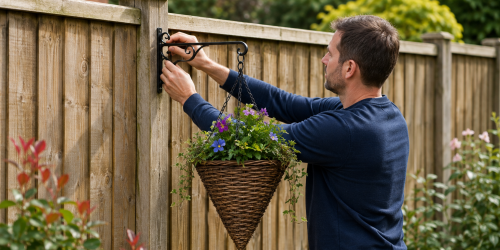
Quick answer: If the fence belongs to your neighbour, do not attach planters, trellis, lights, screening, hooks, mirrors, plants or decorations without their permission. The face visible from your garden is still part of their fence. Even lightweight items can mark the surface, trap moisture or increase wind loading. Where ownership is unclear, speak to your neighbour first. The safest alternative is an independent screen or trellis supported by posts inside your own boundary.
It is easy to assume that the side of a boundary fence facing your garden is yours to decorate. In practice, the important question is not which side you can see. It is who owns the physical fence and whether you have permission to alter it.
Attaching an item can mean drilling holes, adding weight, trapping moisture or changing how the fence responds to wind. What begins as a small hanging basket or string of lights can become a source of damage or disagreement if the fence belongs to someone else.
Fence ownership is not always obvious. Title plans normally show the general extent of a property rather than identifying the exact ownership of every fence, hedge or wall. Common assumptions about the left-hand fence, right-hand fence or position of the posts are not reliable.
This guide explains how to approach a neighbour’s fence, what requires permission, how to check ownership, which items create the greatest risks and how to add privacy, planting or decoration without relying on someone else’s structure.
What Can You Attach To A Neighbour’s Fence?
If the fence belongs to your neighbour, the practical answer is nothing unless they have agreed.
This includes items that are screwed, nailed, clipped, tied, hooked, glued or otherwise supported by the fence.
| Item | Permission Needed? | Main Risk | Independent Alternative |
|---|---|---|---|
| Hanging planters | Yes | Weight and moisture | Ground-standing troughs |
| Trellis panels | Yes | Wind and plant loading | Trellis on your own posts |
| Privacy screening | Yes | High wind resistance | Independent screen |
| Lights and cables | Yes | Holes, clips and cable strain | Stake lights or separate posts |
| Mirrors and decorations | Yes | Weight, rubbing and breakage | Freestanding frame |
| Climbing plants | Yes | Moisture and mature plant weight | Separate plant support |
| Paint or stain | Yes | Permanent appearance change | Your own decorative screen |
An item does not become acceptable simply because it is lightweight, removable or fitted only on your side. It is still using your neighbour’s property.
Do You Own The Side Of The Fence Facing Your Garden?
No. A fence does not have a separate owner for each face.
If your neighbour owns the fence, the boards, rails, posts and both visible faces form part of the same structure. The fact that one face can only be reached from your garden does not give you an automatic right to drill, paint or attach items to it.
The same principle applies to a neighbour’s wall. Being able to see or reach a surface from your property does not make the structure yours.
How Can You Find Out Who Owns The Fence?
Fence ownership may be recorded in property documents, but it frequently is not.
Useful documents can include:
- The title register
- The title plan
- Filed conveyances or transfers
- Older property deeds
- Boundary agreements
- Information supplied during a previous property sale
- Documents held by a landlord or management company
A title plan normally shows the general extent of the registered property. It does not usually identify the exact boundary line or state who owns every physical fence.
Some filed deeds contain T marks or written obligations relating to a boundary. A T mark is only useful when it is supported by wording in the relevant deed or register. A symbol appearing on an old plan without supporting wording should not be treated as conclusive evidence by itself.
Does Maintenance Responsibility Prove Ownership?
Not necessarily. A deed may require one property owner to maintain or repair a boundary feature without conclusively establishing ownership of the physical fence.
Responsibility, ownership and the exact legal boundary are related questions, but they are not always the same question.
This is one reason boundary issues become confusing. A neighbour may have replaced and maintained a fence for years without there being a clear document stating who owns it.
Who Owns The Left Or Right Fence?
There is no dependable rule that every homeowner owns the fence on the left, the right or at the rear of the garden.
These common sayings should not be used as evidence:
- You always own the fence on the left
- You always own the fence on the right
- The posts face the owner
- The good side must face the neighbour
- The person who paid for the latest repair automatically owns it
The construction of a fence may provide some practical clues, but it has no universal legal meaning.
What If Fence Ownership Is Unclear?
Do not alter the fence while ownership remains uncertain.
Speak to your neighbour and explain what you would like to do. They may know who installed the fence, have relevant paperwork or be willing to agree a practical arrangement.
Where ownership or maintenance responsibility cannot be established, it is sensible to treat the boundary feature as shared for decision-making purposes. Alterations, replacement and added loads should then be agreed by both neighbours.
A short conversation is usually easier than trying to resolve ownership after an item has caused damage.
Can You Put Screws Or Nails Into A Neighbour’s Fence?
Not without permission.
Screws and nails create permanent holes in the timber. They can also:
- Split thin boards
- Expose untreated timber
- Allow moisture into rails and boards
- Cause rust staining
- Interfere with later repairs
- Weaken an already weathered panel
A single small screw may not seriously affect a sound fence, but the decision still belongs to the fence owner.
Where permission is given, use exterior-grade fixings and place them into substantial framing rather than thin decorative boards. Pre-drilling may reduce the risk of splitting.
Can You Use Removable Hooks Or Adhesive Strips?
Ask permission before using them.
A fitting described as removable can still:
- Pull away surface fibres
- Leave adhesive residue
- Mark paint or treatment
- Trap water behind the fitting
- Rub against the surface in wind
Removable does not mean damage free, particularly on weathered or rough-sawn timber.
Can You Hang Planters On A Neighbour’s Fence?
Only with clear permission.
A planter becomes much heavier after it has been filled with compost, plants and water. The load may be concentrated on a small hook or bracket rather than spread through the fence frame.
Planters can also keep the fence wet. Water may run down the boards, collect around screw holes and remain trapped behind the container.
The risk is greater where:
- The panel is old or lightweight
- The planter is watered frequently
- Several planters are installed in one bay
- The fence is exposed to strong wind
- The fixing enters only a thin board
- The lower panel rail is already damp
Ground-standing planters, raised beds and troughs provide planting space without loading the fence.
Can You Attach Trellis To A Neighbour’s Fence?
Do not attach trellis without the owner’s agreement.
Trellis adds height and changes the way wind acts on the fence. It may appear open when first installed, but climbing plants can eventually turn it into a dense screen.
The combined load can include:
- The weight of the trellis
- Wet foliage
- Woody stems
- Wind pressure
- Movement caused by plants pulling across the frame
Old fence posts may not have enough length, foundation depth or remaining strength to support the extra height.
The safer solution is to install trellis panels on your own wooden posts inside your boundary. This keeps the planting and screening independent from the neighbour’s fence.
Can You Attach Bamboo Or Privacy Screening?
Only with permission, and even then the supporting fence should be assessed carefully.
Reed, bamboo, fabric and artificial screening can act like a sail. The screening may be light to carry, but once it blocks airflow it can place considerable pressure on the panels and posts.
Attaching screening with cable ties does not remove the risk. The ties transfer wind force into the fence and may cut into timber or decorative lattice.
Use an independent framed screen where privacy is the main aim.
Can You Paint Your Side Of A Neighbour’s Fence?
Not without their permission.
Paint, stain and timber treatment can:
- Change the appearance permanently
- Run through gaps onto the opposite face
- Conflict with an existing coating
- Make later maintenance more difficult
- Leave overspray on posts, paving or plants
The owner may wish to keep a natural finish, use a different colour or replace the fence shortly.
Where permission is refused, install your own decorative screen rather than coating their property.
Can You Grow Climbing Plants On A Neighbour’s Fence?
Ask before allowing climbers to use the fence as support.
Climbing plants can:
- Wrap around rails
- Grow through panel gaps
- Trap moisture against timber
- Make repairs difficult
- Pull loose boards and lattice apart
- Spread into the neighbouring garden
- Add considerable weight after rain
Dense evergreen plants can also increase winter wind pressure because they retain foliage throughout the year.
Install a separate trellis panel, wire system, obelisk or frame inside your garden. Leave enough space between it and the boundary fence for pruning and maintenance.
Can You Attach Lights To A Neighbour’s Fence?
Permission is still required, even for lightweight solar or battery lights.
Possible issues include:
- Screw or clip holes
- Cables rubbing against timber
- Water collecting around fittings
- Loose lights striking the fence
- Access being needed for battery replacement
- Disagreement over glare
Ground stakes, freestanding lanterns, your own posts or lighting fixed to your own building are normally simpler alternatives.
Can You Hang A Mirror Or Garden Decoration?
Only with permission.
Mirrors and solid decorations can be heavier than expected and may catch wind. A mirror may also break if the panel flexes or the fixings loosen.
Other concerns include reflected sunlight, glare, sharp broken material and moisture trapped behind the item.
A freestanding decorative frame allows the feature to be positioned safely without altering the boundary fence.
What Should You Do If Your Neighbour Gives Permission?
Make sure the permission is clear and specific.
Agree:
- What will be attached
- Where it will be positioned
- How it will be fixed
- How much it weighs
- Whether plants will be added
- Who will maintain it
- Who will repair any damage
- When it must be removed
A vague agreement to put something on the fence may not cover a later row of heavy planters or a full-height privacy screen.
Should Permission Be In Writing?
Written permission is sensible where the proposal involves holes, permanent coatings, substantial weight, added height or climbing plants.
The agreement does not necessarily need to be a formal legal document. A clear message can record what was discussed.
Written confirmation can prevent later disagreements about:
- The number of fixings
- The size of the item
- Whether it was intended to be permanent
- Responsibility for repairs
- What happens when either property is sold
How Should An Agreed Item Be Fixed?
Where the owner has agreed, keep the installation light and reversible where possible.
For a timber fence:
- Check that the panel and posts are sound
- Fix into substantial rails or framing
- Avoid thin boards and split edges
- Use exterior-grade fixings
- Pre-drill vulnerable timber
- Keep heavy items supported from the ground
- Avoid trapping water behind the item
- Inspect it after strong winds
Do not drill into concrete fence posts without knowing their construction. Concrete posts may contain reinforcement and can be damaged by unsuitable drilling.
What If Your Neighbour Attaches Something To Your Fence?
Start by speaking to them calmly. They may believe the fence is shared or may not realise that the item is causing a problem.
Explain:
- Why you believe the fence is yours
- What has been attached
- Whether holes or damage have been created
- Why the weight or moisture concerns you
- What action you would like them to take
Where the issue cannot be resolved verbally, follow up in writing and keep photographs of the fence and attachments.
A measured written request is normally better than immediately removing someone else’s planter, mirror or screening yourself. Removing it carelessly could damage their property or escalate the dispute.
What If An Attachment Damages The Fence?
Record the condition before anything is removed or repaired.
Useful records include:
- Clear photographs
- Dates
- Copies of messages
- Repair estimates
- Evidence of earlier fence condition
Discuss a practical repair first. For localised damage, this might involve replacing a board, backrail or panel rather than renewing the complete fence.
Where ownership, damage or compensation remains disputed, mediation or professional legal advice may be more proportionate than allowing a minor garden issue to develop into a prolonged neighbour dispute.
What If The Fence Is Shared?
A genuinely shared fence should be altered only by agreement.
Shared responsibility does not mean either neighbour can unilaterally:
- Add trellis
- Increase the height
- Paint the complete fence
- Hang heavy items
- Remove panels
- Replace the fence with a different design
Discuss how the change will affect appearance, maintenance, wind loading and future replacement.
Can You Build Your Own Fence In Front Of A Neighbour’s Fence?
You may be able to install an independent fence or screen inside your own boundary, provided it does not encroach onto the neighbouring property and complies with the relevant restrictions.
Before starting:
- Confirm the boundary position
- Leave enough installation space
- Keep access for maintenance where practical
- Check the complete finished height
- Consider drainage between the two structures
- Avoid trapping leaves and damp debris
- Locate underground services before digging
A very narrow gap between two fences can become difficult to clean and may encourage damp conditions.
What Are The Best Alternatives To Using A Neighbour’s Fence?
Freestanding Trellis
Traditional square, privacy square, diamond or horizontal slatted trellis can be installed on posts inside your garden.
This provides support for climbing plants while keeping their weight off the boundary fence.
Independent Privacy Panels
A small number of well-positioned decorative or slatted panels may screen a patio more effectively than increasing the height of the complete boundary.
Position the screen close to the area where privacy is needed.
Ground-Standing Planters
Large pots, troughs and raised planters can provide colour and screening without hanging weight from the fence.
Freestanding plant supports can be installed inside the containers.
Garden Arches And Obelisks
These structures support climbing plants away from the boundary and create height within the garden.
Your Own Fence Posts
Pressure-treated wooden fence posts can support trellis, decorative panels and other suitable screening. Post size, length and foundations should be chosen for the screen height and wind exposure.
Raised Sleeper Beds
Landscaping sleepers can create independent raised planting areas, but the bed should not place wet soil or structural pressure against the neighbour’s fence.
How Can You Add Privacy Without Touching The Fence?
Privacy does not always require a taller structure along the entire boundary.
Consider:
- A privacy trellis panel beside a seating area
- A double slatted screen near a patio
- A pergola with side screening
- Tall planters
- A row of suitable shrubs
- A garden room screen
- A freestanding decorative panel
Positioning is often more important than total height. A screen close to the seating area can interrupt a view more effectively than a distant boundary extension.
Does Adding Trellis Or Screening Affect Fence Height Rules?
It can. Trellis, screening and other permanent additions may count towards the total height of the boundary structure.
In England, planning permission is generally not required for a new or altered fence, wall or gate where it does not exceed:
- One metre when next to a highway used by vehicles or the footpath of that highway
- Two metres in other locations
If an existing structure already exceeds those limits, alterations that increase its height may still require permission.
Additional restrictions can apply where:
- The property is listed
- The fence is within the curtilage of a listed building
- A planning condition restricts boundary changes
- Permitted development rights have been removed
- The property is subject to estate or management rules
- A restrictive covenant applies
The planning examples above relate to England. Wales, Scotland and Northern Ireland operate separate planning systems.
Do Renters Need Permission?
Tenants should check their tenancy agreement and obtain permission from the landlord or housing provider before altering fencing or installing permanent boundary structures.
The fence may belong to:
- The landlord
- A neighbour
- A management company
- The freeholder
- A housing association
Unauthorised holes, coatings or structures may need to be removed or repaired at the end of the tenancy.
Freestanding planters and removable screens are normally easier to manage, but they must still be positioned safely and must not damage the property.
What About Leasehold Homes And Managed Estates?
A lease, transfer or estate-management agreement may restrict external alterations even where the fence appears to be inside your garden.
Restrictions may cover:
- Fence height
- Fence style
- Paint colour
- Privacy screening
- Additional posts
- Changes visible from communal areas
Check the relevant documents before installing a permanent screen or altering the appearance of a managed boundary.
Which Products Can Create An Independent Boundary Feature?
The right components depend on whether the aim is planting support, partial screening or a complete new boundary.
A practical independent installation may use:
- Pressure-treated wooden fence posts
- Traditional square or privacy trellis panels
- Horizontal slatted trellis
- Decorative fence panels
- Closeboard fence panels
- Hit and miss panels
- Double slatted panels
- Wooden or concrete gravel boards
- Post mix
- Exterior screws, clips and brackets
Choose the complete system rather than only the visible panel. Posts, foundations, gravel boards and fixings determine whether the screen remains upright.
A garden gate needs separate consideration. Use substantial gate posts and appropriate gate furniture rather than hanging a moving gate from lightweight trellis supports or a neighbour’s fence.
Common Mistakes To Avoid
- Assuming the visible face of the fence belongs to you
- Relying on the left-side or right-side rule
- Assuming fence-post position proves ownership
- Confusing maintenance responsibility with ownership
- Drilling first and asking permission later
- Using removable hooks without asking
- Hanging wet planters from lightweight panels
- Adding trellis without checking post strength
- Covering an open fence with wind-resistant screening
- Allowing climbers to spread through the boundary
- Painting the visible face without consent
- Ignoring the total height after adding trellis
- Building raised soil against fence panels
- Removing a neighbour’s property without discussion
- Installing a second fence without confirming the boundary
Before Attaching Anything To A Boundary Fence
Work through this checklist:
- Confirm who owns the physical fence
- Check title documents and filed deeds where available
- Do not rely on construction myths
- Speak to the neighbour
- Explain the exact item and fixing method
- Consider the weight after rain or plant growth
- Consider wind resistance
- Check whether moisture will be trapped
- Obtain written permission for permanent work
- Use exterior-grade fixings
- Keep heavy items independently supported
- Check the total height
- Consider a freestanding alternative
FAQs
Can I Attach Anything To My Neighbour’s Fence?
Not without permission. If the fence belongs to your neighbour, you should not drill, nail, paint, clip or hang items from it without their agreement.
Can I Use My Side Of My Neighbour’s Fence?
The face visible from your garden is still part of their fence. It does not become your property because it faces your land.
Can I Hang Baskets From My Neighbour’s Fence?
Only with permission. Filled baskets are heavy and can keep the fence wet. Ground-standing planters are a safer alternative.
Can I Attach Solar Lights Without Asking?
You should still ask. Even small lights may require clips, screws or adhesive and can mark the fence.
Can I Put Trellis On My Neighbour’s Fence?
Only with their agreement. Trellis adds height and wind resistance, and plants can make it considerably heavier over time.
Can I Attach Bamboo Screening With Cable Ties?
Not without permission. Cable ties still transfer wind pressure into the neighbour’s fence and may damage boards or lattice.
Can I Paint The Side Facing My Garden?
Not if the fence belongs to your neighbour, unless they agree. Painting changes their property and may affect the opposite face.
Can I Grow Ivy On A Neighbour’s Fence?
Ask first. Ivy can become heavy, grow through gaps, trap moisture and make maintenance difficult.
How Do I Know Which Fence Is Mine?
Check the title register, title plan, filed deeds and any boundary agreements. Speak to your neighbour where the documents do not provide a clear answer.
Do Fence Posts Show Who Owns The Fence?
No. The position of posts and rails does not provide a reliable legal rule for ownership.
Does A T Mark Prove Fence Ownership?
It may provide relevant information where it is expressly supported by wording in a deed or register. A standalone mark on an old plan should not be treated as conclusive by itself.
What If Neither Neighbour Knows Who Owns The Fence?
Treat changes as something that requires agreement from both sides. Avoid attaching items until the position has been discussed.
Can My Neighbour Attach Things To My Fence?
They should obtain your permission. Speak to them if something has been attached without agreement.
Can I Remove Something Attached To My Fence?
Ask the neighbour to remove it first. Document any damage and avoid damaging their property while resolving the issue.
What If Their Planter Damages My Fence?
Photograph the damage, discuss removal and agree an appropriate repair. Keep written records if the matter remains unresolved.
Can I Install My Own Trellis In Front Of Their Fence?
You may be able to install independent trellis inside your boundary. Confirm the boundary position, post foundations and total finished height first.
How Close Can My Screen Be To Their Fence?
Keep it entirely within your land and leave enough space for installation, airflow and maintenance. Avoid creating an inaccessible damp gap.
Can I Build A Raised Bed Against Their Fence?
Avoid using an ordinary fence as the side of a raised bed. Wet soil creates moisture and sideways pressure. Build an independent sleeper or retaining structure.
Does Trellis Count Towards Fence Height?
It can count as part of the complete boundary structure. Check the total height from the relevant ground level.
Can A Tenant Attach Things To A Fence?
Tenants should check their agreement and obtain any required landlord permission, as well as permission from the fence owner.
Is A Text Message Enough Permission?
A clear written message may be adequate for a simple arrangement. It should describe the item, position and fixing method.
What Is The Safest Way To Add Privacy?
Use an independent screen, privacy trellis or decorative panel supported by posts inside your own boundary.
Keep Boundary Improvements Independent Where Possible
If a fence belongs to your neighbour, do not treat the visible face as a free fixing surface. Planters, lights, paint, trellis, screening and climbing plants all alter or load the same structure.
Check the available property documents, but remember that plans and traditional fence rules may not provide a definitive answer. Where ownership is unclear, speak to the neighbour and agree any proposed change before starting.
Independent structures are usually the simplest long-term solution. Trellis panels, decorative screening, planting supports and fence panels can be installed on your own posts inside the boundary. This gives you control over decoration and maintenance without risking damage to someone else’s fence.
Clear communication and a correctly supported structure are more reliable than informal assumptions. Establish ownership, obtain permission where needed and choose a solution capable of carrying its own weight.