





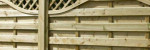

Quick answer: The best Fence Panels for a small garden provide enough screening without making every boundary feel like a solid wall. Closeboard and Waney Lap panels work where privacy is the priority, while Double Slatted and Hit & Miss designs can make compact spaces feel lighter by allowing controlled airflow and visual depth. Picket panels suit low boundaries, while decorative lattice designs work well around planting. Choose the panel height and style according to where privacy is actually needed.
A small garden does not necessarily need a small fence.
It does, however, need a fence that has been chosen with more care.
In a large garden, a tall solid boundary may sit many metres away from the main seating area. In a compact garden, the same panel could be immediately beside the patio, kitchen doors or garden furniture.
That changes how the fence feels.
The aim is usually to create enough privacy for the garden to be comfortable without surrounding the space with so much solid timber that it becomes dark, enclosed or visually dominated by fencing.
Why Fence Panels Feel More Dominant in Small Gardens
The closer you are to a fence, the more of your field of view it occupies.
This means a full-height solid panel can feel much more imposing in a narrow garden than it does at the end of a long lawn.
The effect becomes stronger when:
- The garden is narrow
- Both side boundaries use tall solid panels
- The patio sits immediately beside the fence
- The garden receives limited direct sunlight
- There is little planting to soften the timber
This does not mean you should automatically choose lower fencing.
It means height, openness and panel construction should be considered together.
Start With Where You Actually Need Privacy
One of the most useful questions in a small garden is not simply:
"How private should the garden be?"
Instead ask:
"Which parts of the garden actually need privacy?"
Often the answer is:
- The patio
- The main seating area
- An outdoor dining table
- The area immediately outside the house
The far end of the lawn or a planted border may not require the same level of screening.
This gives you more flexibility when choosing Fence Panels.
Which Fence Panels Work Best in Small Gardens?
The current East Coast Fencing range includes Closeboard, Waney Lap, Picket and Decorative Fence Panels, with decorative options including slatted, Hit & Miss and lattice designs.
Each creates a different balance of privacy and openness.
| Panel Style | Privacy | Visual Openness | Small Garden Use |
|---|---|---|---|
| Closeboard | High | Low | Private rear and side boundaries |
| Waney Lap | High | Low | Straightforward traditional screening |
| Double Slatted | Strong filtered screening | Moderate | Contemporary patios and seating areas |
| Hit & Miss | Moderate | Good | Boundaries where airflow matters |
| Omega Lattice | Stronger below, open above | Good | Planting and decorative feature areas |
| Picket | Low | Very high | Low boundaries and internal divisions |
Choose Closeboard Fence Panels When Privacy Comes First
Closeboard Fence Panels are one of the strongest choices where you genuinely need a solid screen.
The overlapping vertical boards create a dense timber face with very little visibility through the panel.
In a small garden, they work particularly well:
- Along an overlooked rear boundary
- Beside neighbouring seating
- Around a private patio
- Along one side where screening matters much more than light
The main disadvantage is visual weight.
A long run of full-height Closeboard panels on every side can make a compact space feel heavily enclosed.
Where possible, use solid fencing where it solves a real privacy problem rather than assuming every boundary needs maximum screening.
When Waney Lap Fence Panels Make Sense
Waney Lap Fence Panels provide straightforward solid screening with a familiar traditional appearance.
They can be a practical choice where you want:
- A conventional timber boundary
- Useful privacy
- A less decorative panel
- A simple replacement for an existing lap fence
Like Closeboard panels, their largely solid face can make a narrow garden feel more enclosed when used at full height throughout the space.
They work best where a conventional solid boundary is genuinely what the garden needs.
Why Double Slatted Fence Panels Suit Compact Patios
Double Slatted Fence Panels are worth considering when the fence will sit close to where you spend time.
The horizontal design provides substantial screening while the controlled gaps prevent the panel from appearing completely solid.
This combination works particularly well beside:
- Small patios
- Outdoor dining areas
- Garden rooms
- Compact contemporary gardens
The horizontal lines can also visually emphasise width.
That can be useful in a narrow space where strongly vertical fencing might make the boundary feel taller and more dominant.
Use Hit & Miss Fence Panels When Airflow Matters
Hit & Miss Fence Panels use boards positioned alternately across both sides of the panel.
This interrupts direct sightlines while still allowing more air through the fence than a solid panel.
For small gardens, that can be useful where:
- The boundaries are close together
- The garden can feel stuffy or enclosed
- The site is exposed
- You want screening without a completely solid wall
The trade-off is privacy.
Limited views are possible through the panel from certain angles, so Hit & Miss fencing is better when useful screening is enough rather than complete opacity.
Omega Lattice Fence Panels Can Make a Boundary Feel Softer
Omega Lattice Fence Panels combine a screened lower section with an open decorative lattice above.
This is particularly useful in small gardens because the panel provides privacy where people are normally seated while allowing more openness higher up.
The lattice can:
- Let additional light through
- Break up a long timber boundary
- Support manageable climbing plants
- Create a softer top line than a square solid panel
This makes Omega panels particularly effective near planting and more traditional garden layouts.
Picket Fence Panels Are Useful Where Privacy Is Not Needed
Not every fence within a small garden needs to be a privacy screen.
Picket Fence Panels are useful for:
- Dividing lawn from planting
- Separating a vegetable area
- Defining paths
- Creating low internal boundaries
The open gaps preserve views through the garden.
This is particularly valuable in compact spaces because an internal solid fence can visually divide an already limited area into even smaller sections.
Do You Really Need 6ft Fence Panels Everywhere?
No.
The current Fence Panels range includes a broad selection of heights, including approximately 3ft, 4ft, 5ft and 6ft options across different styles, with some ranges also offering additional intermediate or lower sizes.
A full-height panel is useful when privacy requires it.
But a lower panel can be better where you want:
- More daylight
- Views across the garden
- A less dominant boundary
- Greater connection with planting
Choose height according to the purpose of each boundary rather than selecting 6ft simply because it is the familiar default.
5ft Fence Panels Can Be a Useful Compromise
A 5ft panel can provide useful screening without creating quite the same wall-like effect as a full 6ft boundary.
This can work particularly well where seated privacy matters more than complete standing-height concealment.
Before choosing it, consider:
- Ground levels
- Neighbouring patios
- Where people normally sit
- Whether anyone is overlooking from a higher position
A lower panel only works if it still solves the privacy problem.
4ft Fence Panels Can Keep the Garden Feeling Open
Four-foot panels create a clear boundary without dominating the space.
They can be useful for:
- Internal garden divisions
- Less overlooked boundaries
- Areas beside planting
- Gardens where preserving light is important
If additional screening is only needed around one patio, you may be able to use taller fencing there and lower fencing elsewhere.
Use Different Fence Panels for Different Parts of the Garden
A small garden does not need one panel type around every edge.
In fact, using different styles according to their purpose can make the space work better.
For example:
- Closeboard at the overlooked rear boundary
- Double Slatted panels around the patio
- Hit & Miss panels along an exposed side
- Omega Lattice beside a planted section
- Picket panels for an internal vegetable garden
Keep the scheme controlled rather than changing style every single bay.
Group similar panels around complete garden zones.
How to Make Mixed Fence Panels Look Intentional
Keep some features consistent even when the panel changes.
These might include:
- Post type
- Gravel board type
- Timber treatment appearance
- Main panel height
Use natural transition points such as:
- A gate
- The end of a patio
- A garden room
- A change in direction
- A large planting bed
This makes the variation feel designed rather than accidental.
Can Fence Colour Make a Small Garden Feel Bigger?
Colour changes how strongly the boundary attracts attention.
There is no universal rule that dark or light fencing always makes a garden appear larger.
Darker finishes can sometimes visually recede behind planting, particularly when surrounded by green foliage.
Lighter timber can brighten a shaded garden but may also make the fence more visually noticeable.
Consider the complete combination of:
- Light levels
- Planting
- Paving
- Garden furniture
- House exterior
rather than choosing fence colour from one design rule.
Use Planting to Soften Solid Fence Panels
You do not necessarily need a more open fence if solid privacy is important.
Planting can reduce the visual weight of a Closeboard or Waney Lap boundary.
Useful options include:
- Shrubs
- Ornamental grasses
- Climbers with suitable support
- Container planting
A layered planting bed in front of the fence can stop the eye reading the entire boundary as one uninterrupted timber surface.
Do Not Overload Fence Panels With Plants
Planting should soften the boundary rather than become a structural load on it.
Large mature climbers can add:
- Weight
- Wind resistance
- Moisture around the timber
For vigorous climbing plants, an independent support or suitable trellis system may be preferable.
Think About Light Before Choosing a Solid Fence
A fence cannot create or remove sunlight, but its height and openness affect how much light reaches nearby areas.
This matters particularly where the boundary sits:
- Close to a patio
- Beside a narrow side garden
- Immediately behind planting
- Near doors or windows
If privacy allows it, a lower or partially open panel may feel more comfortable in a shaded part of the garden.
Which Fence Panels Work Best Beside a Small Patio?
The answer depends on how overlooked the patio is.
If privacy is essential, Closeboard may provide the strongest immediate screen.
If the patio already feels enclosed, Double Slatted or Hit & Miss Fence Panels can provide a better balance of screening and openness.
Omega Lattice can work well where planting is a major feature.
| Patio Priority | Panel to Consider |
|---|---|
| Maximum privacy | Closeboard |
| Contemporary screening | Double Slatted |
| Privacy with more airflow | Hit & Miss |
| Planting and decorative detail | Omega Lattice |
Which Fence Panels Work Best in a Narrow Garden?
Horizontal designs are worth considering.
Double Slatted and Hit & Miss panels create repeated horizontal lines that can visually emphasise the length or width of the boundary.
They also retain some openness compared with a solid panel.
That does not mean horizontal fencing is always better.
If the narrow garden is heavily overlooked, the privacy provided by solid Closeboard fencing may be more valuable than the visual effect of slats.
What If the Garden Is Both Small and Windy?
This is where the balance becomes particularly important.
A full run of tall solid fencing may provide strong privacy but also presents a substantial surface to the wind.
Hit & Miss fencing allows more airflow and may suit an exposed boundary where partial screening is acceptable.
Double Slatted panels can offer another contemporary compromise.
If you choose solid fencing, make sure the:
- Posts
- Foundations
- Fixings
are suitable for the panel height and exposure.
Should Small Gardens Use Wooden or Concrete Fence Posts?
Both can work.
Wooden posts create a coordinated timber appearance and can make the whole boundary feel visually consistent.
Concrete posts provide a durable support system and can make future panel replacement easier where compatible slotted panels are used.
In a very small garden, appearance may matter more because the posts are always visible at close range.
Choose the post system as part of the complete design rather than as an afterthought.
Are Gravel Boards Worth Using in a Small Garden?
They can be particularly useful because compact gardens often place fencing close to:
- Flower beds
- Lawns
- Raised planting
- Patios
A gravel board helps separate the lower timber panel from damp soil, vegetation and rain splash.
It also creates a consistent lower line.
Remember that the gravel board contributes to the overall visual and physical height of the completed boundary.
Avoid Making Every Surface a Boundary
One of the easiest ways to make a compact garden feel smaller is to divide it repeatedly with solid structures.
If you want separate areas for:
- Dining
- Planting
- Vegetables
- Storage
you do not necessarily need full solid fencing between each one.
Lower Picket panels, planting or open trellis can define internal areas while preserving longer views through the garden.
Common Fence Panel Mistakes in Small Gardens
- Automatically choosing 6ft solid panels for every boundary
- Ignoring where privacy is actually required
- Using internal solid fences that divide the garden into smaller visual compartments
- Choosing a very open panel where complete privacy is needed
- Choosing a solid panel in a shaded patio without considering light
- Ignoring airflow in a narrow enclosed garden
- Using too many unrelated decorative panel styles
- Allowing dense planting to completely cover and overload the fence
- Choosing panel height without considering gravel boards
- Focusing on the panel while ignoring posts, foundations and fixings
Small Garden Fence Panels Buying Checklist
- Identify the areas that genuinely need privacy.
- Assess whether the garden already feels enclosed.
- Check where daylight matters most.
- Consider wind exposure.
- Choose Closeboard or Waney Lap where solid privacy is required.
- Consider Double Slatted for contemporary screening.
- Consider Hit & Miss where airflow matters.
- Consider Omega Lattice around planting.
- Use Picket panels for low internal divisions where appropriate.
- Choose only as much panel height as the space needs.
- Plan posts and gravel boards with the panels.
- Keep panel styles grouped into logical garden zones.
FAQs
What Are the Best Fence Panels for a Small Garden?
There is no single best type. Closeboard suits maximum privacy, Double Slatted provides contemporary screening, Hit & Miss allows more airflow, Omega Lattice works well around planting and Picket panels suit low open boundaries.
Do 6ft Fence Panels Make a Small Garden Look Smaller?
They can make a compact space feel more enclosed, particularly when solid panels are used along every boundary. If 6ft screening is genuinely required, planting or more decorative panel choices can help soften the effect.
What Fence Panels Make a Garden Feel More Open?
Hit & Miss, Double Slatted, Picket and lattice-based panels generally create more visual openness than completely solid Closeboard or Waney Lap fencing.
What Fence Panels Give the Most Privacy?
Solid Closeboard Fence Panels are a strong option where immediate privacy is the priority.
Are Slatted Fence Panels Good for Small Gardens?
Yes. Their horizontal design and controlled openings can provide useful screening without creating the same visual weight as a fully solid panel.
Are Hit & Miss Fence Panels Good for Small Gardens?
Yes, particularly where airflow matters and complete opacity is not required.
Can I Use Different Fence Panels Around the Same Garden?
Yes. Using different panel styles for different garden zones can work very well when transitions are deliberate and recurring elements such as posts or heights remain consistent.
Should a Small Garden Have the Same Fence Height Everywhere?
Not necessarily. Taller panels can be concentrated around overlooked areas while lower or more open panels are used where privacy is less important.
Which Fence Panels Should You Choose for a Small Garden?
Start with privacy, but do not stop there.
A small garden has limited distance between the boundary and the people using it, so the appearance, height and openness of the fence have a stronger effect on how the space feels.
If maximum screening is necessary, Closeboard Fence Panels are a practical choice. Waney Lap panels provide another traditional solid option.
If you want the garden to feel lighter, consider Double Slatted Fence Panels for contemporary screening or Hit & Miss panels where allowing more air through the boundary is particularly useful.
Omega Lattice panels work well where planting and decorative detail matter, while Picket Fence Panels are useful for low internal divisions that preserve views through the garden.
You also do not need to choose one solution for every boundary.
A strong small-garden design might use solid fencing where neighbouring views need to be blocked, a more open decorative panel around the patio and low fencing for internal garden divisions.
The best Fence Panels for a small garden are therefore not necessarily the lowest or most open. They are the panels that provide privacy where it matters while avoiding unnecessary height and solidity everywhere else.