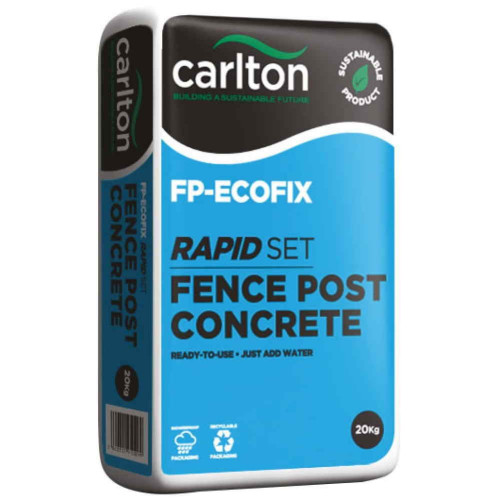




Working out how many bags of Postcrete you need per fence post is an important part of planning a fencing project. Too little material can leave posts poorly supported, while buying far too much adds unnecessary cost and waste. The right amount depends on the size of the post, the depth and width of the hole, the type of fence, the ground conditions and how exposed the site is.
As a broad guide, many standard domestic fence posts need around one to two bags of post mix per post, but this is only a starting point. Heavier fences, deeper holes, larger posts, concrete fence posts, gate posts and poor ground may need more. Always check the guidance on the product you are using and size the hole properly for the job.
This guide explains how to estimate Postcrete quantities, what affects the amount needed, how to calculate hole volume, and how to avoid common mistakes when setting fence posts.
What is Postcrete?
Postcrete is a ready-mixed, quick-setting concrete product designed for setting posts into the ground. It is commonly used for fence posts, gate posts, washing line posts, rotary dryers, signs and other outdoor posts.
Unlike traditional concrete, Postcrete is usually poured dry into a prepared hole with water added according to the product instructions. It sets quickly, which makes it convenient for fencing work.
Postcrete is popular because it is:
- Quick-setting
- Easy to use
- Pre-mixed
- Convenient for DIY projects
- Suitable for many domestic fence posts
- Less messy than mixing concrete from separate materials
Although it is simple to use, it still needs correct hole preparation, post alignment and sufficient quantity to create a stable fixing.
How many bags of Postcrete per fence post?
For many standard domestic fence posts, one to two bags of Postcrete per post is a common estimate. However, this varies. A small low fence may need less support than a tall 6ft fence panel in an exposed garden. A gate post may need more than an ordinary intermediate fence post.
The number of bags depends on:
- The size of the post
- The depth of the hole
- The width of the hole
- The height of the fence
- The weight of the fence panels
- Whether timber or concrete posts are used
- Whether gravel boards are fitted
- Whether the post supports a gate
- The soil type
- Wind exposure
- The manufacturer’s coverage guidance
Do not rely only on a rough bag-per-post rule. It is better to calculate the approximate volume of each hole and check it against the yield stated on the bag.
Why the amount of Postcrete matters
A fence post needs a strong base because the whole fence depends on it. Fence panels catch wind, gates move, and ground conditions change through wet and dry weather. If the post is not properly supported, the fence may lean, rattle or fail in strong weather.
Using too little Postcrete can lead to:
- Loose posts
- Leaning fence panels
- Movement in wind
- Gaps opening along the fence line
- Gate posts twisting
- Shorter fence lifespan
- More repairs later
Using too much is also wasteful. Oversized holes can cost more to fill and may disturb more ground than necessary.
Standard fence posts
Many domestic timber fence posts are around 100mm by 100mm. These are commonly used with standard garden fence panels, depending on fence height and design.
For a typical 100mm timber fence post, one or two bags of Postcrete may be enough, depending on the hole size and depth. Taller fences, exposed sites or loose ground may need the higher end of that range or more.
The aim is not just to fill a hole. The post needs enough concrete around it to resist movement and spread the load into the ground.
Larger timber posts
Larger timber posts, such as 125mm by 125mm posts, usually need larger holes and therefore more Postcrete. These posts may be used for heavier fencing, taller boundaries or stronger garden structures.
Because the post itself takes up more room in the hole, the calculation is not always as simple as “larger post equals much more concrete”. However, larger posts are usually installed in wider or deeper holes, so the total amount of Postcrete often increases.
For larger posts, allow extra material and check the hole volume carefully.
Concrete fence posts
Concrete fence posts are heavier than timber posts and are commonly used with fence panels and gravel boards. They are durable and low maintenance, but they need careful installation.
Concrete posts may need more post mix than a lightweight timber post because the hole often needs to be deep and stable enough to support a heavy fence system.
When using concrete fence posts, accurate spacing is also important. If the posts are not set correctly, fence panels and gravel boards may not fit neatly.
Gate posts
Gate posts usually need more support than ordinary fence posts. A gate is not a fixed panel. It swings, twists, pulls on the hinges and places repeated strain on the post.
For gate posts, consider using:
- A larger post
- A deeper hole
- A wider hole
- More post mix or concrete
- Strong hinges and fixings
- Careful alignment
- Extra curing time before heavy use
A gate post that moves even slightly can cause the gate to drop, drag or fail to latch properly. Do not underfill gate post holes.
Fence height and wind exposure
Fence height affects how much force the post needs to resist. A 6ft fence panel catches much more wind than a low picket fence. In exposed gardens, tall fence panels can act like sails.
Higher fences usually need stronger posts, deeper holes and a more secure fixing. This may mean more Postcrete per post.
Wind exposure is especially important if the garden is:
- On a hill
- Near open fields
- In a coastal area
- At the end of a row of houses
- Beside an open driveway
- Using solid privacy fence panels
In exposed places, it may be worth considering stronger posts, concrete fence posts, hit and miss fence panels or other designs that cope better with wind.
Fence panel weight
Not all fence panels weigh the same. A lightweight lap panel places less load on posts than a heavy closeboard fence panel or a dense decorative panel.
Heavier panels may need stronger support, especially when paired with concrete gravel boards. If the fence system is heavy, do not rely on minimal post foundations.
Think about the whole system: fence panels, posts, gravel boards, capping, trellis and gates all contribute to the load.
Hole depth
Hole depth is one of the most important parts of post installation. A shallow hole is a common reason fences become unstable.
The correct depth depends on post length, fence height, ground conditions and exposure. As a broad principle, a meaningful portion of the post should be below ground so it can resist movement.
For many domestic fence projects, post holes are often dug deep enough to give strong support below ground. Taller fences and gate posts often need deeper holes than low fences.
Always consider the specific fence design and site conditions rather than using one depth for every job.
Hole width
The width of the hole affects how much Postcrete you need. Wider holes use more material, but holes that are too narrow may not provide enough support around the post.
A common rule of thumb is to make the hole several times wider than the post, allowing enough room for post mix around all sides. The exact width depends on the post and the job.
If the hole is very uneven, oversized or collapsed at the sides, it will need more Postcrete than expected.
How to calculate how much Postcrete you need
To estimate the amount more accurately, calculate the volume of the hole and subtract the volume of the post section that sits inside it. The remaining space is the amount the Postcrete needs to fill.
The basic method is:
- Measure the hole width
- Measure the hole depth
- Calculate the approximate hole volume
- Calculate the volume of the post below ground
- Subtract the post volume from the hole volume
- Compare the result with the yield per bag
Most product bags give an approximate yield. Use that figure for the product you are buying, as bag size and coverage can vary.
Simple square hole calculation
If the hole is roughly square, the calculation is:
Hole width x hole width x hole depth = hole volume
Then calculate the volume of the part of the post in the hole:
Post width x post depth x buried post length = post volume
Then subtract:
Hole volume minus post volume = Postcrete volume needed
This gives an estimate. Real holes are rarely perfectly square, and soil can crumble or widen during digging, so allow some extra.
Simple round hole calculation
If the hole is round, the volume calculation is different. A post hole digger or auger often creates a round hole.
The rough calculation is:
3.14 x radius x radius x depth = hole volume
The radius is half the hole width. Once you have the hole volume, subtract the volume of the post section below ground.
If you are not confident with the maths, use a little extra allowance rather than risking being short.
Allow for waste and uneven holes
Post holes are rarely perfect. The sides may crumble, stones may be removed, the base may become uneven and extra material may be needed to fill gaps.
Always allow a margin. Running out of Postcrete halfway through setting posts is frustrating and can compromise the job.
It is usually sensible to buy slightly more than the exact calculation suggests, especially for larger projects or awkward ground.
How many bags for a full fence run?
Once you have estimated the number of bags per post, multiply it by the number of posts. Remember to include end posts, corner posts and gate posts.
For example, a straight run with six fence panels will usually need seven posts if every panel is supported between posts. A corner, return, gate or change in direction may add more.
Do not calculate only by the number of panels. Count the actual posts.
Example estimate for a small fence
Suppose you are installing a short run of standard fence panels with timber posts in good ground. If each post needs around two bags and you have five posts, you would need around ten bags.
It would still be sensible to have an extra bag available in case one hole is wider, deeper or more awkward than expected.
Example estimate for concrete posts and gravel boards
A fence using concrete posts and concrete gravel boards may need more careful allowance because the materials are heavier and accurate post setting is essential.
If each post hole is larger or deeper than a lightweight timber installation, the number of bags per post will rise. On a longer run, this can make a noticeable difference to the total number of bags.
Calculate using hole size rather than assuming the same amount as a lighter fence.
Postcrete for sloping gardens
Sloping gardens can affect Postcrete quantities because post depths and hole positions may vary. Stepped fence panels, gravel boards and changing ground levels can mean some posts need different hole depths.
Do not assume every post hole will use the same amount. Measure as you go, especially where the ground rises or falls.
On slopes, good alignment is just as important as quantity. Posts must be set correctly so panels fit and the fence line looks neat.
Postcrete in clay soil
Clay soil can be heavy, sticky and slow-draining. It may hold water around posts, which can affect timber over time.
When installing timber posts in clay, think carefully about drainage and the shape of the concrete finish at the surface. The top should shed water away from the post rather than leave a dip where water collects.
Clay can also make digging harder, so allow extra time and be prepared for holes that are not perfectly neat.
Postcrete in sandy or loose soil
Sandy or loose soil may collapse into the hole, making the hole wider than planned. This increases the amount of Postcrete needed and can make post alignment harder.
In loose ground, dig carefully and avoid leaving holes open for longer than necessary. You may need extra material to fill around the post properly.
For exposed sites or poor ground, consider whether deeper holes, wider holes or a different post system is needed.
Postcrete in wet ground
Wet or waterlogged ground can complicate post installation. Water in the hole may affect the way the product behaves, depending on the instructions and conditions.
If the hole fills with water, check the product guidance before proceeding. In some cases, drainage improvements or a different installation approach may be needed.
Do not ignore persistent wet ground. It can affect long-term fence stability, especially with timber posts.
How to use Postcrete correctly
Always follow the instructions on the bag. Different products may have different guidance, so do not assume every post mix is used in exactly the same way.
A typical process involves:
- Digging the post hole to the correct depth and width
- Positioning the post
- Checking height and alignment
- Adding water and post mix as instructed
- Keeping the post upright while the mix sets
- Shaping the surface to shed water
- Allowing suitable curing time before loading the fence
Because Postcrete sets quickly, have everything ready before you open the bag.
Set posts one at a time
For DIY work, it is usually easier to set posts one at a time. This gives you time to check alignment, level and spacing before the mix starts to set.
Use a spirit level on two sides of the post. Check the post is upright, then re-check after adding the mix. Posts can move while material is being poured into the hole.
If using slotted concrete posts with fence panels and gravel boards, spacing must be accurate. Take your time before the mix sets.
Use a string line
A string line helps keep the fence run straight. Set it along the proposed fence line before digging or setting posts.
Use the line to check:
- Post positions
- Fence alignment
- Panel spacing
- Changes in direction
- Gate positions
A fence can be structurally sound but still look poor if the posts wander in and out of line.
Check post spacing
Post spacing is critical when using ready-made fence panels. If posts are too close together, the panels may not fit. If they are too far apart, the panels may be loose or unsupported.
Measure carefully between posts and account for the way panels fit into or onto the posts. Concrete slotted posts and timber posts are installed differently, so check the system before setting anything permanently.
Once Postcrete sets, moving a post is difficult.
Do not add too much water
Too much water can weaken the mix or affect setting. Too little water may stop it hydrating properly. Follow the instructions for the product.
Do not guess if the bag gives clear guidance. Keep a watering can or bucket ready before starting so you can work efficiently.
If weather is very wet or the hole contains standing water, check the manufacturer’s guidance before use.
Shape the top of the Postcrete
Once the post is set, shape the top of the mix so rainwater runs away from the post. Do not leave a bowl-shaped dip around a timber post.
This is especially important for wooden fence posts because water sitting at the base can encourage decay over time.
A neat sloped finish also looks better and reduces the chance of water pooling around the post.
How long does Postcrete take to set?
Postcrete is designed to set quickly, but setting time and full strength are not always the same thing. Follow the guidance on the bag before putting strain on the post.
For ordinary fence posts, avoid pushing, pulling or loading the post too soon. For gate posts, allow extra caution because gates place more movement and strain on the post.
Cold, wet or difficult conditions may affect setting and curing.
Can you use Postcrete with wooden fence posts?
Yes, Postcrete is commonly used with wooden fence posts. The post should be suitable for ground contact and properly treated. The hole should be deep enough, and the surface should be finished so water drains away from the timber.
Using a suitable pressure treated fence post helps improve durability. However, even treated timber benefits from good installation and drainage.
Can you use Postcrete with concrete fence posts?
Yes, Postcrete can be used with concrete fence posts where suitable. Concrete posts are heavy, so take care with lifting and alignment.
Because concrete posts are often used with fence panels and gravel boards, spacing must be accurate before the mix sets.
Use temporary support if needed while the post is being positioned and the mix begins to firm up.
Can you use Postcrete for metal posts?
Postcrete is often used for various post types, including some metal posts. Check that the post and product are suitable for the intended installation.
Metal posts may need specific protection against corrosion, especially where they meet concrete or ground moisture. Follow the post manufacturer’s guidance.
Can you use Postcrete for repair jobs?
Postcrete can be useful for repair work, but the old post hole and existing concrete must be considered. If an old post has rotted, snapped or left a loose hole, simply adding more material may not solve the problem.
For repairs, check:
- Whether old concrete needs removing
- Whether the hole is oversized
- Whether the ground is stable
- Whether the new post can be set in the correct position
- Whether nearby panels need supporting
In some cases, a concrete repair spur may be more practical than replacing a post. In others, full post replacement is better.
Postcrete vs traditional concrete
Postcrete is quick and convenient. Traditional concrete may be preferred for some heavier, larger or specialist jobs, depending on site conditions and requirements.
Postcrete is useful for:
- Domestic fence posts
- Quick repairs
- DIY convenience
- Small to medium projects
- Situations where fast setting is useful
Traditional concrete may be considered where a larger foundation, slower working time or different mix specification is needed.
For most domestic fencing, Postcrete is popular because it reduces mixing time and is simple to handle.
Should you use gravel at the bottom of the hole?
Some installers add a small amount of gravel at the base of a post hole to aid drainage, especially for timber posts. Others set posts directly into the post mix according to their usual method and product guidance.
If using gravel, make sure it does not reduce the effective depth of the post or make the base unstable. The post still needs firm support.
For timber posts, drainage and surface shaping are important because moisture at ground level is a common cause of rot.
How to avoid running short
Running short of Postcrete during a fencing job can be awkward, especially once a post is positioned and ready to set.
To avoid this:
- Calculate based on hole size
- Count every post, including corners and gates
- Allow extra for uneven holes
- Buy spare bags for larger projects
- Check bag yield before ordering
- Keep materials dry before use
Unused bags may be helpful for another garden project, but opened or damp bags can spoil, so store them properly.
Storage before use
Keep Postcrete dry before use. If bags get damp, the product may begin to harden or clump, making it difficult or unsuitable to use.
Store bags:
- Off the ground if possible
- Under cover
- Away from rain
- In a dry shed or garage
- Protected from punctures
Do not rely on old, damp or partly set material for structural post installation.
Common mistakes when using Postcrete
Most problems come from poor preparation or rushing.
Common mistakes include:
- Using too little Postcrete
- Digging holes too shallow
- Making holes too narrow
- Not checking post alignment before setting
- Forgetting to use a string line
- Adding too much water
- Letting the post move while the mix sets
- Putting strain on posts too soon
- Leaving water to pool around timber posts
- Using damp or spoiled bags
- Not allowing extra for gate posts
- Assuming every hole needs the same amount
A fence is only as good as its posts. Care at this stage saves repairs later.
Postcrete planning checklist
Use this checklist before ordering materials:
- Measure the full fence line
- Count the number of posts
- Identify corner, end and gate posts
- Choose timber or concrete posts
- Decide whether gravel boards are being used
- Check fence height and wind exposure
- Estimate hole depth and width
- Calculate approximate hole volume
- Check the yield per bag
- Allow extra for uneven holes
- Buy additional bags for gate posts if needed
- Store bags somewhere dry
- Have water, tools and levels ready before use
Frequently asked questions
How many bags of Postcrete do I need per fence post?
Many standard domestic fence posts use around one to two bags per post, but the exact amount depends on the post size, hole size, fence height, soil and exposure. Always check the product yield and calculate based on the hole volume.
Is one bag of Postcrete enough for a fence post?
One bag may be enough for some small posts or shallow low-fence applications, but many standard fence posts need more. If the hole is deeper or wider, one bag may not provide enough support.
Do concrete fence posts need more Postcrete?
They may do, especially if the holes are deeper or wider to support a heavier fence system. Concrete posts are heavy and need accurate, stable installation.
Do gate posts need more Postcrete?
Usually yes. Gate posts take more strain than ordinary fence posts because the gate moves and hangs from the post. Larger holes and more material may be needed.
How do I calculate Postcrete for a post hole?
Calculate the volume of the hole, subtract the volume of the post section below ground, then divide by the approximate yield per bag. Add a margin for uneven holes and waste.
Can I use Postcrete for wooden posts?
Yes, Postcrete is commonly used for wooden fence posts. Use suitable treated timber and shape the surface so water drains away from the post.
Can I use Postcrete for concrete posts?
Yes, Postcrete can be used for concrete fence posts where suitable. Take care with alignment and spacing, especially when fitting fence panels and gravel boards.
How deep should a fence post hole be?
The required depth depends on fence height, post length, ground conditions and exposure. Taller fences and gate posts usually need deeper holes than low decorative fencing.
Can I use too much Postcrete?
Using more than needed is usually wasteful and can make future removal harder. The aim is to dig the right size hole and fill it properly, not create unnecessarily large concrete foundations.
How quickly does Postcrete set?
Postcrete is designed to set quickly, but follow the instructions on the bag. Avoid putting strain on posts too soon, especially gate posts or exposed fencing.
Final thoughts
The number of bags of Postcrete needed per fence post depends on the size of the post hole, the post type, the fence height and the conditions of the site. A rough rule may help with early planning, but the best estimate comes from calculating the volume that needs filling and checking the yield of the product you are using.
For standard domestic fencing, many posts may need one to two bags each, while larger posts, concrete fence posts, gate posts and exposed sites may need more. Always allow a small margin so you do not run short during installation.
Good fencing starts with strong posts. Dig suitable holes, align each post carefully, use enough post mix, shape the surface to shed water and allow the material to set properly. Taking time at this stage helps create a fence that stands straighter, lasts longer and performs better in everyday weather.