






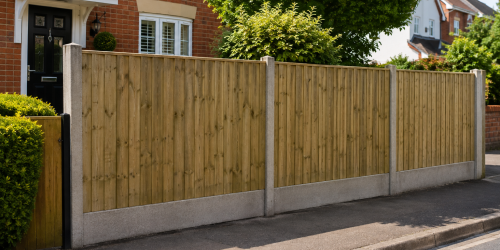
If you want to put a 6ft fence at the front of your property, the first thing to check is whether the boundary sits next to a road, footpath or verge. In many UK homes, a front garden fence beside a highway is usually limited to 1 metre overall unless planning permission is granted.
That does not mean you have no options. A lower front boundary, careful planting, set-back screening and the right fence style can still give your frontage a smart, practical finish without causing planning problems.
Quick answer: A 6ft fence at the front of a house will usually need planning permission if it is next to a road, footpath or verge. The usual permitted height for a front boundary beside a highway is 1 metre overall. Rules can vary, so check with your local planning authority before ordering materials or starting work.
Can You Have A 6ft Fence In A Front Garden?
In many cases, no, not without planning permission. A 6ft fence is around 1.83m high, which is usually above the permitted height for a front boundary that sits next to a highway.
For rear and side gardens, the usual limit is often up to 2 metres overall. Front boundaries are treated differently because they can affect visibility, road safety and the look of the street.
If your front boundary is not next to a road, footpath or verge, the rules may be different. The safest approach is to check with your local planning authority before you build.
At A Glance: Will A 6ft Front Fence Need Planning Permission?
| Situation | Likely Position For A 6ft Fence | What To Do |
|---|---|---|
| Front boundary next to a road, footpath or verge | Planning permission usually needed | Check with the local planning authority |
| Front area not next to a highway | Rules may be different | Confirm before building |
| Corner plot beside a road or junction | Extra restrictions are common | Check visibility and highway requirements |
| Listed building or conservation area | Additional consent may be needed | Check local restrictions first |
| New-build estate with covenants | Private rules may restrict fencing | Check deeds or management company rules |
What Counts As A Front Garden Boundary?
A front boundary is usually the part of the property that faces the road or main public approach. This may include the front lawn, driveway edge, entrance path or the boundary between the garden and pavement.
On corner plots, a side fence may also be treated like a front or roadside boundary if it runs beside a road. This is where people often get caught out, as a side garden can still affect road visibility.
If the boundary is clearly away from the highway and sits within the garden, different height rules may apply. Because every plot is different, it is worth checking before assuming a 6ft fence is allowed.
Why Front Fence Heights Are Lower
Front boundaries are usually kept lower to protect visibility for drivers, cyclists and pedestrians. A tall solid fence near a driveway, bend or junction can make it harder to see people or vehicles approaching.
Planning rules also consider how the boundary affects the street scene. A 6ft solid fence at the front can look very dominant, especially on open front gardens where neighbouring properties have lower walls, hedges or picket fencing.
How Fence Height Is Measured
Fence height is measured as the total height of the whole structure, not just the panel. This includes any posts, gravel boards, capping, trellis or decorative details.
For example, if you install a 1m fence and add 0.3m of trellis on top, the total height becomes around 1.3m. That may be above the usual permitted height for a front boundary next to a highway.
| Part Of The Fence | Does It Count Towards Height? | Why It Matters |
|---|---|---|
| Fence panel | Yes | This is the main height of the boundary |
| Fence post | Yes | Posts can project above the panel |
| Gravel board | Yes | It lifts the panel and adds to the total |
| Panel capping | Yes | It sits above the panel |
| Trellis topper | Yes | Trellis is part of the overall structure |
Can You Add Trellis To A Front Fence?
You can use trellis in a front garden, but it still counts towards the total fence height. If the boundary is next to a highway, adding trellis to a fence that is already close to 1 metre may take it above the usual permitted height.
For a softer front boundary, low trellis panels can work well with planting. If you are using trellis on top of a fence you own, fence topper trellis can add detail, but the combined height still needs to be checked.
Good Alternatives To A 6ft Front Fence
If a 6ft fence is not suitable at the front, there are still practical ways to improve privacy and kerb appeal.
Use A Lower Front Fence
Lower fence panels can define the front boundary without making the property feel closed in. Picket fence panels are often a good choice where you want a traditional, welcoming look.
Set Privacy Screening Back From The Boundary
In some gardens, the best option is to keep the front boundary low and add taller screening further inside the garden. This can give privacy where you actually need it, such as around a seating area, without creating a tall barrier right on the roadside.
Depending on the layout, double slatted fence panels, hit and miss fence panels or decorative fence panels can work well for set-back screening.
Use Planting For Privacy
Planting can soften a front boundary and provide gradual screening. Hedges, shrubs and climbers can make the garden feel less exposed without the hard look of a tall solid fence.
Hedges are not always treated in the same way as fences, but local restrictions may still apply, especially in conservation areas or managed developments.
Front Garden Fence Options
| Option | Best For | Things To Check |
|---|---|---|
| Picket fence panels | Traditional front boundaries | Keep within the usual front height limit |
| Low decorative panels | A smarter, more detailed frontage | Check overall height and visibility |
| Low trellis with planting | Soft, natural screening | Trellis still counts towards structure height |
| Set-back taller screen | Privacy inside the garden | Check placement and height before building |
| Railway sleepers | Edging, raised beds and kerb appeal | Use as landscaping, not as a tall boundary |
What To Ask Your Local Planning Authority
If you are not sure whether a 6ft front fence is allowed, contact your local planning authority before starting work. It helps to have a clear description of the boundary and a few photos ready.
You can ask:
- Is my front boundary classed as adjacent to a highway?
- Would a 1.83m fence need planning permission in this location?
- Are there any conservation area, Article 4 or local design restrictions?
- Do visibility splays apply near my driveway, bend or junction?
- Would a lower boundary with a set-back privacy screen be acceptable?
Corner Plots And Driveways
Corner plots often need extra care. A fence that appears to be along the side of the garden may still sit next to a road or junction. In that case, the usual 1 metre front or roadside limit may apply.
Driveways are another important point. If a fence or hedge blocks visibility when pulling out, it may cause safety concerns even if the fence looks reasonable from the garden side.
Where there is any doubt, check before building. It is much easier to adjust the plan at the start than to change the boundary later.
Building A Front Boundary That Lasts
Even a low front fence should be built properly. Posts, gravel boards, fixings and gates all affect how neat and durable the finished boundary will be.
For timber fencing, suitable wooden fence posts can give a traditional look. For a stronger, lower-maintenance setup, concrete fence posts may be more suitable.
Gravel boards can help protect fence panels from splashback and damp ground. For a more durable base, concrete gravel boards are a practical choice, while wooden gravel boards give a softer timber finish.
For a tidy top edge, panel capping can help shed water and improve the appearance of the fence. Use proper outdoor screws, fixings and fasteners and suitable ironmongery for gates and finishing work.
Front Gates And Posts
A front garden fence often looks best when the gate is planned at the same time. A mismatched or poorly supported gate can make even a new boundary look unfinished.
Choose garden gates that suit the style and height of the fence. For a low front boundary, picket or decorative gates can work well. For side returns or set-back privacy screens, a more solid gate may be suitable depending on the location.
Use suitable gate posts so the gate is properly supported. Good hinges, latches and garden gate furniture also make a big difference to everyday use.
Planning Permission Checklist For A 6ft Front Fence
| Check | Why It Matters | What To Do |
|---|---|---|
| Boundary next to a road, footpath or verge | The 1m limit may apply | Ask the local planning authority |
| Fence height including all parts | Posts, capping and trellis all count | Measure the full structure |
| Corner plot or driveway visibility | Sightlines may be affected | Keep visibility clear and check restrictions |
| Conservation area or Article 4 direction | Permitted development rights may be restricted | Check local planning guidance |
| Estate covenant or management rules | Private restrictions may apply | Check deeds or estate documents |
Common Mistakes To Avoid
- Assuming 6ft is fine everywhere: Front boundaries next to roads are usually treated differently to rear gardens.
- Forgetting that trellis counts: Any topper adds to the total height.
- Ignoring corner plot visibility: Side fences can still affect road safety.
- Building before checking covenants: Estate rules can restrict height, materials or colour.
- Using weak posts or fixings: Even a low fence needs proper support.
Can You Apply For Permission For A 6ft Front Fence?
Yes, you can apply for planning permission if you want a 6ft fence at the front. Whether it is approved depends on the property, road layout, visibility, local character and any restrictions affecting the site.
If you apply, clear drawings and measurements will help. Show the boundary line, the proposed height, nearby roads, driveways and junctions. Photos of the current frontage and nearby boundaries may also help explain the proposal.
Where visibility is likely to be a concern, a lower fence or set-back screen may have a better chance of being accepted.
If You Are Allowed To Build A 6ft Fence
If you get permission, or if your boundary is in a location where a taller fence is allowed, choose a style that suits both the house and the site.
For strong privacy, closeboard fence panels are a practical option. For a less solid look, double slatted fence panels or hit and miss fence panels can allow more airflow while still giving screening.
For a more decorative boundary, decorative fence panels can give a softer finish than a plain solid run.
Step By Step Front Boundary Plan
- Check the boundary: Work out whether it sits next to a road, footpath or verge.
- Measure the proposed height: Include panels, posts, gravel boards, capping and trellis.
- Check restrictions: Look for conservation area rules, Article 4 directions, covenants or estate requirements.
- Speak to the local planning authority: Ask whether planning permission is needed before you start.
- Choose the right style: Use a low front fence, set-back screen or planting if a 6ft boundary is not suitable.
- Plan the full system: Order the panels, posts, gravel boards, gate and fixings together so the boundary looks consistent.
Final Thoughts
A 6ft fence at the front of a property will usually need planning permission if it sits next to a road, footpath or verge. The usual permitted height in that position is often 1 metre overall, and the full height includes posts, gravel boards, capping and trellis.
If a tall front fence is not suitable, you can still create a smart and practical frontage with lower fencing, planting, set-back screening and a well-chosen gate. Start by checking the rules, then choose materials that suit the house, the boundary and the way you use the garden.