





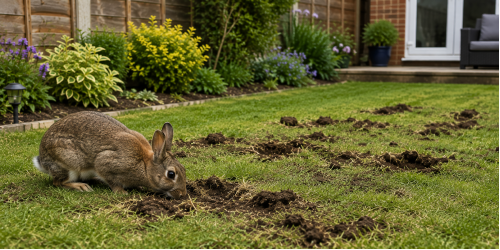
Rabbits can look harmless in a garden, but they can cause real damage once they start feeding, digging and creating runs through lawns and borders. A few nibbled leaves may not seem serious at first. Over time, rabbits can leave bare patches in grass, dig shallow scrapes, damage young plants, chew bark, eat vegetables and weaken newly planted borders.
If rabbits are digging up your lawn, the best approach is to make the garden harder to access, less attractive and less comfortable for them to use. Repellents and scare devices may help for a short time, but physical barriers, tidy boundaries, protected planting and regular checks usually give better results.
This guide explains why rabbits dig in lawns, how to stop them getting into the garden, which deterrents are worth trying, how to protect plants, and how to repair lawn damage once the rabbits are under control.
Why rabbits dig up lawns
Rabbits dig for several reasons. They may be looking for food, creating a scrape, testing soft ground, sheltering, escaping predators or exploring a place that feels safe. Lawns are often attractive because the grass is short, the ground is easy to dig and nearby borders or hedges provide cover.
Rabbits may dig more where the lawn is soft, damp, newly laid or poorly rooted. Freshly seeded lawns can also attract them because new shoots are tender and easy to eat.
Common signs of rabbit activity include:
- Small shallow holes in the lawn
- Bare or grazed patches of grass
- Droppings on the lawn or near borders
- Chewed young plants
- Gnawed bark on shrubs or young trees
- Runs through long grass or under hedges
- Scrapes near fence lines or sheds
- Soil disturbed around beds and borders
Before choosing a solution, check whether rabbits are definitely the cause. Foxes, badgers, squirrels, birds and pets can also dig in lawns.
Find out how rabbits are entering the garden
The most effective rabbit control starts with access. If rabbits can easily get into the garden every evening, repellents alone are unlikely to solve the problem.
Walk around the full boundary and look carefully at ground level. Rabbits can squeeze through small gaps, especially under fences, hedges and gates.
Check:
- Gaps under fence panels
- Spaces beneath garden gates
- Holes in hedges
- Loose gravel boards
- Damaged wire mesh
- Gaps behind sheds or storage areas
- Open areas under decking
- Low points where soil has washed away
- Neighbouring boundaries where rabbits may pass through
Rabbit proofing works best when every possible route is considered. Blocking only one gap may simply push rabbits to another weak point.
Install rabbit-proof fencing
A physical barrier is usually the most reliable way to keep rabbits off a lawn. Standard garden fence panels can help, but rabbits may still dig underneath or squeeze through gaps at the base.
Rabbit-proof fencing usually uses small mesh fixed securely along the boundary. The mesh should extend below ground or be turned outwards at the base to stop rabbits digging underneath.
For many gardens, a practical rabbit barrier includes:
- Small-gauge wire mesh
- A buried section or outward-facing skirt at ground level
- No large gaps at gates or corners
- Secure fixing to posts or existing fencing
- Regular checks for damage and digging
The exact specification depends on the garden and the level of rabbit pressure. If rabbits are persistent, a lightweight temporary barrier may not be enough.
Use mesh at the base of fence panels
If you already have fence panels, you may not need to replace the whole boundary. In many cases, adding mesh at the base can reduce rabbit access.
Fix the mesh securely to the lower section of the fence or posts. Then either bury the lower edge or fold it outwards along the ground and cover it with soil, turf, gravel or edging. The outward skirt makes it harder for rabbits to dig directly under the fence.
Pay attention to corners and gate posts. Rabbits often exploit the smallest weak points.
Use gravel boards to close lower gaps
Gravel boards can help reduce gaps beneath fence panels. They sit at the base of the fence and create a more solid lower line.
Concrete gravel boards are especially useful where rabbits, pets or other animals dig at the base of a fence. They are more resistant to damp and ground contact than timber panels.
Wooden gravel boards can also help, especially where a natural timber appearance is preferred. However, if rabbits are already digging under the fence, mesh may still be needed below or beside the board.
Gravel boards are not always enough on their own, but they are a useful part of a rabbit-resistant boundary.
Check gates carefully
Garden gates are often the weakest point in a rabbit-proof garden. A fence line may be secure, but a gap beneath a gate can allow rabbits straight in.
To reduce rabbit access through gates:
- Check the gap beneath the gate
- Fit a lower board or threshold where suitable
- Use mesh on the lower section if needed
- Keep the gate properly aligned
- Repair dropped hinges
- Make sure the latch closes securely
- Check side gaps beside gate posts
If the gate opens over uneven ground, closing the gap can be more difficult. A threshold strip, low gravel board or carefully fitted mesh may help.
Protect individual plants
If rabbits are mainly damaging certain plants rather than the whole lawn, protect those plants directly. Young plants, vegetables, soft new growth and bark on young trees are especially vulnerable.
Protection methods include:
- Wire mesh plant guards
- Tree guards around young trunks
- Raised beds with mesh protection
- Cloche covers for young vegetables
- Temporary netting over new planting
- Fencing around vegetable patches
Make sure any netting is secure and does not create a hazard for birds, hedgehogs, pets or other wildlife. Loose netting can trap animals.
Use raised beds for vulnerable crops
Raised beds can make it easier to protect vegetables, herbs and young plants from rabbits. They lift the growing area, define the bed and allow mesh or covers to be fixed more neatly.
Raised beds made from suitable garden timber or sleepers can also give structure to the garden. However, rabbits may still jump into low beds or dig around them if they are very determined.
For edible crops, combine raised beds with mesh hoops, cloches or removable covers where needed.
Choose rabbit-resistant plants
No plant is completely rabbit-proof if rabbits are hungry enough, but some plants are less appealing than others. Rabbits often prefer tender young growth, soft leaves, vegetables and low-growing plants.
Plants with strong scents, tough leaves, prickly stems or aromatic foliage may be less attractive. Lavender, rosemary, sage, thyme, ornamental grasses, some ferns and many established shrubs are often less tempting than soft bedding plants.
Rabbit-resistant planting can help, but it should not be the only defence. Young shoots of many plants can still be eaten, especially in winter or when food is limited.
Protect young trees and shrubs
Rabbits can damage young trees and shrubs by chewing bark near the base. This can be more serious than lawn damage because ring-barking may kill the plant.
Use tree guards or mesh guards around young trunks. Keep guards secure but not so tight that they damage the plant as it grows. Check them regularly and adjust as needed.
New hedging should also be protected if rabbits are active in the area. Young hedge plants can be badly damaged before they establish.
Keep the garden tidy
Rabbits prefer gardens where they can feed close to cover. Dense shrubs, long grass, piles of cuttings, clutter, gaps under sheds and overgrown boundaries can all provide shelter.
To make the garden less inviting:
- Keep grass cut regularly
- Trim overgrown boundary planting
- Clear piles of branches and garden waste
- Remove clutter from fence lines
- Block access beneath sheds where suitable
- Keep compost areas tidy
- Cut back dense low cover near the lawn
Do not remove every wildlife habitat from the garden. The aim is to reduce rabbit shelter close to vulnerable lawns and planting, not strip the garden bare.
Reduce hiding places near the lawn
If rabbits feel exposed, they are less likely to spend long periods feeding or digging. They often prefer areas where they can retreat quickly into hedges, shrubs or gaps under structures.
Look for cover close to the damaged lawn. This may include low shrubs, overgrown borders, open shed bases, stacked timber, long grass or dense climbers on fencing.
Cut back plants enough to improve visibility and airflow. Keep the base of fence panels and garden gates clear so you can inspect them regularly.
Be careful with alternative feeding areas
Some advice suggests planting clover or other food plants away from the lawn to distract rabbits. This can sometimes reduce pressure on one area, but it can also encourage rabbits to stay in or near the garden.
If your main aim is to keep rabbits out, do not deliberately provide them with food. It may attract more rabbits and make the problem worse.
A better approach is usually to protect the garden boundary, remove hiding places near the lawn and choose less vulnerable planting.
Use rabbit repellents realistically
Rabbit repellents can be useful as part of a wider plan, but they are rarely a complete solution. They usually work by smell or taste, making plants or areas less appealing.
Repellents may need reapplying after rain, watering or mowing. Rabbits may also become used to them over time, especially if food is scarce.
When using repellents:
- Follow the product instructions
- Check whether they are safe for pets and children
- Avoid using unsuitable products near edible crops
- Reapply after rain where required
- Use alongside fencing or plant protection
- Do not rely on them for serious rabbit pressure
Repellents can help protect specific plants, but a physical barrier is usually more reliable.
Natural deterrents
Some gardeners use natural deterrents such as garlic, strong-smelling plants or homemade sprays. Results vary. These may discourage light browsing, but they are unlikely to stop determined rabbits.
Strong-smelling plants such as lavender, rosemary and sage can be included in borders, but they should be seen as part of the planting design rather than a guaranteed barrier.
Be cautious with homemade mixtures. Some ingredients can harm plants, pets, soil life or beneficial insects. Avoid spreading anything in the garden unless you are confident it is safe.
Motion-activated deterrents
Motion-activated sprinklers, lights or sound devices may startle rabbits and discourage them from lingering. These can be useful where rabbits visit at predictable times or enter through a specific area.
The limitation is that rabbits may get used to them. Moving the device occasionally and combining it with other methods may improve results.
Make sure any device is suitable for outdoor use and does not disturb neighbours, pets or beneficial wildlife unnecessarily.
Ultrasonic rabbit deterrents
Ultrasonic deterrents are marketed for a range of garden pests, including rabbits. Results can be mixed. Some gardeners find them useful, while others see little difference.
They may be worth trying in low-pressure situations, but they should not replace proper boundary protection. If rabbits are entering freely through gaps, sound devices are unlikely to solve the issue on their own.
Do scare tactics work?
Scare tactics can help for a short time, but rabbits are adaptable. Wind chimes, reflective tape, fake predators and moving ornaments may startle them at first. Over time, they may realise there is no real threat.
If you use scare tactics, rotate them and move them around. Use them alongside barriers, tidying and plant protection.
Scare methods are usually best for mild problems, not established rabbit activity.
Encouraging predators: use caution
Rabbits have natural predators, but deliberately encouraging predators into a domestic garden is not always practical or appropriate. Foxes, birds of prey and other predators may already be part of the local environment, but they should not be relied on to control rabbits in a garden.
Creating a wildlife-friendly garden can support a balanced ecosystem, but it will not guarantee rabbit control. Also consider pets, chickens, small animals and neighbours before making changes intended to attract predators.
For most domestic gardens, physical exclusion is more predictable than relying on predators.
Protect newly seeded lawns
New grass seed is vulnerable to rabbits. Fresh shoots are tender, and the soil surface is easier to disturb.
To protect a newly seeded lawn:
- Keep rabbits out with temporary mesh or fencing
- Use lightweight protective netting carefully where suitable
- Avoid leaving seed exposed on the surface
- Water gently so soil is not washed away
- Keep the area undisturbed while grass establishes
- Repair rabbit access points before sowing
Do not reseed repeatedly before solving the rabbit problem. The new growth may simply be eaten again.
Protect new turf
New turf needs time to root into the soil. Rabbits may graze it, dig at edges or disturb soft joins between rolls.
If rabbits are active, protect the lawn before laying turf. Check boundaries, close gaps and use temporary barriers if needed.
Keep rabbits off the turf until it is properly established. Once the turf is rooted, it will be more resilient, but it can still be damaged by repeated digging or grazing.
Repairing rabbit damage to lawns
Once rabbits are controlled, repair the lawn. There is little point repairing damage while rabbits still have easy access.
For small holes and bare patches:
- Remove loose debris
- Level the soil
- Add topsoil if needed
- Firm gently
- Reseed with a suitable grass seed mix
- Cover lightly with soil or lawn dressing
- Water gently
- Protect the area until established
If the damage is widespread, overseeding or returfing may be needed. Improve soil condition and drainage before repairing if the lawn is compacted or waterlogged.
Improve lawn health
A healthy lawn recovers from minor wildlife damage more easily than a weak one. Good lawn care will not stop rabbits, but it can help the grass recover once access is controlled.
Useful lawn care tasks include:
- Regular mowing at a sensible height
- Overseeding thin areas
- Aerating compacted soil
- Improving drainage where needed
- Feeding the lawn appropriately
- Watering during dry establishment periods
- Repairing bare patches promptly
A dense lawn is harder for rabbits to damage than a thin, patchy one with loose soil.
Check for burrows
In some gardens, rabbits may be living nearby or even under sheds, decking, hedges or banks. If there are burrows in the garden, the problem is more established than occasional visits.
Look for entrances in quiet corners, under hedges, behind sheds, near banks or along boundaries. Do not block burrows without understanding whether animals are inside. Blocking occupied burrows can cause welfare issues and may not be legal or appropriate depending on the situation.
If rabbits are established on your property and causing significant damage, seek professional pest control or land management advice.
Rabbits under sheds and decking
Sheds and decking can provide shelter if there are open voids underneath. Rabbits may use these spaces as cover while feeding nearby.
Block access carefully using strong mesh or suitable boards, but first check that no animals are trapped inside. Leave one-way exit arrangements or get advice if you are unsure.
Keep the area around sheds clear and check for digging at the base. A gravel strip, paving edge or mesh skirt may help reduce access.
Rabbits and vegetable gardens
Vegetable patches are especially attractive to rabbits. Lettuce, beans, peas, brassicas, carrots, herbs and young seedlings may all be eaten.
The best protection is usually a dedicated mesh fence around the vegetable area. Raised beds with removable mesh covers can also work well.
Protect seedlings early. Once rabbits learn where food is available, they are likely to return.
Rabbits and flower borders
Flower borders can be damaged by grazing and digging, especially where young plants are used. Bedding plants and tender perennials are particularly vulnerable.
Use plant guards for vulnerable plants, choose less appealing varieties and avoid leaving large open soil areas where rabbits can dig easily.
Dense, established planting may be less attractive than open beds full of fresh new growth.
Rabbits and hedges
Hedges can provide shelter and routes into the garden. They may also hide gaps where rabbits enter.
Check the base of hedges for runs and holes. If rabbits are coming through, install mesh along the hedge line. The mesh may need to be partly buried or turned outwards at the base.
Keep hedges managed, but avoid cutting during nesting season without checking for birds. A well-managed hedge can provide wildlife value while still being less useful as rabbit cover.
Rabbits and garden fencing
Standard garden fencing can help keep rabbits out, but only if the base is secure. Rabbits usually exploit low-level gaps rather than jumping high fences.
Useful fencing features include:
- Secure fence panels
- Concrete or timber gravel boards
- Small-gauge mesh at the base
- Well-fitted garden gates
- No gaps around posts
- Clear fence lines for inspection
- Repairs after storms or ground movement
If you are installing new fencing and rabbits are a known problem, plan rabbit protection into the project from the start. Retrofitting mesh later is possible, but it is usually easier to include it during installation.
Work with neighbours where possible
Rabbits do not respect property boundaries. If they are moving through several gardens, one household may struggle to solve the problem alone.
Speak to neighbours if rabbits are entering through shared boundaries, hedges or adjoining land. Coordinated repairs to fence lines and gates can be more effective than isolated action.
If the rabbits are coming from open land, woodland or fields, full exclusion may be more difficult, but securing your own boundary can still reduce damage.
When to seek professional help
Professional advice may be needed if rabbit damage is severe, burrows are established or the garden borders farmland, woodland or open land with frequent rabbit activity.
Professional help may be sensible if:
- Rabbits are causing repeated serious lawn damage
- Burrows are present in or near the garden
- New fencing is needed along a long boundary
- Rabbits are damaging trees or crops
- DIY barriers have failed
- You are unsure how to deal with occupied burrows
- The property includes paddocks, orchards or larger grounds
For domestic gardens, a fencing or pest control professional can help identify the best practical solution.
Common mistakes when trying to stop rabbits
Rabbit problems often continue because the main access route has not been blocked.
Common mistakes include:
- Relying only on repellents
- Leaving gaps under gates
- Using mesh with holes that are too large
- Failing to bury or skirt the mesh
- Repairing the lawn before excluding rabbits
- Planting tender seedlings without protection
- Leaving dense cover beside the lawn
- Ignoring gaps behind sheds
- Using loose netting that can trap wildlife
- Assuming one scare device will work permanently
- Not checking the boundary after storms
The most reliable approach is to combine secure boundaries, protected planting and regular maintenance.
Rabbit control checklist
Use this checklist to reduce rabbit damage in your garden:
- Confirm rabbits are causing the damage
- Inspect the full boundary at ground level
- Block gaps under fence panels
- Check garden gates and side gaps
- Add small-gauge mesh where needed
- Use gravel boards to close low-level gaps
- Protect young trees and shrubs
- Use mesh guards around vulnerable plants
- Keep the lawn and boundaries tidy
- Reduce hiding places near the lawn
- Avoid planting rabbit favourites without protection
- Use repellents only as a supporting measure
- Protect new seed or turf until established
- Repair lawn damage after access is controlled
- Seek professional advice for severe or established problems
Frequently asked questions
How do I stop rabbits digging up my lawn?
The most reliable method is to stop rabbits entering the garden. Check the boundary, close gaps under fence panels and gates, and use small-gauge mesh at ground level. Repellents may help, but they work best alongside physical barriers.
What kind of fence keeps rabbits out?
A rabbit-resistant fence usually includes small-gauge wire mesh that extends below ground or is turned outwards at the base. Standard fence panels may help, but rabbits can dig underneath if the bottom is not protected.
Can rabbits get under fence panels?
Yes. Rabbits often enter through gaps beneath fence panels, under gates or through hedges. Gravel boards and mesh can help close these gaps.
Do gravel boards help stop rabbits?
Gravel boards can help reduce gaps at the base of a fence and make it harder for rabbits to pass under panels. For persistent rabbits, mesh may also be needed below or beside the gravel board.
Do rabbit repellents work?
Rabbit repellents can help in some situations, but they need regular reapplication and are not always reliable. They are best used with fencing, plant guards and good garden maintenance.
What plants do rabbits avoid?
Rabbits often avoid strongly scented, tough, prickly or aromatic plants, but no plant is completely safe if rabbits are hungry. Lavender, rosemary, sage, thyme and some ornamental grasses may be less attractive than soft young plants.
Will rabbits damage newly seeded grass?
Yes. Rabbits may eat new shoots and disturb soft soil. Protect newly seeded areas with temporary barriers and solve rabbit access before reseeding.
How do I repair rabbit holes in a lawn?
Level the hole, add topsoil if needed, firm gently, reseed and water carefully. Protect the repaired area until the grass establishes. Repairing the lawn before excluding rabbits may lead to repeated damage.
Are scare devices effective against rabbits?
They can help temporarily, but rabbits may become used to them. Motion sprinklers and moving deterrents work best when combined with boundary protection.
Should I feed rabbits away from my lawn?
Usually no. Providing an alternative food source may encourage rabbits to stay nearby and could attract more. It is normally better to exclude them and protect vulnerable plants.
Final thoughts
Rabbits can cause frustrating lawn and garden damage, but the solution is usually practical rather than complicated. The first priority is to stop them getting in. Check fence panels, gravel boards, garden gates, hedges and gaps behind sheds. Then protect vulnerable plants and reduce hiding places near the lawn.
Repellents, scare devices and rabbit-resistant planting may help, but they are rarely enough on their own. A secure boundary with mesh at ground level is usually the most reliable long-term defence.
Once rabbits are under control, repair the lawn with fresh soil and seed, improve lawn health and keep checking the boundary. With the right combination of fencing, planting and maintenance, you can reduce rabbit damage and keep your garden looking much better through the growing season.